maxgreco

79.6K posts

maxgreco banner
maxgreco

maxgreco

@maxgreco

sysadmin, web manager, photographer, gamer, bouncing between my tech and humanistic side, Biella - Italy

Biella - Italia Katılım Nisan 2008
5.8K Takip Edilen1.3K Takipçiler
maxgreco retweetledi

Libertario 🟨⬛
Libertario 🟨⬛@QuotesforGoal·
"Yo no escucho lo que dice la gente, solo observo lo que hacen. El comportamiento nunca miente" Winston Churchill

Libertario 🟨⬛ tweet media
Español
11
429
1.6K
22.4K
maxgreco retweetledi
Luigi Basemi 🏅
Luigi Basemi 🏅@LBasemi·
🧵⚡️⛔️🖥🇪🇺 "Dobbiamo considerare di sospendere temporaneamente i social media", ha dichiarato martedì a Copenaghen la Presidente della Commissione europea von der Leyen.
Italiano
951
871
1.1K
70.4K
maxgreco retweetledi
Álvaro J
Álvaro J@jota_snchez·
Richard Feynman ganó el Nobel de Física y dijo algo que dejó huella: "La mayoría de personas saben muchas cosas. Pero no saben pensar." Feynman dio una clase magistral de 1 hora sobre física e imaginación. Sus 12 lecciones de vida: 1. La imaginación le gana al conocimiento
Español
72
1.6K
6.6K
583.9K
maxgreco retweetledi
Carlos Montero
Carlos Montero@CMonteroOficial·
“Estoy aquí para apoyar a Stephen, el primer tipo en 🇺🇸 que perdió su programa porque tenemos un presidente que no acepta una broma... y porque dueños de Paramount sienten que tienen que lamerle el culo para conseguir lo que quieren.”Bruce Springsteen
Español
42
1.7K
5.3K
65.6K
maxgreco retweetledi
Tom Turney
Tom Turney@no_stp_on_snek·
After testing a replay of prompts from this model I can confidently say it's a viable replacement for one of my products running gpt-mini-5.1 in terms of conversational personas, following instructions, and threaded-discussions and cross references. Great work! huggingface.co/llmfan46/Qwen3…
English
2
8
60
1.9K
maxgreco retweetledi
Suryansh Tiwari
Suryansh Tiwari@Suryanshti777·
Every AI agent today has the same problem. It forgets everything the moment the session ends. Your workflow. Your preferences. The fixes it learned yesterday. All gone. Hermes Agent is one of the first projects pushing in a completely different direction. Instead of treating AI like a temporary chat window, it treats it like a system that should: • remember • evolve • reuse experience • and improve over time That’s why developers are suddenly paying attention to it. The architecture behind it is genuinely interesting: • self-evolving skills • multi-layer memory • cross-session recall • autonomous agents running 24/7 • GEPA optimization loops • persistent personalities & workflows The result feels less like “using an AI tool” and more like building a long-term AI operator that compounds with usage. Made this infographic to simplify how the whole system actually works because this is easily one of the most interesting open-source AI agent projects right now.
Suryansh Tiwari tweet media
Nainsi Dwivedi@NainsiDwiv50980

x.com/i/article/2057…

English
31
75
325
33.2K
maxgreco retweetledi
LM Studio
LM Studio@lmstudio·
MTP is available in LM Studio 0.4.14. Sound on.
English
18
25
260
12.6K
maxgreco retweetledi
Ihtesham Ali
Ihtesham Ali@ihtesham2005·
A 22-year-old graduate student in Kazakhstan got so angry at journal paywalls in 2011 that she built a pirate website holding 88 million scientific papers, and last month she turned the whole thing into an AI that lets you ask one question and get the actual research as the answer. Her name is Alexandra Elbakyan, and the website is called Sci-Hub. The AI she just launched is called Sci-Bot. It lives at sci-bot.ru and almost nobody outside academia knows it exists yet. Here is the story, because it is one of the strangest things to happen in science publishing in the last 50 years. Elbakyan was born in Almaty in 1988, the year the Soviet Union started to collapse. She taught herself programming at 12. She read Soviet science books that explained things her family used to call miracles. She got into computer security at university and graduated in 2009 with a degree she barely needed because by then she was already a serious hacker. Alexandra moved to Moscow that fall. Then Germany. Then a research internship in the United States. She was working on brain-computer interfaces, the kind of research that requires you to read hundreds of papers a year just to keep up with the field. And every single one of those papers was locked behind a journal paywall that cost between 30 and 50 dollars to read once. She did the math. A graduate student in Kazakhstan could not afford to read science. The first thing she did was learn how to get around the paywalls one paper at a time. She passed the trick around to other students. They asked her for papers constantly. She got tired of doing it manually. So in September 2011, in three days, she wrote a script that automated the whole thing. A user pastes a DOI. The script logs in through a donated institutional credential. The paper comes back free. The website caches it. The next person who asks for that paper gets it instantly because the previous request already saved a copy. That was Sci-Hub. Three days of code. One graduate student. Done. 15 years later, the cache holds 88 million scientific papers. Almost every piece of scholarly literature published before 2020 is sitting on her servers. Researchers in 190 countries use it. Studies in Nature have shown that roughly half of all academic paper downloads worldwide now go through Sci-Hub, not the publishers who actually own the copyrights. Elsevier sued her in 2015 and won a 15 million dollar judgment. She did not pay. The American Chemical Society sued her and won an injunction. She did not comply. Courts in India, France, Russia, and the UK have tried to block the domain. She just moves it. Sci-hub.se. Sci-hub.ru. Sci-hub.ee. The site has had over 20 domains and is still up. Nature put her on its list of the 10 people who mattered most to science in 2016. The New York Times compared her to Edward Snowden. The Verge called her the pirate queen of science. She has not been to the United States in over a decade because she would be arrested at the airport. The Sci-Bot launch in April 2026 is the part that nobody is talking about. She took the 88 million paper database and put a small language model on top of it. You ask a question in plain English. The model searches the entire shadow library, pulls the relevant papers, synthesizes an answer grounded in real citations, and links you to the full text of every source. Free. No login. No institutional credential. No paywall. Three real scientists tested it for a Chemical and Engineering News article last month. They asked it medical and chemistry questions. The radiologist said the answer he got was usable. The chemist said the gaps in recent literature were obvious but the older science was solid. The publisher community is furious. What she built is what the paid academic AI tools are trying to build. Except the paid ones are limited to what their parent publisher legally owns. Hers is limited to almost nothing. Alexandra still lives somewhere in Russia. She does not give her address. She does not do video interviews. She gives talks over Skype with the camera off. She runs the largest illegal library in human history from a laptop and a donation page. A graduate student who could not afford to read science built the system the entire scientific community now quietly depends on. The publishers have spent a decade trying to shut her down. She just shipped an AI that makes their entire business model outdated.
Ihtesham Ali tweet media
English
36
564
1.6K
56.9K
maxgreco retweetledi
Report
Report@reportrai3·
Scuole in affitto, a Palermo ogni anno decine di milioni di euro a una nota famiglia. Ne parliamo domenica, dalle 20.30 su #Rai3
Italiano
4
132
268
5.8K
maxgreco retweetledi
Francesco Sylos Labini
Francesco Sylos Labini@fsyloslab·
Segnalo questo articolo su The Guardian che sostiene la stesa tesi di quella che ho sostenuto io in un mezzo di un mese fa sul Fatto. L’articolo sostiene che l’equilibrio globale del potere stia passando da un ordine fondato sui combustibili fossili e dominato dagli USA 1/
Italiano
4
36
108
11.5K
maxgreco retweetledi
Giuseppe Conte
Giuseppe Conte@GiuseppeConteIT·
Carlo Petrini ha rivoluzionato il nostro modo di guardare all’agricoltura, all’ambiente, al cibo. Ha inciso sulle nostre abitudini, sul nostro modello di consumo, sul nostro modo di vivere e di pensare. Le sue idee non se ne vanno con lui. Il @Mov5Stelle lo ricorda generoso relatore nella nostra Scuola di formazione e grande ispiratore del tempo nuovo. Ci stringiamo attorno ai suoi cari e alle comunità di Terra Madre e Slow Food.
Giuseppe Conte tweet media
Italiano
11
61
241
3.8K
maxgreco retweetledi
M5S Berlino
M5S Berlino@M5SBerlino·
Il fallimento del Governo Meloni in questo grafico: Italia ultima in Europa per crescita del Pil (più bassa) e per Debito pubblico (più alto) sia nel 2026 che nel 2027. Questa l'eredità che ci lascia. @PTridico
M5S Berlino tweet media
Italiano
0
33
39
313
maxgreco retweetledi
Kyle Hessling
Kyle Hessling@KyleHessling1·
BREAKING! Qwopus 3.6 27B is LIVE! Thank you for your patience on this one, but I believe you'll find the wait was worth it! We've benchmarked this thing up and down, verified that it holds at least a 75.25% (152/202) in the initial 202 SWE bench solves. Not a full run of 500, but it shows the agentic coding quality from the original 27B is retained while adding all of the additional Qwopus benefits across many domains. As always, Jackrong is absolutely cooking here! COT quality has improved significantly through the inversion techniques from our Negentropy proof of concept. It also went through thorough curriculum training. You can check out the MMLU pro benchmarks on the model card, but it improved a whopping 10 points over the base model in physics, as well as meaningful jumps in Chemistry, business, and computer science. However, the best part is that I was able to build an entire survival shooter game using this local model entirely. I genuinely was blown away by the results, which you can play right now on my HF space (link in comments below). "Qwopus Commander" was completed in 9 turns of Qwopus 3.6! To test the new long context training, I made it re-output the entire 3000+ line program each turn, and it would make fixes and add features that I requested in large prompts, while perfectly replicating the entire rest of the game from context. What's more is that I did it all at Q8 KV cache quantization, and never had an issue over the entire 303k token run! IMPORTANT: Run it at --temp 0.75 to 1. Mess with it in that range for your use case. Higher temp actually lets the fine-tune shine and be exploratory and is also more stable. Swe Bench was run at temp 1, the game was built mostly at 0.8! We're so blessed to have all of you here and using the models! The support means so much! Please let me know what you build with it in the comments! Or if you have any issues getting it up and running, I will try my best to get back to you! Looking forward to seeing what you legends produce with it this weekend! huggingface.co/Jackrong/Qwopu…
English
46
68
686
29.5K
maxgreco retweetledi
Stephen King
Stephen King@StephenKing·
PROVE THAT TRUMP ISN’T A PEDOPHILE. RELEASE THE EPSTEIN FILES.
English
3.3K
5K
30.5K
829.3K
maxgreco retweetledi
Akshay 🚀
Akshay 🚀@akshay_pachaar·
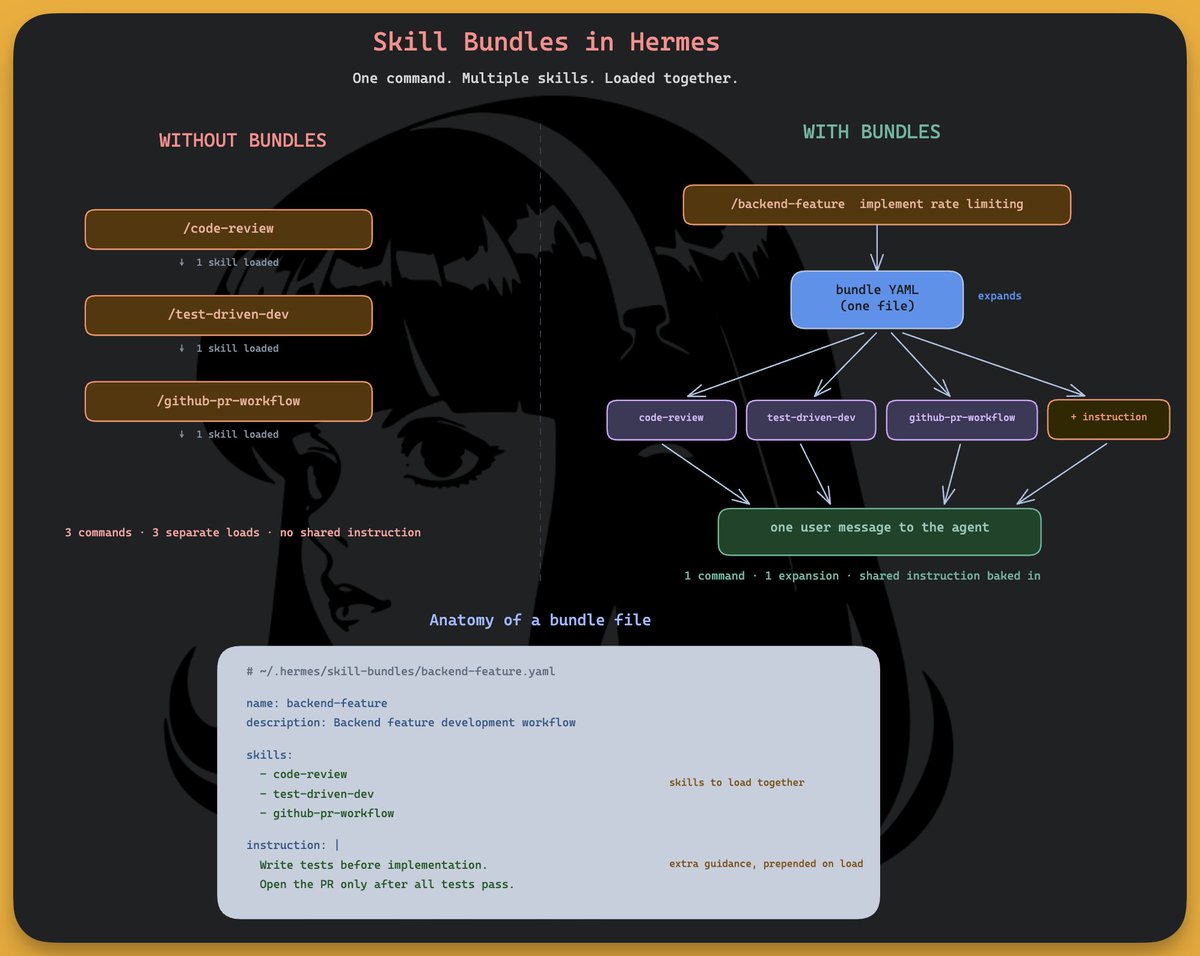
skill bundles in Hermes agent. i found this to be the most underrated feature in Hermes. real workflows need clusters of skills together, not one at a time. for example, writing code might need a code review skill, a testing skill, and a PR workflow skill. every time, you're loading the same group manually. three slash commands in sequence, or asking the agent in natural language and hoping it picks the right ones. a 𝘀𝗸𝗶𝗹𝗹 𝗯𝘂𝗻𝗱𝗹𝗲 fixes this with a single YAML file that groups multiple skills under one slash command. when you invoke it, every listed skill loads at once, plus any custom instruction you've baked in. the image below shows the anatomy of a bundle file and how it expands at invocation. one command, one expansion, shared instruction baked in. but the design choices underneath are what make it practical: 1. 𝗺𝗶𝘀𝘀𝗶𝗻𝗴 𝘀𝗸𝗶𝗹𝗹𝘀 𝗮𝗿𝗲 𝘀𝗸𝗶𝗽𝗽𝗲𝗱, 𝗻𝗼𝘁 𝗳𝗮𝘁𝗮𝗹: if one skill in the bundle is uninstalled, the rest still load. you don't lose the whole workflow because of one missing piece. 2. 𝗯𝘂𝗻𝗱𝗹𝗲𝘀 𝗯𝗲𝗮𝘁 𝘀𝗸𝗶𝗹𝗹𝘀 on name collisions: if a skill and a bundle share a name, the bundle wins. you opted into it. 3. 𝘄𝗼𝗿𝗸𝘀 𝗲𝘃𝗲𝗿𝘆𝘄𝗵𝗲𝗿𝗲: CLI, TUI, dashboard, Telegram, Discord, Slack. one YAML definition, all platforms. 4. 𝗻𝗼 𝗰𝗮𝗰𝗵𝗲 𝗶𝗻𝘃𝗮𝗹𝗶𝗱𝗮𝘁𝗶𝗼𝗻: bundles generate a fresh user message at invocation, same as individual skill loading. no performance cost. once your bundles are stable, the natural next step is 𝘁𝗲𝗮𝗺 𝘀𝗵𝗮𝗿𝗶𝗻𝗴. bundle YAMLs are just files. put them in a Git repo, have each team member symlink into ~/.𝗵𝗲𝗿𝗺𝗲𝘀/𝘀𝗸𝗶𝗹𝗹-𝗯𝘂𝗻𝗱𝗹𝗲𝘀/. update the repo, everyone gets the update. no registry, no central server. this is what turns a personal agent into something a small team can standardize around. i wrote a full deep dive covering hermes agent's self-evolving skills, three-tier memory, GEPA optimization, and setting up multiple specialized agents. the article is quoted below.
Akshay 🚀 tweet media
Akshay 🚀@akshay_pachaar

x.com/i/article/2053…

English
19
11
133
14.1K
maxgreco retweetledi
Ivan Fioravanti ᯅ
Ivan Fioravanti ᯅ@ivanfioravanti·
Anthropic opening an office in Milan on 28th May was not on my bingo card 👀
English
29
16
576
38.1K