Namit Arora

3.7K posts

Namit Arora banner
Namit Arora

Namit Arora

@NamitArora0

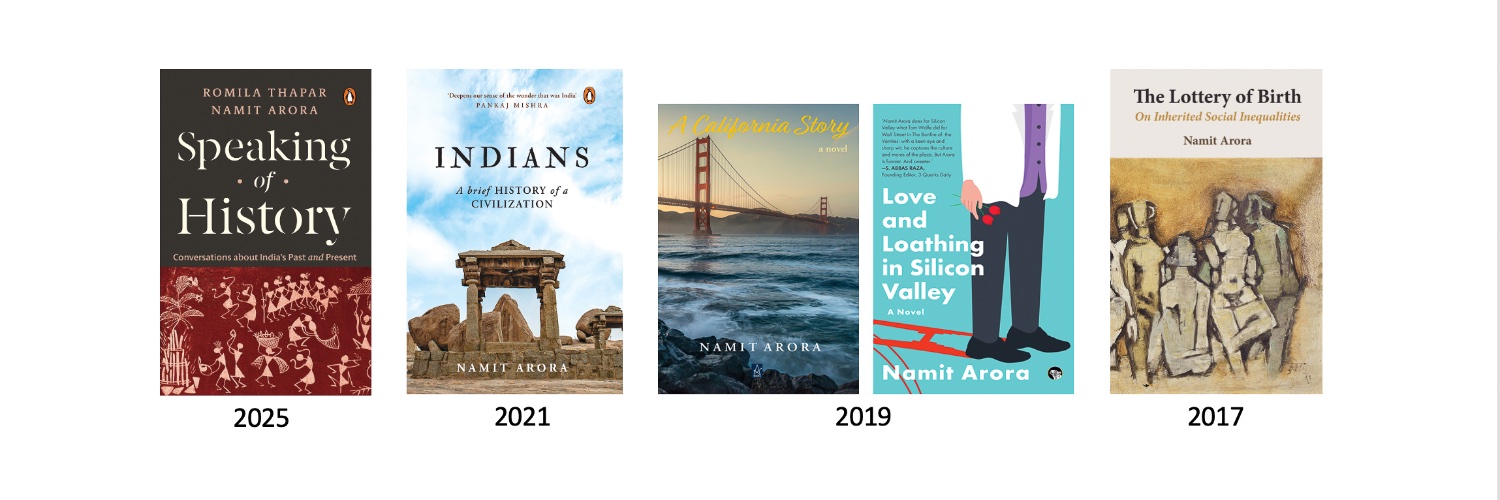
Writer, humanist, social critic, @IITKgp. Books: Speaking of History; Indians: A Brief History of a Civilization; The Lottery of Birth; Love & Loathing in SV.

Gurgaon, Haryana Katılım Ocak 2012
429 Takip Edilen4K Takipçiler
Sabitlenmiş Tweet
Namit Arora
Namit Arora@NamitArora0·
A recent Scroll interview that features me and the inimitable Romila Thapar, focusing more on the interface between history and modern politics—a key topic in Speaking of History. This well-produced video also has Prof. Thapar (94) in great form. Do watch! blog.shunya.net/2026/05/why-is…
English

0
9
43
2.4K
Namit Arora retweetledi
AnnieZaidi PhD
AnnieZaidi PhD@anniezaidi·
Would you support legislation that makes housing discrimination a jailable offence? Also, would you endorse a call to fund a pan-india report on housing discrimination + a report on who is most affected by communal violence (to update the book साम्प्रदायिक देंगे और भारतीय पुलिस)?
Mohandas Pai@TVMohandasPai

Muslims should stop getting ghettoised, herded into groups by parties based on identify, stop victimhood narratives, delusions of power, start participating in politics with all parties as equals.

English
4
91
275
11.5K
Namit Arora
Namit Arora@NamitArora0·
"Loktak Lake in Manipur, India, is a living mosaic of floating islands called phumdis. The region is home to Keibul Lamjao National Park, the only floating national park on Earth." youtu.be/oeiT85Y38tY?si…
YouTube video
YouTube
English
0
0
1
138
Namit Arora retweetledi
Scroll.in
Scroll.in@scroll_in·
The worship of Satyapir, involving both Hindu & Muslim symbolic elements, points toward forms of communal harmony developed through popular creativity, a theological innovation that emerged from below rather than being imposed by reformist elites. scroll.in/article/108878… @ankushpal2001 writes
Scroll.in tweet media
English
0
14
33
1.7K
Namit Arora retweetledi
Dhruv Rathee
Dhruv Rathee@dhruv_rathee·
Meet Bengal’s New CM - Suvendu Adhikari
Indonesia
4.3K
14.4K
54.7K
1M
Namit Arora retweetledi
Sam Haselby
Sam Haselby@samhaselby·
On the peopling of ancient India by @kikumbhar. Scholars have used linguistics, archeology, and now genetics to try to figure out from where, and when, people came to ancient India. aeon.co/essays/ancient…
English
2
22
82
5.9K
Namit Arora retweetledi
Sandeep Manudhane
Sandeep Manudhane@sandeep_PT·
"They can vote next time". This statement, and the Judge who said this, have entered the history books for ever.
English
145
3K
12.1K
114.2K
Namit Arora retweetledi
S
S@Shirink_13·
This is not normal. Don’t normalize this. Palestinian lives matter just like yours.
S tweet media
English
594
24.5K
71.7K
492.9K
Namit Arora retweetledi
Tirthankar Roy
Tirthankar Roy@RoyHistory1·
This essay (3,300 wds), just published in The Spectator, distils my thinking on the relationship between colonialism and development, and a scholarship that has examined this relationship in a somewhat fragmented way. Shorter versions will appear later on LinkedIn, X, Substack.
English
4
17
112
13.2K
Namit Arora retweetledi
Shalinee Kumari
Shalinee Kumari@shalineekumari_·
India's Aravalli range needs protection from rampant illegal mining. Many native communities are already fighting, and now a legal challenge over its definition adds to the threat. In my story: what makes a hill an Aravalli, and the fight to protect it. dialogue.earth/en/nature/the-…
English
2
61
116
2.4K
Namit Arora
Namit Arora@NamitArora0·
It took them a while but today's verdict in West Bengal has to be the sweetest of victories for the BJP—not the least as an emotionally symbolic homecoming to the very land of Hindutva’s birth in the Indian subcontinent. livehistoryindia.com/story/eras/bha…
English
0
4
7
196
Namit Arora
Namit Arora@NamitArora0·
Just out, an interview featuring Romila Thapar and me. @ShoaibDaniyal, political editor at Scroll, understandably focused more on the interface between history and modern politics that we explore in Speaking of History. Romila is in great form! (1:10 hrs) youtube.com/watch?v=u06Cy0…
YouTube video
YouTube
English
3
5
20
1.8K
Namit Arora retweetledi
Carissa Véliz
Carissa Véliz@CarissaVeliz·
No, #AI is not conscious, and it's unlikely to ever be conscious. Here's why. @anilkseth's brilliant and poetic #TED talk brings some sense into a field filled with outrageous claims (I suspect at least sometimes designed merely to attract attention). ted.com/talks/anil_set…
English
40
48
135
32K
Namit Arora retweetledi
Rana Safvi رعنا राना
In 1526, Babur won against Ibrahim Lodi on the plains of Haryana, and the Mughal empire was born. It would last more than 300 years, all the way through to 1857. Echoes still linger, in India’s bureaucracy and jewellery, art, food and fashion. In the way our capital city looks, and the shape of the civil services. Read on for essays on food, art, fashion and more by Rana Safvi, Vir Sanghvi, Swapna Liddle, Muzaffar Ali and Dhamini Ratnam. hindustantimes.com/specials/The-M…
English
8
43
160
6.8K
Namit Arora retweetledi
Hartosh Singh Bal
Hartosh Singh Bal@HartoshSinghBal·
Why popular ‘historians’ from the right (and perhaps not just of the right) fail history
The Caravan@thecaravanindia

The May issue—Romila Thapar's view of history; A BSF soldier dies in NCB custody; Police repression of Noida strikes; The Modi government's all-too-transparent ploy around women's reservations; The story of an incomplete cricketer in Kashmir; and more. Read now: caravanmagazine.in/magazine The May 2026 issue is now available online for all subscribers. If you are a subscriber and unable to log in to our website, please write to subscriptions@caravanmagazine.in Print copies of the issue will be delivered to print subscribers and rolled out to newsstands over the next two weeks, depending on location. Copies will also be available for purchase on Amazon from May 10th. The Caravan is able to publish journalism like this thanks to the support of our subscribers. To help us continue doing this work, subscribe today: caravanmagazine.in/subscribe Or contribute: caravanmagazine.in/contribute Cover Photograph by Shahid Tantray (@shahidtantray)

English
4
20
88
9.2K
Namit Arora retweetledi
Elias Al
Elias Al@iam_elias1·
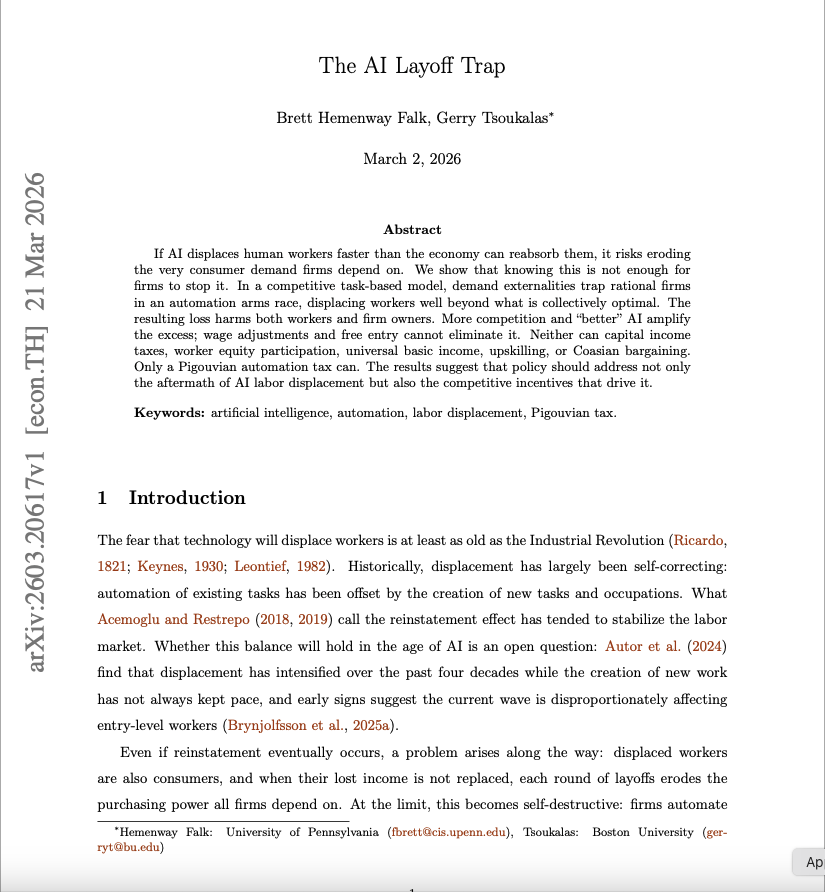
Two economists just published a mathematical proof that AI will destroy the economy. Not might. Not could. Will — if nothing changes. The paper is called "The AI Layoff Trap." Published March 2, 2026. Wharton School, University of Pennsylvania. Boston University. Peer reviewed. Mathematically modeled. The conclusion is one sentence. "At the limit, firms automate their way to boundless productivity and zero demand." An economy that produces everything. And sells it to nobody. Here is how you get there. A company fires 500 workers and replaces them with AI. A competitor fires 700 to keep up. Another fires 1,000. Every company is behaving rationally. Every company is following the incentives correctly. And every company is building a trap for itself. Because the workers who were fired were also customers. When they lose their jobs faster than the economy can absorb them, they stop spending. Consumer demand falls. Companies respond by cutting costs — which means automating more workers — which means less spending — which means more falling demand — which means more automation. The loop has no natural exit. The researchers tested every proposed solution. Universal basic income. Capital income taxes. Worker equity participation. Upskilling programs. Corporate coordination agreements. Every single one failed in the model. The only intervention that worked: a Pigouvian automation tax — a per-task levy charged every time a company replaces a human with AI, forcing them to price in the demand they are destroying before they pull the trigger. No government has implemented this. No major economy is seriously discussing it. Meanwhile the numbers are already tracking the curve. 100,000 tech workers laid off in 2025. 92,000 more in the first months of 2026. Jack Dorsey fired half of Block's workforce and said publicly: "Within the next year, the majority of companies will reach the same conclusion." Nobody is doing anything wrong. Companies are following their incentives perfectly. That is exactly the problem. Rational behavior. At scale. Simultaneously. With no mechanism to stop it. Two economists built the math. The math leads to one place. Source: Falk & Tsoukalas · Wharton School + Boston University · arxiv.org/pdf/2603.20617
Elias Al tweet media
English
1.1K
4K
9.9K
1.3M