

Naruto
1.8K posts




Gm
@RialoHQ is designed to enable privacy, which is why confidential computation is integrated directly into the base layer rather than treated as an afterthought or outsourced to third-party protocols. This design preserves the verifiability of execution while making sure applications don’t leak sensitive data during user interactions. It also makes the blockchain platform compatible with traditional digital infrastructure and lays the foundation for interoperability between web2 and web3 systems by allowing any other blockchain to use Rialo as a service.

English
Rialo Foundations II:Supermodularity and Blockchain Integration @RialoHQ
“Modular vs. monolithic” has been one of crypto’s defining debates in the last decade. Indeed, this framing was useful when blockchain design was primarily concerned with basic properties, such as throughput, speed, and simple composability. Then, the decision to decouple the blockchain stack into separate layers or tightly integrate everything into a single execution environment was considered the biggest determinant of performance and utility.
However, these properties have been partially commoditized in recent years due to significant improvements in scaling techniques, execution environment design, and interoperability infrastructure. Chains can no longer treat being fast, cheap, or even interoperable as a unique selling point. At the same time, “modular vs. monolithic” is less useful now that the features that motivated the framing (and associated design decisions) are widely accessible and no longer serve as a differentiating factor.

English
The privacy limits of public blockchains
Blockchain @RialoHQ
networks provide evidence that secure, resilient, high-value systems can be run on the public internet without the need for complex security measures such as firewalls and intrusion detection systems. Bitcoin has become a durable digital store of value (“digital gold”), giving individuals and institutions a hedge against financial uncertainty and macroeconomic conditions. DeFi (decentralized finance) systems have expanded access to lending, trading, speculation, and other financial primitives that were previously available only through centralized intermediaries. Stablecoins have evolved into a programmable layer for transferring value and increasingly serve to bridge onchain systems and traditional payments infrastructure.

English
Gm
@RialoHQ is designed to enable privacy, which is why confidential computation is integrated directly into the base layer rather than treated as an afterthought or outsourced to third-party protocols. This design preserves the verifiability of execution while making sure applications don’t leak sensitive data during user interactions. It also makes the blockchain platform compatible with traditional digital infrastructure and lays the foundation for interoperability between web2 and web3 systems by allowing any other blockchain to use Rialo as a service.

English
Be involved in income-generating projects in 2026; it's not a good time for airdrop farming, you should focus on quality products with future potential.
I think coins will hit even lower FDV, then we'll enter a bull market with a few good projects.
I will be watching the market for a long time.
English
Reactive workflows and long-running programs @RialoHQ
Reactive transactions, also known as conditional transactions, execute based on predefined conditions or predicates. This structure allows developers to create long-running programs that unfold over time rather than inside a single atomic transaction. A conditional transaction can also create additional conditional transactions, enabling workflows that span many blocks, react to intermediate results, and continue operating for hours or even days if necessary. This capability marks a clear departure from legacy smart contract models, which require that all logic be compressed into a single execution step, with no ability to suspend, wait, or resume based on future conditions.

English
Reactive transactions make conditional and time-based execution native to @RialoHQ
Developers and users can schedule logic to run automatically the moment predefined conditions are met. These conditional transactions persist across blocks, enabling long-running workflows and asynchronous execution patterns that mirror real-world systems. One-off operations and recurring tasks (e.g., liquidations, oracle updates, and subscriptions) can be reliably and safely executed onchain.
Reactive execution broadens the design space for onchain systems by enabling autonomous operations and self-maintaining applications. Perps and lending markets, RWAs, prediction engines, subscription platforms, and other protocols can operate automatically and asynchronously without bots, cron jobs, or keeper networks. Applications gain a direct way to react to onchain and real-world signals without relying on fragmented middleware.

English
What is supermodularity? @RialoHQ
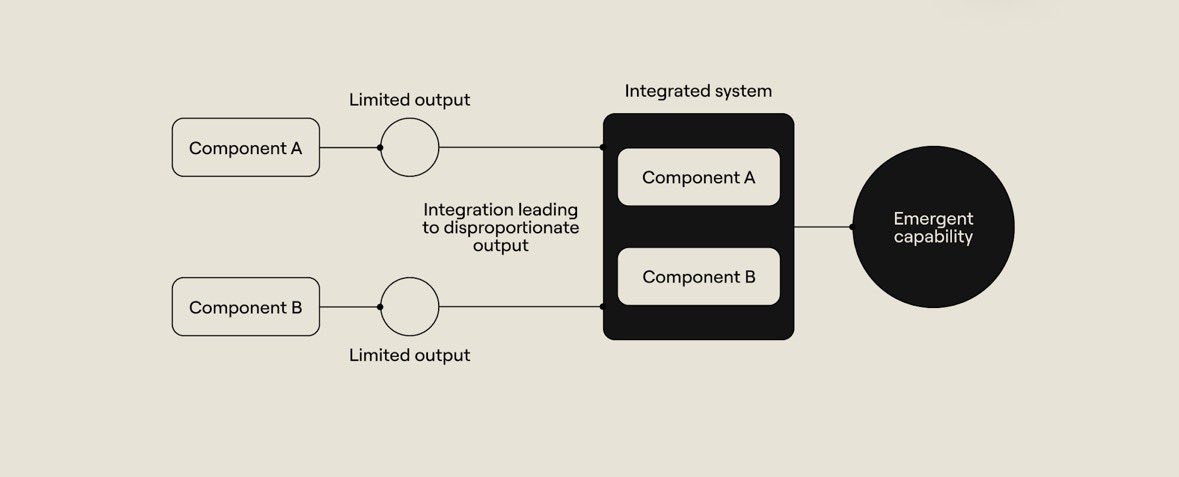
Supermodularity describes the compositional power a system gains by integrating components that complement each other in production and create new system-level capabilities when composed together.
In a supermodular system, integration follows a very deliberate pattern: components are integrated only if integration makes the system more capable and powerful.
English
How fragmentation destroys surplus in practice @RialoHQ
The welfare costs described in the previous section are real and borne by developers and users today. As explained previously, those costs result from fragmenting the blockchain stack into separate layers and forcing applications to rely on (monopolistic) middleware protocols for access to critical services that complement execution. Reliance on third-party infrastructure increases execution costs, degrades availability, and lowers aggregate demand.
Currently, developer surveys show that protocol teams are spending hundreds of thousands of dollars per month to integrate their applications with offchain infrastructure (oracles, keepers, bridges, privacy gadgets, confidential computation, and more). The problem is particularly pronounced in high-throughput chains, where third-party infrastructure costs are higher, and protocols must contend with increased operational overhead.

English
Gm @RialoHQ fam
If blockchain applications tried to process this information offchain to preserve privacy, they would lose the benefits of onchain execution and become slightly worse versions of the web2 apps they hope to replace. This means equipping blockchains with the capacity to process transactions onchain without exposing inputs–that is, confidential computation–is on the critical path to accelerating real-world usage of blockchain applications. With Rialo, we overcome privacy limitations by introducing a privacy-preserving execution layer (let’s call it “Rialo Extended Computation,” or REX) that uses confidential computation over user inputs to securely and efficiently advance the blockchain state.

English
An overview of the @RialoHQ 1337 architecture
Rialo’s architecture proves that real-world market data can move through a decentralized system at real-time speeds. The 1337 demo tested every stage of that process, from live data ingestion to real-time onchain updates, under production-like conditions.
The system consists of five major components:
1. Data Source
2. Pre-processing and Cryptographic Verification
4. Onchain Logic (e.g., Perps Controller)
5. Frontend
Each part serves a distinct purpose in the system and combines with others to form a closed feedback loop that ensures onchain prices are aligned with real-world prices.

English
Gm Rialo fam
FHE enables computation directly on encrypted data, so that anyone can evaluate a circuit without needing access to the underlying inputs. To use FHE in a blockchain context, nodes can jointly generate a public-private key pair, with the private key split into shares and distributed among participants. Users encrypt transaction data with the public key (producing a ciphertext) and send it to nodes that run computations locally. Nodes can later run an MPC protocol to collectively decrypt and obtain the result in the clear, or they can keep the ciphertext as input for future computations.
While FHE provides valuable privacy guarantees, it still incurs a large computational overhead,
making the use of FHE systems for large-scale, general-purpose computations impossible. However, FHE is today ready for smaller computation and can be used for instance to build private stablecoins or private swaps.

English
How fragmentation destroys surplus in practice @RialoHQ
The welfare costs described in the previous section are real and borne by developers and users today. As explained previously, those costs result from fragmenting the blockchain stack into separate layers and forcing applications to rely on (monopolistic) middleware protocols for access to critical services that complement execution. Reliance on third-party infrastructure increases execution costs, degrades availability, and lowers aggregate demand.
Currently, developer surveys show that protocol teams are spending hundreds of thousands of dollars per month to integrate their applications with offchain infrastructure (oracles, keepers, bridges, privacy gadgets, confidential computation, and more). The problem is particularly pronounced in high-throughput chains, where third-party infrastructure costs are higher, and protocols must contend with increased operational overhead.

English
Hyperliquid will house all of finance
waka.eth@wakawakaeth
Hyperliquid will house all of finance
English
Predicates can reference Rialo :
•Time-based conditions: block height, epoch boundaries, calendar events, and timestamps.
•State-based conditions: account balances, collateral ratios, liquidity thresholds, and program storage values.
•Event-based conditions: transaction results, emitted logs, and state transitions produced by other programs.
•External signals: oracle price feeds, API responses, macro indicators, and cryptographic attestations.

English
Gm @RialoHQ fam
When developers complain that crypto applications are expensive to build and hard to run profitably, they often blame gas fees, scaling limits, or user friction. But there’s another, deeper issue at play: the compounding cost of middleware.
Middleware originally emerged to provide the functionalities that base-layer blockchains lacked. They provided critical (off-chain) services, like feeds, indexing, scheduling, and bridging, that made it possible to build more sophisticated applications. These services carried extra costs, but the value they offered easily justified the expense, and demand for them created a flourishing middleware ecosystem.

English