Nicolás Metallo

5.3K posts

Nicolás Metallo banner
Nicolás Metallo

Nicolás Metallo

@nicolasmetallo

Un pibe del conurbano que anda de ciudad en ciudad / Machine Learning at Amazon / Opinions are my own / 🇦🇷 in 🇬🇧

London, UK Katılım Ekim 2017
2.4K Takip Edilen544 Takipçiler
Nicolás Metallo retweetledi
Richard Seroter
Richard Seroter@rseroter·
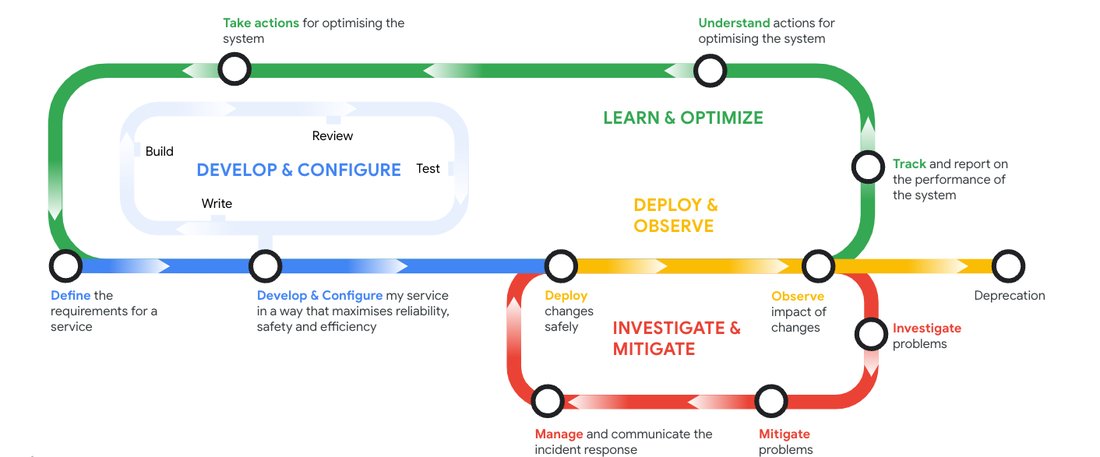
"Google SRE is on the path to fully adopt AI and agentic technologies, leveraging AI as a force multiplier while also maintaining control. We call this SRE AI." cloud.google.com/blog/products/…
Richard Seroter tweet media
English
2
17
160
8.9K
Nicolás Metallo retweetledi
cat
cat@_catwu·
Excited to share our most powerful new Claude Code feature: dynamic workflows! Mention "workflow" in a prompt and Claude will dynamically create an orchestration plan that it strictly follows, allowing you to confidently trust that every stage happens in the right order even across 100s of agents.
cat tweet media
English
289
726
6.9K
1.3M
Nicolás Metallo retweetledi
alex zhang
alex zhang@a1zhang·
In case you're curious about why dynamic workflows are so powerful and the future, read the RLM paper! Opus 4.8 + dynamic workflows in Claude Code is perhaps the first instance of a frontier model seriously trained to be an RLM. I suspect within a year they'll just become the standard for nearly all coding agent interactions.
alex zhang tweet media
ClaudeDevs@ClaudeDevs

New in Claude Code (research preview): dynamic workflows. Claude writes an orchestration script on the fly, then spins up a large fleet of coordinated subagents in parallel to take on your most complex tasks. Use the word "workflow" in a prompt to get started.

English
48
157
1.3K
246.4K
Nicolás Metallo retweetledi
Jesús Fernández-Villaverde
Jesús Fernández-Villaverde@JesusFerna7026·
This figure by Leandro Prados de la Escosura (@LdelaEscosura), from his new paper “Accounting for the Reversal of Fortune: Spain and Britain, 1501-1800,” is striking. Something very fundamental broke in Spain around 1560. Having a GDP per capita slightly above Britain's around 1560, Spain fell to less than 50% of it by 1790/99. Part of this was a drop in absolute level: Spanish GDP per capita was around 10% lower in 1790/99. But most of it was due to Britain taking off while Spain did not. Leandro argues that the evidence points to low input efficiency in Spain (plus ça change, plus c’est la même chose). Spain’s economic performance during the 19th century and the first half of the 20th century was not much better. You cannot understand Spanish history, or even current events, without appreciating its centuries of stagnation and decline. The figure also shows the growing consensus among economic historians: modern economic growth started in Britain around 1650, much earlier than conventional accounts of the Industrial Revolution suggest. Link to the paper: ehes.org/wp/EHES_302.pdf
Jesús Fernández-Villaverde tweet media
English
46
165
559
66.7K
Nicolás Metallo retweetledi
Jerry Liu
Jerry Liu@jerryjliu0·
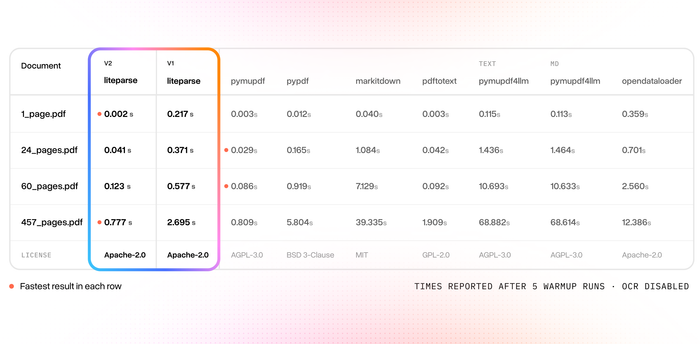
We've created the world's fastest PDF parser ⚡️ And it's more accurate than any other open-source, model-free PDF parser out there (pymupdf, pypdf, markitdown, pdftotext, opendataloader, pymupdf4llm) Introducing LiteParse v2 - we rewrote the entire library into Rust and adapted it as native packages for Python and Node. It supports 50+ different document types, can be triggered directly or installable directly within your favorite AI agent. Blog: llamaindex.ai/blog/liteparse… Repo: github.com/run-llama/lite…
Jerry Liu tweet media
LlamaIndex 🦙@llama_index

LiteParse v2.0 is out now, and it is blazing fast + runs everywhere! We rewrote everything from scratch in Rust, and now: - up to 100x faster parsing - install natively in Rust, JS/TS, and Python - a custom WASM package enables browser and edge runtime usage pip install liteparse npm i @llamaindex/liteparse npm i @llamaindex/liteparse-wasm cargo install liteparse Blog: llamaindex.ai/blog/liteparse… Repo: github.com/run-llama/lite…

English
87
342
3.9K
489.8K
Nicolás Metallo retweetledi
Akshay 🚀
Akshay 🚀@akshay_pachaar·
Hermes agent masterclass. In this video, I cover everything you need to understand and customize Hermes Agent. Self-evolving skills, three-tier memory, GEPA optimization, and going from 1 to 10 agents that work for you 24/7. Enjoy! Chapters: 00:00 - Intro 02:03 - How to get the most out of this video 02:32 - What we're building (and why it's wild) 07:11 - How the whole thing works under the hood 09:27 - The SOUL.md: your agent's personality file 11:15 - The 3-tier memory system that keeps it all together 14:16 - Skills: what your agent can actually do 16:49 - The self-evolving loop (agents that improve themselves) 19:58 - The curator: Hermes' built-in garbage collector 22:56 - GEPA optimization: making your agent sharper 25:08 - Installation and setup 27:38 - Connecting your agent to Telegram 30:36 - Configuring programmer with Claude Code 31:53 - Adding new skills (from a hub of ready-made skills) 34:59 - Going from 1 to 10 agent profiles 36:49 - Building a custom designer from scratch 40:42 - Anatomy of the .hermes folder (where everything lives) 45:05 - Skill taps: sharing skills via a GitHub repo 45:59 - Skill bundles: stacking skills for workflows 47:19 - Hermes Kanban (coming soon) 48:05 Outro Cheers! :)
Akshay 🚀@akshay_pachaar

x.com/i/article/2053…

English
37
219
1.5K
177.8K
Nicolás Metallo retweetledi
Philipp Schmid
Philipp Schmid@_philschmid·
Working on an interactive Blog post for Gemini Managed Agents. What do you think about the visual? Is it easy to follow/understand?
English
24
2
101
9.5K
Nicolás Metallo retweetledi
れにゃ。
れにゃ。@recat_125·
Bedrock AgentCore Runtime上でのAgent 向けのネットワークアーキテクチャパターンについての解説記事です。 パブリックアクセス、VPC接続、Resource-based policies + PrivateLinkによる inboundアクセス制御、閉域VPCパターンなど、段階的に紹介されており参考になります。 aws.amazon.com/jp/blogs/netwo…
れにゃ。 tweet media
日本語
0
14
71
4.6K
Nicolás Metallo retweetledi
Akshay 🚀
Akshay 🚀@akshay_pachaar·
Your agent remembers everything and understands nothing. Most agent memory systems optimize for recall. The harder problem is what to forget, or more precisely, what to never store in the first place. The default agent memory pipeline hands an LLM raw text and asks it to extract entities and relationships. The model decides the types, the labels, the attributes, all on its own. The result is a knowledge graph that behaves like an expensive vector store. Entity types collapse into generic labels. Relationships flatten into a single "RELATES_TO." The graph has the data, but no query can reach it with precision. The problem is not retrieval. It is structure. And the fix is the same pattern that already works everywhere else in the AI stack: constrain the output space before generation, not after. 𝗘𝗻𝘁𝗶𝘁𝗶𝗲𝘀 define what the agent is allowed to remember. Pydantic models with typed fields and descriptive docstrings replace the LLM's guesswork with domain vocabulary it was never trained on. 𝗘𝗱𝗴𝗲𝘀 define how things connect. Source/target constraints on relationship types mean the graph can only form valid connections. If your schema has no edge connecting Project to Competitor, that relationship cannot exist in memory. 𝗧𝗲𝗺𝗽𝗼𝗿𝗮𝗹 𝗿𝗲𝘀𝗼𝗹𝘂𝘁𝗶𝗼𝗻 handles what was true versus what is true. Fact resolution invalidates outdated edges while preserving history, so the graph never silently serves stale state. The schema guides extraction at two points in the pipeline (entity extraction and fact extraction) while resolution and temporal processing run automatically downstream. You define what to look for. The system handles deduplication, contradiction detection, and time-windowing without additional configuration. A useful constraint: 10 entity types, 10 edge types, 10 fields per type. That forces you to model the 80% that matters rather than attempting completeness. Start with 3-4 of each and expand only when retrieval fails. Zep AI's Graphiti does all of this as a fully open-source temporal knowledge graph library. Pydantic-based ontology definition, schema-guided extraction, entity resolution, fact resolution, and temporal windowing out of the box. If you are building agent memory with any kind of domain specificity, it is worth looking at before rolling your own. Check this out: github.com/getzep/graphiti (don't forget to star 🌟) Agent memory without schema discipline is storage without structure. The schema is what turns a pile of facts into a queryable model of your domain. I covered this topic in more depth in the article quoted below.
GIF
Akshay 🚀@akshay_pachaar

x.com/i/article/2058…

English
49
60
450
74.8K
Nicolás Metallo retweetledi
Philipp Schmid
Philipp Schmid@_philschmid·
Gemini Managed Agents Dev Guide: 1 API call = Gemini 3.5 Flash + Antigravity Harness + remote Linux sandbox. No infra, no orchestration. - Antigravity quickstart (code/files/browsing) - Persistent multi-turn + streaming - Custom agents (AGENTS.md + mounts) - Ops: snapshots, allowlists, egress creds
Philipp Schmid tweet media
English
20
25
204
18.1K
Nicolás Metallo retweetledi
じんの
じんの@yjinn448208·
先日弊社でHarnessのハンズオンを実施して、せっかくなので手順をブログ公開しました! [資料公開] Amazon Bedrock AgentCore Managed Harness でAIエージェントを作るハンズオンを実施しました!dev.classmethod.jp/articles/amazo… #DevelopersIO
日本語
0
18
77
4.7K
Nicolás Metallo retweetledi
れにゃ。
れにゃ。@recat_125·
AWSからAgentの4つの security principles が出ていました。 特に、確率的な仕組み (Agent) に対する以下の原則について、日々考えていることが綺麗に言語化されておりよかったです。 - 決定論的な外部コントロールが重要 - Agentの自律性は継続的な評価を​通じて拡張すべき aws.amazon.com/jp/blogs/secur…
日本語
0
22
122
6.2K
Nicolás Metallo retweetledi
Siddhartha Saxena
Siddhartha Saxena@siddsax·
Anthropic onboarding day: Michael Scott introducing Karpathy like he just signed Wemby in free agency.
English
393
1.5K
17.6K
2.3M