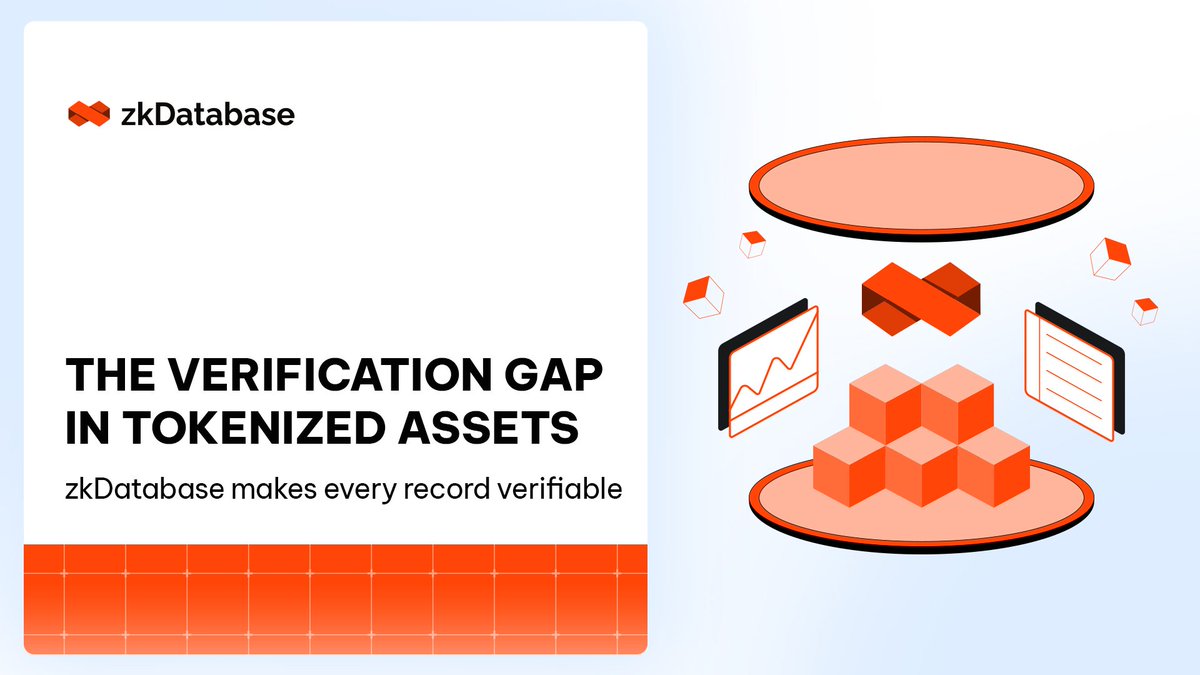
Privacy-first is the foundation of zkDatabase.
Built with Zero-Knowledge Proofs, zkDatabase enables private data to become verifiable without revealing the underlying information.
Privacy-first. Verifiable by default.
6/ The bigger point: on-chain finance does not scale only by putting assets on-chain.
It scales when the data behind those assets becomes provable, private, and continuously verifiable.
That is the role zkDatabase can play in capital markets
5/ For capital markets, this enables:
- Proof of Reserves
- Private KYC/KYB checks
- Verifiable collateral and liabilities
- Audit-ready reporting
- Selective disclosure for regulated workflows
- Proof interoperability across chains and venues
Capital markets are moving on-chain, but tokenization only solves one part of the problem.
The asset may be represented on-chain, while the data that defines it still sits off-chain: ownership, liabilities, collateral, NAV, eligibility, and disclosures.
🧵
The CLARITY Act advanced from Senate Banking on May 14, 2026.
The bill still has to clear the full Senate, reconcile with the House version if needed, and reach the President's desk.
Still, the signal is clear: U.S. digital asset market structure is getting more concrete.
For stablecoin issuers, RWA platforms, and institutional DeFi teams, that puts more weight on reserve data, collateral data, and asset-state data.
Read the full breakdown from Orochi Network:
orochi.network/blog/clarity-a…
What is Orochi Network?
A Verifiable Data Infrastructure that lets Web3, RWA, and capital market applications prove data integrity with Zero-Knowledge Proofs.
Full intro here:
orochi.network/blog/what-is-o…
The token layer works. The data layer underneath it doesn't.
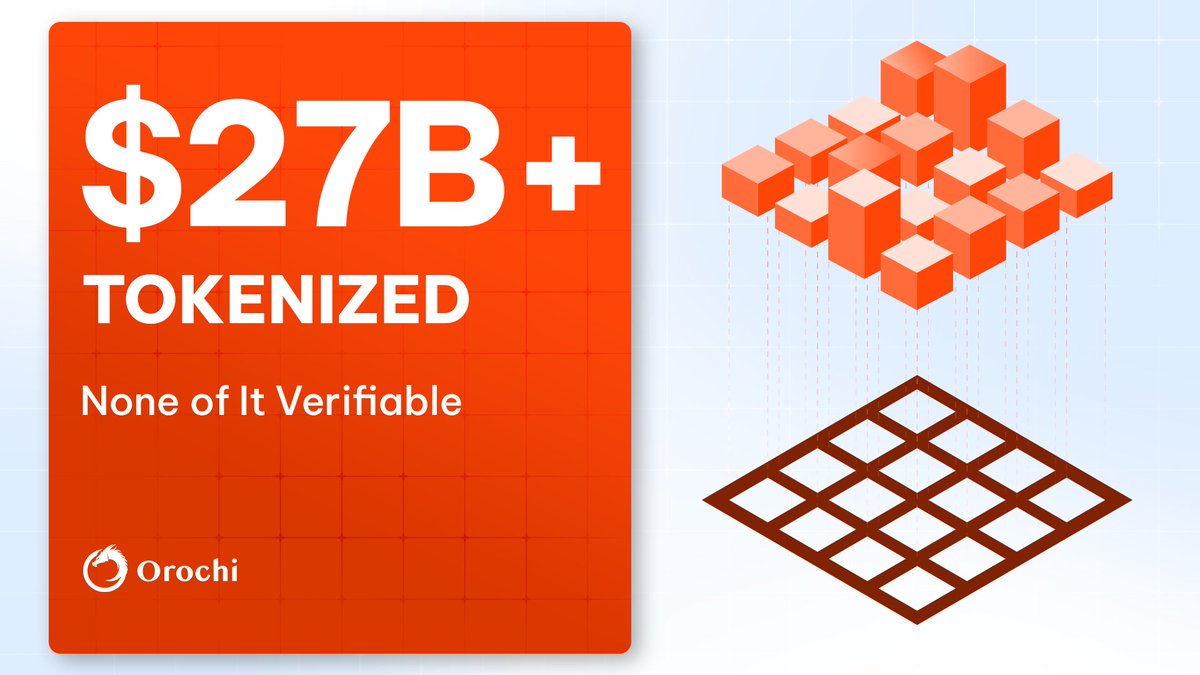
RWA protocols have built real infrastructure - $27B+ in on-chain tokenized assets confirms it. But the data connecting each token to the real-world asset still runs through oracle networks and attestation providers. You're trusting the network, not the data itself.
That's the gap institutional counterparties keep pointing at.
→ Verifiable data for tokenized assets: zkdatabase.org
DeFi rebuilt every layer of finance except one: the trust infrastructure underneath the data.
The application layer works - smart contracts, tokenization, liquidity provision. But when an institution asks "how do I know the data feeding this contract is correct?" the answer is still "trust the oracle network." That's a distributed form of trust - but it's still trust, not proof.
The missing layer is verifiable data - cryptographic proof that the input data is what it claims to be, before the contract executes on it.
→ Verifiable data for institutional DeFi: zkdatabase.org
3/3
zkDatabase is a verifiable database powered by Zero-knowledge proofs. It proves integrity of custodian-reported data and generates continuous cryptographic proof with every state change.
The on-chain record reflects what actually exists in the vault, not what was verified 30 days ago.
→ How zkDatabase handles physical asset verification: zkdatabase.org
2/3
It matters when tokenized gold enters DeFi. As collateral in lending protocols. As a yield base in structured products.
In those contexts, counterparties need to know the vault's status now, not as of last month's inspection.
Tokenized gold has crossed $7.6B in market cap, one of the fastest-growing RWA categories.
Behind that number: custodian vaults, regular third-party attestations (often monthly), and public supply ledgers. The transparency infrastructure is real.
But an attestation tells you what was in the vault on inspection day. 🧵
Flash loan attacks are the most repeated exploit pattern against oracle-dependent protocols. The mechanics are always the same.
A flash loan pushes a token's rate up 60% in one block. The oracle reports the new price, because that's its job. A lending protocol accepts it as collateral. By the time the price snaps back, the bad debt is already there.
The data was manipulated before it reached the oracle. The oracle just relayed it.
Oracles confirm data came through authorized sources. zkDatabase confirms the data was real by generating Zero-knowledge proofs at the source before anything reaches the chain.
→ zkdatabase.org
Privacy enhancing methods are playing a larger role in decentralised identity frameworks as AI agents take on sensitive or regulated workflows.
Techniques such as selective disclosure allow agents to share only the minimum information needed for a specific interaction.
👇
3/3
zkDatabase is a verifiable database powered by Zero-Knowledge Proofs. Every data operation produces a cryptographic proof that counterparties can verify on-chain, without relying on who pushed the data.
Still early. But the direction is clear.
→ zkdatabase.org
2/3
The question isn't whether this model has worked. It has, for a market still establishing institutional credibility.
As tokenized RWAs move from experiment to settlement infrastructure, used as collateral, moving toward integration with prime brokerage and clearinghouse workflows, counterparties will start asking harder questions about data provenance.
The tokenized RWA market crossed $27 billion. Much of that market runs on the same verification model: one authorized entity updates the on-chain record, and counterparties trust it.
That model built the market. At this scale, it's worth examining what comes next.
🧵