New podcast episode:
"In this bonus episode recorded live at the @CollegisEdu DisruptED summit in Phoenix, Dustin Ramsdell spoke with me and Charlie Rose about the rapidly shifting higher education policy landscape and its implications for institutions. They unpack how recent federal actions—particularly new legislation and accelerated rulemaking—are creating both urgency and uncertainty, while also signaling a longer-term shift toward accountability, affordability, and measurable student outcomes."
enrollify.org/episodes/live-…
New post at On EdTech:
The new graduate loan caps are being discussed as a federal finance policy issue. That is true, but it is also incomplete.
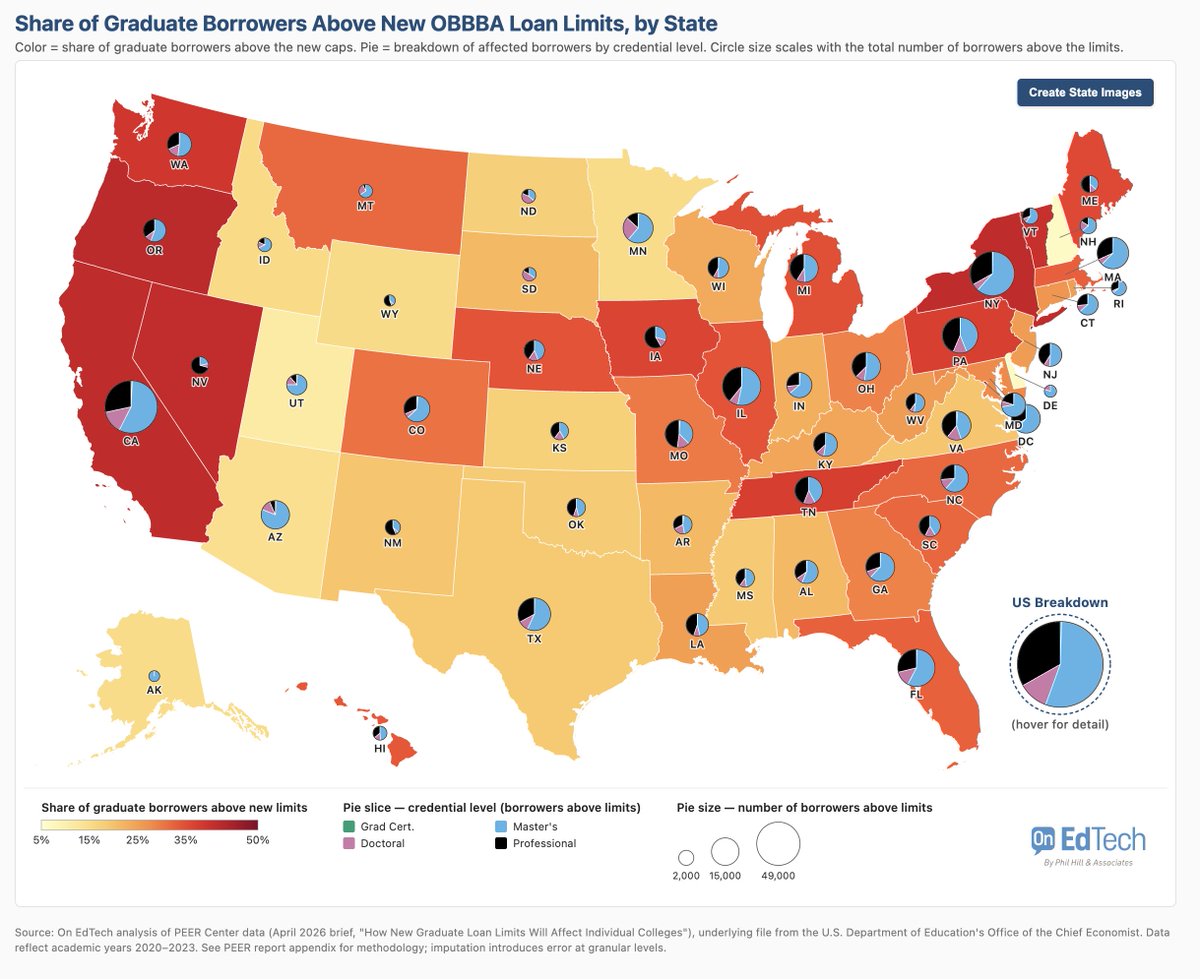
Using data from PEER Center’s new report, I created a set of visualizations to show a point that is hard to grasp from tables alone: the impact will not hit evenly. At California, Oregon, New York, Nevada, and Vermont institutions, more than 40% of graduate borrowers already borrow above the new OBBBA loan caps. In Arizona, Delaware, New Hampshire, and Utah, the share is 15% or lower.
The geography matters, but it is not the whole story. What the data really suggest is a geography-plus-program-portfolio problem. Professional programs such as medicine, law, and dentistry face one kind of pressure, while MBA, nursing, social work, PT, and physician assistant programs face another. Same federal law, very different local consequences.
I also included a downloadable PDF with all 52 images (50 states + DC + US view) for anyone who wants to explore the state-level patterns more directly.
The post is here: onedtech.philhillaa.com/p/the-graduate…
Incoming Blackboard CEO, Matthew Pittinsky, will take the stage at @asugsvsummit to discuss "The Higher Education Learning Platform at 30: The End of the Beginning or The Beginning of the End?"
Matthew will weigh in on the big question on everyone's mind: what’s next for learning platforms in the age of AI?
Be sure to attend this engaging session moderated by @PhilOnEdTech.
📆 April 14
🕑 2:00 p.m.
🔗 hubs.ly/Q04bxvVV0#ASUGSVsummit#AiInEducation#LMS
With the talk of anytime-anywhere access from online education, there is often an assumption that location doesn't matter. The competing view is an overly-simplistic view that students-choose-local.
The data say otherwise.
In this post, I take a closer look at where online students actually come from—and the patterns don’t match the mantras that too often enter EdTech discussions. Even in fully online programs, institutions show very different geographic realities: some operate at national scale, others extend regionally, and many still serve primarily local demand.
That leads to a more interesting takeaway:
Online education isn’t replacing local markets.
In many cases, it’s reinforcing them.
This matters for how institutions think about:
Enrollment strategy
Competition (who they’re actually competing against)
And policy frameworks that assume programs are interchangeable across regions
It also can raise bigger questions:
Are we designing accountability and ROI metrics based on a model of online education that doesn’t really exist?
This is an early look—more to come—but the goal is to challenge some core assumptions and put better questions on the table.
Full post: onedtech.philhillaa.com/p/the-locality…
Earnings data are now driving federal higher-ed policy. But are we measuring what we think we’re measuring?
The new OBBB accountability rules treat post-graduation earnings as a direct proxy for program and institutional quality. Miss the threshold → risk losing access to federal student loans.
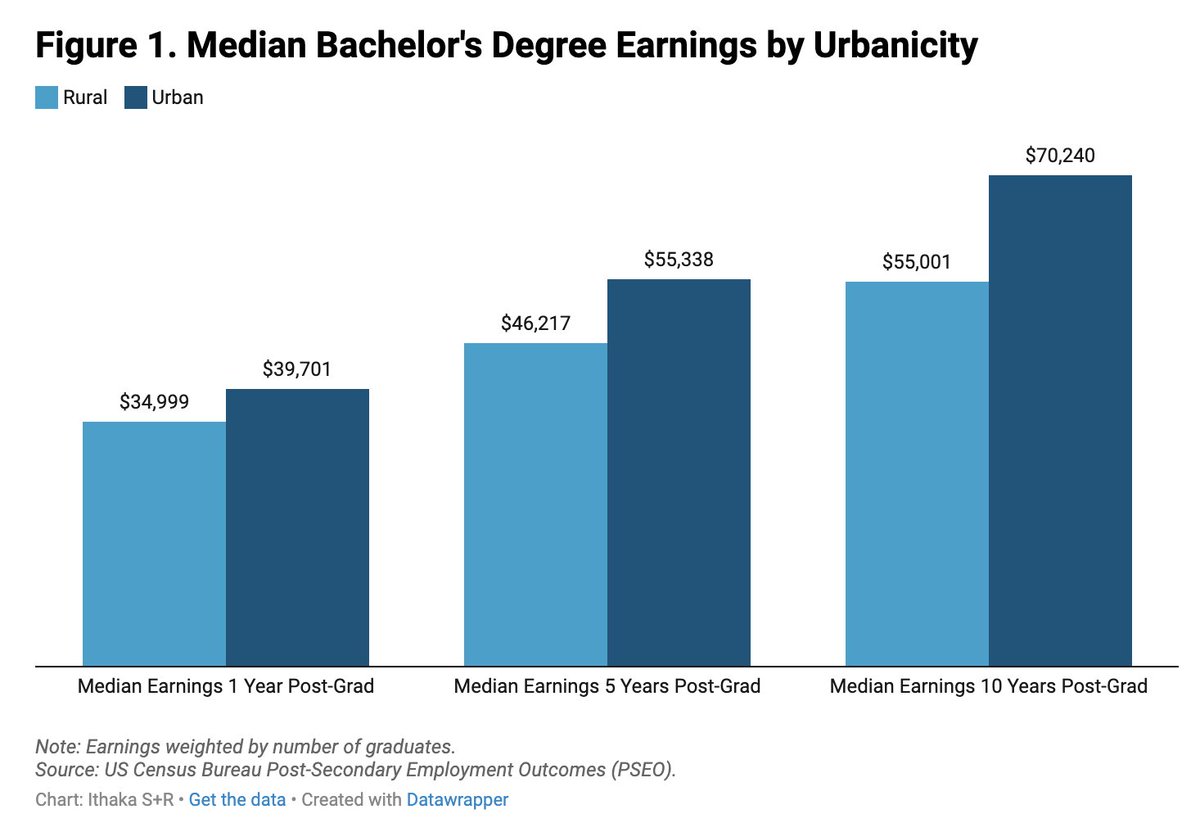
Recent research from Ithaka S&R (focused on South Carolina, but the dynamics apply nationwide) shows why this is more problematic than it first appears: graduate earnings are shaped far more by labor markets, geography, occupational pathways, and time than by anything colleges directly control.
We are not measuring institutional quality.
We are measuring systems—and then blaming or rewarding colleges for the results.
Rural institutions serving rural students, high-variance fields that drive innovation, and socially vital low-floor programs all get penalized under this logic. The policy risks exactly the distortions it claims to prevent.
@morganmundum unpacks the data in this week’s On EdTech (with clear charts and a revealing industry-concentration table). It’s the clearest explanation I’ve seen of why refining the earnings metric won’t fix the underlying problem—we’re still measuring the wrong thing.
→ Full post here: onedtech.philhillaa.com/p/earnings-dat…#HigherEd#EdPolicy#Accountability#WorkforceOutcomes#OBBB
AI is already changing how software gets built.
But does that mean EdTech vendors—and SaaS in general—are about to become irrelevant?
A reader pushed me to react to a “SaaS apocalypse” argument making the rounds. The core claim: if AI can generate software cheaply, the economic case for proprietary platforms collapses and we will see open source as the winning approach.
There’s something real here. AI is dramatically lowering the cost and speed of writing code. Open source communities in EdTech, in particular, should take notice.
But the conclusion goes too far.
Writing code is not the same as delivering a software service.
Universities don’t pay EdTech vendors just for features. They pay for security, compliance, integrations, uptime, and ongoing updates—what it takes to support learning at institutional scale. AI may accelerate development, but it doesn’t remove the operational burden.
If anything, it raises the stakes.
In this post, I break down:
• Where the “AI changes everything” argument has merit
• Why the SaaS model isn’t going away
• What this shift really means for LMS providers and open source
Bottom line: AI changes the economics of creation—but not the need for trusted, managed services.
onedtech.philhillaa.com/p/ai-saas-and-…
The emerging reality of OB3 accountability:
For many academic programs, by the time the first official Do No Harm earnings metrics arrive, it will already be too late to use them as a meaningful guide for improvement.
Why? Because the early rounds of accountability are not really judging behavior shaped by the new policy. They are judging historical cohorts that enrolled years before the earnings-premium metric even existed. For a 1-year certificate, the lag is roughly 6-7 years. For bachelor’s programs, it stretches close to a decade.
That means the near-term effect is less “improve and respond” and more delayed penalty system. Programs may be sanctioned based on student cohorts admitted long before institutions had any way to understand the rules of the game.
I walk through the timeline and explain why this matters for colleges trying to plan under the new accountability regime.
Read the full post: onedtech.philhillaa.com/p/its-already-…#HigherEd#EdPolicy#FinancialAid#HigherEducation
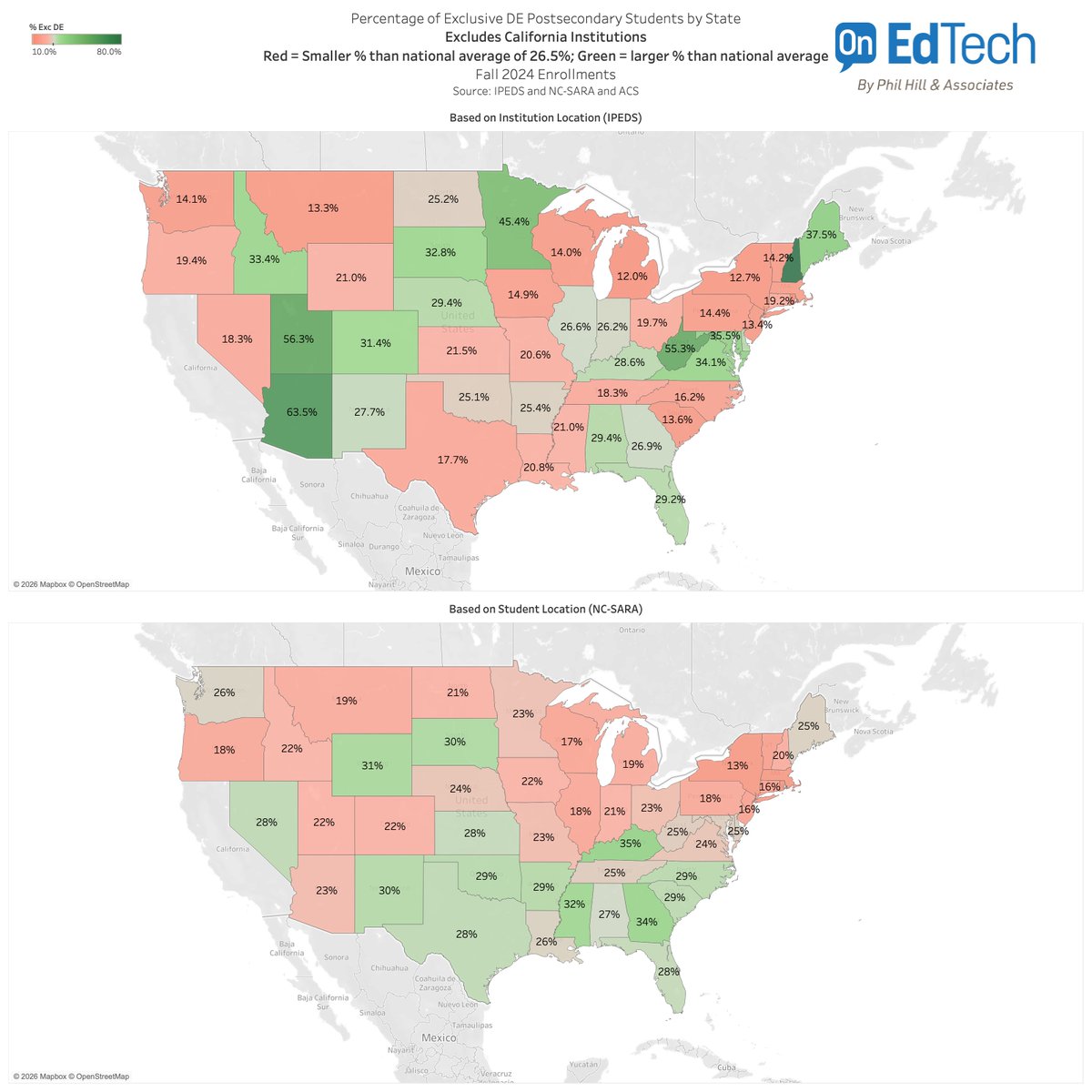
We often talk about online higher education as if it’s a single, borderless market.
The data suggest otherwise.
In my latest analysis using NC-SARA distance education data, I flipped the usual perspective. Instead of asking where students go, I looked at where institutions get their students.
The result: very different geographic strategies—even among the largest online providers.
A few examples:
* Western Governors University draws students from across the country, with only ~5% from its home state
* Georgia Tech’s online programs (starting with the Udacity MSCS) have built a strong national footprint, especially in large tech-heavy states
* Lone Star College System is almost entirely in-state, with ~98% of students coming from Texas
Same modality (online). Completely different markets.
For those who have seen NC-SARA data before, this is a different way to visualize it. For those who haven’t, it’s a reminder that geography still matters—even in online education.
The post includes interactive-style visualizations and a breakdown of three common patterns across institutions.
👉 onedtech.philhillaa.com/p/a-view-of-on…
Over the next few years, many higher education leaders are going to encounter a surprising policy outcome.
Programs that increase student earnings will fail federal accountability metrics.
When that happens, the first reaction will be: the data must be wrong.
But in many cases the data will be doing exactly what the policy requires.
The real issue is that the concept people believe the policy measures is not the same as what the metric actually measures.
I tried to explain this gap using one annotated chart from a recent Urban Institute report.
The chart shows programs where students clearly earn more after completing the program.
Yet some of those same programs would likely fail the new federal earnings premium accountability test.
Why?
Because the policy compares program graduates to a statewide median of high school graduates, not to students’ own pre-enrollment earnings.
That difference may sound technical, but it’s going to produce results that surprise a lot of institutional leaders over the next several years.
I walk through the issue in a new On EdTech post and use the annotated figure to explain the concept vs. reality gap.
Full Article:
onedtech.philhillaa.com/p/the-concept-…
Blackboard has officially emerged from bankruptcy.
The five-month Chapter 11 process went largely according to plan. The company is now essentially debt-free, backed by $70 million in new financing, and controlled by Nexus and Oaktree. Matt Pittinsky is set to return as CEO once his non-compete obligations expire.
If you’ve been reading On EdTech over the past 14 months, none of this should be surprising.
We covered:
• The early signs of financial strain
• The shift from PR optimism to creditor control
• Nexus and Oaktree positioning in the debt process
• The Pittinsky return
The financial reset is complete.
The strategic reset is still to come.
One real test will be Blackboard's Users Conference in July — when we’ll get the first visible read on product direction, sales posture, and whether this is stabilization or repositioning in the LMS market.
Full analysis here: onedtech.philhillaa.com/p/the-new-blac…#HigherEd#EdTech#LMS#Blackboard#PrivateEquity
@beehiiv Thanks for the quick work. Please make sure in your investigation to address the outages on Feb 18 & 23 and if they're related. But great response today!
Online learning isn’t as location-agnostic as we often assume.
I just published a new post looking at the regionality of online learning—specifically, how student location, institutional geography, and local labor markets still shape outcomes, even in a modality designed to transcend place.
This is very much an initial view, not the final word. The goal is to surface patterns, ask better questions, and flag where common assumptions start to break down—especially as accountability, earnings metrics, and policy frameworks increasingly treat online programs as interchangeable across regions.
There’s a lot more work to do here. In upcoming On EdTech+ posts, I’ll dig deeper into:
* More granular regional breakdowns
* Stronger causal framing
* And analysis that’s directly usable for institutional leaders and policymakers
For now, this post is about setting the table and showing why geography still matters—even online.
👉 Read the post: onedtech.philhillaa.com/p/on-the-regio…
Fall 2024 IPEDS data are out, and the story is quieter (and more interesting) than the headlines suggest.
Yes, total U.S. higher ed enrollment grew again in Fall 2024. But the IPEDS census data show a modest, uneven recovery, not a broad-based rebound - and a much more restrained picture than early Clearinghouse estimates implied.
A few top line takeaways:
* Enrollment is up for the second straight year, but still well below pre-2019 levels.
* Community colleges and private nonprofit four-years are driving most of the growth, but much of the 2-year rebound is tied to dual enrollment with very different economics than traditional students.
* Despite all the backlash to “Zoom U,” online participation remains structurally elevated. More than half of all students now take at least one online course, well above the pre-pandemic trend line.
Taken together, the data suggest higher ed hasn’t “bounced back.” Instead, it’s settling into a new equilibrium: fewer students overall than a decade ago, more hybrid participation than ever, and recovery that varies sharply by sector.
I’ve shared the full Fall 2024 IPEDS profile, continuing an annual data series I’ve published since 2012, with charts, sector breakouts, and long-term trend context here:
👉 onedtech.philhillaa.com/p/fall-2024-ip…
It’s the End of FVT & GE as We Know It
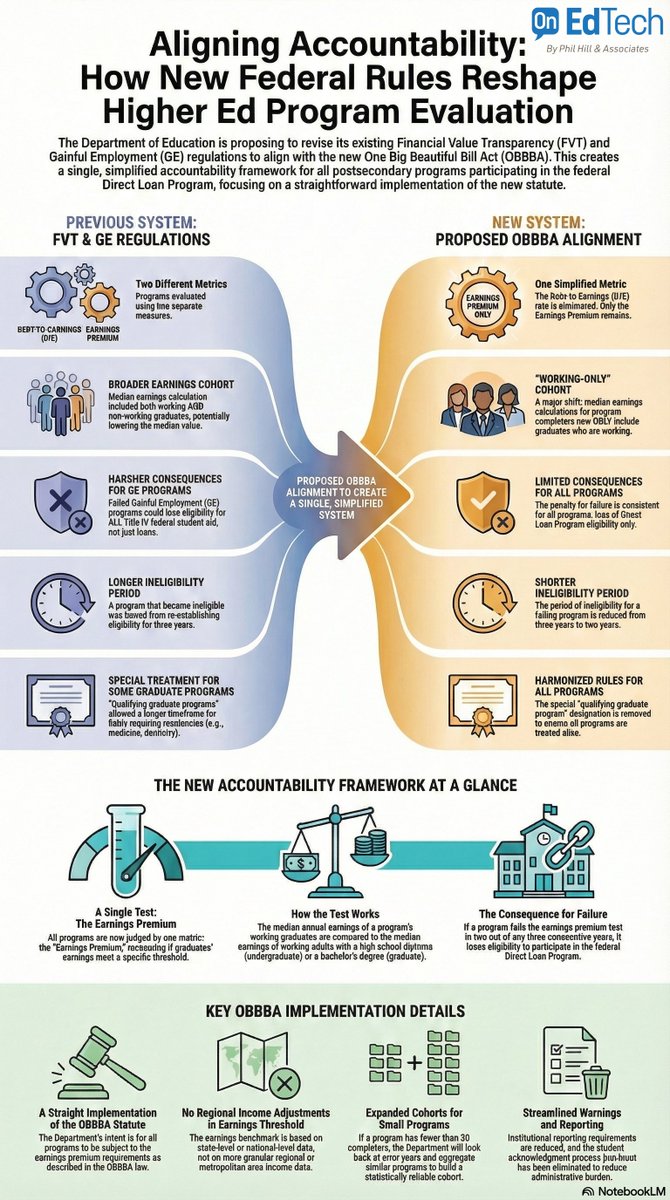
The Department of Education just proposed a major rewrite of federal program accountability, collapsing Financial Value Transparency (FVT) and Gainful Employment (GE) rules into OBBBA's simplified earnings-based test.
If the proposals go through:
👉 No more Debt-to-Earnings metrics
👉 No more qualifying graduate program carve-outs
👉 No metro-area or sub-state wage adjustments
👉 A single “earnings premium” test for all Direct Loan-eligible programs
This proposal reflects a statute-driven prioritization of simplicity and uniform enforcement, even where that means accepting known distortions in comparison groups.
Check out the infographic below for a visual summary, and read the full breakdown of what this means for colleges, students, and negotiators at the link:
🔗 onedtech.philhillaa.com/p/its-the-end-…
If you care about federal accountability policy, this shift is one that cannot be ignored.
In which Glenda Morgan and I, in a joint post, make a counter-argument to the "LMS is Dead" thesis most recently shared at Inside Higher Ed op-ed and by Alfred Essa. It's a good debate to have in public, and not a new one.
onedtech.philhillaa.com/p/the-report-o…