

@Suchmo83 Indeed, it may sound obvious but that doesn’t mean it always happens.
English
Daniel Muijs
8K posts
@ProfDanielMuijs
Professor and Head of the School of Social Sciences, Education and Social Work, Queen’s University Belfast @QUBSSESW @QUBelfast

I've seen a fair few people suggest recently that the 'science of reading' can essentially be boiled down to two messages: 1. Explicitly teach kids to decode (i.e. systematic phonics). 2. Build knowledge. But in many schools, these two things alone will fail. >>
1/3 🇫🇮Finland is often held up as an education success story, but the narrative doesn’t hold up. They topped PISA reading once (2000) & declined ever since. What explains that early one-time success, and why have they been declining? My guest breaks down the Finland myth 👇
Education research the least likely to replicate according to a huge new paper published by Nature
Onderwijskwaliteit gaat verder achteruit: bijna 1 op de 5 Vlaamse scholen haalt minimumdoelen niet vrtnws.be/p.GvBoDWNKP?t=… #vrtnws
Abolish Ofsted. theguardian.com/politics/live/…
“I think critical thinking should be a school subject. I've always encouraged my kids to question absolutely everything.” ~ @sequi_simon Completely agree. Critical thinking should be on the school curriculum. But governments hate critical thinkers.

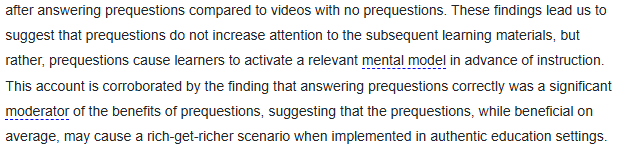




Our new research for @nationaltrust finds that after the NHS it’s Britain’s countryside and nature and historic buildings and architecture that are their biggest sources of pride in the UK.




NEW BLOG. Impressively wrong- why Alfie Kohn's advice on behaviour management is not good behaviourguru.blogspot.co.uk/2018/04/impres…

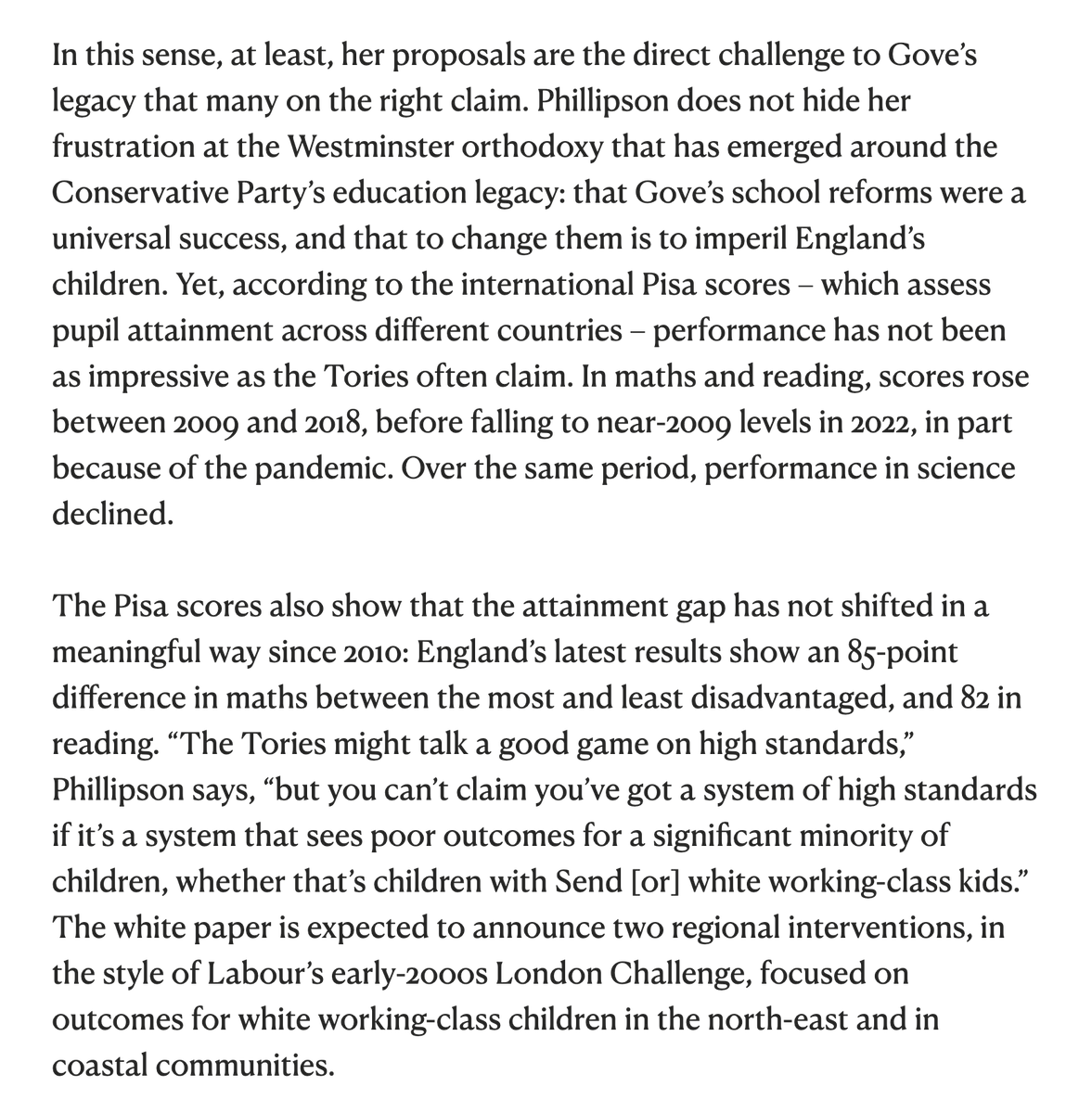
CLASS WARRIOR by Pippa Bailey Is Bridget Phillipson really the most dangerous education secretary ever? Bridget Phillipson has certainly faced her critics since she entered the Department for Education in July 2024. She was likened to a Nazi for Labour’s promise to remove the VAT exemption on private-school fees. The Children’s Wellbeing and Schools Bill saw her derided as a “Marxist”. Her changes have been interpreted as an attack on Michael Gove’s legacy. For them, Phillipson has been labelled an enemy of progress who wants to cut down the tall poppies rather than help them grow. The Mail considers her “the most dangerous education secretary in living memory”. Phillipson and Keir Starmer are close allies. On 9 February, as pressure mounted on the Prime Minister to resign over the appointment of Peter Mandelson, Phillipson volunteered to support him on the media round. (She was “extremely keen” to do so, a Labour figure says.) Now, Phillipson faces two even more toxic challenges, the outcome of which will make or break her career, and perhaps the government itself. First, the long-awaited schools white paper is expected in the coming days. Its most difficult proposals involve reforms to special educational needs (Send) provision. Months of painstaking work have gone into building support among Labour MPs in hopes of avoiding a Welfare Bill-style rebellion that could threaten the Prime Minister’s fragile grip on power. Second, as Women and Equalities Minister, Phillipson is responsible for delivering guidance on how organisations implement the Supreme Court’s ruling that, for the purposes of the Equality Act, a woman is defined by biological sex. Businesses and services are still operating under a code of practice last updated in 2011. Pressure is mounting on Phillipson to deliver its replacement – and fast. Labour is on the brink. If Phillipson can steer through Send reform and the trans guidance, she could restore a sense of strength and confidence about this government – and perhaps even give it a sense of purpose. If she cannot, she risks becoming an emblem for a government that has neither a coherent vision nor the ability to communicate it; at once loathed and without the radicalism to justify such loathing. On Send reform in particular, the timing is crucial: Labour’s performance in the local elections in May could end Starmer’s premiership. But who is the woman at the heart of these challenges – and what does she want? Is she a radical reformer, intent on ripping up the legacy of the Gove era to set a path of her own? Or is she a more conservative figure, seeking sensible tweaks to the system she inherited? Does she – and the government more widely – know which she wants to be? Most importantly, perhaps, can she grip the challenges ahead with enough strength to save Keir Starmer’s faltering government, before time and the last vestiges of goodwill run out? (Cover photo by Kate Peters for the New Statesman)

New blog, inspired by the excellent qualitative paper by Makel and colleagues: On the reliability and reproducibility of qualitative research. I reflect on realist ontologies in qualitative research, and how I will incorporate these in my own research. daniellakens.blogspot.com/2026/02/on-rel…
I have a new paper. We look at ~all stats articles in political science post-2010 & show that 94% have abstracts that claim to reject a null. Only 2% present only null results. This is hard to explain unless the research process has a filter that only lets rejections through.