
CurmudgeonAtLarge
16.5K posts
CurmudgeonAtLarge
@ProfNich
Newhouse Professor Emeritus Freelance broadcast talent/writer/producer/coach, Semi-grammarian, We/Us
Syracuse, New York Katılım Ağustos 2009
404 Takip Edilen768 Takipçiler

Tell that guy with the glasses to get out of the shot.
CitrusTV Sports@CitrusTVSports
BREAKING: Sadiq White Jr. is returning to Syracuse for the 2026-2027 season.
English
CurmudgeonAtLarge retweetledi


CurmudgeonAtLarge retweetledi

On March 30, 2026, we honored the life and legacy of Col. (Ret.) Bud Anderson, America's last triple ace pilot of World War II. His legacy will live in the skies he journeyed, forever embedded in the freedom he helped defend.
English
CurmudgeonAtLarge retweetledi

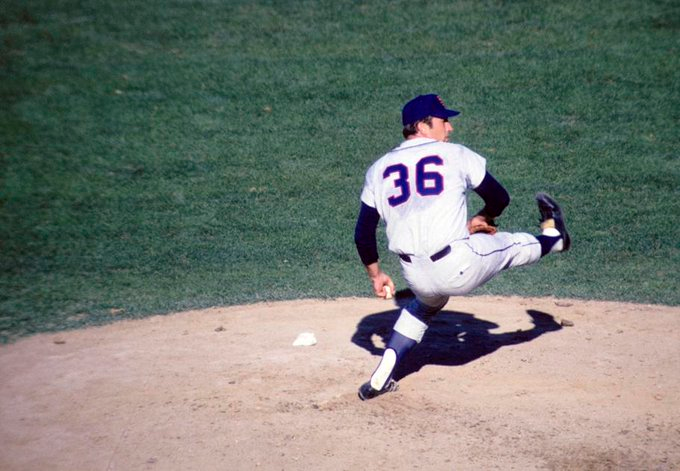
"Late in 1969, the Cubs came in to Shea and Jerry Koosman was pitching against Bill Hands.
Hands made the mistake of throwing at Tommy Agee.
You just knew retribution was at hand.
Koozie didn’t fool around with that business.
You gave him an excuse to drill you and he was going to drill you up around your neckline.
Leo Durocher, who thought he invented baseball, started that crap and Koozie threw one at Ron Santo and that sucker was heading right for his jawbone if he didn’t get his arm in front of it.
It sounded like someone hit him with a two-by-four.
Santo screamed, you know.
And Ron Santo was a very tough guy.
I thought Koosman broke his arm, but he didn’t.
But I think Santo went down to first base a different person.
I remember Seaver was standing on the steps, yelling across the way:
‘You guys don’t want to play that game.’
And that knockdown crap was over.
And I think it was a harbinger of things to come..."
Ron Swoboda.
"Jerry Koosman had brains, heart and guts, it was his misfortune to always be second best.
Runner up to Johnny Bench for the 1968 ROY despite 19 wins, runner up to Randy Jones for the Cy Young in 1976 despite 21 wins, always the Number Two starter behind Tom Terrific."
"Jerry Koosman threw a 90-plus fastball."
Roberto Clemente said Koosman was the only guy who threw a fastball:
"That never moved the same way twice."
Jerry Koosman's catcher in his Mets days, J.C. Martin, once said that Koosman could throw his 11-5 curveball "Any time."
In 1977, Jerry Koosman lost 20 games and had an ERA+ of 107, WAR 2.9, and lead the league in SO/9!!!!!!
He was that good!
How does a player with 222 wins, 73rd all-time, an ERA of 3.36 and 2,556 strikeouts make it on just ONE, yes ONE, Hall of Fame ballot, with only FOUR votes???
In my HOF!!!
English
Two days later we did it again as SU took Louisville to overtime and lost 96-88 and John Wooden’s Bruins won their tenth title beating the Wildcats 92-85. What a weekend!
English
51 years ago Joel Mareiniss, Charlie Bivins and I sat center court three rows up at the Final Four in San Diego. Joel called both games on WSYR Radio - SU v Kentucky & UCLA v Louisville. SU lost 95-79. UCLA won 75-74 in OT - best game I’ve ever seen in person.
English

CurmudgeonAtLarge retweetledi

On the air for Patriot League softball on ESPN+ as Colgate hosts Army. First pitch is at 2:05 p.m.
📺 espn.com/watch/player/_…

English
The latest update has completely screwed up my iPad. I am not alone, am I?
English

Hooray for Red - great man going to what should be a great situation.
Brent Axe@BrentAxeMedia
Adrian Autry stays in the ACC and will get to square off with 🍊🏀 in his new gig. syracuse.com/orangebasketba…
English


Unfortunate news for Syracuse women’s basketball.
Rising senior guard Sophie Burrows announces she will enter the transfer portal after 3 seasons at SU 🍊🏀

English

CurmudgeonAtLarge retweetledi

Alan Hale Jr. once risked his own job on Gilligan’s Island—by sneaking food onto set for the crew when the production tried to cut costs. The studio hated it, but Hale shrugged. “If the Skipper can’t look after his crew,” he reportedly said, “then what’s the point of being the Skipper?” That small rebellion says everything about him: beneath the bluster of his famous captain’s cap was a man defined by loyalty and generosity.
On screen, Hale’s Skipper was comic relief—gruff, bumbling, always thumping Gilligan’s head with his hat. Off screen, Hale became the quiet glue of the cast. He’d take Bob Denver out for late-night meals when the younger actor felt trapped by typecasting, and he regularly visited Dawn Wells and Natalie Schafer when health troubles struck. Crew members said he had a gift for lifting spirits on tense days—telling jokes, hugging extras, even carrying heavy equipment himself when grips were overworked.
What fans never saw was how much Hale wrestled with the shadow of his role. Like Denver, he was forever tied to Gilligan’s Island, struggling to land serious parts. Yet he never let bitterness take over. Instead, he leaned into the identity, greeting strangers with, “Hello, little buddy!” and delighting sick children by showing up in full Skipper costume at hospitals. The hat, which could have been a curse, became his way of turning typecasting into human connection.
And here’s the part that lingers: even after the show ended, Hale opened a seafood restaurant in Los Angeles—not as a vanity project, but as a gathering spot for fans. He’d walk table to table, posing for photos, cracking jokes, and asking about people’s families as if they were old friends. It wasn’t about fame anymore. It was about belonging.
Alan Hale Jr.’s story reveals something often overlooked in Hollywood lore: sometimes the greatest rebellion isn’t smashing guitars or burning bridges—it’s choosing to live out your role with warmth, turning a sitcom caricature into a lifelong act of kindness.

English
Which is the greater Temptations song my girl or just my imagination or could it be a tie?
English