Ryan@ohryansbelt
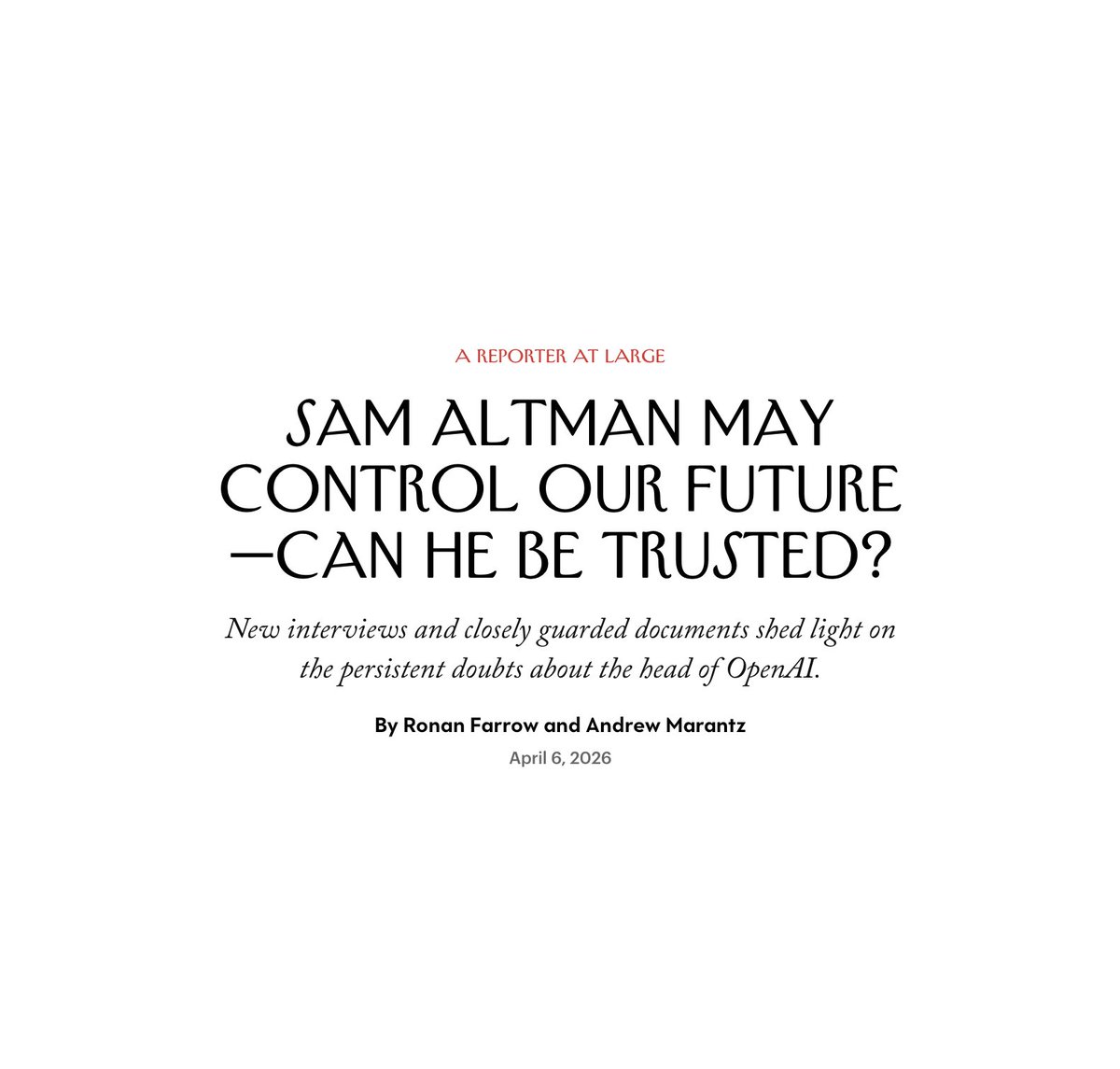
The New Yorker just dropped a massive investigation into Sam Altman, based on over 100 interviews, the previously undisclosed "Ilya Memos," and Dario Amodei's 200+ pages of private notes. It's the most detailed account yet of the pattern of behavior that led to Sam's firing and rapid reinstatement at OpenAI. Here's the breakdown:
> Ilya compiled ~70 pages of Slack messages, HR documents, and photos taken on personal phones to avoid detection on company devices. He sent them to board members as disappearing messages. The first memo begins with a list headed "Sam exhibits a consistent pattern of . . ." The first item is "Lying."
> Dario kept detailed private notes for years under the heading "My Experience with OpenAI" (subheading: "Private: Do Not Share"), totaling 200+ pages. His conclusion: "The problem with OpenAI is Sam himself."
> Sam reportedly told Mira his allies were "going all out" and "finding bad things" to damage her reputation after the firing. Thrive put its planned $86B investment on hold and implied it would only close if Sam returned, giving employees financial incentive to back him.
> Sam texted Satya Nadella directly to propose the new board composition: "bret, larry summers, adam as the board and me as ceo and then bret handles the investigation." The two new members selected to oversee an independent inquiry into Sam were chosen after close conversations with Sam himself.
> Before OpenAI, senior employees at Loopt asked the board to fire Sam as CEO on two separate occasions over concerns about leadership and transparency. At Y Combinator, partners complained to Paul Graham about Sam's behavior, and Graham privately told colleagues "Sam had been lying to us all the time."
> OpenAI's superalignment team was promised 20% of the company's compute. Four people who worked on or with the team said actual resources were 1-2%, mostly on the oldest cluster with the worst chips. The team was dissolved without completing its mission.
> Sam told the board that safety features in GPT-4 had been approved by a safety panel. Helen Toner requested documentation and found the most controversial features had not been approved. Sam also never mentioned to the board that Microsoft released an early ChatGPT version in India without completing a required safety review.
> Sam made a secret pact with Greg and Ilya where he agreed to resign if they both deemed it necessary, essentially appointing his own shadow board. The actual board was alarmed when they learned about it.
> Sam struck a deal with Greg to become CEO while simultaneously telling researchers that Greg's authority would be diminished, and telling Greg something different.
> A board member described Sam as having "two traits almost never seen in the same person: a strong desire to please people in any given interaction, and almost a sociopathic lack of concern for the consequences of deceiving someone." Multiple sources independently used the word "sociopathic."
> OpenAI is reportedly preparing for an IPO at a potential $1 trillion valuation while securing government contracts spanning immigration enforcement, domestic surveillance, and autonomous weaponry in war zones.