
Sabitlenmiş Tweet
cricket
2.7K posts

cricket retweetledi

cricket retweetledi


cricket retweetledi


cricket retweetledi

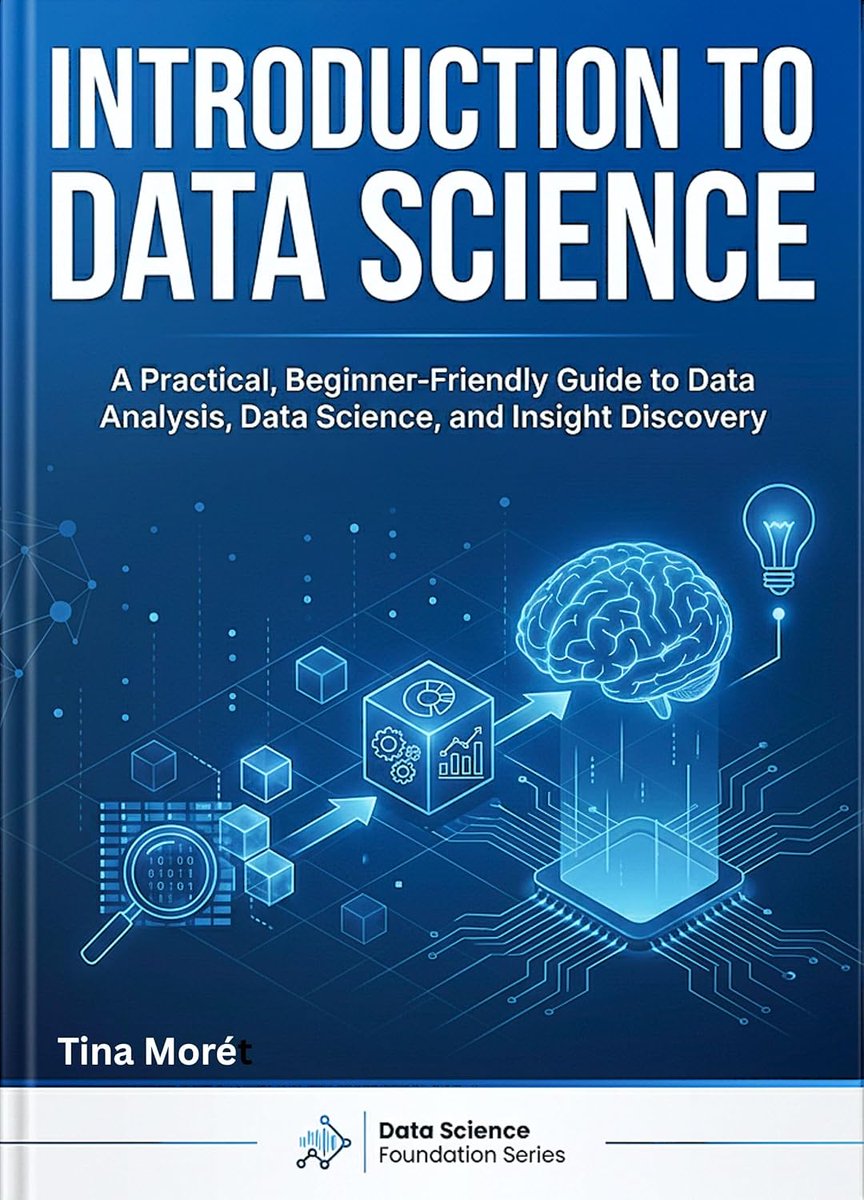
INTRODUCTION TO DATA SCIENCE: A Practical, Beginner-Friendly Guide to Data Analysis, Data Science, and Insight Discovery (Data Science Foundation Book 1)
clcoding.com/2026/05/introd…
English
cricket retweetledi


cricket retweetledi


cricket retweetledi

cricket retweetledi
cricket retweetledi

This IS NOT an intelligence game
I am not smart at all
Most reading this are smarter than me
But
I'm disciplined
Patient
Have a true edge
I stack base hits (1:1 rr)
I'm honest with myself
That's why I became a millionaire with trading
English
cricket retweetledi

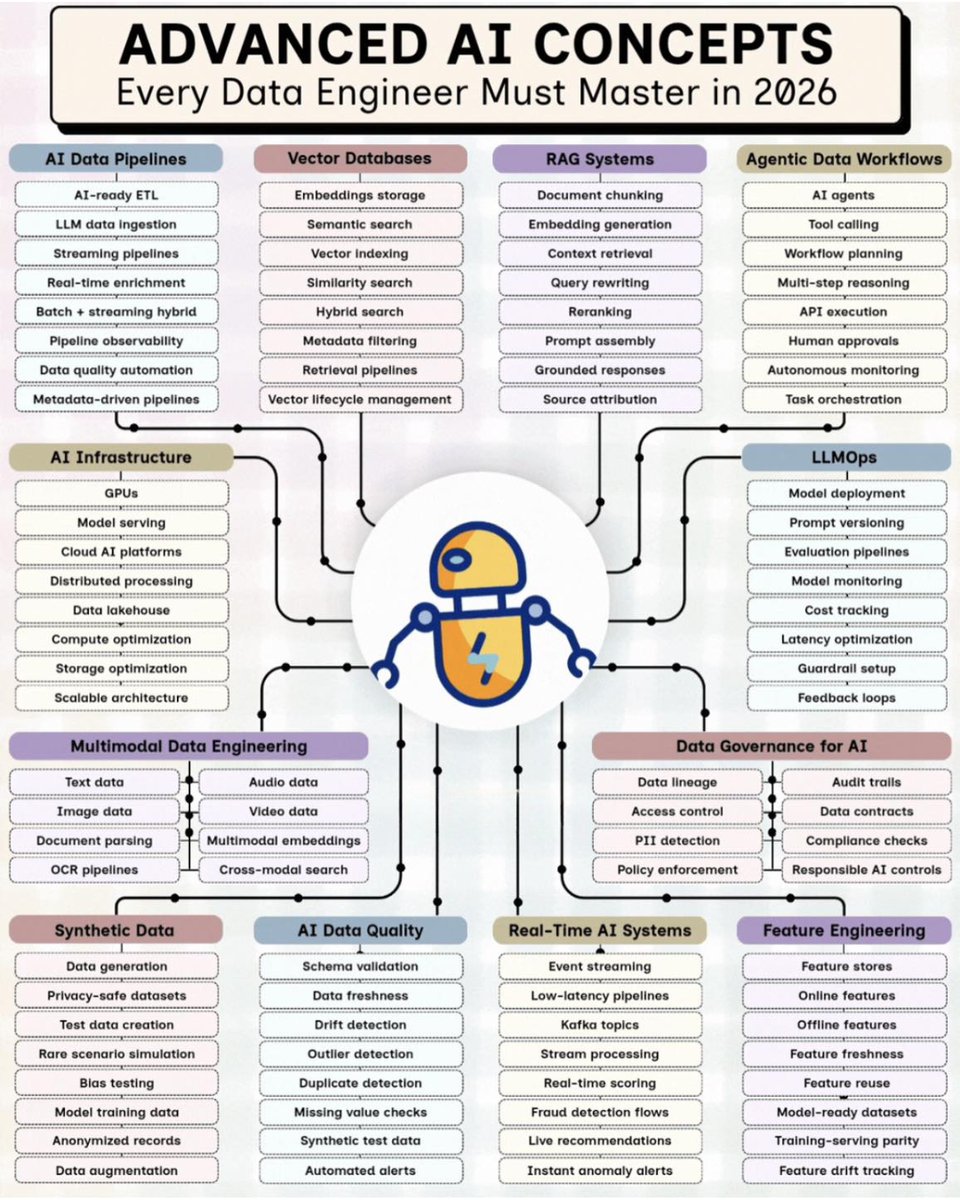
Advanced AI Concepts Every Data Engineer Must Master in 2026
In 2026, data engineers need to understand how data powers AI systems.
Because modern AI products depend on more than pipelines, warehouses, and dashboards.
They need:
➞ Clean data
➞ Real-time pipelines
➞ Vector databases
➞ RAG systems
➞ AI data quality checks
➞ Feature engineering
➞ LLMOps
➞ Data governance
➞ Agentic workflows
➞ Multimodal data processing
This is where the role of a data engineer is changing.
Earlier, the focus was mostly on collecting, transforming, and storing data.
Now, data engineers also need to prepare data for AI models, retrieval systems, autonomous agents, and real-time decision-making systems.
That means understanding concepts like embeddings, vector indexing, prompt versioning, context retrieval, model monitoring, drift detection, data lineage, synthetic data, and AI-ready pipelines.
The future data engineer will not just build data infrastructure.
They will build the foundation for intelligent systems.
If you are learning data engineering in 2026, do not stop at SQL, Spark, Airflow, Kafka, and cloud platforms.
Start learning how AI systems consume, retrieve, validate, monitor, and act on data.
That is where the next big opportunity is.
♻️ Repost to help others grow
English
cricket retweetledi
Everyone Wants AGI… But Most People Haven’t Climbed Layer 1 Yet.
📍 Understanding AI is like climbing a mountain — and most people are staring only at the summit.
A few years ago, “AI” meant simple automation.
Then came Machine Learning.
Then Neural Networks.
Then Deep Learning changed everything.
And suddenly…
💥 ChatGPT arrived.
People thought:
“This is it. AGI is here!”
But here’s the truth 👇
We are not at the top of the mountain yet.
We are standing somewhere around Agentic AI — where systems can plan, act, and execute.
Still powerful.
Still revolutionary.
But not AGI.
Not yet.
Let me explain this journey like a story:
🏔️ Layer 1: Classical AI
The rule-following student.
“If this happens → do that.”
📊 Layer 2: Machine Learning
The student starts learning from examples.
🧠 Layer 3: Neural Networks
Now it learns like a simplified brain.
🔍 Layer 4: Deep Learning
It gets better at images, speech, and language.
🎨 Layer 5: Generative AI
Now it creates—text, images, videos, code.
🤖 Layer 6: Agentic AI
It doesn’t just answer.
It thinks, plans, and executes tasks.
☁️ Layer 7: AGI
The dream.
Human-level intelligence across everything.
And no…
We’re not there yet.
But we are closer than ever.
The mistake people make?
They fear the summit…
without understanding the climb.
AI isn’t magic.
It’s layers.
Built over decades.
Step by step.
And the people who understand these layers today…
Will lead tomorrow.
📌 Don’t just use AI.
Learn where it stands.
Because the future belongs to those who understand the mountain before trying to conquer it.
🔥 Which layer do you think will change the world the most?
👇 Drop your thoughts below.
✨ “The future is not built by those who wait for it, but by those who understand it early.”

English
cricket retweetledi

cricket retweetledi

Your app works. But if 1,000 people show up tomorrow:
→ It breaks under load
→ Bots find your exposed API keys
→ Errors crash silently with no logs
→ Shared links preview as blank
→ Google can't find you
Production-ready means polished, secure, reliable, and ready for real users.
English
cricket retweetledi

• Claude → Copywriter, SEO Writer, Social Media Manager
• Perplexity → Researcher
• Nano Banana → Designer
• CapCut → Video Editor
• Cursor → Developer
• Gamma → Presentation Designer
• ElevenLabs → Voiceover Artist
• DeepL → Translator
• Ideogram → Thumbnail Designer
• Suno → Music Composer
• ChatGPT → Customer Support Agent
AI is replacing entire teams.
I probably just saved you $15,000/month.
Save + Share 🙂
English
cricket retweetledi

How to quit your job in 90 days trading ICT concepts:
English
cricket retweetledi
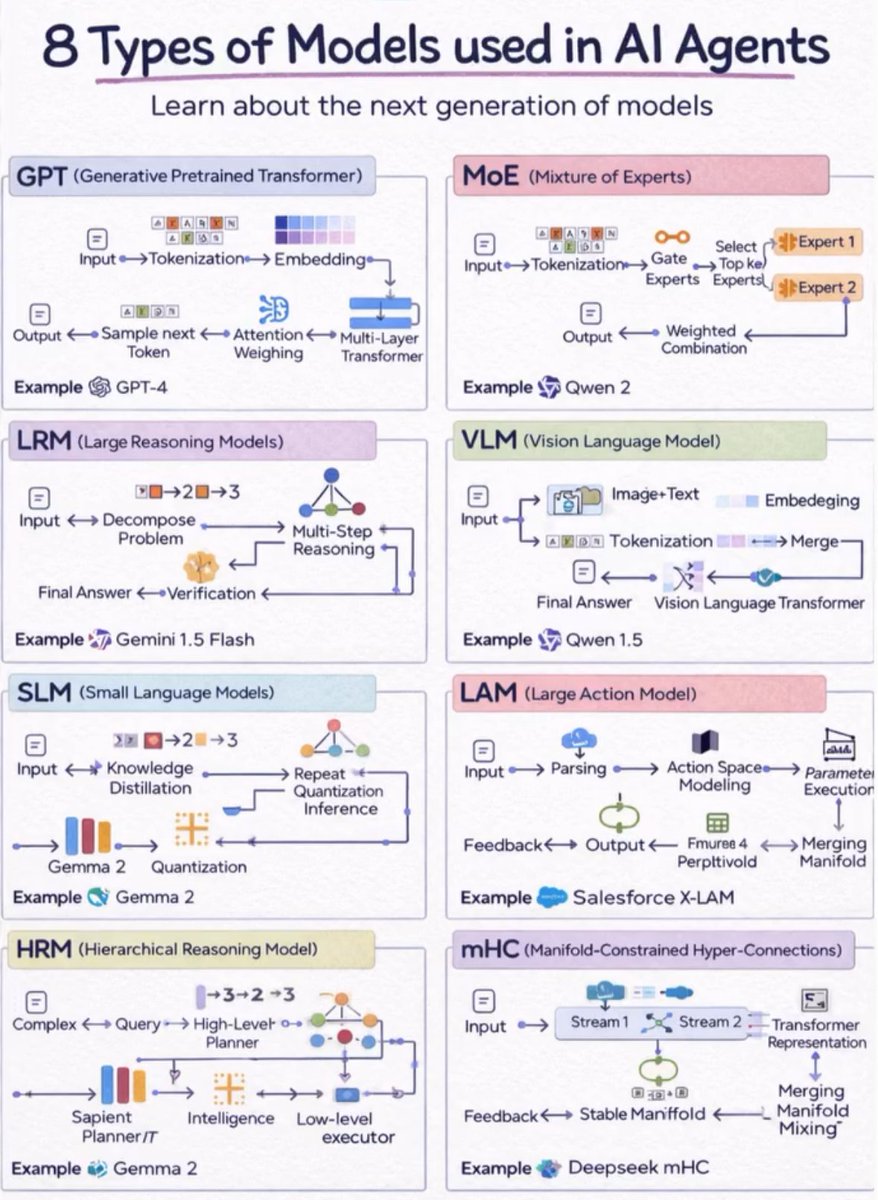
AI agents are evolving beyond simple automation into multi-model intelligent systems that combine reasoning, perception and action. Understanding the architecture behind these systems is critical for building scalable, production-grade AI solutions.
🔹 Key Technical Insights from the Architecture:
1. Transformer-based models (GPT) rely on self-attention and token embeddings for contextual understanding
2. MoE architectures optimize compute using sparse expert routing and gating networks
3. LRM & HRM models enhance decision-making with multi-step reasoning and hierarchical planning
4. VLM integrates multi-modal embeddings (vision + text) for richer contextual outputs
5. SLM enables edge deployment via quantization and knowledge distillation
6. LAM focuses on intent parsing → action mapping → execution loops
7. mHC introduces manifold-constrained representations for stable learning systems
If you're building AI agents, the future lies in model orchestration, not just model selection.
English
cricket retweetledi

Quantum computing is on track to become an $850 billion industry by 2040, with $65 billion in government money already committed worldwide.
It's in the same window the internet had in 1992 and cloud computer had in 2010.
3 quantum stocks I'm looking at in 2026:🧵
English
cricket retweetledi
cricket retweetledi

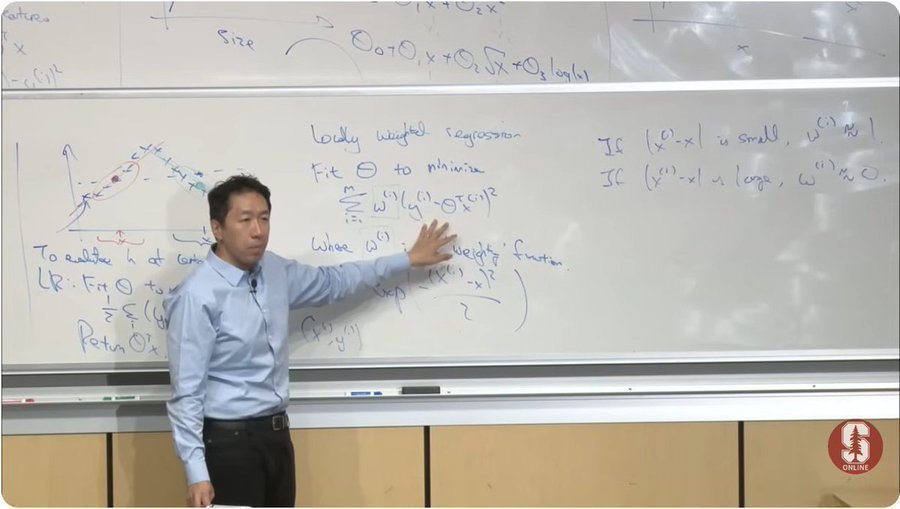
Stanford's ALL FREE Courses on AI & ML:
❯ CS221 - Artificial Intelligence
❯ CS229 - Machine Learning
❯ CS230 - Deep Learning
❯ CS234 - Reinforcement Learning
❯ CS224N - NLP with Deep Learning
❯ CS336 - LLM from Scratch
13 Course links inside:
English
cricket retweetledi
Life cycle of a trader:
1st year - watches 400 hours of YouTube and demo trades
2nd year - goes live blows accounts
3rd year - refines "strategy" still blows accounts
4th year - finally break even
5th year - still not profitable but starts posting charts on Twitter
6th year - 12k followers and launches a $499 course
English