
Sara El-Yafi

1.2K posts

Sara El-Yafi banner
Sara El-Yafi

Sara El-Yafi

@SaraYafi

There is a problem with this chair

Katılım Eylül 2011
233 Takip Edilen24.1K Takipçiler
Sabitlenmiş Tweet
Sara El-Yafi
Sara El-Yafi@SaraYafi·
Happy to report that this video garnered more than 100,000 views within the first couple of hours on IG. Over the last 111 days, since October 7, Isræl has consistently denied targeting civilians. Well, in this video, I am going to show you that in the history of its occupation, not only does Isræl actively target civilians, but they specifically target children. More importantly, I explain why they do it. We all have been collectively forced to observe the core of unmitigated and unbounded state terrorism carried out by Isræl, shielded by the sponsorship of the wide majority of the Global North, their governments, and their media. The institutionalized Isræli policies that involve the actions of killing, maiming, abducting, abusing, jailing, and r@p!ng children has yet to be brought to the forefront of Western consciousness. I hope this video helps create said consciousness. Thank you for interacting with and sharing this video widely; thank you for working towards a world where such crimes are not only morally condemned but also carry tangible penalties. Onwards. PS: Thank you to @Patrick_Baz for the inspiration and the permission to share his extraordinary photos
English
2K
14.8K
20.5K
2M
Sara El-Yafi
Sara El-Yafi@SaraYafi·
Glad to hear this, there is a lot more data coming. Stay tuned. Just be careful who you engage with, there’s a whole ecosystem of loud, extremely violent, anonymous accounts working overtime to shut down conversations like this. They get especially agitated when people start educating themselves because it threatens their tired script of turning Lebanon into a playground for Zionist control. Watch closely: the more informed you get, the more violent and incredibly disparaging they sound. Not a single one engages respectfully. Not a single one. Not one counter-argues with calm facts, only with insults, character denigration, and bursts of vitriolic emotion. That’s what people resort to when their narrative can’t survive basic scrutiny. So just be mindful.
English
2
14
55
10K
Anythinbz 🇮🇹
Anythinbz 🇮🇹@30nemagar·
@SaraYafi @aidamoun Thanks for sharing Sara, I have never heard of these before. I wish I had time to spend on these to be more educated.
English
2
0
5
942
Sara El-Yafi
Sara El-Yafi@SaraYafi·
In case you were still wondering what I$r@€l wants from Lebanon
English
195
1.4K
3K
253.5K
Sara El-Yafi
Sara El-Yafi@SaraYafi·
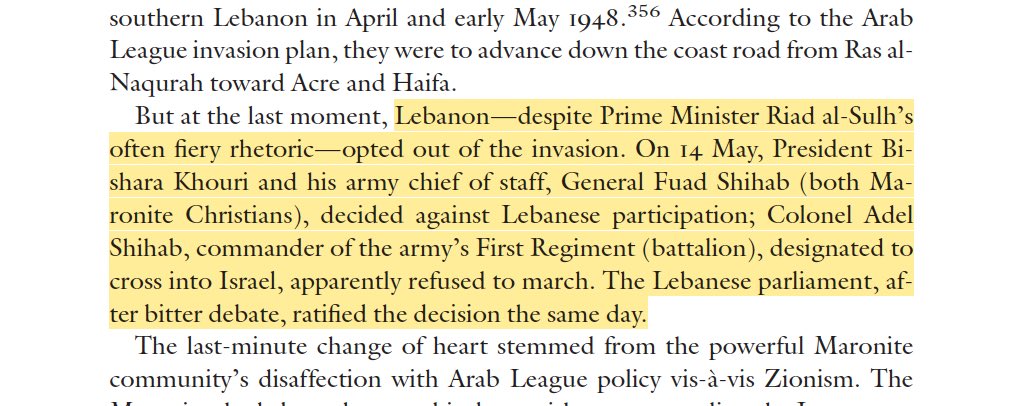
Pascal, Let me start with this, in good faith, if you felt I was dismissing your views or labeling you a Zionist sympathizer, and that caused offense, that was not my intention. If you do not identify with that label, you have my acknowledgment and respect on that point. Don’t regret engaging with me. It’s essential that we talk to each other, even, and perhaps especially, when our views diverge or strike a nerve. Sometimes, asserting an uncomfortable truth is part of honest discourse, even when it’s unwelcome. Now, allow me to reiterate, gently but clearly: Your assertion that Lebanon “participated alongside the Arab armies” in the 1948 war is simply NOT supported by the historical record in the way you claim. Yes, Lebanon was to a certain degree politically aligned with the Arab states, and yes, it was present at the 1949 Lausanne Conference, as was the Palestinian delegation, which had no army at all. Political participation does not equal military engagement. As for the Armistice Agreement you cited, it is indeed a binding legal document, but armistice agreements were signed with all neighboring states, regardless of the level of actual combat involvement. Lebanon’s agreement formalized the cessation of hostilities, NOT the acknowledgment of military engagement. If anything, it highlights Lebanon’s desire to establish clear borders precisely because its territory was being violated, despite its military restraint. Regarding Matthew Hughes, I’m very familiar with his work. His own conclusions stress the limited and largely symbolic nature of Lebanon’s military presence, and he underscores that the government, the army leadership, and segments of the public were all reluctant to engage. So no, citing Hughes does not help your argument, it complicates it. Finally, I have attached one quote for you by Benny Morris, that I hope puts an end to this sincerely frustrating debate. The quote is heavily developed with detail in both his book and Hughes’ writings: Lebanon stayed out of the damn war. I welcome differing views and I hope you won’t mistake disagreement for hostility. Dissent and critique are part of how we sharpen our understanding, and I believe that, in this case, your position could really benefit from greater precision and a closer reading of the sources you cite. I hope you’ll give this thoughtful consideration and remain open to revisiting this important historical record with greater precision without conflating accuracy with rigidity. That said, I look forward to any future exchange where your thoughtful engagement, rooted in fact, might well enlighten me in turn. All the best.
Sara El-Yafi tweet media
English
1
2
15
861
Pascal TORBEY 🇱🇧🇫🇷🇪🇺
Dear Sara, In your message, you directly accused me of sympathizing with Zionism - a serious accusation that reflects either a bad-faith reading of my response or an inability to approach historical facts objectively. I merely presented documented events in response to the points you raised, but it seems your condescending tone blinded you to the substance of what was written. I won’t prolong this exchange, as it’s becoming clear that you approach conversations with a rigid certainty - always convinced of your own correctness, and quick to dismiss differing views as either uninformed or ill-intentioned. Now, as for the facts: All reliable historical records confirm that Lebanon participated alongside the Arab armies in the 1948 war. This participation was both political and military, and it was later formalized through Lebanon’s presence at the 1949 Lausanne Conference, convened by the United Nations, where Lebanon joined Egypt, Jordan, and Syria in demanding refugee rights and the demarcation of borders - clear evidence that Lebanon was a recognized party to the war. Furthermore, the Armistice Agreement - peacemaker.un.org/sites/default/… - signed between Lebanon and Israel in March 1949 is a binding legal document that confirms Lebanon was in an official state of armed conflict with Israel. I also invite you to revisit your own source, Matthew Hughes, who published a paper on December 21, 2020, titled ‘Lebanon’s Armed Forces and the Arab-Israeli War, 1948–49,’ in which he explicitly highlights Lebanon’s military involvement in that war. To deny this reality is to either falsify history or expose a fundamental lack of awareness regarding established and internationally recognized sources. I regret engaging with you, as your authoritarian tone clearly clashes with the academic standards I hold myself to - and with the minimum respect that any dialogue should entail. Best regards.
English
1
0
4
544
Sara El-Yafi
Sara El-Yafi@SaraYafi·
What keeps coming to mind as I read your long message is how fortunate Zionists are to have such committed and poised defenders of their cause, ones who even place the Lebanese flag next to their names. No, Pascal, Lebanon did NOT participate in the 1948 war. That decision to not participate was FORMALLY ratified by the Lebanese parliament on the eve of the war. General Chehab himself refused to march and instead positioned his troops defensively within Lebanese territory. And still Lebanese civilians got massacred. Even Haganah intelligence reports acknowledged Lebanon’s passivity, and Israeli historian Benny Morris described Israel’s actions as “an unprovoked attack.” I vehemently reject your narrative because it deliberately distorts well-documented history in order to justify cyclical and consistent Zionist aggression against Lebanon. No amount of academic rewording can change facts that are extensively documented by both British and Israeli historians. This will be the subject of my next video where I furnish fact by fact how Lebanon stayed out of the war and still got massacred. Read Matthew Hughes, read Benny Morris, or feel free to watch my video when it’s out if you have the stomach. Beyond that, there’s little left to debate, Pascal. It’s like watching someone break into your house, only to be told: “Yes, he entered, but don’t get emotional, he was lost and meant no harm, plus he says you broke into his house first.” A lie. That’s not analysis. That’s excuse-making and gaslighting. I’d also appreciate it if we could move beyond framing facts as “emotional,” when what I’m doing is engaging critically and reclaiming a narrative that has too often been sidelined due to inaccuracies like the ones you’ve conveyed. Thank you for respecting this space.
English
3
1
24
591
Pascal TORBEY 🇱🇧🇫🇷🇪🇺
Your passion is noted, but strong emotions must not obscure historical accuracy. What follows is not an opinion nor a defense of any party, but a clarification of documented historical facts - whether we like them or not. It’s a fact, not an interpretation, that in 1919 Lebanon did not yet exist in its modern borders. What we now call “South Lebanon” was part of the Ottoman Vilayet of Beirut and, after the Ottoman defeat in WWI, came under French military occupation. The State of Greater Lebanon - including the south - was only proclaimed on September 1, 1920, by French General Henri Gouraud. That’s when the modern Lebanese map was drawn. So any references to “Lebanon” in 1919 must be understood in this transitional, pre-state context. Yes, Chaim Weizmann submitted a memorandum at the 1919 Paris Peace Conference, proposing to include parts of Southern Lebanon (the Litani basin) in the Jewish homeland. This was not an isolated or technical proposal - it was part of a broader Zionist effort to secure maximal territorial foundations for a future Jewish state. But the French, driven by their own colonial goals under the Sykes-Picot framework, rejected the proposal. This is documented history - the idea gained no legal traction. It’s also true that in 1948, during the Arab-Israeli war, Israeli forces made a limited push toward South Lebanon. Benny Morris, the Israeli historian you reference, does document this. However, even he - a self-described Zionist but a meticulous scholar - notes that while Ben-Gurion discussed military options involving South Lebanon, they were never formalized into state policy. A key correction: Lebanon did not stay out of the war. It joined the 1948 Arab-Israeli war, albeit with limited military involvement. This participation is documented and culminated in the Lebanese-Israeli Armistice Agreement of March 1949. Lebanon was not neutral - it was a declared party to the conflict. The Israeli incursion toward the Litani was short-lived, and Israel withdrew. There was no annexation attempt, and Lebanese sovereignty remained intact. These are facts. Israel’s interest in the Litani River is well-documented. The Johnston Plan of the 1950s, aimed at regional water distribution, sparked Israeli lobbying. Yet the Lebanese government refused to engage, and no agreement or diversion took place. You cite a declassified CIA document quoting Moshe Dayan on possible intervention in Lebanon. This quote exists. But context matters: CIA memos often reflect strategic speculation, not policy. Even if the conversation occurred, it did not lead to annexation or the establishment of a pro-Israel regime in Lebanon. The 1982 Israeli invasion of Lebanon was devastating and led to an 18-year occupation. It spurred the rise of Hezbollah and regional instability, drawing harsh criticism - even from U.S. President Ronald Reagan. Importantly, during this occupation, Israel never built civilian settlements in South Lebanon - unlike the West Bank or Golan Heights. This shows a different strategic aim: a military buffer zone, not territorial annexation. Had annexation been the goal, the same settlement model would likely have applied - but it didn’t. Israel eventually withdrew fully in 2000. The United Nations verified that it had returned to the internationally recognized border. You are right to highlight Israeli ambitions and document aggressive behavior. But conflating aspirations, proposals, or brief military actions with annexation or legal legitimacy is historically inaccurate. This is not a defense of Zionism or a denial of its impact. It is a call to base arguments on fact. Recognizing that Lebanon’s modern borders were drawn in 1920, that Weizmann’s 1919 proposal failed, that Lebanon joined the 1948 war, and that Israel did not annex Lebanese land - especially given the absence of settlements - preserves the historical record without denying the consequences of Zionist expansionism.
English
1
0
7
556
Sara El-Yafi
Sara El-Yafi@SaraYafi·
That's an interesting set of questions; I'll answer as it helps me help you see what you may refuse to see. Let me clarify, without spider metaphors or emotional condescension. The suggestion by Weizmann to include South Lebanon in 1919 was not haphazard, there was an economic formula to it all, which was especially centered on the waters of the Litani. And I would ask you to keep the word "economic" in mind because that is at the core of the equation of Israel v neighbors. Water is power, especially in a dry land trying to sustain an imported population. The French blocked the 1919 attempt, partly because Britain had already betrayed them over Palestine. So South Lebanon stayed out of the deal. But the Zionists never gave up the claim. I’ll show you. In 1948, the "birth year" of Israel, at barely 5 months old, Israel attacked Lebanon, while Lebanon stayed out of the war. They made their way all the way to Litani & committed massacres in South Lebanon. Please don’t challenge me on this. If you doubt it, wait for my next videos. For now, listen to Israeli historian Benny Morris in his book 1948: "[Ben Gurion] was motivated by the consideration that the Litani River and Wadi Duba afforded natural, defensible boundaries for Israel." (pp. 344,) and "Already in mid-May, Ben-Gurion had spoken of conquering southern Lebanon” (pp. 339.) This comes from a non-sensationalist, respected Israeli historian, a self-described Zionist. Why did they retreat? The Americans forced them to. OK? But they didn’t stop. For more than a decade, the Israelis heavily lobbied the Americans to divert the Litani into Hasbani. Please refer to the Johnston Negotiations (JohnsTon with a T) in the 50s as superbly archived in US National Archives & State Department records. All documents relaying the details of the "Johnston water negotiations" are digitized & free to read. The Israelis were obsessed with the Litani. Their bullying worked for the Jordan river, but it didn't work for the Litani. So the Zionists upped the ante. Next, they attacked with a plan. And this is evidenced by documented policy papers including this declassified CIA document. This is quoted straight from a 1982 declassified CIA doc word for word. Let’s read together: "Lebanon was ripe for the picking. The only thing that's necessary is to find an officer, even just a major," Dayan said. "We would either win his heart or buy him with money, to make him agree to declare himself the savior of the Maronite [Christian] population. Then the Israeli army will enter Lebanon, will occupy the necessary territory and will create a Christian regime which will ally itself with Israel," […] "The territory from the Litani [River] southward will be totally annexed by Israel and everything will be all right." Just making sure you read this again; if I could I would print it and frame it for you: "The territory from the Litani southward will be totally annexed by Israel and everything will be all right." Source: cia.gov/readingroom/do… This was the plan put forth in the 1970s, Mr. Matta. Declassified by CIA in 1982. Thus, there was an Israeli invasion in 1982. Followed by an 18-year occupation. Even Ronald Reagan called the israeli invasion a HOLOCAUST. Was this US President also a sensationalist, Mr. Matta? Source: reaganfoundation.org/ronald-reagan/… They failed at establishing a stable, “pro-Israel government” in Beirut, to use their words, who would “give them the south.” They tried to take it by force. Instead, the occupation bred insane instability and gave rise to Hezbollah. In hindsight, the idea that Israel could have successfully “restructured” Lebanon during its “weak time” i.e. civil war to take its land and resources underestimates the complexity & unpredictability of such interventions. They know it. The problem is you don’t. If that feels “sensationalist” as you so callously called me & my work, it’s only because the reality is more obscene than you are ready to admit, David.
English
8
16
78
10.9K
David Matta
David Matta@ddmatta·
So, assuming what you said is correct, could you explain how Hezbollah’s actions either thwarted that plan or, conversely, accelerated it? And I’m curious: why didn’t Israel implement this plan earlier, when Lebanon was at its weakest, such as during the 1975 civil war or the 1982 invasion? You seem to be spinning sensationalist tales, like the spider that weaves webs to capture the gullible.
English
2
0
12
2.1K
Sara El-Yafi
Sara El-Yafi@SaraYafi·
No, they crossed the Lebanese border and committed massacres in Lebanon as early as 1948. They continued crossing and raiding the border throughout the 1950s and 1960s (evidence is provided in my second-to-last video). The 1948 massacres will be the focus of my next two videos. Stay tuned.
English
13
9
94
3.4K
Atlantis
Atlantis@SamisLoud·
@SaraYafi Nice, but you missed one thing. It is only when hezb ignites a fight (2006, 2023) that Israel ever crossed the blue line into lebanon. Something to ponder on.
English
6
0
55
3.3K
Sara El-Yafi
Sara El-Yafi@SaraYafi·
I am being asked: "Will the U.S. be dragged into war?" The short answer comes in the first minute of this video. But we’re going deeper—because it’s essential to understand how this war fits into the broader master plan of the deep state.
English
23
128
345
25.2K
Sara El-Yafi
Sara El-Yafi@SaraYafi·
Start with Benny Morris’s 1948 book, Pierre— yes, the right-wing Zionist historian. He dedicates an entire section to Lebanon’s role, laying out in staggering detail how Lebanon stayed out of the 1948 war and still paid a heavy price for reasons even Zionists admit were “unjustified.” Alternatively, you can wait for my next video, where I’ll walk through Lebanon’s role in 1948 in full detail. And because you have integrity, you’ll come back and apologize for your comment — and admit you mostly have no idea what the fuck you’re talking about. Thank you in advance for not filling my platform with more comments packed with absurd misinformation — or disparaging my work without even watching it. Much appreciated.
English
3
3
47
928
🇨🇦 ⚜️ Pierre Hnoud
🇨🇦 ⚜️ Pierre Hnoud@PierreHnoud·
That's a big fat Lie and distortion of history. The bitter truth, unfortunately, is that Lebanon influenced by Arabs attacked Israel on May 5, 1948, as part of the Six-Nation Alliance (Lebanon, Jordan, Saudi Arabia, Iraq, Syria, and Egypt). Armed Palestinian organizations entered the south and carried out operations against Israel, which led to the Hula massacre on October 31, 1948. Lebanon suffered from the Palestinians from 1948 to 1982 where tens of Thousands of Lebanese Christians were killed by the Palestinians. Then from the Iranian faction Hezbollah subjected Lebanon to Israel retaliation from 1982 to 2025.
English
6
0
9
1.3K
Sara El-Yafi
Sara El-Yafi@SaraYafi·
This video lays bare a truth long buried beneath silence and distortion: Ï$ř@€l’s violence against Lebanon has never been defensive. It has been deliberate, methodical, and unrelenting *since its creation.* From their unprovoked massacres in Lebanese villages in 1948 all the way to their continuous bombings in 2025, Ï$ř@€l’s 77-year assault on Lebanon has never paused, never relented—not for a single year, not for a single ceasefire. This is a deep-dive into our history. Before paramilitaries. Before rockets. Before a single shot was fired from the South toward Ï$ř@€l, Ï$ř@€l was looting, bombing Lebanese towns, massacring Lebanese civilians; unprovoked and unpunished. Ceasefires didn’t matter. Neutrality didn’t matter. Diplomacy didn’t deter them. Every single Ï$ř@€li government has targeted Lebanon—not in response, but by design. And I will prove every word of this to you in a three-part series that begins with this video. Most importantly, to those who still cling to the illusion that “if you don’t provoke Ï$ř@€l, it won’t attack,” this is your reckoning. In a time where they are bombing our country in the midst of a “ceasefire”, erasing entire villages, targeting civilians, k!ll!ng children, if that doesn’t open your eyes, I hope the history will. It took me months of gruesome, painstaking research to gather, verify, and stitch together this evidence—buried, denied, and distorted. This is not just a history lesson—it’s a warning, and a call to responsibility. I’ve done the work. All you need to do is watch. And watch the whole thing. Onwards and upwards. Sara El-Yafi
English
40
193
442
37K
Sara El-Yafi
Sara El-Yafi@SaraYafi·
The Syrian dictatorship has fallen in the early hours of this morning. For those feeling overwhelmed by the pace of these developments, it's important to step back and recognize that we are witnessing history being written in real time—a pivotal moment in the region's long and grueling journey of relentless heartbreaks and profound resilience. For many Syrians, and for many Lebanese—particularly those of my generation and older—the recent turn of events feels surreal. Having lived through decades of Assad's dominance, marked by an iron-fisted rule, extrajudicial killings, enforced disappearances, and a systematic machinery of torture and fear, we have become conditioned to expect ruthless reprisals against any form of dissent. The regime's survival strategy has relied on a calculated campaign of terror—silencing opposition through secret prisons, torturing political dissidents, erasing entire families, and reducing resistance to whispers in the dark. For years, even the smallest acts of defiance were met with merciless repression. Yet today, we are witnessing something extraordinary: forces withdrawing without resistance, a regime once deemed invincible beginning to falter. If you mute the geopolitical analysis, it feels almost too surreal to believe—like a scene from a science fiction novel. This moment is not confined to Syria; it reverberates across the region, carrying profound implications for Lebanon, Palestine, and beyond. It forces us to navigate a complex spectrum of emotions—sympathy, hope, but also, fear, and skepticism—while grappling with difficult questions about the balance between pragmatic alliances and the uncompromising pursuit of justice. In the coming days, I will delve deeper into the unfolding events in Syria and Lebanon, the ceasefire, Israel, and our shared history—step by step, hand in hand. There is so much to unpack, so many data points to analyze. But tonight, I hope we all can honor the raw emotions of the Syrian people as they soar, resisting the urge to cloud their moment with doubts, questions, and cynicism. Let us simply bear witness to their long-overdue liberation. The sight of political prisoners walking free—some still young enough to call their mothers whom they haven't spoken to or seen in years—families torn apart finally reuniting, and exiled Syrians booking flights home is, undeniably, a moment of collective nourishment. Critics might call it PR, but amidst the relentless and unimaginable pain endured by our region, we must allow ourselves to embrace these rare moments of humanity and hope. Take it in, not because it erases any looming uncertainty, but because it reminds us that all people deserve freedom. The future remains uncertain, its path shaky ano uncharted. Yet today is a day to hold space for our brothers and sisters in Syria, to honor their resilience, and to celebrate their hard-fought liberation. This chapter is momentous. Though the struggle for a truly free Syria is far from over, true liberation lies ahead—in building a Syria free from all forms of external control and foreign interference, a Syria focused solely on nourishing and uplifting its sons and daughters. Here's to a Syria reborn in freedom, and may the spirit of liberation take root in Lebanon, Palestine, and every place in this world where people are bound by oppression and long for justice and dignity. Onwards and upwards.
English
16
23
126
12.3K
Sara El-Yafi
Sara El-Yafi@SaraYafi·
Welcome to the Genocidal Tour. In this talk, I’ll expose why the U.S. is not a true democracy and how this impacts not only Americans but people across the globe. I’ll delve into how both Trump and Harris uphold deeply genocidal policies, which makes them both disastrous choices for those beyond U.S. borders. You’ll get a clear view of what a Trump victory would mean—since this is the expected outcome. I’ll also unpack how the U.S., far from embodying true democracy, has become a tool for corporate interests, foreign lobbyists, and a bipartisan agenda that perpetuates oppression globally and inherently enables policies that lead to genocide. True democracy today demands that policy aligns with the values of the people, yet current U.S. actions fall woefully short. From unchecked military aid to genocidal states to profit-driven decisions that ignore human welfare, these policies betray the core democratic promise to serve the people’s will. A better world is possible when we confront imperialism, democratize the U.S., and adopt policies rooted in justice and humanity—rather than profit and oppression. Until that call is finally heard, pour yourself a cup of coffee or tea and sit with me. Let's dig in. Onwards and upwards.
English
38
237
552
39.1K
Sara El-Yafi
Sara El-Yafi@SaraYafi·
Let's put this invasion of Lebanon into perspective: The Gaza Strip covers an area of 365 square kilometers. Despite 11 months and 3 weeks (almost one year now) of continuous bombing and a carte blanche to wreak havoc and commit free genocide — bombing homes, hospitals, schools, mosques, churches, and killing countless civilians, tens of thousands of unarmed men, tens of thousands of women, tens of thousands of children — the Israelis still haven't declared victory. That's 365 square kilometers of complete mayhem, and they couldn't even claim triumph there or bring home the hostages after nearly a year of relentless carnage. Despite all the destruction, all the bloodshed, they have failed to achieve even their own stated goals. So, what will they do when they face approximately 5,000+ square kilometers of Hezbollah-controlled land in Lebanon? The entire military command chain of Hezbollah has already been eliminated. What level of destruction would they consider "success"? How many villages and towns will they flatten? How many civilians will suffer in their path of devastation? Is this a 10-year war? If Gaza has been a quagmire, what are they prepared to do in Lebanon? What scale of violence is waiting to unfold? But perhaps the most damning question is: How long will the United States and the European Union — the largest suppliers of weapons and aid to Israel — stand by, their hands dripping with blood, offering empty calls for "ceasefire" while fueling not just one mass murder, but another? This is not just complicity; it is direct participation in genocide. And we will try them all for their roles in this atrocity. Oh yes, we will.
English
14
110
257
16.6K
Sara El-Yafi retweetledi
Rayane Moussallem
Rayane Moussallem@RioMoussallem·
Following the 2020 Beirut port explosion and the Lebanese economic crisis which the World Bank described as one of the worst the world has ever seen in the past 200 years, @SaraYafi said this about Lebanon: “What we are currently living is something I believe, even if you were to do a Hollywood movie out of it, probably the producers would tell you to tone it a bit down because it doesn’t look very realistic.” Today I remembered that quote.
English
2
28
158
13.7K
Sara El-Yafi
Sara El-Yafi@SaraYafi·
Every day, the people in South Lebanon endure relentless bombings by I$r@€l, and the question looms: is a broader war inevitable? To answer this question, you MUST understand I$r@€l's modus operandi—how it orchestrates war and mayhem—and how it manipulates the U.S. to wage its wars. This understanding dismantles the myth that I$r@€l only acts in self-defense. Last Wednesday marked the 23rd anniversary of 9/11, the event that led to the U.S. invasion of Iraq. Today, the 4.5 million lives lost due to the lies of that war are disturbingly normalized, while the true reasons for the invasion remain obscured for many. In this video, I will expose those reasons, as they are not relics of the past but are being replayed on the global stage today, with Lebanon and Ir@n in the crosshairs for very different reasons. And the same crazies are drumming up more wars that could lead to millions more casualties. By exposing these forces that pushed the U.S. into Iraq, I uncover how the same playbook is in motion today. To see the future, we must first understand the past. So, answer me this: Why did the U.S. invade Iraq in 2003? Watch this video, and I’ll quiz you later. Onwards & upwards.
English
48
276
581
37.3K
Sara El-Yafi
Sara El-Yafi@SaraYafi·
In contemporary history, the origins and escalation of nearly every war can be traced back to media lies. Considering that I$r@€l has been heavily intensifying its war rhetoric and actions against L€b@non, it's crucial to understand that they cannot pursue their war agenda _without an orchestrated media campaign._ Thus, it’s essential to understand how the media operates. In this video, I will reveal how the Western media and leaders have utilized the classic strategy of DEHUMANIZATION as part of their pro-I$r@€l propaganda campaign to fuel the war against P@l€$tini@n$, and soon they hope the Lebanese too. This strategy, which has been historically used to justify violence against groups of people, makes them deeply complicit in the genocide of the P@l€$tinians and the war crimes being committed against L€b@non. Their record of journalistic malpractice is egregious. It is an absolute must to expose it, and that's precisely what I aim to do in this video and the next. Understanding this is crucial for recognizing the broader implications of your influence. Do you know what they're most scared of? You. They are terrified of your eyes uncovering the truth and escaping their propaganda. They fear your likes and comments going to alternative narratives because it makes their empire of lies much more expensive to maintain. Supporting alternative voices with your likes and shares is a part of the solution; I'll link some of my favorites in the first comment below. Onwards and upwards.
English
201
1.1K
1.9K
144.9K
Sara El-Yafi retweetledi
Sait Simsek
Sait Simsek@Sait_Simsek_·
“Students really have always been at the heart of social change; emphasis on the word, heart.” @SaraYafi It's been 44 days since the @UofT students started their encampment, and their spirit is only growing stronger. More power to the students!
English
43
53
166
14.1K
Sara El-Yafi
Sara El-Yafi@SaraYafi·
Things that I predicted in the past and I was right: •Donald Trump beating Hillary Clinton •Joe Biden beating Donald Trump •Post-revolution Lebanon schizophrenia •French elections •Brexit Things that I predicted in the past and I was wrong: • Katy Perry having so many hits Follow for more. TBC.
English
2
3
47
5.7K