A Donut Discovery Just Broke a 150 Years Math Law
For 150 years, a principle in geometry held firm: if you know how a surface measures distance and how it curves at every point, you know exactly what that surface is. The rule was so reliable mathematicians barely questioned it. A French mathematician named Pierre Ossian Bonnet established it in 1867, and it quietly became one of geometry's unspoken certainties.
Bonnet's rule said that if two key properties of a surface - its metric and its mean curvature - are known at every point, the surface's overall shape can be uniquely determined. The metric captures internal distances. The mean curvature captures how the surface bends. Together, they were supposed to be enough to identify any compact surface completely.
They weren't.
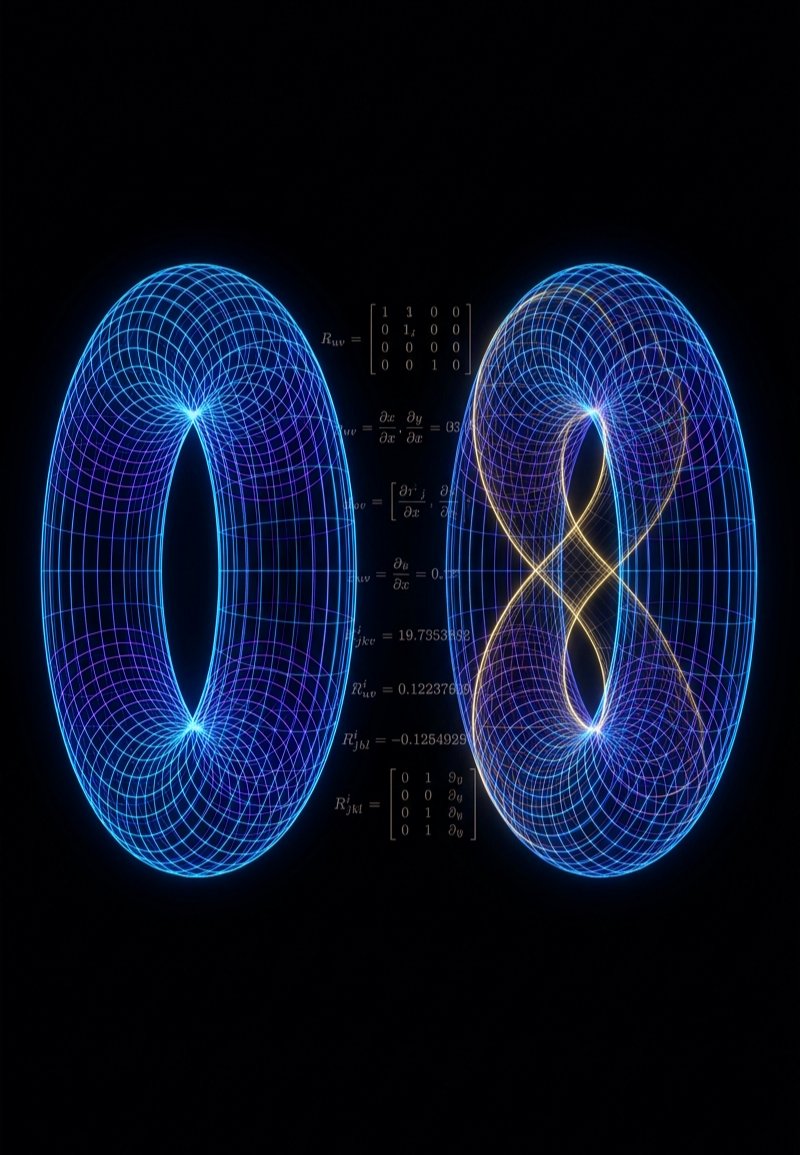
A team of mathematicians from the Technical University of Munich, the Technical University of Berlin, and North Carolina State University managed to disprove this recognized rule. They constructed two compact, doughnut-shaped surfaces - known as tori - which have the same metric and mean curvature, even though they are structurally different on a global scale.
Same local measurements. Different global shapes. A mathematical ghost. The result surprised mathematicians like Rob Kusner of the University of Massachusetts, Amherst. It demonstrates that even tori - among the best-studied surfaces in geometry - cannot always be perfectly described by their local characteristics. "It's an example of something where our intuition wasn't good enough," said Robert Bryant of Duke University.
The team spent years hunting for this example. The breakthrough came through discrete mathematics - pixelated, low-resolution approximations of smooth surfaces - which ultimately provided the tools to construct the pair. The two tori they found are strange objects: they pass through themselves like figure eights. But they exist. And their existence is enough to break the rule entirely.
What makes this unsettling isn't just the math. It's what it implies about identity itself. Two objects can be locally indistinguishable - same distances, same bending, same geometry at every measurable point - and still be fundamentally different things. Local truth doesn't always add up to global truth.
The study was published in the peer-reviewed journal Publications mathématiques de l'IHÉS.
English