

Shaun Modi
5.6K posts

Shaun Modi
@ShaunModi
ceo of @capitolai. optimist. designer. builder. worked at @airbnb @google @motorola @nasa studied at @risd
Washington, DC Katılım Nisan 2009
2.2K Takip Edilen2.8K Takipçiler

My dear front-end developers (and anyone who’s interested in the future of interfaces):
I have crawled through depths of hell to bring you, for the foreseeable years, one of the more important foundational pieces of UI engineering (if not in implementation then certainly at least in concept):
Fast, accurate and comprehensive userland text measurement algorithm in pure TypeScript, usable for laying out entire web pages without CSS, bypassing DOM measurements and reflow
English
Full post here: capitol.ai/blog/losses-vs…’s-past-reveals-its-future-when-it-comes-to-ai-jobs
English
Don't panic.
It's too early to predict the future of jobs in the wake of AI advancement. All we have is an educated guess - want to know my views?
-While some jobs may shrink, others will GROW
-NEW job roles and responsibilities are emerging faster than we can define them - we barely know what the next 12 months will look like, let alone the next decade
-There's a clear OPPORTUNITY - businesses that make the right AI investment get ahead, grow faster, and increase headcounts
-Rather than using a crystal ball for the future, LOOK AT THE PAST - the dot com and App eras can help us understand the impact of new technologies on job roles
English

I have spent a lot of time understanding diligence processes with our customers, across commercial and government. The same pattern shows up every time: the *expertise inside the room is rarely the problem.*
What slows everything down is the synthesis. Teams spend weeks reconciling documents, rebuilding models, and chasing context across systems before the real judgment work even begins.
Intuitive software powered by multiple ai models has the potential to change this rhythm of work. When structure and compliance is built into the workflow, information connects more quickly and experts spend their time evaluating the signal rather than assembling it.
Diligence sits behind some of the most consequential decisions organizations make. It’s time to make it work at the pace those decisions demand. 💥
Capitol@capitolai
Commercial due diligence drives some of the most critical decisions across modern enterprises. Acquisitions. Vendor procurement. Strategic partnerships. IPO preparation. Yet most diligence processes still rely on fragmented workflows. Analysts reconcile spreadsheets, reports, and internal systems while trying to rebuild the same analyses across teams and transactions. Over time, that strain becomes structural. Automation changes diligence, though, when structure leads the design. In our latest blog, we examine why commercial due diligence struggles at scale and what effective automation requires: Standardized workflows that preserve institutional knowledge Governed data sources with consistent, trusted inputs Traceable evidence chains that support defensible conclusions Decision grade outputs built to withstand scrutiny Read the full article here: capitol.ai/blog/the-case-…
English
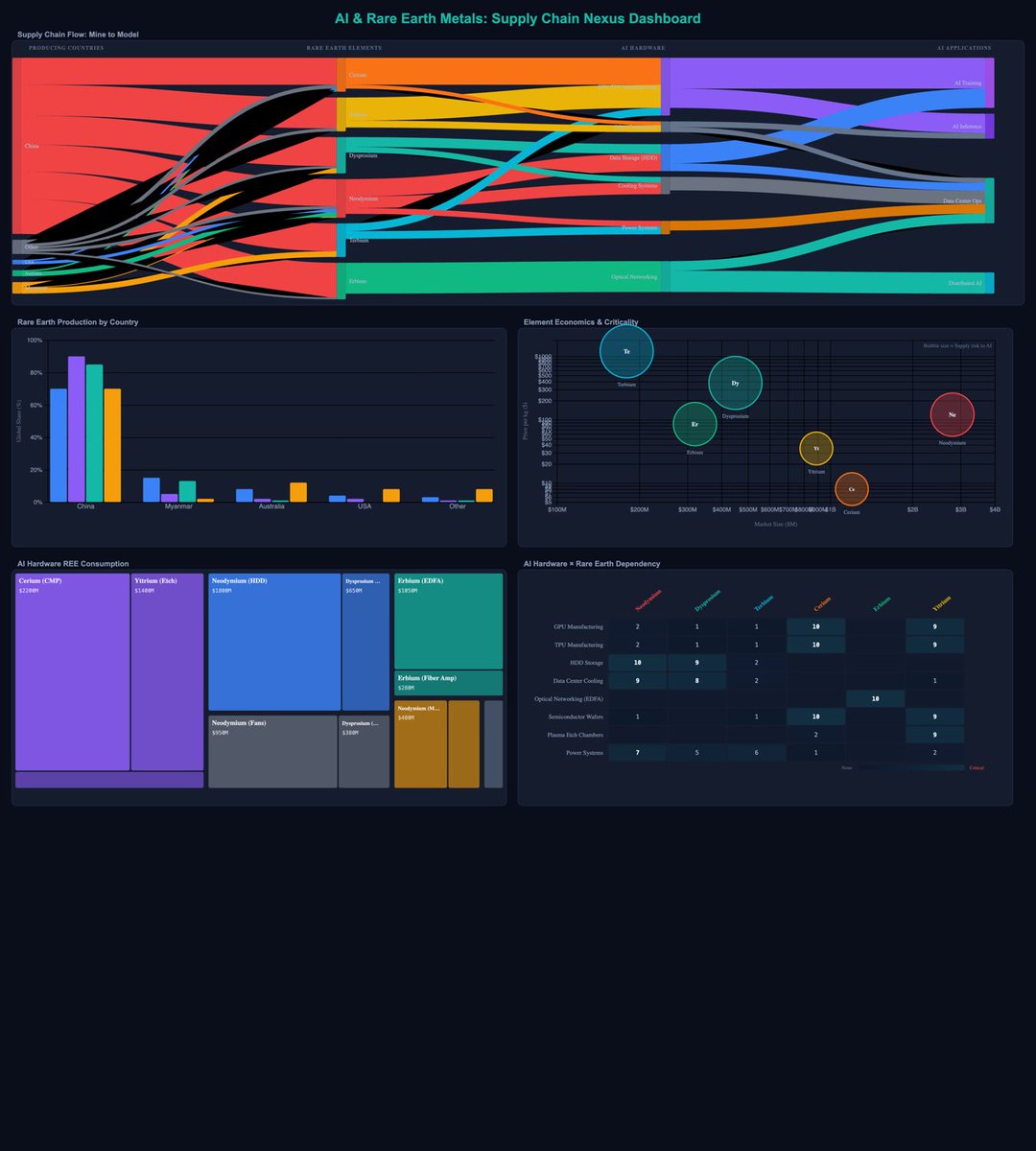
Visualization on quantum entanglement, built on Capitol AI. Our team is cooking on a Friday night, 11:15 p.m. Eastern Standard Time.

English
If there’s one thing I hope you’ll take from my recent piece in Battle Updates is that defense procurement is overdue for modernization.
There is a great need for structured intelligence in defense procurement and for AI in high-stakes environments to be governed from day one as a baseline requirement.
I hope you’ll take just a few minutes to read it: battle-updates.com/ai-procurement…
English

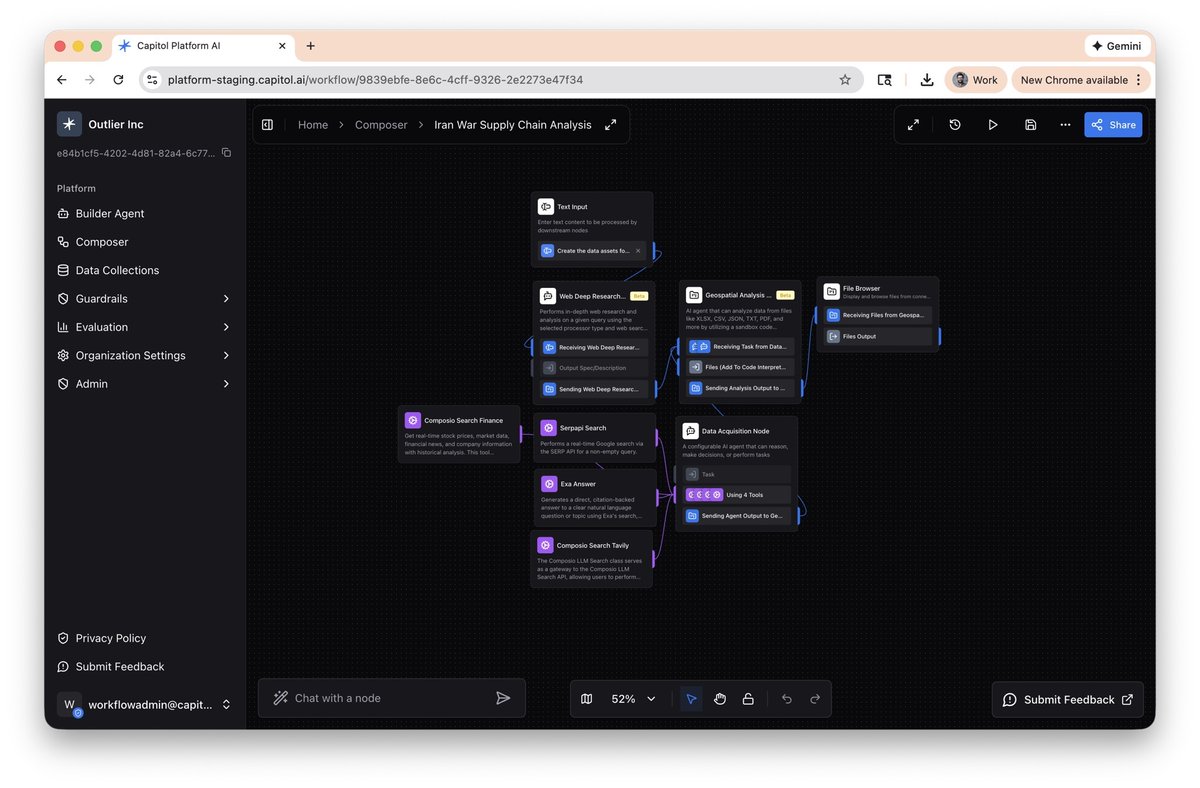
Here is the Composer workflow that powered it. Let me know what data you'd like to see.
English
Most AI is a chatbot. This Persian Gulf Crisis Global Energy Trade Impact Dashboard was built in a fully automated way using @capitolai's Composer product. It maps a 97% collapse in traffic through the Strait of Hormuz, freight insurance shocks, fertilizer + food security trends, and country exposure... amongst other key trends that matter.
Play around with the link (on a desktop). Would love to hear your feedback on what's missing. Can be easily updated by simply dropping datasets into the Composer. Raw, but that's how we like it.
vercel-deploy2-khaki.vercel.app
English
Cool statue of General George Thomas in front of @capitolai’s new DC office. He was known as “The Rock of Chickamauga”. civilwarmonitor.com/rock-of-chicka…

English
Consulting firms partnering with OpenAI or Anthropic makes sense right now. Enterprises want speed, and model companies want distribution.
But there’s a longer term issue.
When your core capability is tied to a single model provider, you inherit their roadmap, pricing power, and policy decisions. That’s manageable in experimentation but becomes very risky in defense, finance, and other regulated industries.
In high stakes environments, model choice is a requirement.
The firms that separate orchestration from any single model will have more leverage and more durability because infrastructure outlasts models.
wsj.com/tech/ai/ai-nee…
English
Appreciated the chance to speak with Pulse 2.0's @amitchowdhry about what we’re building at @capitolai and how we got here.
I’ve always been drawn to the space between information and understanding and creating Capitol has been my answer to fixing the bottleneck issues I’ve seen over my career in the public and private sector.
This piece dives into why we believe the next phase of AI is about model choice, data sovereignty, infrastructure, and governance inside real workflows. You can read the full interview here:
pulse2.com/capitol-ai-pro…
English
The case for sovereign AI is very real
Danny Crichton@DannyCrichton
No discussion of tech media can get past this basic traffic fact: in the AI world, Google and social no longer refer traffic, which means that the vast majority of readers just never find you in the first place. Analysis: growtika.com/blog/tech-medi…
English
2027:
>_ the world’s most critical organizations are facing an intelligence paradox:
they have more data than ever, but less control over the outcomes.
they are currently renting intelligence from west coast monoliths. creating a monopolistic lock-in that turns their proprietary IP into someone else's training data.
this isn't just a technical hurdle;
it’s a security liability.
@capitolai
Matt Turck@mattturck
enterprises in 2025: we care immensely about privacy, data sovereignty, vendor lock-in risk, governance and cost enterprises in 2026: ah, whatever, let's just run the whole thing on Claude
English
Nearly 2/3 of companies say they don’t know where all their data lives while simultaneously giving AI broad access to it.
I see this tension constantly and it’s clear the issue is a sovereignty problem rather than an AI problem.
Shared drives, data rooms, internal messages, research archives and machine speed wired into the organization before leadership even fully understands what’s inside. This scenario invites risk to compound which, for institutions, shows up later in audits, litigation, and regulatory reviews.
If a conclusion can’t be traced, defended, and repeated across teams under the same conditions pulling from the same source material, that becomes improvisation rather than infrastructure.
Sovereignty keeps control intact and repeatability makes decisions durable. The winners in this phase of enterprise AI will understand their data well enough to let intelligence run and structured well enough to reproduce every outcome when challenged.
Otherwise you’re just accelerating uncertainty.
fortune.com/2026/02/25/tha…
English
Consultancies are entering a new phase of the AI cycle. The era of open-ended experimentation is closing. Clients are no longer impressed by pilots. They expect measurable financial and operational impact.
In advisory work – diligence, integration, compliance, transactions – that pressure shows up fast. Teams are consolidating thousands of documents under compressed timelines, and every recommendation has to stand up to board-level and regulatory scrutiny.
This isn’t a chatbot problem. It’s an infrastructure problem.
The firms pulling ahead are embedding governed, model-agnostic intelligence directly into their workflows. Not to replace expertise, but to strengthen it. Advisory teams can synthesize proprietary information into clear, attributable, decision-grade artifacts that clients can actually act on.
Our work with organizations like EY reflects this shift. By operating inside secure environments, teams generate structured deliverables from sensitive data while preserving sovereignty, attribution and control.
When AI lives where expertise already lives, it doesn’t create noise. It sharpens judgment.
That’s the phase we’re in now.
giftarticle.ft.com/giftarticle/ac…
English