Spout Finance

7K posts

Spout Finance banner
Spout Finance

Spout Finance

@SpoutFi

Enabling anyone, anywhere to borrow against their equities at 0% APR on @solana

New York, NY Katılım Mayıs 2025
14 Takip Edilen5.3K Takipçiler
Sabitlenmiş Tweet
Spout Finance
Spout Finance@SpoutFi·
Whale Hub applications are officially open. This is your entry point into a based system where participation builds leverage. Beyond participation, you’re building a reputation inside Spout Finance ecosystem that unlocks real financial progress: - Deeper product advantage. - Stronger positioning across DeFi and RWA. Spots are limited and entry is selective by design. Apply now: hub.spout.finance
Spout Finance tweet media
English
49
19
267
21.8K
Spout Finance
Spout Finance@SpoutFi·
@nobrainflip Mispriced relative to stocks, gold, and housing is the entry window closing in real time
English
0
0
0
17
𝗰𝘆𝗰𝗹𝗼𝗽
𝗰𝘆𝗰𝗹𝗼𝗽@nobrainflip·
If you're not a millionaire, building wealth has never been harder... Stocks? ATH. Gold? ATH. Cash? Inflation eats it. Housing? Priced out. Bonds? Pointless. Crypto is the last asset class, which is still mispriced. This thread will create many new millionaires:
𝗰𝘆𝗰𝗹𝗼𝗽@nobrainflip

Most are reading current crypto market wrong I called the EXACT cycle top using a pattern that's worked 3 cycles in a row Following this pattern, I made $6M+ from $8k When crypto bottom? When BTC reclaim ATH? How to make 100x this cycle? 🧵: The answers👇

English
15
4
106
11.9K
Spout Finance
Spout Finance@SpoutFi·
@mert Humans buy presence, not absence. Time, money, access, identity, status, joy. Bitcoin sells the promise, not the architecture
English
0
0
0
18
mert
mert@mert·
decentralization is a bad sell the reason is that it focuses on the absence of something rather than a concrete, perceptible difference gained from its addition humans buy presence -> i.e the gain of time, money, access, identity, status, and joy bitcoin does this well, and is arguably the only one to have done so the decentralization isn't why you buy bitcoin, you buy it because of what it promises you for some people, this is money free from the state; for others it's identity, for some insurance, for some status, and for most it's the appreciation of the asset and hence money decentralization is necessary for the selling point to work, but it is not the end itself so if you've made the choice to build on top of a decentralized platform, it is mostly useless to talk about it (except in so far as trying to avoid regulatory responsibility, which is fair), talk about why you are now different as a result perhaps that's asset selection, perhaps that's access, perhaps it's efficiency or composability or speed or security, but without something tangible you won't be able to sell effectively once you do this, you'll understand whether the thing you're building is useless or not because if there's nothing gained from the decentralization vector except putting the word itself in your tweets to signal virtue, then you are building the wrong thing
English
105
25
323
25.8K
CoinGecko
CoinGecko@coingecko·
market is healing
CoinGecko tweet media
English
384
204
1.7K
56.3K
CoinForge
CoinForge@Realcoinforge·
🇺🇸 THE U.S. STOCK MARKET IS ALMOST AT THE END OF AN ASCENDING WEDGE. This comes in 5 phases and the last one is where it explodes. If this is accurate, the S&P-500 is headed straight towards $8,000. Most will call this a bubble and that's exactly why it won't pop right now. Bubbles always pop when people least expect it. There is still another rally left.
English
6
5
40
12K
Spout Finance
Spout Finance@SpoutFi·
Full expensing through 2031 pulling capex forward, reshoring building domestic supply chains, AI compressing costs across every sector while the US controls the energy inputs AI requires. This is the structural case that makes “bubble” the lazy explanation. If earnings grow faster for longer than historical norms, the multiple that looks excessive under old assumptions is rational under new ones. Crypto repricing collateral and settlement rails sits inside that same re-rating. Tokenized equities with real borrowing infrastructure beneath them are exactly the kind of productive capital formation that belongs in a supercycle economy.
English
0
0
0
10
James E. Thorne
James E. Thorne@DrJStrategy·
For the record Markets are not in a bubble. They are being re-rated. A bubble implies detachment from reality. A re-rating reflects a change in fundamentals. And the fundamentals of the U.S. economy have shifted decisively. Start with growth. America’s demographic profile is entering a more economically potent phase. A large cohort is moving into prime family formation and peak earning years, driving housing, consumption, and sustained investing flows. That raises the economy’s baseline speed limit in ways most developed economies cannot match. But the real shift is productivity. Artificial intelligence is a true general-purpose technology, closer to electrification or the internet than a typical cycle. It is compressing costs, expanding margins, and reshaping capital allocation. After years of stagnation, productivity growth is reaccelerating, and doing so alongside an economy deliberately running hot. That combination is powerful. Strong nominal growth paired with rising productivity is the ideal backdrop for profits. Earnings are not just improving, they are likely to continue surprising to the upside. Key point: Policy is amplifying the shift. As it did in the 1980s. Washington is moving back toward supply-side economics: reshoring, industrial policy, and incentives tied to production. The return of full expensing, 100% deductibility of capex until 2031, lowers the cost of investment and pulls spending forward. This is not a typical cycle. It is the early stage of a capex supercycle, more reminiscent of the postwar buildout of the 1950s or the technology surge of the 1990s than anything in the post-2008 era. The AI boom also exposes a harder constraint: energy. Compute at scale requires vast, reliable power. Here, the United States is uniquely advantaged. It is a hard resource superpower, with abundant natural gas, growing nuclear capacity, and scalable renewables. Energy is cheaper and more secure in America than in any other major developed economy. If AI is the next industrial revolution, the U.S. controls a critical input. All of this feeds directly into valuation. If earnings grow faster, and for longer, than historical norms, multiples must adjust. What looks like excess under old assumptions is rational under new ones. Even crypto reflects a broader repricing of money itself, introducing alternative rails for collateral, settlement, and liquidity in a more expansive system. Add it up: prime-age demographics, a productivity boom, a capex supercycle, and abundant energy, all reinforced by policy that favors production and tolerates a hotter economy. The result is structurally higher earnings growth and a secular bull market. Volatility will come and go. But the direction is clear, due north. Ignore the Doomers. This is not a bubble. It is a re-rating. 1979👇
James E. Thorne tweet media
English
24
10
94
5.1K
Alex Hormozi
Alex Hormozi@AlexHormozi·
You get rich by betting on things other people are wrong about. Because most "good" investments have their "goodness" priced into them, making them "mediocre" or "bad" investments in reality. The key is to find something that looks bad but is actually good. Which means you gotta be willing to have people tell you why you're dumb (then wait). Then get called lucky. Then do it a few more times. Then have people say you're finally good. But by the time they say you're good it already stopped mattering to you what they thought because why would you respect someone's judgment who was so repeatedly bad? They now only say you're good because everyone else does and not because they could ever make up their minds on their own.
English
114
66
723
17K
Spout Finance
Spout Finance@SpoutFi·
“The leverage that fueled the final leg up is now unwinding while the market slams into structural ceiling” is the most important sentence in this entire breakdown. Five consecutive -20%+ selloffs were all preceded by this exact signal. History doesn’t guarantee the sixth, but ignoring five data points with the same outcome is how people become exit liquidity. Position management before the unwind matters more than calling the timing. Holding quality assets with borrowing infrastructure beneath them instead of margin is the difference between surviving a 20%+ drawdown and being forced out at the bottom. That’s what we’re building
English
0
0
0
7
King of the Charts - The Michael Burry of Bitcoin
. Margin Debt Has Marked Major Market Tops & Peaks: A Consistent Historical Signal The margin debt chart has consistently flagged major market tops over the last 25+ years. Margin Debt Spike High & Divergences with S&P 500 • Here’s the pattern: margin debt surges higher during the late stages of a bull run or at a market peak as investors borrow aggressively to chase the rally. The chart goes almost parabolic. Then, right at the peak, it reverses hard—often in just a couple of months—creating a textbook “spike high.” That sharp drop after the blow-off peak is the warning. It’s not a slow roll-over; it’s a violent reversal that screams the party is over. • The pattern is striking and repeatable: During the final stages of a bull market, margin debt surges as investors borrow aggressively to chase higher prices, often pushing the series into a near-parabolic advance. It then forms a sharp “spike high” before reversing abruptly—typically within a few months. This violent reversal after the peak is the key warning sign. In some cases the spike marks the exact market top. In others, margin debt forms lower highs while the S&P 500 continues to climb, creating a clear bearish divergence. Still other times, margin debt simply continues to decline as the S&P 500 puts in its final high. In every instance, the breakdown in leverage has preceded significant market weakness. Keep in mind that we don't have the margin debt data for April or May, but if it ticks back up with the S&P 500 moving to new highs here May, it could mark the divergence reversal point I've been talking about. Classic Margin Debt Peaks at Major Market Tops in 2000 & 2007 • March 2000 Top: Margin debt reached its absolute peak in tandem with the NASDAQ and S&P 500, marking an immediate top right before the bursting of the dot com bubble. Margin debt hit its absolute high right as the NASDAQ and S&P 500 topped. No lag, the spike high in margin debt marked the market top. • October 2007 Top: Margin debt peaked in July 2007, followed three months later by the S&P 500’s final high in October 2007, just before the Global Financial Crisis. margin debt peaked, then three months later the S&P 500 made its final high in October 2007 before the Global Financial Crisis unfolded. Other Notable Margin Debt Divergences During the 2009–Present Bull Market • 2025 February Peak Before the Tariff Selloff: Margin debt spiked to a record high in January 2025 and remained near those elevated levels in February. At the same time, the S&P 500 pushed to its all-time high on February 19, 2025. This created another notable bearish divergence as tariff threats intensified, triggering a sharp selloff in late February that accelerated into March and the larger April tariff-related declines, resulting in a 21% selloff. • January 2022 Peak: Margin debt peaked in October 2021 and formed a massive spike high, with the S&P 500 making its ultimate top three months later in early January 2022. This was followed by a sharp 27.5% selloff in 2022. • Pre-COVID Crash February 2020 Peak: A clear bearish divergence formed right before the 2020 pandemic crash. Margin debt peaked in December 2019 and then declined for two consecutive months. Meanwhile, the S&P 500 continued to push higher, reaching its all-time high two months later on February 19, 2020. This divergence, with margin debt rolling over while stocks made new highs, served as a notable warning signal ahead of the sharp COVID-driven market crash that began in late February. This divergences resulted in a 35% crash on the S&P 500. SPX's Two Major Drops in 2018 • Early 2018 Peak: Margin debt was already near record highs from late 2017 and kept climbing into January. SPX made its cycle high on Jan 26 (~2,872.87 intraday), then dropped sharply. This created a bearish divergence setup between margin debt and SPX. S&P 500 got a 11.9% correction in a short period after this divergence • Late 2018 Peak: After the May 2018 peak, margin debt began rolling over while SPX pushed to new highs in September (~2,940+ intraday), the divergence was followed by a 20% decline into the Christmas Eve lows. • Larger Bearish Divergence (2018–2020): A much larger and more prolonged bearish divergence developed between margin debt and the S&P 500 from the 2018 period through the February 2020 peak. After margin debt spiked to highs in late 2017 and peaked in May 2018, it failed to confirm the new all-time highs in the S&P 500 in 2019 and early 2020, rolling over well ahead of the February 2020 top. This extended divergence was significantly more pronounced than the earlier 2018 signals and stood as a major warning ahead of the pandemic crash. • 2015–2016 Peaks & Selloff Divergence: A notable bearish divergence developed between margin debt and the S&P 500 ahead of the 2015–2016 market selloffs. Margin debt spiked to its then-record high in April 2015, just before the S&P 500 reached its peak in May 2015. It then rolled over and stayed well below that high as the S&P 500 experienced sharp corrections — first an 11.9% intraday high-to-low drop into late August 2015, followed by a rebound that made a lower high, and then another significant 10.5% intraday high-to-low plunge into early February 2016 — while the index later recovered to new highs in 2016 with margin debt still lagging significantly. This extended divergence mirrored the longer-term warning patterns seen in other cycles. • 2011 Selloff Divergence: A clear bearish divergence appeared between margin debt and the S&P 500 ahead of the 2011 correction. Margin debt spiked to a record high in April 2011. The S&P 500 reached its cycle peak on April 29, 2011, then entered a sharp 21% decline into early October 2011 (driven by the European debt crisis and the U.S. credit rating downgrade). Margin debt rolled over after its April peak and remained lower during the selloff, providing an early warning signal consistent with patterns in later years. 2026 Margin Debt Topping Signal Now look at the current chart. Margin debt made a clear spike high in January 2026. We’re already seeing the sharp drop— with a second consecutive monthly decline by March. Four months after the margin debt peak, the S&P 500 is doing exactly what it did at the prior tops: it’s stalling at major long-term resistance on both the weekly and monthly timeframes. Even more striking, price is turning down right off a 100-year-old trendline on the monthly chart and the upper channel line from the 2022 low on the weekly chart just as margin debt is already collapsing from its spike high. Historical the S&P 500 has gotten a crash of 20% or more to kick off the last 2 bear markets. It may not happen tomorrow, but the margin debt spike high setup is textbook. The leverage that fueled the final leg up is now unwinding, and the market is slamming into the same kind of structural ceiling it hit in 2000, 2007, and 2022. When margin debt spikes and then turns down sharply, the market rarely keeps going higher for much longer after this margin debt spike high signal forms. Conclusion – Recurring Margin Debt Warnings Across the Bull Market and Past Market Tops During the long bull market from the 2009 lows to the present, bearish divergences between margin debt and the S&P 500 have precisely marked five major selloffs of -20% or more. These occurred in 2011 (-21%), 2018 (-20%), 2020 (-35%), 2022 (-27.5%), and 2025 (-21%). With the S&P 500 now sitting at major long-term resistance on weekly and monthly timeframes, the current margin debt divergence carries the same powerful warning signal seen at previous cycle tops. This setup has the potential to mark another major top, similar to the classic divergences that preceded the peaks in 2000 and 2007. Just my take on margin debt. History doesn’t repeat, but it sure rhymes—and right now the rhyme is getting loud. $SPY $SPX #SP500 $NDX $QQQ #stockmarketcrash #oil #war #Iran #Trump #MarginDebt #AIbubble #Recession #Geopolitics
King of the Charts - The Michael Burry of Bitcoin tweet media
English
5
12
110
7.2K
Michaël van de Poppe
Michaël van de Poppe@CryptoMichNL·
It’s not like many altcoins out of the millions of altcoins that have been created, have done well. Only a selective group of altcoins will survive. Just like back in the internet days, only some of those companies survived and if you bet on those, it changed your life. That’s the whole game, picking the right ones and betting on those, which is what I’m doing with my portfolio.
English
61
5
170
16.3K
Spout Finance
Spout Finance@SpoutFi·
@MiniRetireMatt The real flex is having assets that generate yield while you borrow against them instead of drawing down.
English
0
0
0
6
Matt | The Mini-Retirement Maximalist
Don’t think $1M is enough to retire comfortably on? Consider this: Fewer than 5% of Americans with retirement accounts have $1M+ saved for retirement.
English
47
4
164
35.5K
Allen B.
Allen B.@Alleninvests·
The MOST dangerous investor is the beginner who started investing during a bull market. They catch a few wins and it convinces them they’re Warren Buffett. Then the cycle changes.
Allen B. tweet media
English
9
0
19
364
Spout Finance
Spout Finance@SpoutFi·
@Invest_Brandon Give the thesis time, borrow against the position if you need liquidity before it plays out, never let a short-term move force a long-term decision.
English
0
0
0
10
Investing With Brandon
Investing With Brandon@Invest_Brandon·
THE MARKET CAN MAKE A GOOD DECISION LOOK STUPID FOR A LONG TIME. That's what people can't handle... You can buy a great company at a fair price and still watch it drop in the short term. You can sell a stock that is a bubble and it keeps going up. This is why giving yourself enough time for your thesis to play out is critical. Don't stare at the share price 26 times a day... Be patient. Market isn't always rational in short term. Only do 1+ year options. Give time for your thesis to play out.
English
7
2
9
1.1K
Spout Finance
Spout Finance@SpoutFi·
@BrianSozzi Goldman flagging the circularity is the honest admission that the risk isn’t priced
English
0
0
1
76
Brian Sozzi
Brian Sozzi@BrianSozzi·
Goldman Sachs on a potential large sell-off in stocks soon: "Although we agree that the risks have fallen, the prospect of more adverse outcomes is still very real, and we think that deeper downside tail is underpriced. There is a challenging circularity here too: although markets are looking through any temporary disruptions, it may also be that another bout of market worry is needed to force an agreement that allows oil flows to resume. The longer we go without a clear peace agreement and a convincing reopening of the Strait of Hormuz, the more likely we are to revisit that risk as energy product shortages become clearer."
Brian Sozzi tweet media
English
12
31
167
20.1K
Oguz Erkan
Oguz Erkan@oguzerkan·
I feel like SpaceX IPO could mark the peak for this cycle and we may get into a serious correction from there. Here is a meltdown scenario: - SpaceX reaches over $2 trillion valuation in its first week. - Valuations across the board get bubbly. - Inflation keeps inching up, the Fed has no other option but hike rates. - AI infrastructure spending slows down, OpenAI & Anthropic postpone IPO. - Yield curve inverts, we get into a recession. - The market crashes by +25% from the current levels. In a more likely scenario, bubble keeps inflating until OpenAI and Anthropic IPOs and we crash from there. It looks like valuations are less important than ever, this is why it’s actually more important than ever. Stay grounded, don’t ignore valuations. We are moving a step closer to peak cycle every day and it won’t be pleasant for those who have stretched themselves too much.
The Kobeissi Letter@KobeissiLetter

BREAKING: SpaceX is now expected to raise as much as $75 billion in its IPO which could debut as soon as June 12th. That's 2.5 TIMES larger than Saudi Aramco's IPO, the current largest IPO ever. Nothing in history has ever come close to what SpaceX is about to do.

English
19
19
115
21.4K
Lark Davis
Lark Davis@LarkDavis·
Most people think Samsung = phones. Galaxy. TVs. Maybe fridges. But Samsung is actually a big memory chipmaker, and the AI boom just sent it past a $1 TRILLION market cap, putting it ahead of Walmart, Berkshire, and Eli Lilly. AI is doing that. And the narrative isn't going anywhere. Will it pop like the dot-com bubble? Honestly... yeah, maybe. WHEN? Nobody knows. Some say we've still got years of runway. Others say the IPO wave is the needle that pricks the balloon. But here's the thing, the dot-com bubble destroyed a lot of people AND made a lot of others generational wealth before it did. You can sit on the sidelines waiting for the pop, or you can wake up, pay attention, and be strategic. You choice.
Lark Davis tweet media
English
23
8
77
7.9K
Spout Finance
Spout Finance@SpoutFi·
@EdwardGofsky Historical precedent doesn’t guarantee the same outcome, but ignoring it has been the most expensive mistake in every prior cycle
English
0
0
0
10
Edward Gofsky
Edward Gofsky@EdwardGofsky·
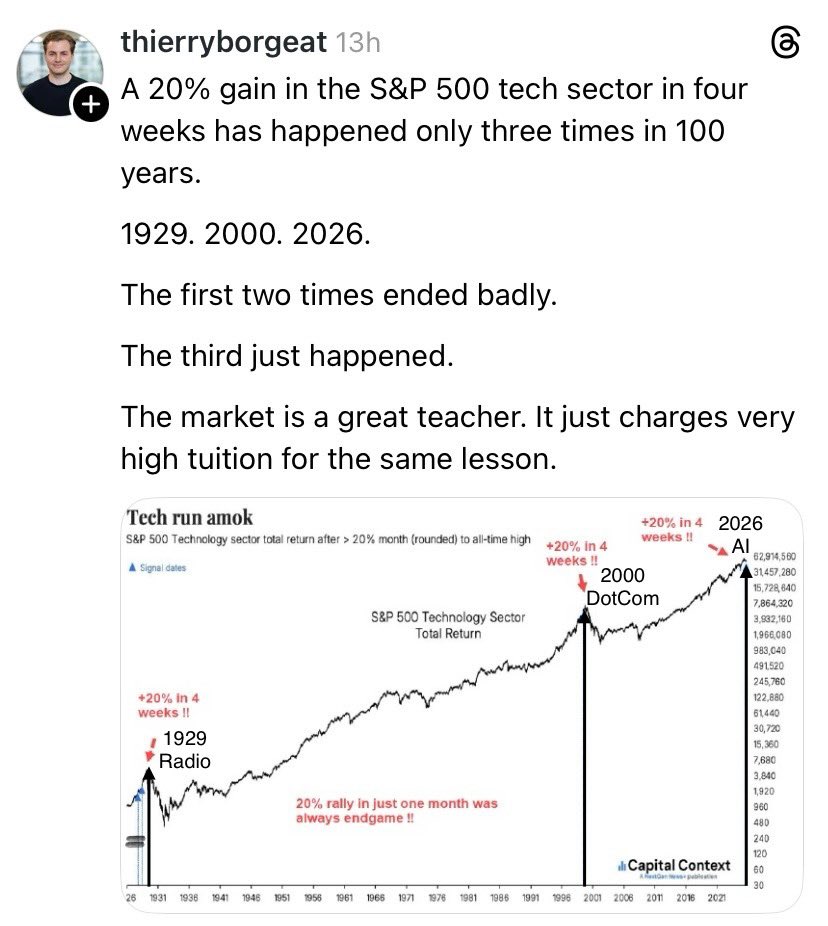
$SPY ~ A 20% gain in the S&P500 tech sector in 4 weeks has happened only 3 times in 100 years. 1929 Radio Mania. 2000 DotCom Mania. 2026 Al Mania. The first 2 times ended badly. The 3rd just happened in April/May 2026. Markets keep charging very high tuition for the same lesson.
Edward Gofsky tweet media
English
10
20
89
6.4K
Spout Finance
Spout Finance@SpoutFi·
@StealthQE4 The difference between margin and borrowing against real assets at near-zero rates is risk management. One forces a sale at the worst moment, the other doesn’t.
English
0
0
0
3
Spout Finance
Spout Finance@SpoutFi·
@investingluc Process and consistency over swinging for the fences is the discipline that compounds
English
1
0
1
6
Luc
Luc@investingluc·
The main perk of starting with a slightly bigger $$$ account is that you don’t need to do stuff you KNOW you shouldn’t be doing in the market. The level of heinous risk/leverage needed to take $1K to $100K can create horrific habits that will take years to break. You can absolutely build a tiny account into a big one, but saving up some money and starting a lil bigger is underrated because it allows you to focus on process + consistency instead of constantly feeling forced to swing for the fences. Would recommend.
English
18
6
112
8.7K
Finance Guy
Finance Guy@GuyTalksFinance·
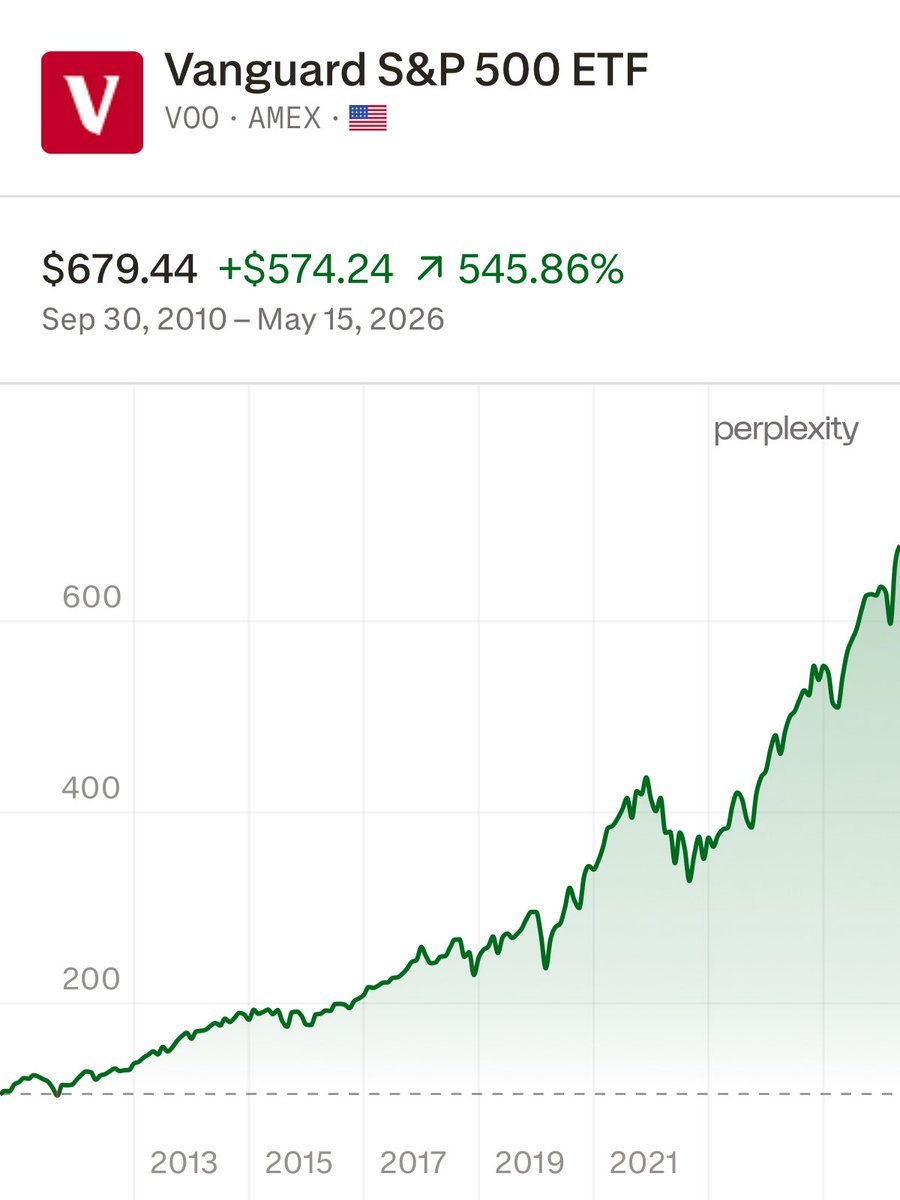
If you’re worried about investing just remember the S&P500 has never delivered a negative return for a long term investor
Finance Guy tweet media
English
28
3
92
4K
Spout Finance
Spout Finance@SpoutFi·
@adamkhootrader The investors who captured those moves had borrowing infrastructure that let them hold through the pain without forced selling. That’s the access most retail doesn’t have. That’s what Spout Finance is building
English
0
0
0
10
Adam Khoo
Adam Khoo@adamkhootrader·
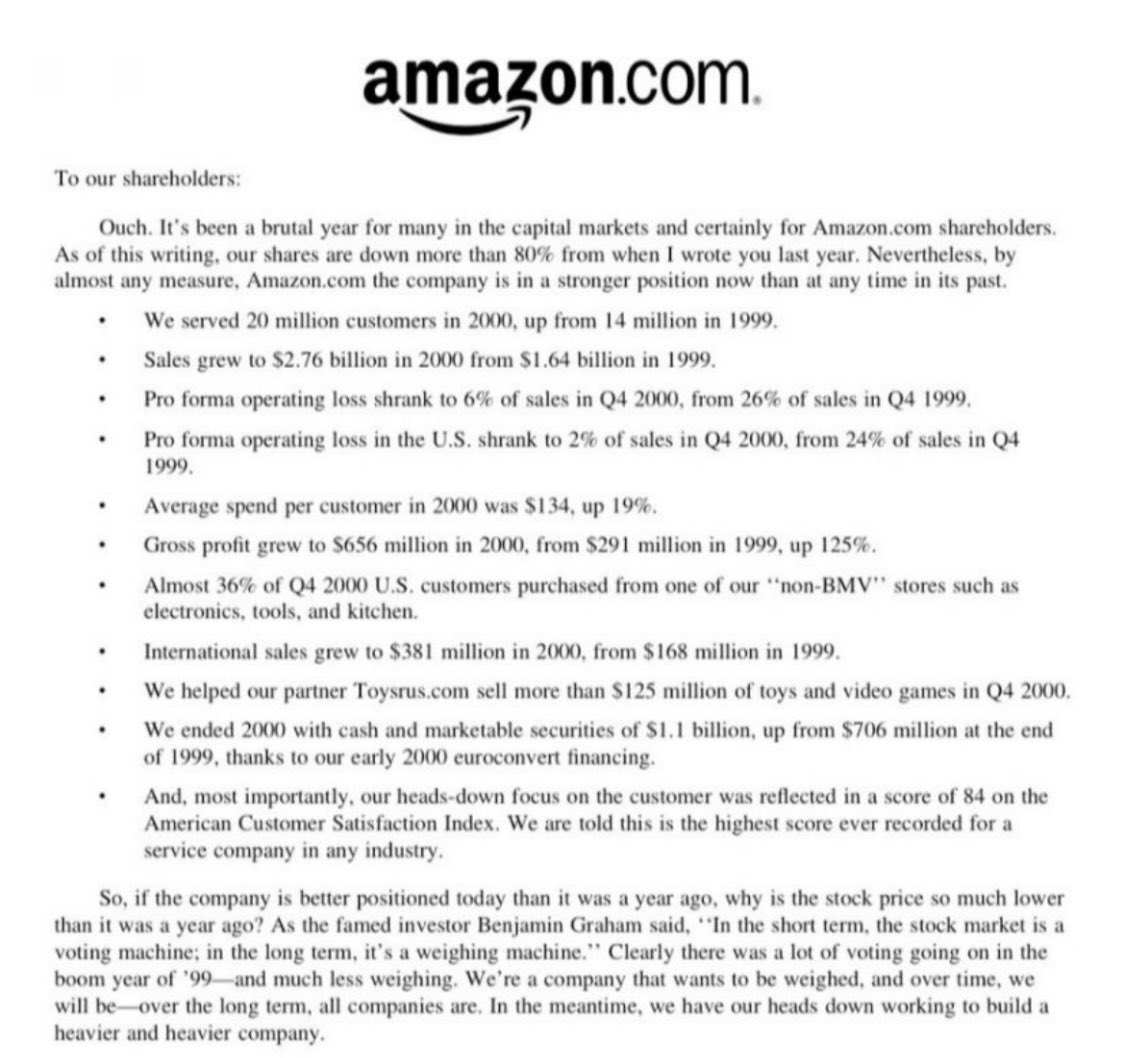
This is an example of how irrational Mr. Market gives us life changing investment opportunities from time to time. When Amazon stock crashed 80% during the dot-com bust, Jeff Bezos famously told shareholders to focus on the long-term "weighing machine" over short-term market panic. If you ignored the noise and put $10,000 into AMZN that month, your split-adjusted entry (~$0.40 ) would be worth $6.6 Million today. These massive opportunities always happen from time to time when the market overreacts to temporary headwinds. For instance, we saw this cycle repeat when Meta dropped over 70% in 2022, Google dropped nearly 45% by its early 2023 trough (just shy of 50%), and UnitedHealth plunged over 50% at its lowest point in 2025. When premier companies go on a deep discount due to short-term fear, generational wealth is born. Always zoom out.
Adam Khoo tweet media
English
11
16
209
16.1K
Spout Finance
Spout Finance@SpoutFi·
@robprogressive First generation builds it through discipline, second generation spends it through comfort, third generation starts from scratch
English
0
0
0
5
Rob Moore
Rob Moore@robprogressive·
85% of all wealth is self made, but…

70% of wealth is lost by the 2nd generation & 90% by the 3rd Generational wealth is passed down through knowledge, not money
English
8
5
51
4.3K