USDR

83 posts

USDR banner
USDR

USDR

@USDR_Global

A transparent, stable digital currency backed by real-world assets and responsible reserve management.

Katılım Ocak 2026
2 Takip Edilen1.8K Takipçiler
USDR
USDR@USDR_Global·
USDR Discord is now OPEN! The Early Bird role is available for the first members joining the community. Don’t miss your chance to be part of the founding community. 🔗 Join & Claim now: discord.gg/usdr
USDR tweet media
English
5
0
19
2.4K
USDR
USDR@USDR_Global·
Asset-backed does not mean speculative development exposure. USDR references stabilized, income-producing properties with established operating history. Economic substance. Verifiable performance. Conservative valuation principles.
USDR tweet media
English
22
17
44
5.5K
USDR
USDR@USDR_Global·
The reserve foundation of USDR includes operating hospitality properties in Bangkok: • Ramada Plaza by Wyndham Bangkok Sukhumvit 48 • Ramada by Wyndham Bangkok Sukhumvit 87 These are not development-stage projects. They are stabilized, income-producing assets with operating history and measurable performance indicators, including occupancy levels, average daily rates, and revenue per available room. By referencing established operating properties, USDR anchors digital issuance to tangible economic activity.
USDR tweet media
English
10
4
18
6.7K
USDR
USDR@USDR_Global·
Over the past several years, the digital asset industry has experimented with multiple stabilization models. Some rely on algorithmic balancing mechanisms. Others depend on volatile digital collateral or incentive-driven participation loops. USDR adopts a fundamentally different orientation. It is structured as a full-reserve, non-algorithmic digital instrument referencing the United States Dollar as its unit of account. Its design emphasizes clarity of backing, conservative asset selection, and controlled issuance governance. Stability is approached through disciplined architecture rather than market reflexivity.
USDR tweet media
English
1
16
19
14.4K
USDR
USDR@USDR_Global·
Digital finance continues to evolve, yet questions around stability, transparency, and reserve integrity remain central to long-term credibility. USDR is a USD-referenced digital token designed within a disciplined, asset-backed framework. Rather than relying on algorithmic stabilization or unsecured collateral structures, USDR is anchored to stabilized, income-generating hospitality assets located in Bangkok. Its architecture prioritizes reserve alignment, governance separation, and issuance discipline. The objective is not rapid expansion, but structural durability.
USDR tweet media
English
0
16
22
9.4K
USDR
USDR@USDR_Global·
𝗞𝗲𝘆 𝗠𝗲𝘁𝗿𝗶𝗰𝘀 𝗢𝘃𝗲𝗿𝘃𝗶𝗲𝘄: 𝗛𝗼𝗹𝗱𝗲𝗿𝘀 & 𝗥𝗲𝘀𝗲𝗿𝘃𝗲 𝗩𝗮𝗹𝘂𝗲 The number of holders indicates distribution breadth and ecosystem participation. A growing holder base signals expanding adoption and reduced concentration risk across the network. Reserve value represents the structural backbone of USDR. It reflects the total underlying assets supporting circulating supply under the full-reserve framework. Alignment between reserves and issued tokens remains fundamental to stability and peg integrity. Together, these metrics provide a clear view of scale and balance sheet discipline: one measures market reach, the other measures financial backing.
USDR tweet media
English
0
15
17
8.3K
USDR
USDR@USDR_Global·
𝗡𝗲𝘅𝘁 𝗦𝘁𝗲𝗽: 𝗕𝗿𝗶𝗱𝗴𝗶𝗻𝗴 𝗧𝗿𝗮𝗱𝗶𝘁𝗶𝗼𝗻𝗮𝗹 𝗙𝗶𝗻𝗮𝗻𝗰𝗲 𝗮𝗻𝗱 𝗗𝗲𝗙𝗶 The next evolution for USDR is structural integration between traditional financial systems and decentralized infrastructure. This means enabling real-world assets and regulated capital to interact seamlessly with DeFi protocols — without compromising reserve integrity or compliance standards. Stable value, transparent backing, and programmable settlement become the foundation for trust across both systems. On one side, traditional finance demands auditability, governance clarity, and regulatory alignment. On the other, DeFi offers efficiency, automation, and global accessibility. The bridge is built where these requirements converge — not where they clash. USDR’s role is to function as that connective liquidity rail: USD-denominated stability backed by tangible assets, operating within programmable on-chain environments. The goal is not to replace TradFi. It is to modernize its settlement layer.
USDR tweet media
English
0
15
17
8.6K
USDR
USDR@USDR_Global·
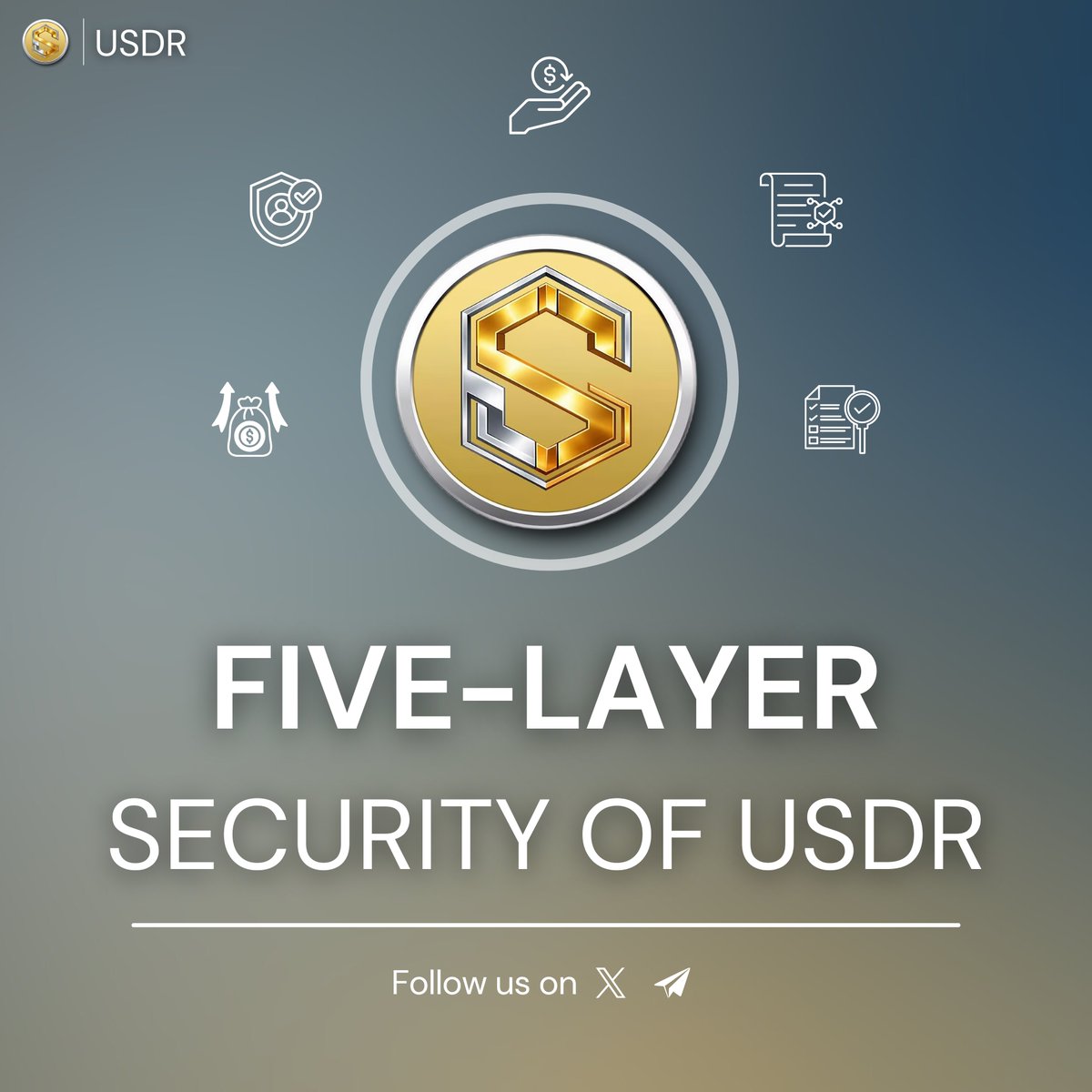
𝗙𝗶𝘃𝗲-𝗟𝗮𝘆𝗲𝗿 𝗦𝗲𝗰𝘂𝗿𝗶𝘁𝘆 𝗼𝗳 𝗨𝗦𝗗𝗥 USDR’s security framework is built around structural reinforcement across five core layers. First is full-reserve backing, ensuring circulating supply remains aligned with underlying asset value. Second is smart contract control, where issuance and redemption logic operate under restricted permissions and predefined code. Third is governance safeguards, limiting operational concentration risk through controlled authorization. Fourth is liquidity architecture, maintaining buffers that support redemptions without destabilizing long-term assets. Fifth is compliance and transparency, strengthening reporting integrity and audit readiness. 𝗦𝗲𝗰𝘂𝗿𝗶𝘁𝘆 𝗵𝗲𝗿𝗲 𝗶𝘀 𝗻𝗼𝘁 𝘀𝘆𝗺𝗯𝗼𝗹𝗶𝗰 — 𝗶𝘁 𝗶𝘀 𝗹𝗮𝘆𝗲𝗿𝗲𝗱 𝗯𝘆 𝗱𝗲𝘀𝗶𝗴𝗻.
USDR tweet media
English
0
15
15
5.3K
USDR
USDR@USDR_Global·
𝗟𝗮𝘁𝗲𝘀𝘁 𝗣𝗿𝗼𝗷𝗲𝗰𝘁 𝗦𝘁𝗮𝘁𝘂𝘀 𝗨𝗽𝗱𝗮𝘁𝗲 USDR’s development continues to progress as planned. Asset onboarding remains aligned with the defined phased roadmap, with hospitality reserve assets fully integrated under verified valuation frameworks. Liquidity structures and issuance controls are operational within the full-reserve discipline. Technical infrastructure, including smart contract governance and redemption mechanics, remains secure and tested under structured review processes. Exchange and ecosystem integrations are advancing with institutional partners, supporting broader liquidity and market access pathways. Compliance frameworks and reporting mechanisms are being refined to ensure alignment with applicable regulatory standards and transparency expectations. Overall, the project remains on schedule with disciplined execution and continued focus on structural stability, reserve integrity, and scalable market infrastructure.
USDR tweet media
English
0
15
15
10.4K
USDR
USDR@USDR_Global·
𝗨𝗦𝗗𝗥 𝗮𝘀 𝗮 𝗙𝗹𝗲𝘅𝗶𝗯𝗹𝗲 𝗧𝗿𝗮𝗱𝗶𝗻𝗴 𝗣𝗮𝗶𝗿 USDR is designed to function as a stable base pair across digital asset markets. By maintaining USD-denominated stability, it provides a neutral pricing reference that reduces volatility distortion when trading against non-pegged assets. As a trading pair, USDR enables more precise price discovery because fluctuations primarily reflect the underlying asset rather than instability in the quote currency. This improves clarity for traders managing entry, exit, and hedging strategies. Its reserve-backed structure also supports confidence in settlement value. A stable and transparent base layer reduces counterparty perception risk and strengthens order book depth when integrated across exchanges. Over time, trading pair flexibility depends on liquidity alignment, exchange integration, and interoperability across chains. When those elements scale, USDR can operate not only as a quote asset, but as a foundational liquidity rail within broader market infrastructure.
USDR tweet media
English
1
15
16
5.3K
USDR
USDR@USDR_Global·
𝗦𝗺𝗮𝗿𝘁 𝗖𝗼𝗻𝘁𝗿𝗮𝗰𝘁 𝗦𝗲𝗰𝘂𝗿𝗶𝘁𝘆 𝗙𝗿𝗮𝗺𝗲𝘄𝗼𝗿𝗸 𝗕𝗲𝗵𝗶𝗻𝗱 𝗨𝗦𝗗𝗥 The smart contracts governing USDR function as the enforcement layer of the system. They manage issuance, redemption mechanics, and token supply controls under predefined logic that cannot be altered arbitrarily once deployed. Security begins with controlled contract architecture. Core functions such as minting and burning are typically restricted to authorized roles, with strict permission management to prevent unauthorized supply changes. Role-based access control and multi-signature authorization reduce single-point-of-failure risk. Code integrity is strengthened through structured development standards, formal testing, and (where applicable) independent security audits. Audit review focuses on vulnerabilities such as reentrancy risks, privilege escalation, improper access control, and supply manipulation vectors. Operational safeguards may include time-lock mechanisms for critical parameter updates, monitoring systems for anomalous transactions, and transparent on-chain verification of total supply. In a reserve-backed model, smart contracts are not merely technical infrastructure — they are the rule engine that enforces supply discipline and redemption integrity. Strong governance combined with verifiable code security forms the foundation of long-term system trust.
USDR tweet media
English
1
15
16
8.2K
USDR
USDR@USDR_Global·
𝗥𝗲𝗱𝗲𝗺𝗽𝘁𝗶𝗼𝗻 𝗦𝘆𝘀𝘁𝗲𝗺 Redemption is the process that allows holders to exchange USDR back into its underlying reference value under a defined framework. It is the structural mechanism that validates full-reserve integrity. When redemption is initiated, the submitted tokens are removed from circulation and the equivalent reserve value is released. Supply contracts in proportion to reserve outflow, maintaining balance sheet alignment between circulating tokens and underlying assets. Liquidity buffers and predefined settlement procedures ensure redemptions can be processed without destabilizing long-term reserve assets. This separation between liquid and income-generating reserves supports operational resilience. Redemption also reinforces peg stability. If market price deviates below parity, redemption incentives help reduce supply and restore equilibrium. In a reserve-backed model, redemption is not a feature — it is the real-time proof of solvency.
USDR tweet media
English
0
15
16
15.3K
USDR
USDR@USDR_Global·
𝗘𝘅𝗲𝗰𝘂𝘁𝗶𝘃𝗲 𝗩𝗶𝘀𝗶𝗼𝗻: 𝗧𝗵𝗲 𝗙𝘂𝘁𝘂𝗿𝗲 𝗼𝗳 𝗥𝗲𝗮𝗹 𝗘𝘀𝘁𝗮𝘁𝗲 𝗼𝗻 𝗕𝗹𝗼𝗰𝗸𝗰𝗵𝗮𝗶𝗻 The future of real estate on blockchain is not defined by speculation, but by structural efficiency. Distributed ledger infrastructure enables property ownership, income distribution, and capital allocation to become more transparent, programmable, and globally accessible. Tokenization transforms traditionally illiquid real estate into digitally native financial instruments, allowing fractional participation while preserving underlying asset integrity. This shifts real estate from a static balance sheet holding toward a dynamic, yield-generating on-chain asset class. Beyond access, blockchain integration enhances auditability, cash flow tracking, and automated distribution mechanisms. Smart contract infrastructure can reduce administrative friction while strengthening governance visibility across stakeholders. Institutional adoption will likely accelerate where regulatory alignment, reserve discipline, and asset transparency converge. The next phase is not about replacing traditional real estate — it is about digitizing its financial infrastructure. Long term, blockchain-backed real estate frameworks have the potential to redefine how capital flows into tangible assets: more efficient, more transparent, and structurally resilient.
USDR tweet media
English
0
16
16
5.3K
USDR
USDR@USDR_Global·
𝗧𝗮𝘅 𝗣𝗹𝗮𝗻𝗻𝗶𝗻𝗴 𝗮𝗻𝗱 𝗗𝗶𝗴𝗶𝘁𝗮𝗹 𝗔𝘀𝘀𝗲𝘁 𝗛𝗼𝗹𝗱𝗶𝗻𝗴𝘀 Tax planning for digital assets should be approached as a structural exercise, not a reactive year-end calculation. As regulatory frameworks tighten globally, transparency and documentation become central to compliance and capital efficiency. At a high level, planning involves understanding how digital assets are classified within your jurisdiction — whether as property, financial assets, or other taxable instruments. This classification determines how capital gains, income from staking, and transactional events are treated. Key considerations typically include transaction timing, realized versus unrealized gains, offsetting losses, income recognition from yield activities, and cross-border reporting obligations. For businesses, treasury allocation and balance sheet treatment introduce additional accounting implications. Proper record-keeping is non-negotiable. On-chain transparency does not replace structured accounting. Wallet tracking, cost basis methodology, and reconciliation with fiat on/off-ramps must align. The direction globally is clear: regulatory reporting is expanding, not shrinking. Strategic holders focus on compliance discipline, audit readiness, and long-term capital efficiency rather than opportunistic avoidance. This is a structural planning issue, not a loophole game.
USDR tweet media
English
0
16
16
7.3K
USDR
USDR@USDR_Global·
𝗪𝗵𝗮𝘁 𝗱𝗼 𝘆𝗼𝘂 𝘂𝘀𝗲 𝗦𝘁𝗮𝗯𝗹𝗲𝗰𝗼𝗶𝗻𝘀 𝗳𝗼𝗿 𝗺𝗼𝘀𝘁 𝗼𝗳𝘁𝗲𝗻?
English
0
0
3
1.6K
USDR
USDR@USDR_Global·
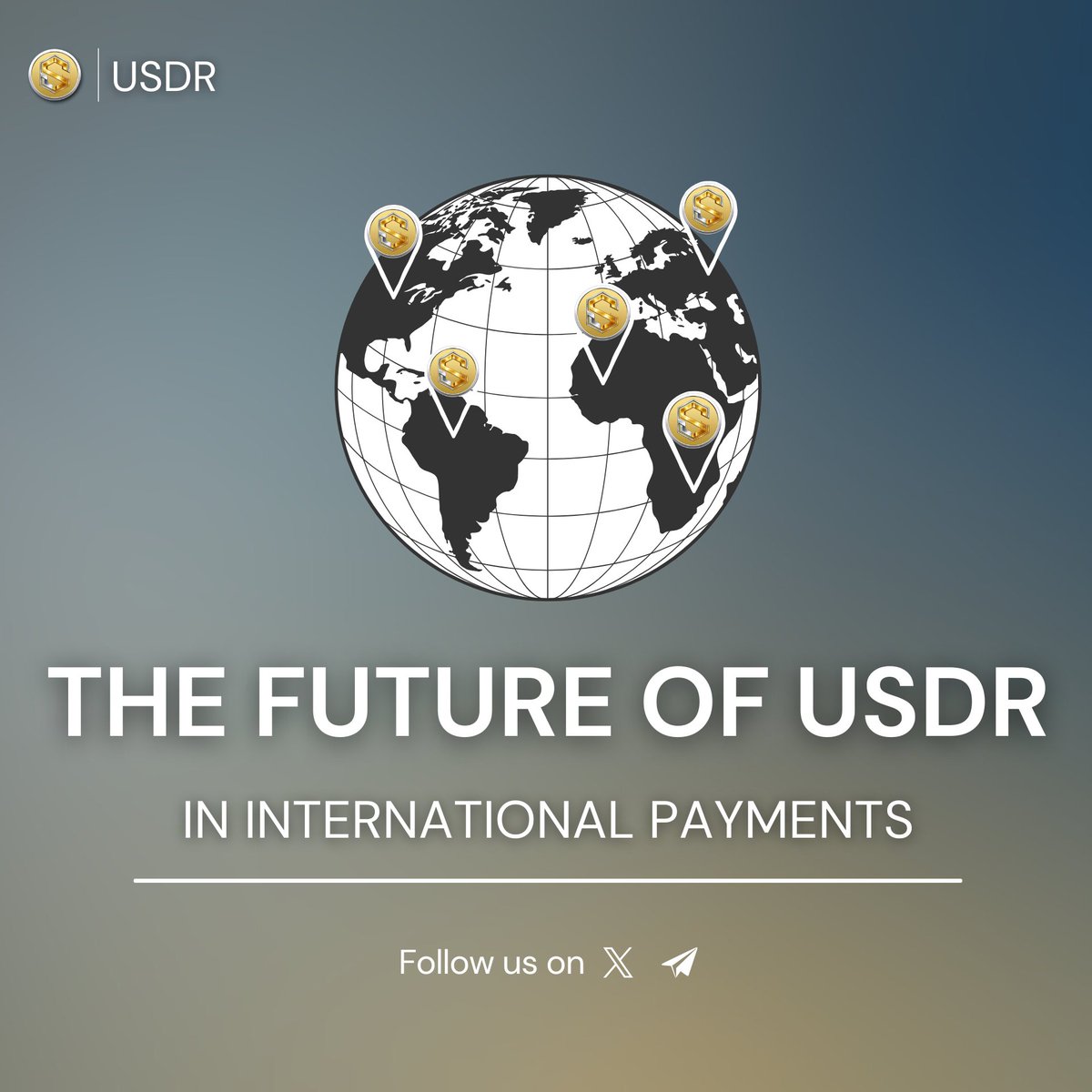
𝗧𝗵𝗲 𝗙𝘂𝘁𝘂𝗿𝗲 𝗼𝗳 𝗨𝗦𝗗𝗥 𝗶𝗻 𝗜𝗻𝘁𝗲𝗿𝗻𝗮𝘁𝗶𝗼𝗻𝗮𝗹 𝗣𝗮𝘆𝗺𝗲𝗻𝘁𝘀 As global commerce digitizes, cross-border settlement is moving toward faster, programmable, and transparent infrastructure. USDR is positioned to serve as a USD-denominated settlement layer within this shift. Traditional international payments often involve delays, intermediaries, and limited visibility. A reserve-backed digital instrument enables near real-time settlement, on-chain traceability, and efficient liquidity use while maintaining USD-aligned value stability. For exporters and importers, USDR can reduce settlement friction and currency exposure. For enterprises operating across multiple jurisdictions, it supports coordinated liquidity management between digital and traditional systems. As institutions increasingly prioritize transparency, solvency discipline, and regulatory alignment, reserve-backed digital assets are expected to play a larger role in global payments. USDR is designed to function as reliable cross-border infrastructure — not a speculative vehicle.
USDR tweet media
English
0
15
17
14.9K
USDR
USDR@USDR_Global·
𝗗𝗲𝗲𝗽 𝗗𝗶𝘃𝗲: 𝗣𝗵𝗮𝘀𝗲 𝟯 & 𝟰 — 𝗡𝗼𝘃𝗼𝘁𝗲𝗹 𝗮𝗻𝗱 𝗛𝗶𝗹𝘁𝗼𝗻 𝗚𝗮𝗿𝗱𝗲𝗻 𝗜𝗻𝗻 Phase 3 and Phase 4 introduce internationally recognized hospitality assets under the 𝗡𝗼𝘃𝗼𝘁𝗲𝗹 and 𝗛𝗶𝗹𝘁𝗼𝗻 𝗚𝗮𝗿𝗱𝗲𝗻 𝗜𝗻𝗻 brands, marking a strategic move toward professionally managed, globally standardized properties. These assets operate within established reservation networks and brand-level revenue management systems, supporting occupancy visibility, pricing discipline, and operational transparency. Their structure combines tangible real estate value with recurring operating income rather than relying solely on asset appreciation. Within a reserve-backed framework, branded hospitality assets strengthen income resilience and institutional credibility, reinforcing long-term balance sheet stability.
USDR tweet media
English
0
15
15
7.3K
USDR
USDR@USDR_Global·
𝗨𝗦𝗗𝗥 𝗳𝗼𝗿 𝗖𝗼𝗿𝗽𝗼𝗿𝗮𝘁𝗲 𝗖𝗮𝘀𝗵 𝗙𝗹𝗼𝘄 𝗠𝗮𝗻𝗮𝗴𝗲𝗺𝗲𝗻𝘁 USDR can function as a USD-denominated on-chain instrument for corporate cash flow management, offering greater flexibility and settlement efficiency. Operating companies can hold short-term liquidity in a stable, reserve-backed digital format while facilitating cross-border payments without prolonged banking delays. It also supports alignment of USD obligations with a predictable unit of value. From a treasury perspective, USDR operates as a digital liquidity layer that supports working capital management, operational disbursements, and temporary allocation of idle funds within a structured reserve-backed framework. Unlike volatile digital assets, USDR is designed to maintain value stability, allowing finance teams to prioritize capital planning rather than price risk mitigation. In environments where timing, transparency, and predictability are critical, a reserve-backed digital instrument enhances liquidity agility while preserving balance sheet discipline.
USDR tweet media
English
0
16
16
10.5K
USDR
USDR@USDR_Global·
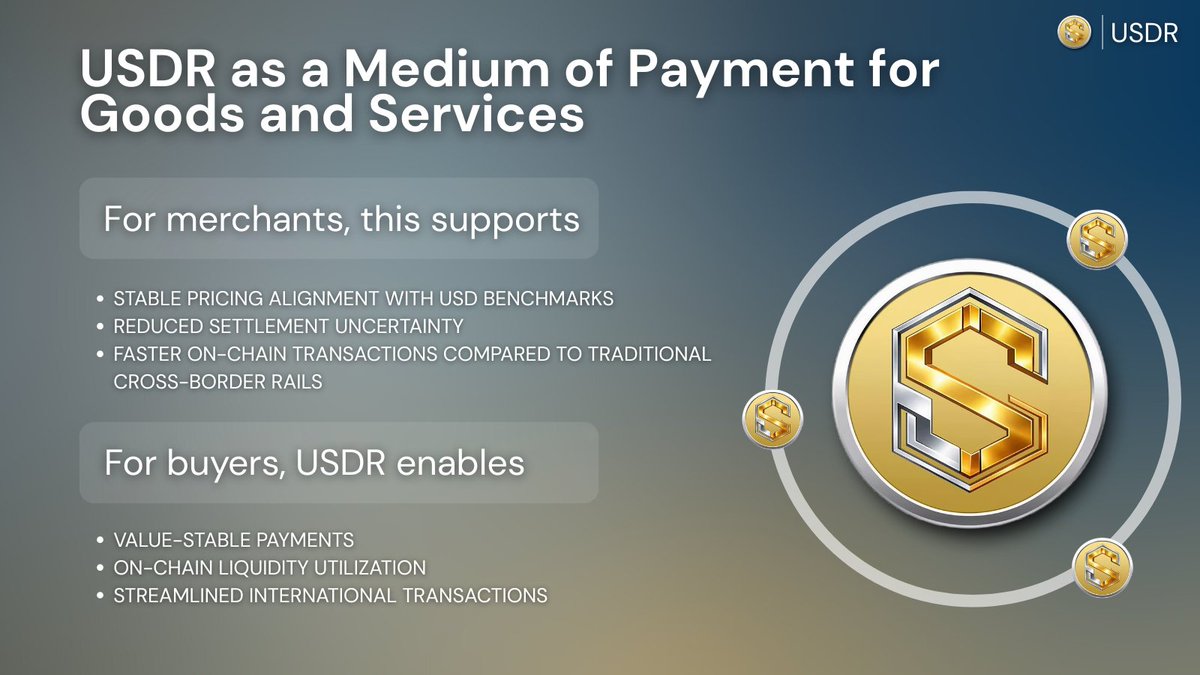
𝗨𝗦𝗗𝗥 𝗮𝘀 𝗮 𝗠𝗲𝗱𝗶𝘂𝗺 𝗼𝗳 𝗣𝗮𝘆𝗺𝗲𝗻𝘁 𝗳𝗼𝗿 𝗚𝗼𝗼𝗱𝘀 𝗮𝗻𝗱 𝗦𝗲𝗿𝘃𝗶𝗰𝗲𝘀 USDR functions as a USD-denominated settlement layer for goods and services across digital and hybrid commercial environments. Backed by reserves and governed by disciplined issuance, it enables predictable value transfer without the volatility of non-pegged digital assets. For merchants, this means stable USD pricing alignment, reduced settlement risk, and faster on-chain transactions compared to traditional cross-border rails. For buyers, USDR supports value-stable payments, efficient on-chain liquidity use, and streamlined international transfers. As digital commerce scales, a reserve-backed digital unit of account enhances operational efficiency while maintaining balance sheet clarity. USDR is positioned as transactional infrastructure — not a speculative vehicle — within real economic activity.
USDR tweet media
English
0
16
16
8.1K
USDR
USDR@USDR_Global·
𝗛𝗼𝘄 𝘁𝗼 𝗜𝗻𝗱𝗲𝗽𝗲𝗻𝗱𝗲𝗻𝘁𝗹𝘆 𝗩𝗲𝗿𝗶𝗳𝘆 𝗣𝗿𝗼𝗼𝗳 𝗼𝗳 𝗖𝗼𝘃𝗲𝗿𝗮𝗴𝗲 Proof of Coverage means verifying that circulating USDR supply is fully supported by reserve assets under a defined valuation framework. Start by reviewing the current circulating supply. This should be publicly observable through on-chain data or official disclosure. Next, review the latest disclosed reserve valuation, including asset classification and aggregate reserve value. Then compare the two figures : 𝗖𝗼𝘃𝗲𝗿𝗮𝗴𝗲 𝗥𝗮𝘁𝗶𝗼 = 𝗧𝗼𝘁𝗮𝗹 𝗩𝗲𝗿𝗶𝗳𝗶𝗲𝗱 𝗥𝗲𝘀𝗲𝗿𝘃𝗲 𝗩𝗮𝗹𝘂𝗲 ÷ 𝗖𝗶𝗿𝗰𝘂𝗹𝗮𝘁𝗶𝗻𝗴 𝗦𝘂𝗽𝗽𝗹𝘆 A ratio equal to or greater than 1.0x indicates full reserve coverage under the stated framework. Finally, assess reporting transparency — frequency of disclosures, valuation methodology, and any third-party verification. Structural transparency strengthens credibility. 𝗩𝗲𝗿𝗶𝗳𝗶𝗰𝗮𝘁𝗶𝗼𝗻 𝗶𝘀 𝗮 𝗽𝗿𝗼𝗰𝗲𝘀𝘀, 𝗻𝗼𝘁 𝗮𝗻 𝗮𝘀𝘀𝘂𝗺𝗽𝘁𝗶𝗼𝗻.
USDR tweet media
English
0
17
17
5.2K