Vincent C. Müller
4.7K posts

Vincent C. Müller
@VincentCMueller
Director, Philosophy and AI Research Centre (PAIR) & A.v.Humboldt Professor @UniFAU Erlangen-Nürnberg
Europe Katılım Eylül 2013
353 Takip Edilen2.2K Takipçiler
Sabitlenmiş Tweet

After six years, a fully updated version of my survey article "Ethics of Artificial Intelligence and Robotics" has been published: plato.stanford.edu/entries/ethics…
(In 2020 it was the first survey article of the field.)
#aiethics
please rt
English
Vincent C. Müller retweetledi

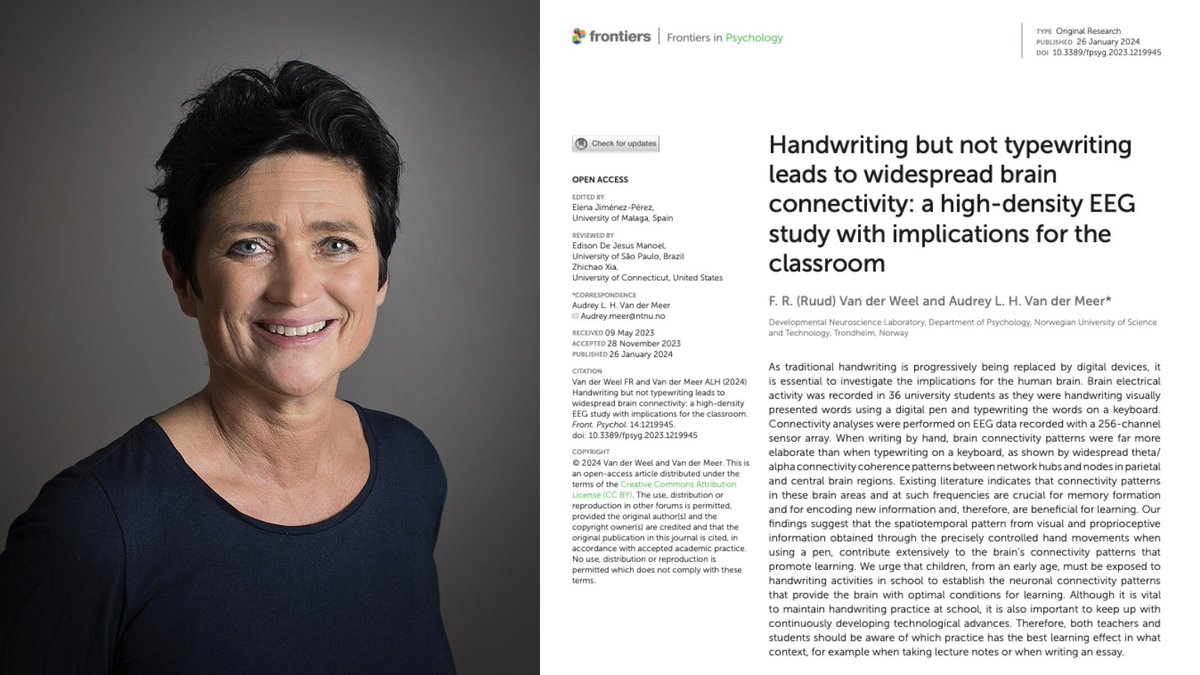
A Norwegian neuroscientist spent 20 years proving that the act of writing by hand changes the human brain in ways typing physically cannot, and almost nobody outside her field has read the paper.
Her name is Audrey van der Meer.
She runs a brain research lab in Trondheim, and the paper that closed the argument was published in 2024 in a journal called Frontiers in Psychology. The finding is brutal enough that it should have changed every classroom on Earth.
The experiment was simple. She recruited 36 university students and put each one in a cap with 256 sensors pressed against their scalp to record brain activity. Words flashed on a screen one at a time.
Sometimes the students wrote the word by hand on a touchscreen using a digital pen, and sometimes they typed the same word on a keyboard. Every neural response was recorded for the full five seconds the word stayed on screen.
Then her team looked at the part of the data most researchers had ignored for years, which is how different parts of the brain were communicating with each other during the task.
When the students wrote by hand, the brain lit up everywhere at once.
The regions responsible for memory, sensory integration, and the encoding of new information were all firing together in a coordinated pattern that spread across the entire cortex. The whole network was awake and connected.
When the same students typed the same word, that pattern collapsed almost completely.
Most of the brain went quiet, and the connections between regions that had been alive seconds earlier were nowhere to be found on the EEG.
Same word, same brain, same person, and two completely different neurological events.
The reason turned out to be something nobody had really paid attention to before her work. Writing by hand is not one motion but a sequence of thousands of tiny micro-movements coordinated with your eyes in real time, where each letter is a different shape that requires the brain to solve a slightly different spatial problem.
Your fingers, wrist, vision, and the parts of your brain that track position in space are all working together to produce one letter, then the next, then the next.
Typing throws all of that away. Every key on a keyboard requires the exact same finger motion regardless of which letter you are pressing, which means the brain has almost nothing to integrate and almost no problem to solve.
Van der Meer said it plainly in her interviews.
Pressing the same key with the same finger over and over does not stimulate the brain in any meaningful way, and she pointed out something that should scare every parent who handed their kid an iPad.
Children who learn to read and write on tablets often cannot tell letters like b and d apart, because they have never physically felt with their bodies what it takes to actually produce those letters on a page.
A decade before her, two researchers at Princeton ran the same fight using a completely different method and ended up at the same answer. Pam Mueller and Daniel Oppenheimer tested 327 students across three experiments, where half took notes on laptops with the internet disabled and half took notes by hand, before testing everyone on what they actually understood from the lectures they had watched.
The handwriting group won by a wide margin on every question that required real understanding rather than surface recall.
The reason was hiding in the transcripts of what the two groups had actually written down.
The laptop students typed almost word for word, capturing more total content but processing almost none of it as they went, while the handwriting students physically could not write fast enough to transcribe a lecture in real time, which forced them to listen carefully, decide what actually mattered, and put it in their own words on the page.
That single act of choosing what to keep was the learning itself, and the keyboard had quietly skipped the choosing and skipped the learning along with it.
Two studies. Two countries. Same answer.
Handwriting makes the brain work. Typing lets it coast.
Every note you have ever typed instead of written went into your brain through a thinner pipe. Every meeting, every book highlight, every idea you captured on your phone instead of on paper was processed at half depth.
You did not forget those things because your memory is bad. You forgot them because typing never woke the part of the brain that would have made them stick.
The fix is the thing your grandmother already knew.
Pick up a pen. Write the thing down. The slower road is the faster one.

English

Interview with me on AI in war:
tovima.gr/2026/05/17/wor…
(Leading Greek newspaper)
English

"PhAI" Mailing list for #PhilosophyofAI & #EthicsofAI
(moderated: jobs, events, news)
lists.fau.de/cgi-bin/listin…
Please post your jobs and important news!
Please RT
English

@noetic_emetic Not true. Dummett supplied a mass of references in the 2nd edition, which is the one everyone read.
And: "Über Sinn und Bedeutung" is not about meaning?
English
Vincent C. Müller retweetledi

Trump just got exposed for running the biggest insider trading operation in American history.
Nancy Pelosi traded $5 million in stocks and Congress lost its mind.
Trump literally executed $750 MILLION worth of stock trades in ONE quarter while being President.
His ethics filing just dropped and the numbers are genuinely unprecedented in history:
Between January and March 2026, Donald Trump personally executed 3,700 individual stock transactions worth between $220 million and $750 million.
That's roughly 60 trades PER DAY.
While signing executive orders, meeting foreign leaders, and making policy decisions that directly impact the companies he's buying and selling.
Now here's where it gets really insane:
On February 10, Trump bought between $1 million and $5 million worth of Dell stock.
Three months later, on May 8, he stood at a Mother's Day event at the White House, thanked Michael Dell by name, and told Americans to "go out and buy a Dell."
Dell stock surged 14.6% that day to an all-time high of $263.99.
Since Trump's February purchase, Dell is up 96%.
And 5 months BEFORE Trump bought Dell stock, Michael and Susan Dell donated $6.25 billion to Trump Accounts, one of the largest philanthropic commitments to a sitting president's signature program in modern history.
So the timeline goes: Dell donates $6.25 billion to Trump's program -> Trump buys Dell stock ->Trump tells America to buy Dell from the White House podium -> Stock hits all-time high
And that's just ONE stock...
The same filing shows Trump bought Nvidia stock on February 10. One week later, Nvidia announced a massive chip deal with Meta.
He bought more Nvidia stock one week BEFORE his own Commerce Department approved the sale of Nvidia chips to Saudi Arabia.
He bought Intel stock starting in March 2026. The US government already owned a 9.9% stake in Intel worth over $41 billion. On April 30, Trump posted on Truth Social praising Intel, writing that "Intel Stock continues to rise."
Intel jumped 3% in after-hours and is now up 140% year-to-date.
He bought Palantir stock while his administration was actively handing them billion-dollar government contracts for immigration enforcement and defense.
He bought Robinhood stock while his own Trump Accounts program uses Robinhood as the broker.
He's currently sitting on over 100% profit on AMD, Intel, Bloom Energy, Marvell Technology, and at least 10 other positions.
Every single president since Lyndon B. Johnson has used a blind trust to avoid exactly this situation. But Trump didn't.
His assets sit in a trust controlled by his own children, and the filings show a broker acted as agent on several trades.
The White House says the portfolio is "independently managed."
But here's what independently managed looks like:
Buy Dell stock. Three months later, publicly endorse Dell from the White House. Stock hits all-time high.
Buy Nvidia stock. One week later, your own government approves their chip sales. Stock rips.
Buy Intel stock. Post about Intel on Truth Social. Stock jumps. The government you run already owns a 10% stake.
Buy Palantir. Hand them contracts. Buy Robinhood. Route a federal program through their platform.
Nancy Pelosi got absolutely destroyed for her husband's stock trades.
Her husband's total disclosed trades in his most controversial year were worth roughly $5 million.
Trump just disclosed up to $750 MILLION in a single quarter.
While making the actual policy decisions that move these stocks.
This isn't a left or right issue.
We're talking about the President of the United States averaging 60 stock trades per day in companies his own administration regulates, contracts with, and publicly endorses.
What do you think?
English
Vincent C. Müller retweetledi

Europe is one of the best places in the world to live, but one of the hardest places to build and scale a company.
After 5+ years in France, following 16+ in the US, I have a conflicted admiration for Europe.
On the one hand, Europe has great potential. When I lived in the US, I was skeptical of the European quality-of-life argument. But after getting used to Sunday morning markets, walkable cities, and 4.5 meter ceilings, I get it. There are things that you simply cannot import or experience as a tourist.
These things can make Europe very attractive for creative and intellectual work. I honestly believe some parts of Europe are the “best neighborhood” in the planet. But that’s not the full story.
I am not only a husband and a dad. I am also an entrepreneur. I founded a company in the US 12+ years ago that has offices in the US and Chile and clients throughout the world. I live in France, yet I have not opened a subsidiary here. That is telling.
We once hired someone in France through one of those remote employment platforms. The person received about 5,000 euros net per month, which is considered a very good salary here. But the total cost to the company was closer to 13,000 per month.
That makes hiring feel less like a relationship between a company and a worker, and more like renting someone from the state. At the same time, you take an enormous amount of legal and administrative responsibility. The presumption is that all companies should operate like a 1960s car manufacturer. The response is simple. Don’t set up operations in Europe.
But this is not a remote-work story. I know many small entrepreneurs in France who do not want to cross the threshold from being a one-person activity to becoming an employer. They sometimes refuse a new customer to stay small and avoid the obligations that come with hiring one person. That should worry us.
Many social protections here are described as being provided by the state, but in practice, a lot of the cost and complexity of the implementation falls on the administrative shoulders of entrepreneurs. That is reasonable for a large energy company or bank. But for a small business, it is the difference between an entrepreneur waking up on a Monday to think about product or paperwork.
Growth is not the enemy of the European social model. It is what enabled it. Much of the quality of life we enjoy here today dates back to growth incubated in the past. Growth that is increasingly hard to find. France once led frontier industries, like bicycles in the 1860s, cinema in the 1890s, and aviation and automobiles soon after. Since then, Europe built a more humane social model. But that model was built on the assumption that Europe and the US were the only two rich and industrialized places in the world.
That is no longer true. Global competition in the 21st century is not what it used to be 50 years ago, and the padding built to protect us, may have grown into the handbrake that constrains the growth of the small and flexible firms we need to compete in new frontier sectors.
We should be able to be critical about Europe in our own terms, without comparing ourselves to the US or China. Innovative parts of Europe, like Sweden or Switzerland, operate differently and provide clues. Sweden has embraced a dynamic of capitalization in its pension system for a long time in a continent where fewer people buy stocks. Switzerland, a place that shares an enormous amount of geography and culture with its neighbors, is built in part on strong internal competition among its cantons.
But neither can light a candle to a French open-air market on a Sunday morning. A market where cash is king, and for a reason.
Europe may be the best place in the world to live. But it is also one of the most challenging places to build and scale an innovative activity. The goal is not to weaken the European model. But to get to a place where we can lead again by example. The world will follow us, but only if we are ahead.

English

Interested in coming to the Centre for Philosophy and AI Research {PAIR}?
Do consider the postdoc AvH Fellowships and MSCA Fellowships listed here: pair.fau.eu/jobs/independe… Deadline for the MSCA is 09.09.2026.
We list scholarships for PhD students as well.
VCM
(please RT)
English
Vincent C. Müller retweetledi

If you have this weird gut feeling that the rich pay little tax in the US, your gut is spot on... Source: nytimes.com/interactive/20…
English
Vincent C. Müller retweetledi

@fredahshi This shows that the conference people were overwhelmed to the extent that they are unable to do their job.
English

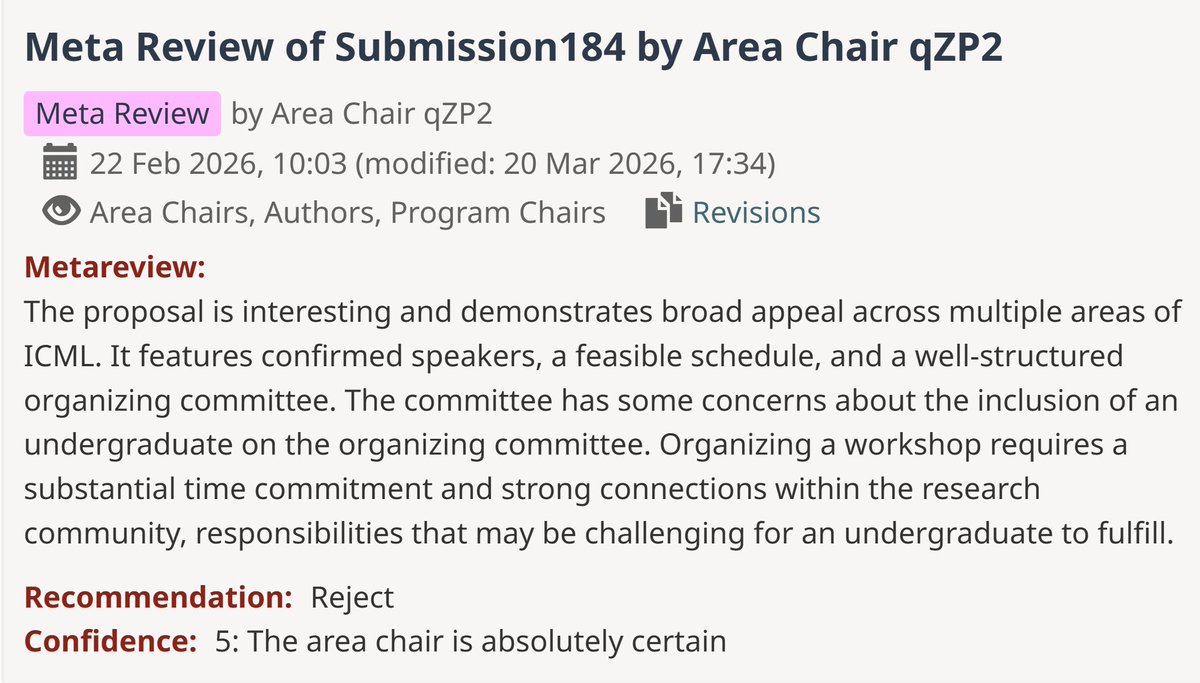
Our workshop was rejected by #ICML2026.
Despite having 3 professors (2 full profs) and 2 senior research scientists, the only reason for rejection was "you got an undergrad on the organizing committee," who is actually a highly competent incoming PhD student. (1/)

English

Some personal news! I'll be taking a break this summer to create general intelligence the old-fashioned way: all going well, Emma and I will be having a daughter in June, and we're very excited.
We're taking shared parental leave, so I'll be mostly unreachable for June-September, and not travelling much for the year after (I'll be v happy to do remote talks and workshop participation from September on though). If you need me this summer, you'll have to find me in the Cambridge Blue's beer garden with a very tiny human on sunny afternoons.
Apologies that I'll be frantically busy the next month too: wrapping up far too many publications, talks and student projects for one month! (But a few exciting things will get through the pipeline before I go, I hope).
(Counting on you good people to prevent civilisation falling while I'm off.)
English

@Dr_Atoosa ... just make sure you keep a critical eye on what the company does (not the PR statements).
English

One thing that makes GoogleDeepMind stand out among other AI companies is the vision of a CEO who has always believed that the number-one application of AI should be to improve human health and wellbeing. It is a vision that is, in my view, deeply and unapologetically pro-human. 👌🏻
Demis Hassabis@demishassabis
I’ve always believed the No.1 application of AI should be to improve human health. That work started with AlphaFold, and now at @IsomorphicLabs with the mission to reimagine drug discovery and one day solve all disease! We are turbocharging that goal with $2.1B in new funding.
English

Cool "Philosophy of AI" PostDoc job in Hong Kong, in connection with {PAIR} at Erlangen (pair.fau.de). Please spread the news!
lnkd.in/eHNRtyHS
English
Vincent C. Müller retweetledi

Many readers replied to my Sunday post on Weber vs. Marx with a version of the argument: “Fine, but capitalism created modernity, so the distinction between capitalism and modernity collapses.” This response is incorrect.
Let me start with the historical claim. Did capitalism create modernity, or did the broader process of rationalization (Weber’s Rationalisierung, the spread of formal institutions, technical reason, impersonal coordination, and calculation) create capitalism and the other features we call modern? The arrow of causality is uncertain. The Roman Army, the Prussian and Habsburg bureaucracies, the Catholic Church’s hierarchy in the Middle Ages, and the Chinese imperial bureaucracy under the Tang: none of these observations fit neatly with the story that capitalism comes first and modernity follows.
But even if capitalism did historically cause modernity, the distinction does not collapse. Two different, and logically separate, kinds of questions are at stake.
The neo-Kantian Baden School (Wilhelm Windelband and Heinrich Rickert, in Heidelberg and Freiburg around 1900) made this point clearly. Rickert, in Die Grenzen der naturwissenschaftlichen Begriffsbildung, distinguishes the genetic question (how did a concrete social configuration arise historically?) from the taxonomic question (what kind of thing is it, and how does it relate to other things of its kind?). Both questions are legitimate. But they are not the same.
Weber, Rickert’s friend and colleague at Heidelberg, built his comparative sociology on this distinction. The ideal type of bureaucracy is taxonomic. It specifies the structural features (hierarchy, written rules, fixed jurisdictions, impersonal authority, technical training) that define the form. The question of how the Prussian bureaucracy arose from the Hohenzollern military obsession is a separate matter. Bureaucracy as a type can be instantiated in the Egyptian New Kingdom, the Tang civil service, the Catholic Church, and the modern corporation. How it came to be in each case and what kind of thing it is in each case are two questions, not one.
Hence, when someone says “capitalism produced modern bureaucracy,” even granting it for the sake of argument, that is an answer to the genetic question. It does not address the taxonomic question of whether the pathologies of large bureaucratic organizations are features of capitalism or of the bureaucratic form itself. The Soviet, East German, and Maoist evidence settles the second question. It shows that bureaucratic dysfunction not only persists but also intensifies in non-capitalist modern regimes.
Now, the serious objection. Quine’s “Two Dogmas of Empiricism” (1951) attacks the analytic-synthetic distinction and, by extension, undermines any clean separation between conceptual-taxonomic and empirical-historical claims. In Quine’s holism, our concept of bureaucracy is a theory derived from historical cases. From this perspective, revising the concept and revising our empirical claims are two sides of the same process. There is no taxonomic standpoint outside the historical record.
I take this objection seriously, but my defense is pragmatic. Weber himself called the ideal type a Gedankenbild, an analytical construct, explicitly heuristic. Read that way, it is just a working tool. Or, as we say in economics, all models are wrong, but some are useful.
You can concede much ground to Quine’s holism and still find it useful, for many purposes, to bracket the genealogy of a category and study the structural relations among its instances. The distinction between modernity and capitalism earns its keep by helping you see that bureaucratic dysfunction in Leipzig in 1982 and in Philadelphia in 2026 are two tokens of the same pathology, regardless of the surrounding economic system.
So, yes, we should distinguish between modernity and capitalism. Otherwise, how are you going to analyze East Germany?
Some (irrelevant) bias: In any case, I am a Saul Kripke fanboy, so who cares about Quine? Water is H2O, baby!
Some (more irrelevant) historical connections: Heinrich Rickert was Heidegger’s most important early teacher, but also had much impact on Rudolf Carnap. Rickert and the neo-Kantians more generally deserve to be better known outside Germany.
Some (truly irrelevant) personal background. I learned all this material in college, thanks to Spain’s long neo-Kantian tradition, transmitted through Ortega y Gasset (who studied with Cohen in Marburg in 1906 and absorbed Baden through Rickert soon after) and the Revista de Occidente. For once, the hard-earned pesetas my father spent on the tuition of what, at the time, looked like spectacularly useless philosophy courses, without complaining once, have turned out to have some minor application. I will let him know when I ring home tonight.

English
Vincent C. Müller retweetledi

Several new volumes in my Elements in Philosophy of Mind series are coming out. Here's the first, a superb survey of debates on agency by Elizabeth Pacherie. Free to download till 11 May! cambridge.org/core/elements/…
English

In memoriam @FiorellaOperto … such sad news and such an example for everyone
English