Zeko Labs

479 posts

Zeko Labs banner
Zeko Labs

Zeko Labs

@ZekoLabs

Building Zeko, a decentralized zero-knowledge scaling protocol powering the future of the Internet, AI, Gaming, & Finance. Testnet: https://t.co/DRhTXYIt2h

Katılım Mayıs 2023
75 Takip Edilen8.1K Takipçiler
Zeko Labs
Zeko Labs@ZekoLabs·
Could be that the real unlock is not onboarding people into crypto, but onboarding them into apps that just happen to run on it. If the plumbing is finally getting good enough, then the edge shifts to product design, privacy where it matters, and how naturally assets and logic can move through the app experience.
English
0
0
1
95
Nick Tomaino
Nick Tomaino@NTmoney·
Now is the best time ever to launch a crypto app that onboards millions of new users quickly. The infrastructure is here. USDC for payments, Privy for wallet UX, Base for fast and cheap transactions, ERC20 and ERC721 for token standards, Uniswap and Opensea for liquidity. Only a matter of time.
English
94
27
340
24.7K
Zeko Labs
Zeko Labs@ZekoLabs·
Yeah, that is a fair point. Institutional adoption on its own does not really create user pull. Privacy does, because it changes how usable a system feels day to day. What gets interesting is when that privacy starts working for actual payments, assets, and broader apps too. That is part of why this area catches my attention, including Zeko.
English
0
0
7
107
MilliΞ
MilliΞ@llamaonthebrink·
Privacy is way more important than institutional adoption. By a long shot. Why? Cuz privacy is the golden ticket to mass adoption. Institutional adoption ≠ mass adoption Institutional adoption without mass adoption gives you a benign settlement layer with negligible value. Mass adoption gives you a global SoV that institutions are forced to adopt due to sheer demand.
English
2
3
38
1.2K
Zeko Labs
Zeko Labs@ZekoLabs·
As settlement expands toward Ethereum, the system retains its core structure while final settlement inherits the guarantees of a widely adopted base layer. This is a starting point: a system that lowers the barrier to running private markets on Ethereum.
Zeko Labs tweet media
Zeko Labs@ZekoLabs

x.com/i/article/2039…

English
1
1
13
488
Zeko Labs
Zeko Labs@ZekoLabs·
Yeah, the signal is pretty hard to miss now. But the more interesting part from here may be everything around stablecoins, not just the stablecoin itself. How they handle compliance, privacy, programmability, and movement across systems. That is where some of the zk oriented work, including Zeko, starts to get more interesting.
English
0
0
3
161
Frank Chaparro
Frank Chaparro@fintechfrank·
If you’re a fintech or bank not paying attention to stablecoins, you’re toast. The signals are everywhere: • Supply > $300B (from <$30B in 2020) • Regulatory clarity (GENIUS Act) unlocking institutional adoption • SoFi, JPM, Visa, Mastercard, Fiserv are all moving in And usage is exploding: • $226B in B2B payments (+733% YoY) • $4.5B in card spend (+673% YoY)
English
28
24
156
14.2K
Zeko Labs
Zeko Labs@ZekoLabs·
Really interesting framing. If intelligence becomes the coordination layer, the bar probably rises on verifiability too. Otherwise we may remove human hierarchy only to create a faster machine hierarchy that is even harder to inspect. That is part of why AI-native and zk-oriented systems like Zeko feel interesting in this broader shift.
English
0
0
5
169
Zeko Labs
Zeko Labs@ZekoLabs·
Zeko Mainnet imminent - but it's not the last stop on our #ZekoRoadtoMainnet - even bigger things are planned 👀 Thanks to our active community for getting on board.
Zeko Labs tweet media
English
2
7
27
797
Mippo 🟪
Mippo 🟪@MikeIppolito_·
Most discussed projects at Eth CC. 1. Tempo 2. Canton 3. Figure
English
112
14
489
142.3K
Zeko Labs
Zeko Labs@ZekoLabs·
Thanks for taking the time to go through the whitepaper and for the support, really appreciate it. Curious to hear more about the kind of partnerships you have in mind. If you’d like, please feel free to share a few more details. You’re also welcome to join us on Discord or Telegram so we can discuss it further there: Discord: discord.gg/ZByTgqnBHj Telegram: t.me/zekoprotocol
English
0
0
1
37
PJ🦅❤️‍🔥
PJ🦅❤️‍🔥@PJs_crypt·
@ZekoLabs @zksecurityXYZ Hi there! I just went through this project white paper, A tool that help you verify without revealing data. Zero prove knowledge Really interesting. And to show my support I can bring in 3 real partnership deal in 1 week
English
1
0
1
31
Zeko Labs
Zeko Labs@ZekoLabs·
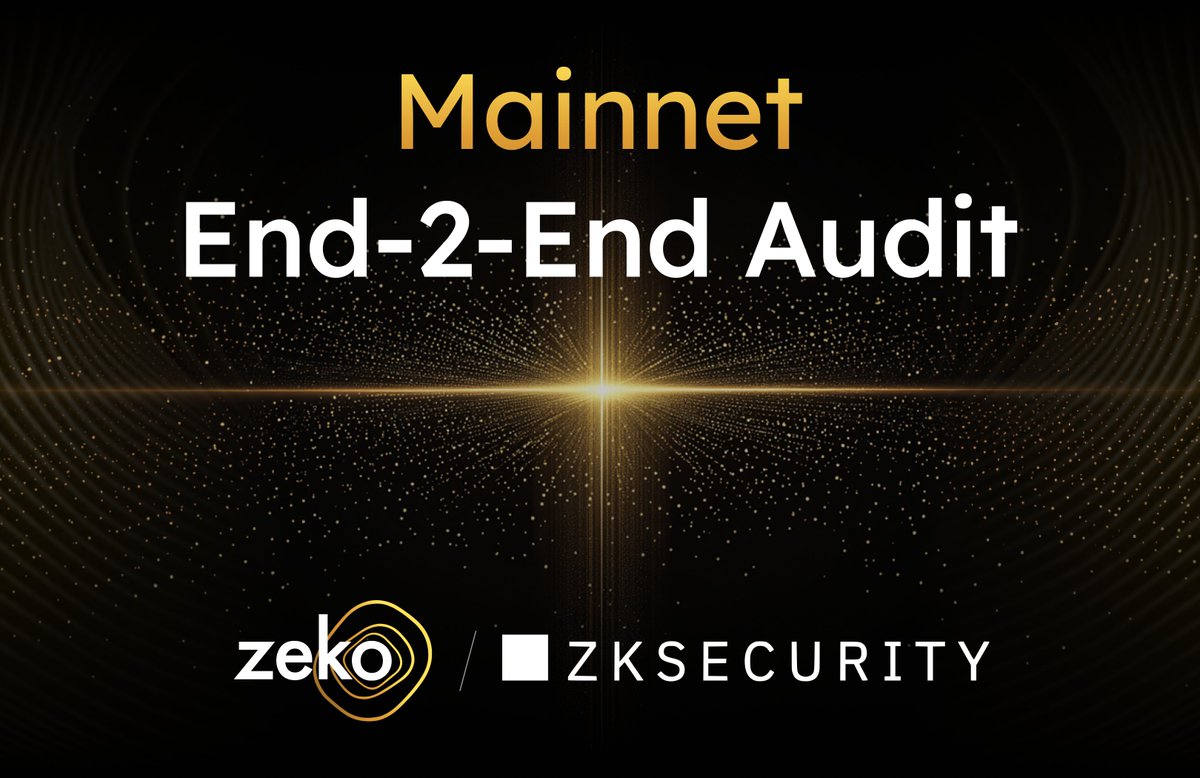
Zeko Mainnet End-2-End audit has started. This final audit with @zksecurityXYZ focuses on: 🟡 Circuit upgrades from the first audit 🟡 Sequencer i) zkApp command logic, ii) Provers, iii) Indexed Merkle tree, iv) Transaction snark merging, v) Committing, vi) Recovery, vii) Emergency features 🟡 DA node 🟡 Proof multisig for utility token The @ZekoLabs team has been hard at work this past year and we’re excited to put the finishing touches on mainnet launch. 🔃 Retweet & Follow us here for the latest news on our progress!
Zeko Labs tweet media
Zeko Labs@ZekoLabs

The Audit of Zeko's Mainnet core and bridge rollup circuits is COMPLETE. Our engineering team enjoyed working with the great @zksecurityXYZ team. Read the report: reports.zksecurity.xyz/reports/zeko/ Get ready for the upgraded community testnet launch and the #ZekoBoom Testnet Contest next on the #ZekoRoadtoMainnet
English
7
24
80
17K
Zeko Labs
Zeko Labs@ZekoLabs·
Interesting part here is not just possible self-censorship. It is the disclosure model itself: withhold the weaponizable circuit details, but still publish a ZK proof so the claim remains independently verifiable. Feels like an underrated direction for zk ecosystems like Zeko too, where proofs may matter not only for scaling or privacy, but for making sensitive claims auditable without revealing everything.
English
1
1
27
3.1K
Jeff Garzik
Jeff Garzik@jgarzik·
"Google paper uses a zero-knowledge (ZK) proof to demonstrate the algorithm's existence without leaking actual optimisations. From now on, assume state-of-the-art algorithms will be censored. There may be self-censorship for moral or commercial reasons, or because of government pressure. A blackout in academic publications would be a tell-tale sign."
Justin Drake@drakefjustin

Today is a monumentous day for quantum computing and cryptography. Two breakthrough papers just landed (links in next tweet). Both papers improve Shor's algorithm, infamous for cracking RSA and elliptic curve cryptography. The two results compound, optimising separate layers of the quantum stack. The results are shocking. I expect a narrative shift and a further R&D boost toward post-quantum cryptography. The first paper is by Google Quantum AI. They tackle the (logical) Shor algorithm, tailoring it to crack Bitcoin and Ethereum signatures. The algorithm runs on ~1K logical qubits for the 256-bit elliptic curve secp256k1. Due to the low circuit depth, a fast superconducting computer would recover private keys in minutes. I'm grateful to have joined as a late paper co-author, in large part for the chance to interact with experts and the alpha gleaned from internal discussions. The second paper is by a stealthy startup called Oratomic, with ex-Google and prominent Caltech faculty. Their starting point is Google's improvements to the logical quantum circuit. They then apply improvements at the physical layer, with tricks specific to neutral atom quantum computers. The result estimates that 26,000 atomic qubits are sufficient to break 256-bit elliptic curve signatures. This would be roughly a 40x improvement in physical qubit count over previous state-of-the-art. On the flip side, a single Shor run would take ~10 days due to the relatively slow speed of neutral atoms. Below are my key takeaways. As a disclaimer, I am not a quantum expert. Time is needed for the results to be properly vetted. Based on my interactions with the team, I have faith the Google Quantum AI results are conservative. The Oratomic paper is much harder for me to assess, especially because of the use of more exotic qLDPC codes. I will take it with a grain of salt until the dust settles. → q-day: My confidence in q-day by 2032 has shot up significantly. IMO there's at least a 10% chance that by 2032 a quantum computer recovers a secp256k1 ECDSA private key from an exposed public key. While a cryptographically-relevant quantum computer (CRQC) before 2030 still feels unlikely, now is undoubtedly the time to start preparing. → censorship: The Google paper uses a zero-knowledge (ZK) proof to demonstrate the algorithm's existence without leaking actual optimisations. From now on, assume state-of-the-art algorithms will be censored. There may be self-censorship for moral or commercial reasons, or because of government pressure. A blackout in academic publications would be a tell-tale sign. → cracking time: A superconducting quantum computer, the type Google is building, could crack keys in minutes. This is because the optimised quantum circuit is just 100M Toffoli gates, which is surprisingly shallow. (Toffoli gates are hard because they require production of so-called "magic states".) Toffoli gates would consume ~10 microseconds on a superconducting platform, totalling ~1,000 sec of Shor runtime. → latency optimisations: Two latency optimisations bring key cracking time to single-digit minutes. The first parallelises computation across quantum devices. The second involves feeding the pubkey to the quantum computer mid-flight, after a generic setup phase. → fast- and slow-clock: At first approximation there are two families of quantum computers. The fast-clock flavour, which includes superconducting and photonic architectures, runs at roughly 100 kHz. The slow-clock flavour, which includes trapped ion and neutral atom architectures, runs roughly 1,000x slower (~100 Hz, or ~1 week to crack a single key). → qubit count: The size-optimised variant of the algorithm runs on 1,200 logical qubits. On a superconducting computer with surface code error correction that's roughly 500K physical qubits, a 400:1 physical-to-logical ratio. The surface code is conservative, assuming only four-way nearest-neighbour grid connectivity. It was demonstrated last year by Google on a real quantum computer. → future gains: Low-hanging fruit is still being picked, with at least one of the Google optimisations resulting from a surprisingly simple observation. Interestingly, AI was not (yet!) tasked to find optimisations. This was also the first time authors such as Craig Gidney attacked elliptic curves (as opposed to RSA). Shor logical qubit count could plausibly go under 1K soonish. → error correction: The physical-to-logical ratio for superconducting computers could go under 100:1. For superconducting computers that would be mean ~100K physical qubits for a CRQC, two orders of magnitude away from state of the art. Neutral atoms quantum computers are amenable to error correcting codes other than the surface code. While much slower to run, they can bring down the physical to logical qubit ratio closer to 10:1. → Bitcoin PoW: Commercially-viable Bitcoin PoW via Grover's algorithm is not happening any time soon. We're talking decades, possibly centuries away. This observation should help focus the discussion on ECDSA and Schnorr. (Side note: as unofficial Bitcoin security researcher, I still believe Bitcoin PoW is cooked due to the dwindling security budget.) → team quality: The folks at Google Quantum AI are the real deal. Craig Gidney (@CraigGidney) is arguably the world's top quantum circuit optimisooor. Just last year he squeezed 10x out of Shor for RSA, bringing the physical qubit count down from 10M to 1M. Special thanks to the Google team for patiently answering all my newb questions with detailed, fact-based answers. I was expecting some hype, but found none.

English
19
94
1.3K
103.8K
Zeko Labs
Zeko Labs@ZekoLabs·
Feels like the lesson here is bigger than Bitcoin or Ethereum alone. Advanced cryptography is not the same as post-quantum readiness by default. For zk-oriented ecosystems like Zeko, the value may come less from claiming immunity and more from being modular enough to evolve cryptographic assumptions cleanly without breaking the product later.
English
1
0
4
196
Vadim
Vadim@zacodil·
Google just mathematically proved they can break the cryptography protecting every major blockchain. Not a blog post. Not a prediction. A zero-knowledge proof - verifiable by anyone, without leaking the actual attack. Until today, breaking blockchain cryptography was estimated to require millions of physical qubits. Google's new paper: less than 500,000. A 20x reduction. Execution time: minutes. Google's Willow chip already runs 1,000+ physical qubits. Their roadmap targets a cryptographically relevant quantum computer by 2029. The distance between "theoretical risk" and "your wallet is compromised" just collapsed. Every blockchain running ECDSA or Ed25519 is affected. Bitcoin. Ethereum. Solana. Cardano. TON. All of them. The zero-knowledge proof part is what makes this different from every "quantum will kill crypto" post you've seen before. Previous estimates were speculation. This is math. Google proved the result is real without showing how to replicate it - like proving you cracked a safe without revealing the combination. Google's recommendations to the crypto industry: - Begin migrating to post-quantum cryptography immediately - Stop reusing wallet addresses that expose public keys - Develop a plan for billions in abandoned coins sitting in vulnerable addresses They're already working with Coinbase, the Ethereum Foundation, and Stanford on the transition. This isn't FUD. This is Google Research telling the crypto industry: the clock is real, the math is proven, move now.
Vadim tweet media
English
26
9
66
7.4K
Zeko Labs
Zeko Labs@ZekoLabs·
That’s already possible using solis.gizmolab.io/token 😄 If your friend has something in mind, we’d love to discuss it further and provide all the necessary support from our side. Please feel free to reach out to us on Discord or Telegram whenever convenient. We’re always happy to discuss and help.
English
1
0
6
151
Gizmolab
Gizmolab@gizmolab_·
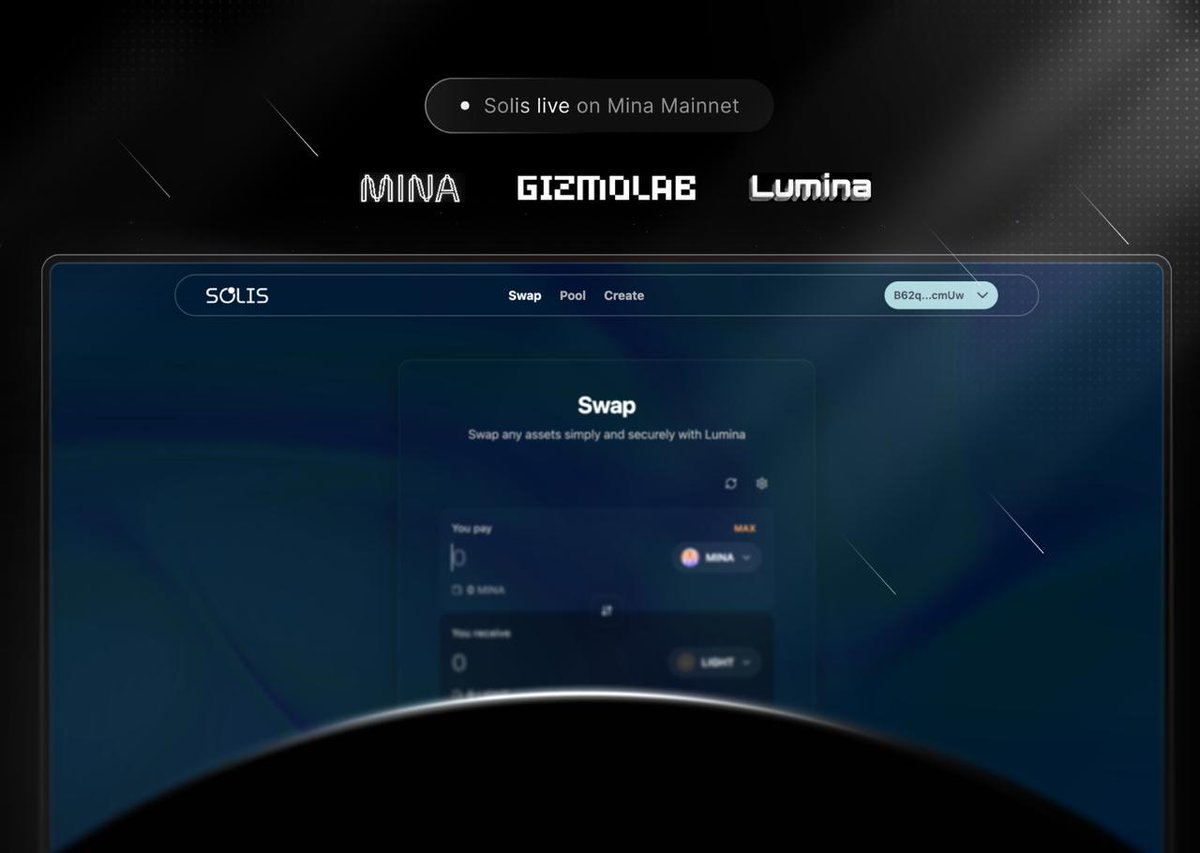
We are glad to announce Solis's launch on @MinaProtocol's mainnet. Built on @LuminaDEX's ZK liquidity protocol, it lets you swap tokens and manage liquidity positions with privacy and compliance built in from day one. Private and compliant by default. Not retrofitted. Check it out: solis.gizmolab.io
Gizmolab tweet media
LuminaDEX@LuminaDEX

Solis is the first DEX on @MinaProtocol mainnet (solis.gizmolab.io), powered by the @LuminaDEX SDK. 👏👏 Start swapping on Mina mainnet today. 🔄 Solis is built by the supreme devs at @gizmolab_ 🛠️

English
3
17
69
2.9K
Haseeb >|<
Haseeb >|<@hosseeb·
After a few weeks in SF, one thing stands out: AI people are more bullish on crypto than crypto people are on themselves. There's this narrative forming in crypto that AI people think crypto is a joke. It's just not true. I keep hearing this over and over from AI people who remain bullish crypto. Hell, Sama, Jensen, Elon, Zuck, the biggest names in AI have all been publicly bullish on crypto and its convergence with AI. Crypto's problem right now isn't that outsiders don't believe. It's that insiders are playing scared.
English
166
117
1.3K
151.8K