William F. Nicklin

3.8K posts

William F. Nicklin banner
William F. Nicklin

William F. Nicklin

@10baggerPicks

Picking stocks 60+ years - Ten Baggers. GE Finance. IB MD. OODA Loop. Focus: Ag Tech, Med Tech, Industrial moat, Energy, the Grid, Super Cycles

Newburgh, NY Entrou em Ağustos 2015
2.4K Seguindo763 Seguidores
William F. Nicklin
William F. Nicklin@10baggerPicks·
I remain invested in $FSLR, with one-half of a full position, primarily for the following reasons. On the technology roadmap (CuRe launch): CEO Mark Widmar yesterday emphasized that their technology strategy is built on the idea that customers value lifetime energy production rather than just nameplate efficiency. He confirmed that the CuRe semiconductor launch at the Perrysburg facility is complete, with the first Series 6 line ramping as expected. He noted that CuRe is expected to deliver up to 8% more lifetime specific energy yield compared to crystalline silicon TOPCon modules. On customer willingness to pay: This came through most clearly in the Q&A. When asked about ASP trends, Widmar explained that since the last earnings call, they have booked 1.4 GW in the U.S. utility-scale market at approximately $0.35/watt, with recent bookings in the $0.36–$0.37/watt range. He described "a lot of momentum and activity" and said the company is being disciplined on pricing. Critically, Widmar explained that as CuRe rolls out, they're shifting away from technology "adjusters" (price uplifts contingent on hitting roadmap milestones) and instead pricing the full value of the higher-performance technology directly into the base contract price. He noted that half the recent volume booked had no adjusters at all because they were simply pricing the CURE technology at its full value, while the other half still used the legacy adjuster structure. On the financial upside from the roadmap: CuRe is scheduled to be replicated across the Series 6 and Series 7 fleet through 2028, which could unlock up to $600 million of additional revenue from technology adjusters in the backlog, with the majority expected in 2027 and 2028. NOTE: "CuRe" is First Solar's next-generation semiconductor platform for its cadmium telluride (CdTe) thin-film solar modules. The name refers to a copper-based replacement chemistry used in the cell's back-contact layer.
English
0
0
1
201
William F. Nicklin
William F. Nicklin@10baggerPicks·
The recent quarterly trajectory shows a clear recovery and normalization in $NRT's distributions: Q1 FY2025: $0.04, Q2 FY2025: $0.20, Q3 FY2025: $0.26, Q4 FY2025: $0.31, Q1 FY2026: $0.22, Q2 FY2026: $0.22. NOTE: There are multiple layers of lag built into NRT's payout structure. In practical terms, we're looking at roughly a two-quarter lag from the point at which gas is actually sold at a given TTF-linked price to the point at which that revenue shows up in a unitholder's distribution. The chart below is simplistic as to lags and lag variability, but useful. ALSO NOTE: There are early signs (political discussion at this point) of a favorable shift in German domestic gas production; $NRT is an option on this policy shift.
William F. Nicklin tweet media
English
0
0
0
81
William F. Nicklin
William F. Nicklin@10baggerPicks·
Not sure. The real dynamic in in medical. $SOTK has been working with many medical companies on balloon coating for many years (R&D stage). Also, medical testing cartriges. These products are now coming to market, so the customer needs production equipment. The production equipment is complex and has high ASPs. R&D machines sell for ~$100k to $200k. Production machines sell for $ 1 million to $2 million. Production needs several machines. A single order is likely to exceed $5 million, possibly $10 million. It is a whole new game for $SOTK. At 50%+ GP, this is real money.
English
0
0
1
145
Z
Z@notprovidedx·
@10baggerPicks Nice write up. Customers/applications for the fully automated ultrasonic semiconductor photoresist coating production systems? Also, what is the opportunity in advanced packaging?
English
1
0
0
35
William F. Nicklin
William F. Nicklin@10baggerPicks·
$SOTK upside is materially higher than prior expectations, based on gross margin profile. This is one of the most misunderstood parts of the Sono-Tek story, and it is worth walking through carefully. The gap between gross and net. Sono-Tek earns roughly 48% to 50% gross margins, but only about 5% to 6% of that translates to net income. That means roughly 43 cents of every dollar of gross profit is absorbed before it reaches earnings. On the surface, that looks inefficient. In practice, $SOTK is a company that invests in building the very capabilities that enable the R&D-to-production transition. Where the money goes. The three buckets eating into gross profit are R&D, sales and marketing, and general and administrative costs. Each one plays a specific role in the transition: R&D spending totaled about $628K in the recent quarter, and the company invested $2.7M over the full fiscal year. This is the software development and applied engineering work that turns a benchtop R&D coating system into a $400k pilot line system and then into a $1M+ production platform. Without that spend, there is no high ASP product to sell. The company recently completed several successful R&D endeavors, leading to a reallocation of specific engineering labor expenses from cost of goods sold to cost of sales. That reallocation actually signals maturation: development work is graduating into production reality. Sales and marketing expenses reflect the costs of selling into new verticals such as clean energy, medical devices, microelectronics, and fully automated ultrasonic semiconductor photoresist coating production systems. These are long sales cycle markets. A production system order can take 12 to 18 months from the first conversation to a signed purchase order. The company has to maintain forward-deployed sales engineers (FEDs), application labs, and distributor relationships across multiple continents before a single or multi-unit high-ASP order materializes. G&A costs cover the corporate infrastructure needed to operate as a public company and support a growing international business. Why is this value creation, not value destruction? The key insight is that Sono-Tek is a small company undergoing an operating-leverage inflection. At $20M in revenue, fixed costs such as R&D, compliance, and sales infrastructure consume a large share of gross profit. But those costs do not scale linearly with revenue. A $1M production system does not require ten times the sales effort of a $100K R&D unit. The engineering team that developed the platform does not need to develop it again for the next order. The audit fees and legal costs stay roughly flat whether the company ships $20M or $30M. As high-ASP production orders take a larger share of the mix, gross profit dollars grow faster than operating expenses. In the most recent nine months, gross margin expanded to 51% versus 48% in the prior-year period, and operating income rose 69% to $1.22M, with operating margin reaching 8%. That 69% jump in operating income on modest revenue growth is exactly what operating leverage looks like when it finally shows up. The balance sheet tells the real story. Sono-Tek holds $12.68M in cash with no debt. Working capital increased by $1.85M to $15.36M since February 2025. The company is not burning cash to fund this transition. It is accumulating capital while simultaneously investing in capabilities that will drive higher-margin revenue in the future. The bottom line looks thin because the company is choosing to reinvest at a stage where those investments are large relative to revenue. As revenue scales, those same fixed investments get spread across a much larger base, and the net margin should expand meaningfully. In short, the gross margin funds the transition. The operating expenses are the transition. And the thin net margin today is the cost of building a business that can generate substantially higher earnings on each incremental dollar of revenue tomorrow.
William F. Nicklin@10baggerPicks

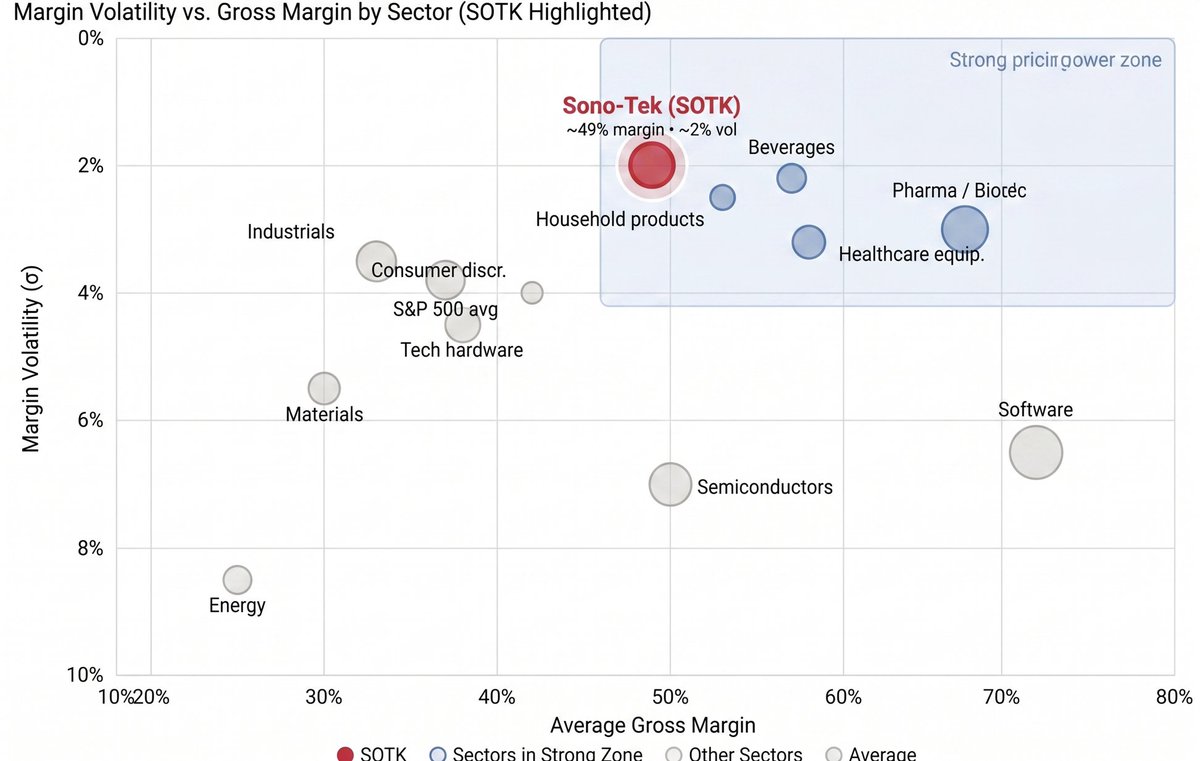
$SOTK investors who have been following me for a while know that I am "all in" and why. For newer Sono-Tek shareholders and onlookers interested in understanding the transition driving $SOTK's business, I present what I believe is fueling it and elevating its intrinsic value far above the current share price. $SOTK has high gross margins with low variability. High gross margins with low volatility provide the financial flexibility to fund FDEs, application engineering, and software development needed to transition from R&D systems to high-volume production machines. Positioning on the chart. Sono-Tek's gross margins have held between 45% and 52% for years, averaging around 49% with very little variation (evidence of a management team operating with clear-headed conviction, steadily building a multi-moat business anchored in higher-ASP production systems). Gross margins between 45% and 52% puts $SOTK in the same territory as pharma, beverages, and household products on the pricing power map. For a $20M industrial equipment company, that is unusual. Most industrials sit around 30% to 35% with wider swings. Even semiconductors, which overlap with some of Sono-Tek's end markets, carry more margin volatility. The S&P 500 average (clocking roughly 37%) falls well below and to the left. The moat behind those margins. Sono-Tek's ultrasonic coating technology sits in a narrow niche with few credible competitors. Their IP and process expertise form a real barrier to entry. Once a customer integrates a Sono-Tek system into a production workflow, the switching costs become significant because coating parameters, recipes, and calibration are all tightly coupled to the equipment. These dynamics check several boxes in the economic moat framework: intellectual property, switching costs, and efficient scale within a specialized market. How margin stability bankrolled the shift to production equipment. Sono-Tek describes its product line as rapidly evolving, transitioning from R&D systems to high-volume production machines with significantly higher average selling prices. The financial mechanics that enabled this are straightforward. Selling R&D units (typically under $100K each) at roughly 50% gross margin threw off enough cash to fund $2.5M to $2.7M in annual R&D without borrowing. The company held $12.68M in cash at the end of the latest fiscal year with zero debt. That balance sheet is a direct consequence of years of consistent, healthy margins on smaller equipment. The R&D systems also created a natural customer pipeline. A lab customer buys a small Sono-Tek unit, validates a coating process on it, and, when the time comes to scale, already knows the technology works. There is no reason to start over with a different vendor. In the alternative and clean energy market alone, sales grew 42%, driven by customers moving from R&D systems to production-scale systems with much higher ASPs. One production system order can cost more than 10 times that of a typical R&D unit. This creates a compounding effect. Low ASP sales build process lock-in. High margins on those sales fund the software development and engineering work needed to develop larger pilot lines and production platforms. Those production systems generate even more gross profit per unit, which in turn fuels further investment. The company's high-ASP strategy continues to drive growth and capture opportunities, shifting towards strong medical markets as clean energy hit speed bumps over the last year. The chart makes the point visually: Sono-Tek occupies moat territory that its industrial peers do not, and that margin cushion gave it the financial room to move from a lab equipment supplier to a production equipment provider without needing outside capital or taking on step-function risk. Disclosure: I am long $SOTK. This is not investment advice. Do your own research before making any investment decisions.

English
1
0
2
476
William F. Nicklin
William F. Nicklin@10baggerPicks·
$SOTK investors who have been following me for a while know that I am "all in" and why. For newer Sono-Tek shareholders and onlookers interested in understanding the transition driving $SOTK's business, I present what I believe is fueling it and elevating its intrinsic value far above the current share price. $SOTK has high gross margins with low variability. High gross margins with low volatility provide the financial flexibility to fund FDEs, application engineering, and software development needed to transition from R&D systems to high-volume production machines. Positioning on the chart. Sono-Tek's gross margins have held between 45% and 52% for years, averaging around 49% with very little variation (evidence of a management team operating with clear-headed conviction, steadily building a multi-moat business anchored in higher-ASP production systems). Gross margins between 45% and 52% puts $SOTK in the same territory as pharma, beverages, and household products on the pricing power map. For a $20M industrial equipment company, that is unusual. Most industrials sit around 30% to 35% with wider swings. Even semiconductors, which overlap with some of Sono-Tek's end markets, carry more margin volatility. The S&P 500 average (clocking roughly 37%) falls well below and to the left. The moat behind those margins. Sono-Tek's ultrasonic coating technology sits in a narrow niche with few credible competitors. Their IP and process expertise form a real barrier to entry. Once a customer integrates a Sono-Tek system into a production workflow, the switching costs become significant because coating parameters, recipes, and calibration are all tightly coupled to the equipment. These dynamics check several boxes in the economic moat framework: intellectual property, switching costs, and efficient scale within a specialized market. How margin stability bankrolled the shift to production equipment. Sono-Tek describes its product line as rapidly evolving, transitioning from R&D systems to high-volume production machines with significantly higher average selling prices. The financial mechanics that enabled this are straightforward. Selling R&D units (typically under $100K each) at roughly 50% gross margin threw off enough cash to fund $2.5M to $2.7M in annual R&D without borrowing. The company held $12.68M in cash at the end of the latest fiscal year with zero debt. That balance sheet is a direct consequence of years of consistent, healthy margins on smaller equipment. The R&D systems also created a natural customer pipeline. A lab customer buys a small Sono-Tek unit, validates a coating process on it, and, when the time comes to scale, already knows the technology works. There is no reason to start over with a different vendor. In the alternative and clean energy market alone, sales grew 42%, driven by customers moving from R&D systems to production-scale systems with much higher ASPs. One production system order can cost more than 10 times that of a typical R&D unit. This creates a compounding effect. Low ASP sales build process lock-in. High margins on those sales fund the software development and engineering work needed to develop larger pilot lines and production platforms. Those production systems generate even more gross profit per unit, which in turn fuels further investment. The company's high-ASP strategy continues to drive growth and capture opportunities, shifting towards strong medical markets as clean energy hit speed bumps over the last year. The chart makes the point visually: Sono-Tek occupies moat territory that its industrial peers do not, and that margin cushion gave it the financial room to move from a lab equipment supplier to a production equipment provider without needing outside capital or taking on step-function risk. Disclosure: I am long $SOTK. This is not investment advice. Do your own research before making any investment decisions.
William F. Nicklin tweet media
English
1
0
2
869
William F. Nicklin
William F. Nicklin@10baggerPicks·
This sums up $SOTK nicely.
elpistollero invest@elpistollero_

🔔Au départ, je suis rentré sur Sono-Tek $SOTK sans énorme conviction “macro”, mais plutôt parce que je suis tombé sur une boîte qui fait un truc très spécifique, assez technique, et qui m’a semblé sous-estimé par le marché. Ce n’est pas une hype stock, ni une grosse valeur suivie par tous les analystes. Justement, c’est ce qui m’a intéressé . une petite boîte industrielle, discrète, mais positionnée sur un vrai problème technique. En creusant, je me suis rendu compte qu’ils travaillent sur le coating de haute précision par ultrasons, ce qui est un sujet beaucoup plus important qu’il n’y paraît. Dès que tu touches aux semi-conducteurs, au médical ou à l’énergie, déposer des couches fines et propres devient critique. Et eux ont une techno qui permet de le faire avec plus de précision et moins de pertes que les méthodes classiques. Donc je ne suis pas rentré pour une histoire de momentum ou de storytelling, mais parce que j’ai vu une brique de process potentiellement intéressante dans des industries en croissance. Côté financier, ce n’est pas non plus une coquille vide, et ça compte beaucoup pour moi. On est sur une petite cap, mais avec des fondamentaux plutôt propres : ils génèrent du chiffre de manière régulière, avec plusieurs trimestres au-dessus de 5 millions de dollars, des marges brutes autour de 50 %, et surtout ils sont rentables. Ils ont aussi un bilan sain, avec de la trésorerie et pas de dette, ce qui est assez rare pour une boîte de cette taille. Et le backlog est solide, ce qui donne un minimum de visibilité. Ce que j’ai trouvé intéressant aussi, c’est que la croissance ne vient pas d’un seul coup de chance. On voit une montée en puissance dans le médical, des commandes qui se répètent, et des partenariats technologiques qui ouvrent des portes dans des domaines plus avancés. Ce n’est pas explosif, mais ce n’est pas non plus fragile. Là où ça devient vraiment intéressant selon moi, c’est avec l’évolution des technologies, notamment dans les semi-conducteurs. Plus on avance, plus les architectures deviennent complexes : empilement 3D, chiplets, nouveaux matériaux, gestion thermique… et tout ça rajoute des contraintes énormes sur les procédés de fabrication. Déposer des couches fines de manière uniforme sur des surfaces de plus en plus complexes devient un vrai défi industriel. Ce qui était une étape secondaire peut devenir un point critique local dans le process. Dans ce contexte, des technologies comme le coating ultrasonique peuvent gagner en importance, parce qu’elles permettent justement ce niveau de précision et de contrôle. Ce n’est pas encore un standard incontournable aujourd’hui, mais on peut imaginer que dans certains cas spécifiques advanced packaging, matériaux avancés, voire certaines applications autour des semi nouvelle génération ce type de solution devienne beaucoup plus utilisé. Donc au final, je suis rentré parce que j’ai vu un combo que j’aime bien : une techno de niche avec du sens, des marchés finaux porteurs, et une base financière suffisamment saine pour ne pas être dépendant du marché à court terme. Ce n’est pas un pari évident, mais c’est typiquement le genre de dossier où il peut se passer quelque chose si la techno trouve sa place dans les bons segments.

English
0
0
1
501
William F. Nicklin
William F. Nicklin@10baggerPicks·
$GRC is working out as expected. Q1 GAAP EPS of $0.68 beats by $0.15. Revenue of $176.6M (+7.7% Y/Y) beats by $5.99M. Shares are up $6 today, passing through $72. Up ~up $20 in 3months. Likely more to go. They serve all of the end markets I like. Low-risk way of playing data center buildout.
William F. Nicklin@10baggerPicks

$GRC is my only "BUY" over the last six months (back in late January in the low $50s). I saw it as a safe play with a datacenter build-out kicker. It now trades in the high $60s, surprising even me. What is happening in the O&G and derivatives market adds another kicker. The shares are likely headed higher. Cattle prices are at historic highs (around 224¢–250¢/lb), which should support their Ag sector, too.

English
0
0
0
331
T
T@deyhatemetoo·
@10baggerPicks Ttf seems way too low here
English
1
0
0
26
William F. Nicklin
William F. Nicklin@10baggerPicks·
$NRT "LONGER" is happening.
William F. Nicklin@10baggerPicks

Keeping an eye on $NRT. As a rough framework: a 2–3 week spike to where #TTF is today (mid-60s euros per megawatt-hour) might add $0.02–0.05/unit to a quarterly distribution, while 6+ weeks of sustained strength could add $0.10–0.20+, depending on where EUR/USD sits. Note: NRT's distributions are calculated quarterly using realized German border gas prices, which reflect contracted and averaged pricing rather than daily spot rates. The German border price tracks TTF closely but with roughly a one-month lag, and it smooths out short-term volatility because many supply contracts use monthly or multi-week averaging formulas.

English
2
0
1
189
William F. Nicklin
William F. Nicklin@10baggerPicks·
$SOTK is a classic "picks and shovels" play on trends in microneedles and microfluidics, which are used in some of the most innovative medical diagnostic devices, such as Tasso Inc.'s Tasso Mini at-home blood-collection devices. You can expect to see substantial growth in this area. tek.com/industry/medic… sono-tek.com/industry/medic… tassoinc.com Tasso Inc. is a private, Seattle-based health-tech company whose FDA Class II 510(k)-cleared Tasso+ and Tasso Mini at-home blood-collection devices aim to bring diagnostic testing into the home for a better patient experience. Their core technology stack combines microneedles with proprietary microfluidics. These technologies underpin shifts that healthcare systems are actively committed to. Decentralized clinical trials (which the FDA and EMA have both issued guidance supporting) rely on at-home sampling to reduce patient burden and expand trial diversity. Continuous glucose monitors, now a multi-billion-dollar category used increasingly beyond diabetes, are essentially microneedle-adjacent biosensors. Point-of-care diagnostics proved their value during COVID and are now expected infrastructure for pandemic preparedness. And the broader move toward chronic disease management at home, driven by aging populations and cost pressures, needs exactly the kind of low-skill, low-pain sampling these technologies enable. Market research firms generally peg the microfluidics market at roughly $25 to $35 billion currently, with projected compound annual growth rates around 12 to 15% through the early 2030s. Microneedle markets are smaller but growing faster in percentage terms, often cited at 7 to 8% CAGR for drug delivery applications and higher for diagnostic and sensing uses. Specific numbers vary across reports and tend toward optimism, but the direction is consistent: both categories are growing meaningfully faster than healthcare overall.
English
0
0
0
278
William F. Nicklin
William F. Nicklin@10baggerPicks·
Two thoughts on $SOTK: (1) $SOTK out of harm's way of AI. (2) If you snooze, you lose.
English
0
0
0
202
William F. Nicklin retweetou
Cato Institute
Cato Institute@CatoInstitute·
One graph tells the story: satellite internet use in Argentina surged the moment the government lifted its ban. One deregulation. Millions connected. That's what getting government out of the way looks like. ow.ly/TQLH50YHizM
Cato Institute tweet media
English
17
298
1.4K
64.5K