atulit@atulit_gaur
i love diffusion models and idk how but i went down a rabbit hole to trace their origins
and honestly this stuff is kinda beautiful when you see how it evolved
like it didn’t just appear out of nowhere… it’s literally years of ideas stacking on top of each other
it starts with
"deep unsupervised learning using nonequilibrium thermodynamics" (sohl-dickstein et al., 2015)
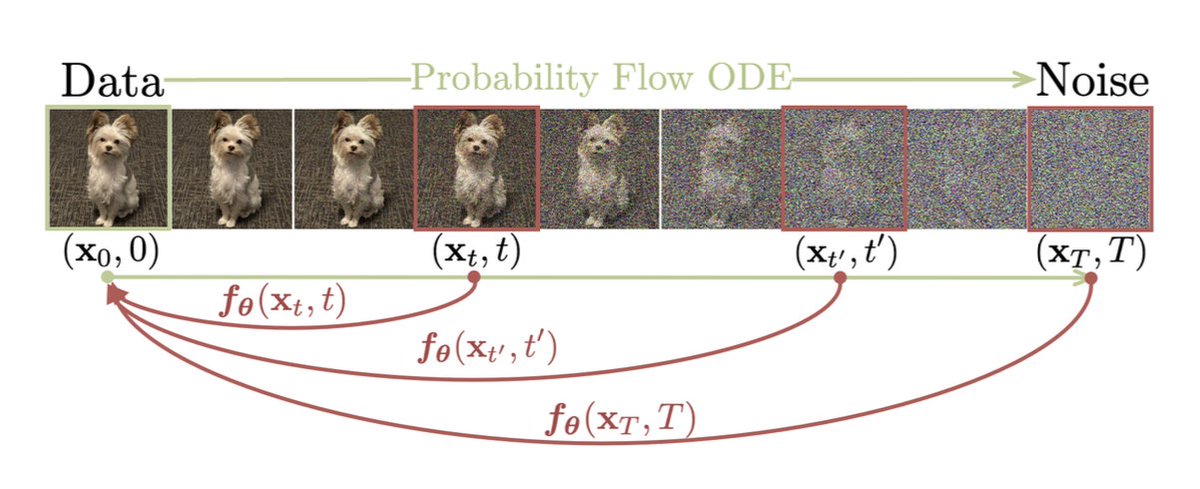
-> slowly destroy data with noise -> learn to reverse it
sounds simple but that’s the seed
then comes
"generative modeling by estimating gradients of the data distribution" (song and ermon, 2019)
-> learn gradients of data distribution -> understand where real images live
this is where score-based models come in
then things get real with
"denoising diffusion probabilistic models" (ho et al., 2020)
-> clean probabilistic formulation -> stable training -> actually works
this paper made diffusion practical
then
"diffusion models beat gans on image synthesis" (dhariwal and nichol, 2021)
-> diffusion > gans
this was a big shift
but still slow as hell
then the most important jump imo
"high-resolution image synthesis with latent diffusion models" (rombach et al., 2021)
-> compress images with vae -> run diffusion in latent space -> huge speedup
this is literally the backbone of stable diffusion
parallel to all this you have
"learning transferable visual models from natural language supervision" (radford et al., 2021)
-> align text and images -> enable text-guided generation
that’s clip
and finally stable diffusion (rombach et al., 2022 release implementation)
-> vae + unet + clip -> trained on large-scale data like laion
what’s crazy is the core idea never changed
add noise -> remove noise -> repeat
but layered with better math, better architectures, and better data
also something about this feels kinda philosophical
instead of solving a hard problem directly
they broke it into tiny easy steps
don’t generate an image
just make it slightly less noisy each time
again -> again -> again
and somehow that builds something meaningful