Anja Forche retweetou
Anja Forche
3K posts

Anja Forche retweetou
Battle of the bugs: how an oomycete pathogen shapes the microbiota of its host: an @NewPhyt perspective authored by @rovenich on the recently published beautiful work by @Kemen_Lab can be found here >> doi.org/10.1111/nph.19…
English
Anja Forche retweetou

Rapid Evolution of Multidrug Resistance in a Candida lusitaniae Infection during Micafungin Monotherapy dlvr.it/Ss020H
English
Anja Forche retweetou

We wrote a review on the importance of stress-responsive calcium-calcineurin signaling in fungal pathogens and how understanding this signaling cascade can be extremely fruitful. Read on -
Calcineurin: The Achilles’ heel of fungal pathogens
journals.plos.org/plospathogens/…

English
Anja Forche retweetou

Alzheimer's GWAS gets a diversity boost with new samples from Hispanics, African Americans and East Asians leading to novel ancestry-specific signals (e.g. PTPRK, GRB14).
A new preprint from Alzheimer's disease genetics consortium (ADGC)
medrxiv.org/content/10.110…
English
Anja Forche retweetou

Fantastic postdoc opportunity in a great lab doing smart science and with a supportive advisor! Apply!
Peter Lind@PeterALind
We have a 2-year postdoc fellowship available in the Lind Lab at Umeå University, Sweden! Predicting and guiding experimental evolution of antibiotic resistance in Pseudomonas aeruginosa. RTs appreciated. euraxess.ec.europa.eu/jobs/125061

English
Anja Forche retweetou

Pangene is a new tool for constructing a pangenome gene graph from multiple assemblies: github.com/lh3/pangene. You can explore the rich haplotypic diversity of human genes at pangene.liheng.org. Still WIP.
English
Anja Forche retweetou

Assistant Professor in Evolutionary Biology at the University of Vermont: uvmjobs.com/postings/64857. Broad expertise in theoretical and experimental approaches, such as evolutionary theory, phylogenetics and systematics, and molecular evolution. Review begins Sept. 1, 2023.
English
Anja Forche retweetou

I'm looking for PhD and Master's students to join the lab!
We're broadly interested in experimental evolutionary dynamics with a slight lean towards host-parasite coevolution and computational approaches. zeeelab.com
Find me at @sacnas!
[plz rt b4 twitter dies]
English
Anja Forche retweetou

Anja Forche retweetou

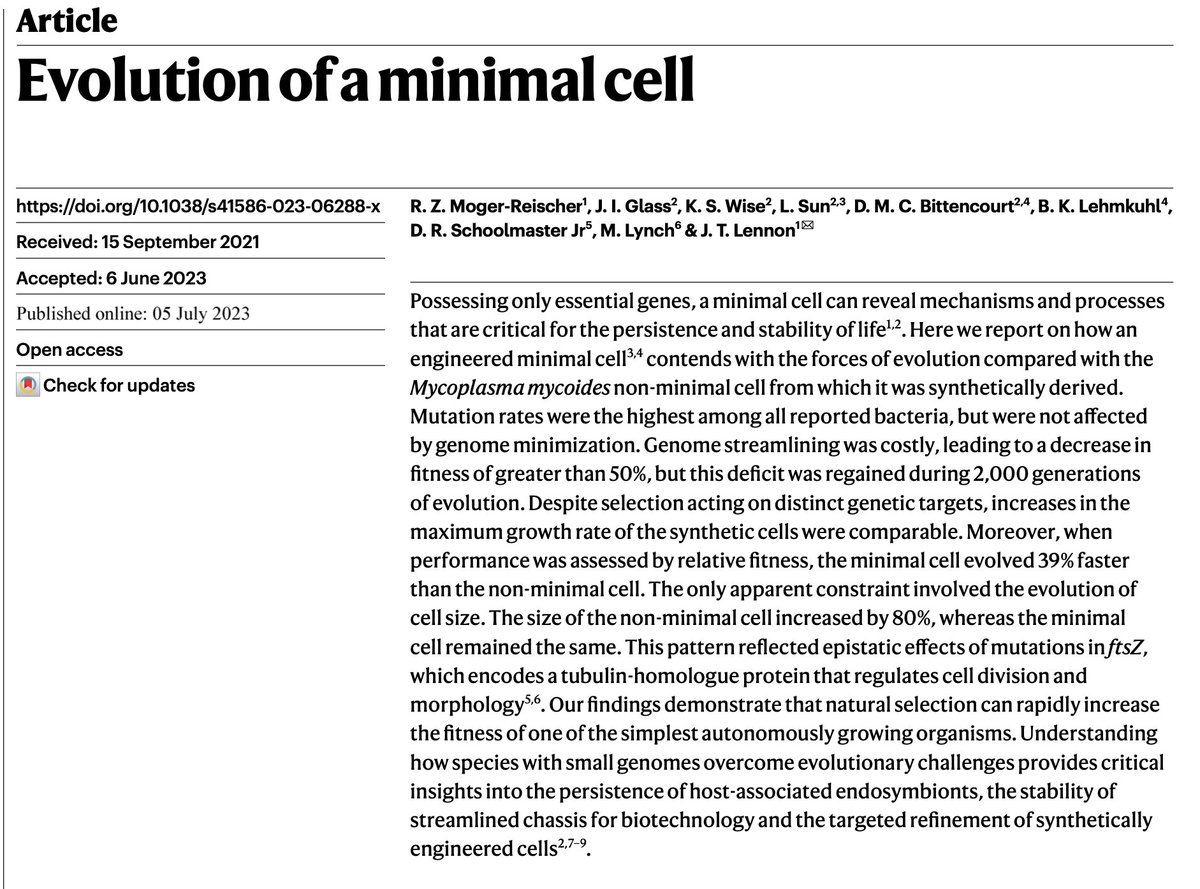
A mind-blowing paper has come out today in @Nature
In 2016, JC Venter Institute scientists trimmed a bacterial genome to its barest minimum required for life to synthesize what they called a "minimal genome" (science.org/doi/10.1126/sc…).
Today, a group of scientists from Indiana University reports how that minimal genome evolved over 2000 generations in comparison to the non-minimal genome.
The authors found that even when you reduce a bacterial genome to its absolute minimum where every nucleotide matters, the genome undergoes mutational events generation after generation as much as the non-minimal genome. One simply cannot stop the evolution.
Just over 300 days of evolution (equivalent to 40,000 years in humans) the minimal cell has gained everything it lacked in fitness on day one in comparison to the non-minimal cell.
When comparing the evolved traits between the minimal and non-minimal cells, the scientists found something striking. The evolutionary process increased the cell size of non-minimal cells but not that of the minimal cell. But that is not the striking part.
The scientists were able to identify the key mutation that resulted in cell size evolution. And it turned out that the mutation that helped the non-minimal cells to grow bigger is the same that helped the minimal cells to stay smaller. Growing bigger had a survival advantage for non-minimal cells and not growing bigger had a survival advantage for minimal cells. So, the mutation had a context-dependent effect. This just demonstrates that the evolutionary effects on traits have no absolute direction. All that matter is what is beneficial for the organism's survival.
The conclusion of the paper is metaphorically a quote from the Jurassic Park movie:
“Listen, if there’s one thing the history of evolution has taught us is that life will not be contained. Life breaks free. It expands to new territories, and it crashes through barriers painfully, maybe even dangerously, but . . . life finds a way". (scienmag.com/artificial-cel…)
nature.com/articles/s4158…

English
Anja Forche retweetou

Check out our new paper by the extremely talented postdoc @James__Cornwell out now in @Nature. For decades it was thought the cell cycle was irreversible, but now we show that is not the case.
nature.com/articles/s4158…
English
Anja Forche retweetou

Researchers carried out a screen to identify small molecules that could restore susceptibility of pathogenic Candida species to azole antifungals. Learn more in @mbiojournal: asm.social/1ja

English
Anja Forche retweetou

UPDATED!
We have updated our large database of POSTDOC fellowships.
373 types of fellowships in all fields.
Each entry provides a description, link, $ amount, deadline, eligibility criteria.
Download this database here: research.jhu.edu/rdt/funding-op…

English
Anja Forche retweetou

Jane is a future leader in fungal pathogenesis - come and hear her great work at the BMS annual scientific meeting!
British Mycological Society@BritMycolSoc
How has the human #fungal pathogen Candida glabrata evolved to withstand challenges from both environmental and imposed drug stresses? Jane Usher will explain all at the Annual Scientific Meeting! Book your place at: britmycolsoc.org.uk

English
Anja Forche retweetou

Online Now: Transcription factors interact with RNA to regulate genes dlvr.it/SrdGMP
English
Anja Forche retweetou

I have a 2 year Wellcome Trust funded post-doc position in my group as part of an exciting collaborative project with @SarahCoulthurs1 and a great team studying T6SS-mediated fungal attack. Please RT
jobs.ncl.ac.uk/job/Newcastle-…
English