Bloop but now BURN

2K posts

Bloop but now BURN banner
Bloop but now BURN

Bloop but now BURN

@Economini

"If you don’t believe it or don’t get it, I don’t have the time to try to convince you, sorry." Satoshi Nakamoto

Entrou em Şubat 2021
1.3K Seguindo77 Seguidores
Bloop but now BURN
Bloop but now BURN@Economini·
@volosatovde Thanks... bro... it's a demo to understand the logic and applications... there are also tests, code and private
English
0
0
0
7
Dmitrii Volosatov
Dmitrii Volosatov@volosatovde·
Build in public means showing what you’re building. Share your product. Drop the link below 👇
English
62
1
37
1.5K
Bloop but now BURN
Bloop but now BURN@Economini·
@W33Z_global RobyRoy AIOS is presented here as a governed execution architecture for AI-assisted systems. This public repository explains how the project approaches execution control, tool access mediation, result handling, and auditability. github.com/Podcast72/roby…
English
0
0
0
9
Weedsdom
Weedsdom@W33Z_global·
It’s that time of the day Founders what are you building? Let’s send traffic!
Weedsdom tweet media
English
89
2
49
2.2K
Bloop but now BURN
Bloop but now BURN@Economini·
@ardent__dev RobyRoy AIOS is presented here as a governed execution architecture for AI-assisted systems. This public repository explains how the project approaches execution control, tool access mediation, result handling, and auditability.github.com/Podcast72/roby…
English
0
0
0
10
Ardent_Dev
Ardent_Dev@ardent__dev·
What are you building? Let's drive traffic to your product 👇🏽
English
135
1
58
4K
Eric Luevano
Eric Luevano@ericjluevano·
I’m 33. I make $40k/month. I owe it all to the world’s most boring strategy. Here’s what I do (& how you can too):
English
7
34
332
149.6K
Bloop but now BURN
Bloop but now BURN@Economini·
RobyRoy AIOS is presented here as a governed execution architecture for AI-assisted systems. This public repository explains how the project approaches execution control, tool access mediation, result handling, and auditability. github.com/Podcast72/roby…
English
0
0
0
5
Tibo
Tibo@thsottiaux·
Don't just reset Codex rate limits for fun, it costs money. Don't just reset Codex rate limits for fun, it costs money. ... but the vibes are good ... I have reset Codex rate limits for ALL paid plans to celebrate a good week and allow everyone to build more with GPT-5.5. Enjoy
English
1.5K
762
17K
1.1M
Elora khatun
Elora khatun@elora_khatun·
Most people say "build an AI agent." Very few know what that actually means. Here’s the real blueprint to go from idea → working agent 👇 1. Define the job What problem are you solving? Who’s the user? What does success look like? 2. Design the brain Clear system prompt, role, instructions, guardrails (This is where most agents fail) 3. Pick the right model Speed vs cost vs intelligence Don’t overpay for simple tasks 4. Add tools APIs, databases, MCP servers, custom functions Agents become powerful when they can act, not just answer 5. Give it memory Short-term + long-term context So it learns, adapts, and improves over time 6. Orchestrate everything Workflows, triggers, retries, agent-to-agent communication 7. Build the interface Chat, app, API, Slack bot Make it usable, not just functional 8. Test + improve Evals, latency checks, real-world feedback Iteration is the real moat 💡 Truth: An “AI agent” isn’t one prompt. It’s a system. And the people who understand systems… are the ones building unfair advantages right now. 📌 Save this (you’ll need it when you build) 🔁 Repost for builders ➕ Follow @elora_khatun for practical AI breakdowns (no fluff) 🚀
Elora khatun tweet media
English
87
336
1.4K
94.6K
Erina | AI Tools & News
Erina | AI Tools & News@AITechEchoes·
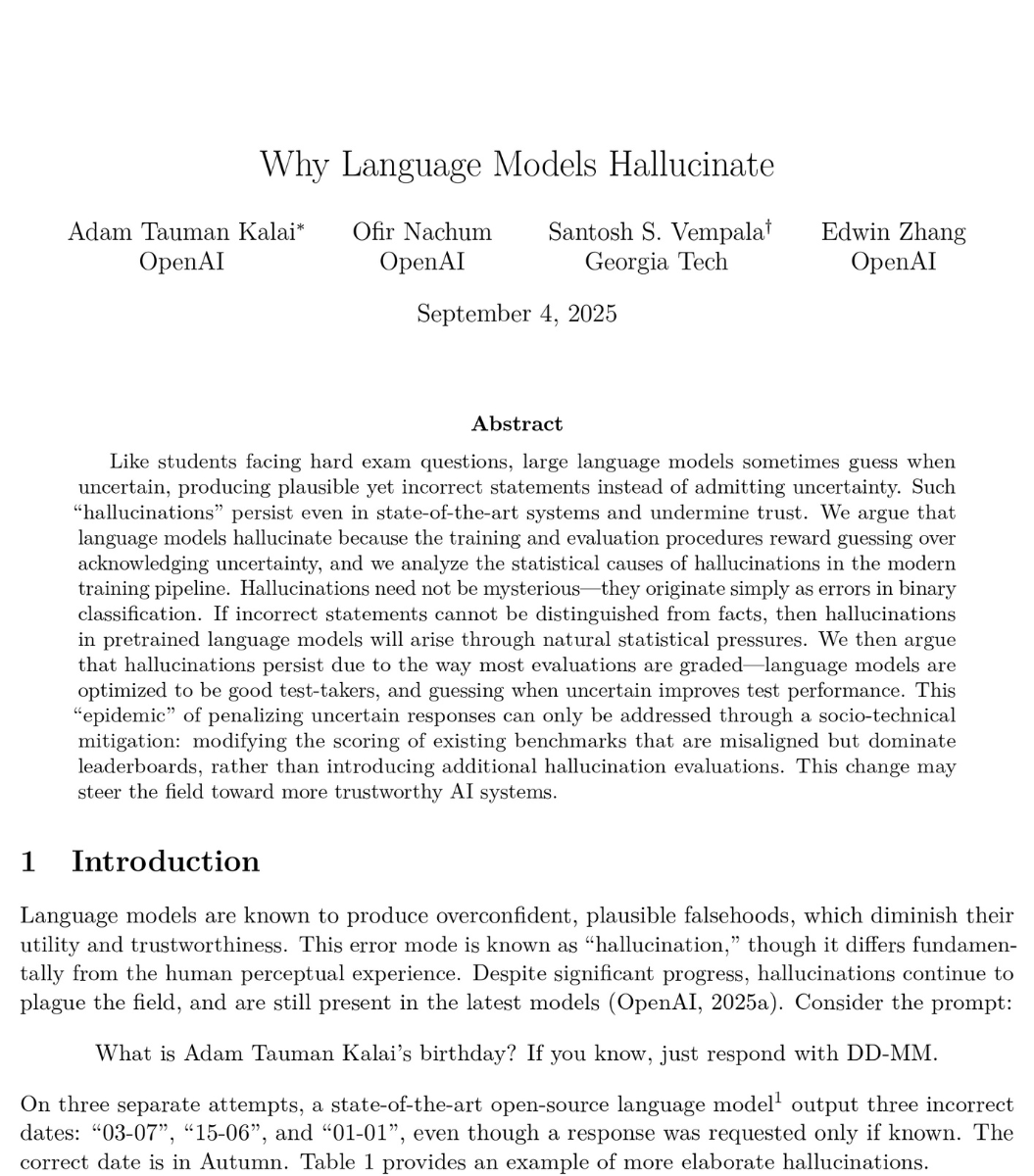
🚨BREAKING: OpenAI published a paper proving that ChatGPT will always make things up. Not sometimes. Not until the next update. Always. They proved it with math. Even with perfect training data and unlimited computing power, AI models will still confidently tell you things that are completely false. This isn't a bug they're working on. It's baked into how these systems work at a fundamental level. And their own numbers are brutal. OpenAI's o1 reasoning model hallucinates 16% of the time. Their newer o3 model? 33%. Their newest o4-mini? 48%. Nearly half of what their most recent model tells you could be fabricated. The "smarter" models are actually getting worse at telling the truth. Here's why it can't be fixed. Language models work by predicting the next word based on probability. When they hit something uncertain, they don't pause. They don't flag it. They guess. And they guess with complete confidence, because that's exactly what they were trained to do. The researchers looked at the 10 biggest AI benchmarks used to measure how good these models are. 9 out of 10 give the same score for saying "I don't know" as for giving a completely wrong answer: zero points. The entire testing system literally punishes honesty and rewards guessing. So the AI learned the optimal strategy: always guess. Never admit uncertainty. Sound confident even when you're making it up. OpenAI's proposed fix? Have ChatGPT say "I don't know" when it's unsure. Their own math shows this would mean roughly 30% of your questions get no answer. Imagine asking ChatGPT something three times out of ten and getting "I'm not confident enough to respond." Users would leave overnight. So the fix exists, but it would kill the product. This isn't just OpenAI's problem. DeepMind and Tsinghua University independently reached the same conclusion. Three of the world's top AI labs, working separately, all agree: this is permanent. Every time ChatGPT gives you an answer, ask yourself: is this real, or is it just a confident guess?
Erina | AI Tools & News tweet media
English
93
195
436
34.7K
Romain Huet
Romain Huet@romainhuet·
Hello builders! What did you build this weekend with Codex + GPT-5.5? Drop it below, I’d love to see what you made!
English
164
10
258
29.3K
Bloop but now BURN
Bloop but now BURN@Economini·
@ZabihullahAtal RobyRoy AIOS is presented here as a governed execution architecture for AI-assisted systems. This public repository explains how the project approaches execution control, tool access mediation, result handling, and auditability. github.com/Podcast72/roby…
English
0
0
1
114
Atal
Atal@ZabihullahAtal·
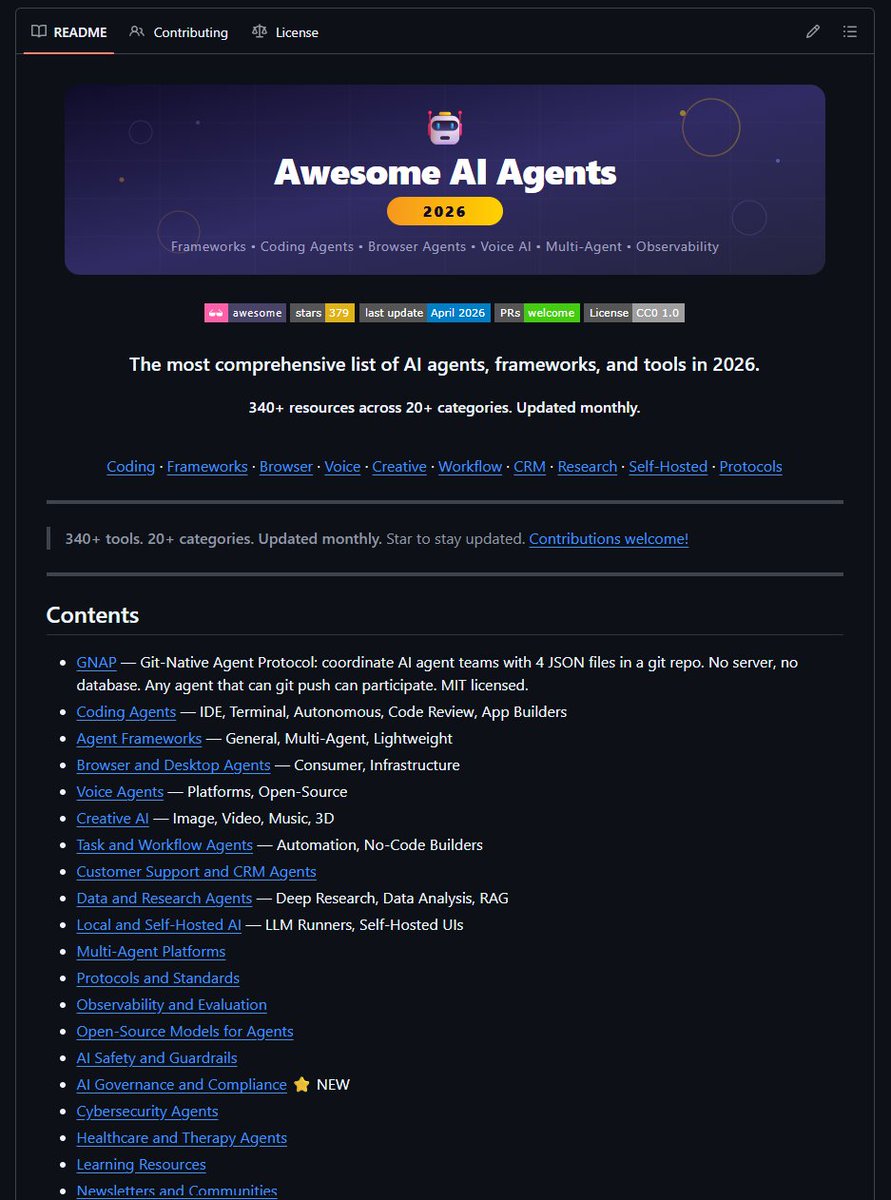
🚨 BREAKING: The AI world is rapidly shifting from prompts to autonomous agents that can plan, decide, and execute tasks end-to-end. I just found a GitHub directory compiling the entire AI agent ecosystem in one place. Frameworks, tools, and real use cases (constantly updated.) Literally This repository maps the entire emerging ecosystem of AI agents: • Autonomous agents that complete complex workflows • Multi-agent systems coordinating hundreds of tasks • Frameworks like AutoGPT, CrewAI, LangGraph • Real-world use cases across business, coding, and research It highlights a critical shift: AI is no longer just a tool you prompt. It is becoming a system that operates. Instead of giving instructions step-by-step, you define goals… and agents handle planning, execution, and iteration. This creates a new dynamic. Traditional AI use: Human → Prompt → Output Agent-based AI: Human → Goal → System → Actions → Results The difference is massive. One generates answers. The other replaces workflows. The directory also shows how fast this space is evolving. New agent frameworks, architectures, and use cases are being added constantly. Which means: The real skill is no longer prompting… It’s designing systems of agents that can think, collaborate, and act. This is where the next major leverage comes from. As AI agents improve, the focus shifts from doing work to orchestrating systems that do work for you. This marks a deeper transition in AI: From tools that assist humans to systems that operate alongside (or instead of) them. check the directory below:
Atal tweet media
English
19
49
227
13.4K
Atal
Atal@ZabihullahAtal·
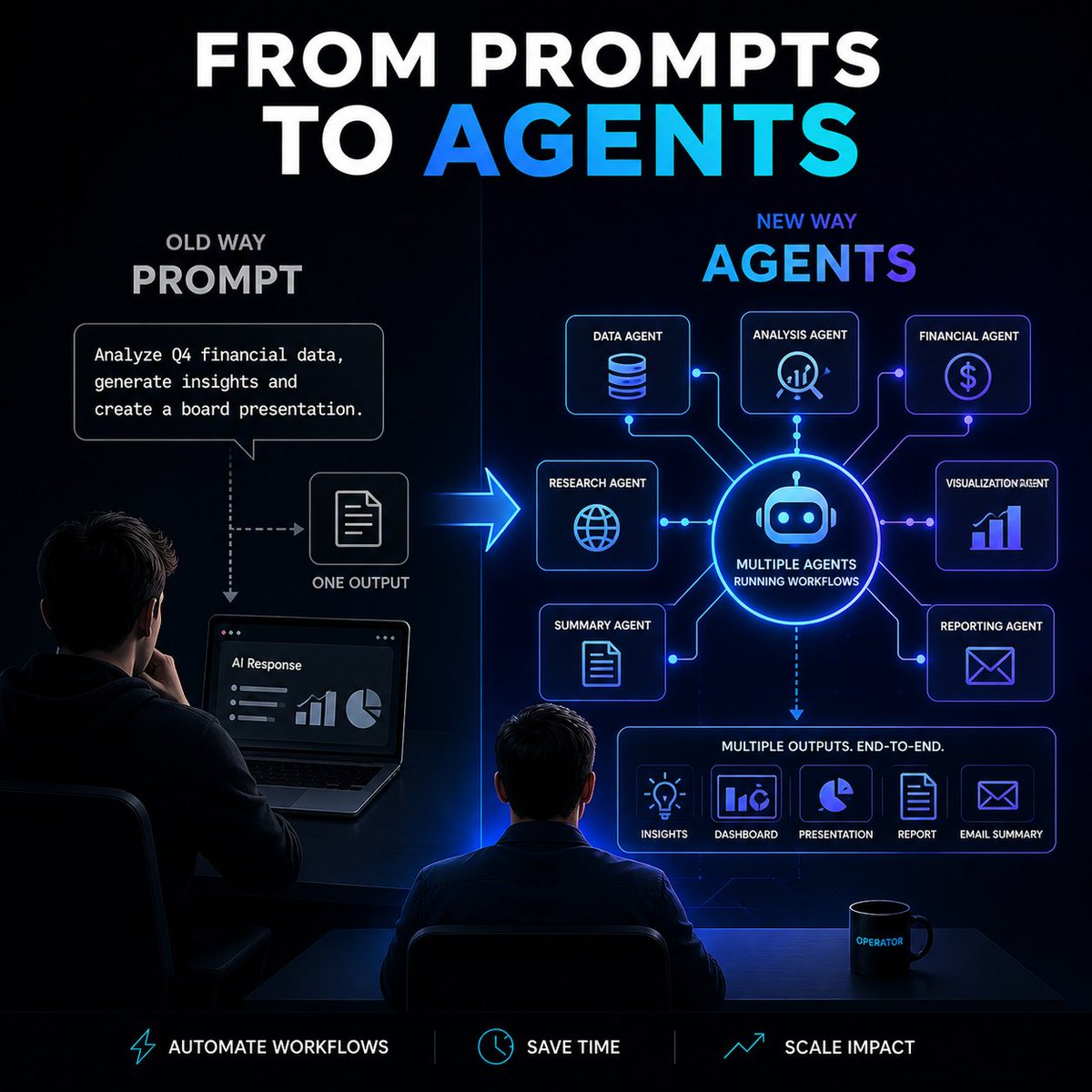
🚨 BREAKING: Building and operating agents is the next million-dollar skill Organizations are shifting from prompting AI to building agents that run workflows and complete tasks end to end. within the next few years, almost every company will run multiple agents. and a new role to operate them "Agent Operator" will emerge, so but how can someone actually build and operate agents? Here is a step-by-step roadmap: 1. Start with a problem, not the AI Agents don’t start with tools. They start with problems. If a task is: • repetitive • structured • time-consuming It can become an agent. 2. Turn the task into a system actually every agent is just a loop: • Input • Process • Output • Feedback map this clearly, otherwise the agent won’t work. 3. Define the agent like a machine You don’t “prompt” an agent. You define: • Role → what it is • Goal → what success looks like • Rules → boundaries • Tools → what it can use • Output → exact format Clarity here = reliability later 4. Give it the ability to act and execute without tools, it’s just text. with tools, it becomes execution: • Browsing • Code execution • APIs • Docs / Sheets This allows your agents stop talking and start acting and executing 5. Run it as a loop, not a one-shot Agents don’t work perfectly once. Operators design: • run • check • fix • repeat Iteration makes it perfect, it is same like iterative software engineering model. 6. Add memory and context, this is very important because Good agents don’t restart every time. They remember: • past outputs • preferences • ongoing tasks This turns them into systems that improve over time 7. Operate, don’t interfere Your role is not to “use” the agent. It’s to: • monitor failures • refine instructions • improve flow • remove friction I simple words i can say a better system → better output 8. Scale what works and save your time Once one workflow works: • duplicate it • connect agents • build multi-agent systems Now you’re not only saving time but You’re building execution infrastructure Remember Don't only focus on: • prompts • tools • interfaces focus and always try to turn messy work into clean, repeatable systems and this is important because: Every company is moving toward: • automated workflows • agent-driven execution • smaller teams, higher output SO The future bottleneck is the people who can make it worki I hope you found this inspiring, For more such valuable posts you can follow me @ZabihullahAtal
Atal tweet media
Atal@ZabihullahAtal

🚨 BREAKING: A new role is quietly emerging and it’s about to dominate the next 5 years. It’s not “AI engineer.” It’s not “prompt engineer.” It’s the Agent Operator. And it will sit inside almost every organization. Most people are still thinking about AI as a tool. That framing is already outdated. What’s actually happening is a shift from: humans using software to humans managing autonomous agents that execute work This is a fundamental redesign of how work gets done. So what is an Agent Operator? An Agent Operator is the person who: • Designs how agents interact with real workflows • Connects tools, data, and systems into agent pipelines • Translates business problems into executable agent behavior • Monitors, corrects, and improves agent performance over time They don’t just “use AI.” They orchestrate outcomes. and this matter because Every function marketing, legal, finance, biotech is becoming “agent-compatible.” Not because companies want it. Because they won’t have a choice. Agents can: • Run research loops • Execute multi-step workflows • Integrate across tools without APIs breaking the flow • Operate 24/7 at near-zero marginal cost The bottleneck is no longer capability. It’s implementation inside real-world systems. Required skills for AI Agent Operator role: → MCPs (Model Context Protocols) Understanding how agents access tools, memory, and structured context. → CLIs (Command Line Interfaces) Because serious agent workflows won’t live in GUIs—they’ll run in programmable environments. → Writing skills (the file kind) Clear specs, instructions, and structured documents. Agents run on precision, not vibes. → agents dot md fluency The ability to define agent roles, constraints, memory, and tool usage in persistent formats. → Business acumen Knowing what actually matters: Where automation creates leverage, not noise. What happens next Enterprises will begin to redesign workflows: Not around employees using dashboards… But around agents executing tasks. That means: • SOPs → Agent playbooks • Teams → Human + agent hybrids • Tools → Composable agent systems When that shift happens, companies won’t just need engineers. They’ll need operators who understand both the system and the business. The leverage is asymmetric One strong Agent Operator can: • Replace fragmented SaaS workflows • Multiply team output without adding headcount • Turn ideas into execution systems in days This is not incremental productivity. It’s operational transformation.


English
13
80
252
38.3K
Greg Brockman
this has one of the most exciting launch weeks in OpenAI's history, with a goal of making agents more real, useful, and accessible for all our users. codex can now smartly do much more on your computer, remember more of your context, and run more ongoing work independently.
English
175
117
3.1K
164.2K
Bloop but now BURN
Bloop but now BURN@Economini·
@montemagno Proprio per evitare gli “agenti impazziti “ sto sviluppando questo github.com/Podcast72/roby… governa il modo in cui gli agenti di intelligenza artificiale eseguono azioni. È una demo il tool è privato . Ti va di parlarne ?
Italiano
0
0
2
628
Marco Monty Montemagno
Marco Monty Montemagno@montemagno·
"Con ChatGPT gratis puoi realizzare i tuoi sogni." Una clamorosa cavolata. Te lo dice uno che sta costruendo una startup da solo, da non programmatore, con agenti AI h24. Costo attuale: circa 2.500 sterline al mese solo di strumenti (senza contare il mio tempo). Per carità: rispetto a fondare una startup 20 anni fa — venture capital, friends & family, sei mesi prima di vedere una riga di codice — sono cifre ridicole. Prima non potevi nemmeno iniziare. Oggi sì. Ma "oggi sì" non vuol dire "gratis". Se stai pensando di lanciare qualcosa in vibe coding da non tecnico, 7 cose che ho imparato sulla mia pelle: 1. I costi sono reali. Claude Code, VPS, un cinema infinito di API. Si sommano in fretta. Metti in piedi un controllo costi serio da subito, altrimenti ti svegli con $200 bruciati in un giorno per un loop impazzito. 2. It's fucking hard. Se vuoi giocare, è facile. Se vuoi fare una cosa seria che funziona davvero, è sangue, sudore e lacrime. Tra 12 mesi sarà diverso. 3. Diventa ossessione. Il loop non finisce mai. C'è sempre una nuova feature, un nuovo paper, un nuovo tool. Puoi stare h24 senza accorgertene. Ma quando succede smetti di fare l'imprenditore e inizi a fare il programmatore. Che non è il tuo mestiere. 4. Non sai quello che non sai. Non sai che non devi lasciare una porta aperta sul server. Non sai cosa sia la rotazione delle chiavi API. Non sai che Claude non deve leggere il tuo file .env. Lo impari scottandoti. 5. Le allucinazioni esistono davvero. "Hai fatto il backup?" "Sì." Vai a controllare: non c'è. "Hai ragione, adesso lo faccio." Zero fiducia, verifica sempre. 6. Stai accumulando debito tecnico. Il prototipo funziona oggi. Con 50.000 richieste al mese probabilmente no. Abituati all'idea: se il progetto funziona, prima o poi lo dovrai rifare da zero. 7. La solitudine del vibe coder. Niente call center. Va giù Claude Code? Stai lì e aspetti. Pensa in anticipo ai piani B. Due cose invece che mi stanno cambiando la vita: → Smetti di parlare con gli "agenti". Parla con un assistente. Un unico interlocutore, come un AD. Tu dai la direzione, lui coordina il resto. → Passa il prima possibile da babysitter a investitore. Costruisciti un control plane di agenti che controllano altri agenti. Editoriale, publisher, incident response, scout, SEO, security. E soprattutto un Cost Guardian che alza la mano quando i costi esplodono. La verità spiacevole è questa: non è gratis, non è facile, e non è per tutti. Ma siamo in un guado di 12 mesi in cui la stragrande maggioranza delle persone non sa ancora usare una mazza di niente. Se azzecchi il timing, l'opportunità è enorme. Basta non credere a chi ti racconta che bastano $20 al mese. (Questo post è stato scritto da AI partendo da un video di Monty)
Italiano
9
6
66
13K
Bloop but now BURN
Bloop but now BURN@Economini·
@W33Z_global RobyRoy AIOS is presented here as a governed execution architecture for AI-assisted systems. This public repository explains how the project approaches execution control, tool access mediation, result handling, and auditability. github.com/Podcast72/roby…
English
0
0
1
13
Weedsdom
Weedsdom@W33Z_global·
Good morning Founders Drop your product! Let’s send traffic!
Weedsdom tweet media
English
165
3
88
4.8K
Ronan Berder
Ronan Berder@hunvreus·
Talking to smarter folks than me, I'm convinced many of the AI folks in my timeline are full of shit. Nobody is "running 20 agents over night" and building stuff for actual users. Maybe some are building internal tools or disposable software. Maybe. But building software people like using? That doesn't get hacked on day one or blow up after the 3rd user? Nope. I don't even understand what that's supposed to look like. Do you work out a 57 pages document that perfectly describes what you want to build and then summon 14 agents and have them run wild for 6 hours? And what comes out on the other end isn't a broken pile of shit? Nope. Not buying it. PS: it may also be that I have an IQ of 82 and can't figure it out.
English
670
271
4.9K
833.4K
Tibo
Tibo@thsottiaux·
Stop tweeting for a hot minute and update your Codex App to find full browser use, global dictation, non-dev mode, a new auto-review mode that is much safer than yolo, in-app docs and PDF viewer, and ... GPT-5.5.
OpenAI Developers@OpenAIDevs

With GPT-5.5, Codex now gets more of the job done across the browser, files, docs, and your computer. We've expanded browser use so Codex can interact with web apps, and test flows, click through pages, capture screenshots, and iterate on what it sees until it completes the task.

English
304
192
3.6K
308K
𝑮𝒂𝒖𝒕𝒊𝒆𝒓🦁💙
Le rêve des vibes codeurs : construire un SaaS en solo, gagner 10k par mois, travailler à distance de n'importe où dans le monde. La réalité: lancer son Saas et ensuite essayer de comprendre pourquoi personne ne lutilise.
Français
59
35
706
66K