Musinguzi Laban

1.2K posts

Musinguzi Laban banner
Musinguzi Laban

Musinguzi Laban

@LabanM1241

Civil Engineer | Leader | Public Speaker|Communitarian and collectivist | Singer and writer🎵 | 7thDay Adventist.

Uganda- Kampala. Entrou em Nisan 2023
1K Seguindo387 Seguidores
Musinguzi Laban retweetou
Buregyeya Apollo, PhD
Buregyeya Apollo, PhD@ApolloBuregyeya·
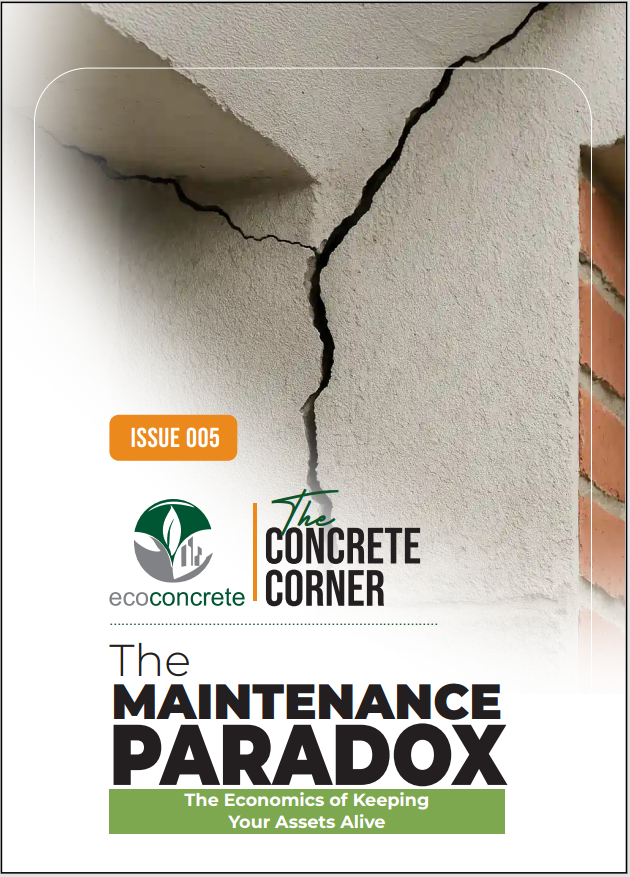
The Maintenance Paradox. The Economics of Keeping Your Assets Alive. Welcome to Issue 005 of The Concrete Corner. The Maintenance Paradox the-concrete-corner.beehiiv.com/p/the-maintena… It is our pleasure to present this fifth edition of The Concrete Corner, Eco Concrete Ltd's technical newsletter dedicated to practical discussions on engineering, infrastructure, construction materials, and the long-term performance of the built environment. This issue focuses on a subject that is often overlooked until problems become unavoidable: maintenance. Across Uganda, enormous attention is given to the design and construction of buildings. New projects are celebrated, ribbon-cutting ceremonies are publicized, and impressive structures reshape our skylines. Yet the true success of a building is not determined on the day construction is completed. It is determined by how well that asset performs over the decades that follow. This reality creates what we call the Maintenance Paradox. Many property owners postpone maintenance to save money, yet the very act of postponing maintenance often creates the highest future costs. A leaking roof becomes structural deterioration. A blocked drain becomes foundation distress. Failed waterproofing becomes extensive rehabilitation. What appears to be a saving today frequently becomes a significantly larger expense tomorrow. Buildings rarely fail suddenly. They deteriorate gradually through small defects that go unnoticed, unreported, or unresolved. Water ingress, corrosion, cracking, drainage failures, service breakdowns, and deferred repairs quietly accumulate until they eventually disrupt operations, reduce property value, and demand costly interventions. In this edition, we examine maintenance not as an expense, but as an investment in asset preservation and performance. We explore the economics of deferred maintenance, compare planned and reactive maintenance strategies, discuss lifecycle costing, and provide practical approaches for inspections, preventive maintenance, and maintenance record management. We also present real-world examples from the Ugandan property sector demonstrating how maintenance philosophy directly influences durability, tenant satisfaction, occupancy rates, operating costs, and long-term asset value. In a country characterized by heavy rainfall, intense solar exposure, growing urban density, and increasing demands on buildings and infrastructure, maintenance can no longer be treated as an afterthought. It is an essential component of responsible asset management. A well-maintained building does more than remain functional. It protects investment, preserves dignity, improves user experience, extends service life, and delivers stronger financial returns throughout its lifecycle. We invite property owners, developers, engineers, architects, facility managers, and construction professionals to join this conversation and to reflect on a simple question: Is your building being maintained as an asset, or is it quietly being allowed to become a liability? We thank you for reading and for being part of the growing Concrete Corner community. Kind regards, The Concrete Corner Team Eco Concrete Ltd admin@ecoconcrete.co.ug +256 781 994 833
Buregyeya Apollo, PhD tweet media
English
1
7
17
698
Musinguzi Laban retweetou
Buregyeya Apollo, PhD
Buregyeya Apollo, PhD@ApolloBuregyeya·
Do Engineers Design Earthquake-Proof Buildings? Hell NO! Nature Doesn't Allow It. ======= Following last night's earthquake, several people asked whether engineers design buildings to be earthquake-proof. The answer may surprise you, because the honest answer is no. Modern engineers generally do not design buildings to remain completely undamaged under every possible earthquake. Such a building would be technically difficult to achieve and, in many cases, economically impossible to justify. Instead, engineers design buildings to protect human life. The goal is not to guarantee that a building will never crack, but to ensure that if nature decides to conduct an audit, the people inside have the best possible chance of walking out safely. Many people think buildings only carry loads that push downward. We see roofs, walls, furniture, water tanks, and people pressing down through the structure, and these are what engineers call gravity loads. An earthquake is different because it introduces movement. The ground suddenly pushes, pulls, twists, and displaces the building, much like a taxi that suddenly brakes, accelerates, and swerves while your body tries to remain where it was. When the foundation moves, the upper parts of the structure resist that movement because of their mass. This creates forces that can crack walls, deform structural members, and stress connections throughout the building. This is why earthquakes are not simply weight problems. They are movement problems, and movement can be more destructive than ordinary vertical loads. Another important point is that a smaller earthquake can sometimes be more dangerous than a larger one. Magnitude is only one part of the story, because depth, distance from the epicenter, soil conditions, duration of shaking, and the rhythm of vibration all affect how dangerous a tremor becomes. A shallow earthquake can produce stronger shaking at the ground surface than a deeper earthquake of similar magnitude. Soft soils can amplify movement, while some buildings naturally sway at particular frequencies and may respond more severely when the ground motion matches that rhythm. This is why engineers rely on historical records, geological information, building codes, safety factors, and probability rather than certainty. A building that survives a severe earthquake with repairable damage may actually be evidence of good engineering, because the first responsibility of a structure is not to protect concrete and steel, but to protect human life. By Dr. Apollo Buregyeya, CEO, Eco Concrete Ltd ecoconcrete.co.ug
Buregyeya Apollo, PhD tweet media
English
1
6
24
935
Musinguzi Laban retweetou
Signum Advocates
Signum Advocates@Signumadvocates·
In 1981, a United States professor was conducting research for a book that she later published in 1988. She sat down with workers during a meal in the United States and discussed the possibility of machines taking over in the future. #LabourLawConf2026
English
4
117
406
20.9K
Musinguzi Laban retweetou
Buregyeya Apollo, PhD
Buregyeya Apollo, PhD@ApolloBuregyeya·
Kampala buildings just received a gentle reminder from the earth. ======= A magnitude 4.5 earthquake, reportedly centered around the Nakasongola area, was felt across the city. For many residents, it was a brief moment of surprise. For engineers, it was a reminder that gravity is not the only force a building may one day have to resist. Earthquakes are fascinating because they do not create weaknesses in structures. They reveal the weaknesses that already exist. What many people do not realize is that one of the most vulnerable moments in the life of a building is not when it is old. It is when it is under construction. Structural engineers design buildings assuming that concrete will achieve its required strength, beams and slabs will act together, walls will be completed, and the structure will function as an integrated system. During construction, however, that system is still being assembled. Concrete may be only a few days old. Temporary supports may still be carrying significant loads. Materials may be stockpiled unevenly on slabs. Some structural elements may be complete while others are still missing. Construction activities themselves can create load patterns that the finished building will never experience again. In simple terms, a building under construction often behaves differently from the building shown in the engineer's calculations. This is why construction engineering matters. A good engineer is not only concerned with whether a building will stand when completed. They are equally concerned with whether it will safely survive every stage between excavation and occupation. Fortunately, tonight's tremor appears to have been modest. However, it raises an important question for every developer and property owner. Who is managing the risks while your building is being built? Many people buy drawings. Some buy supervision. The wisest invest in engineering oversight throughout the entire construction process because structures rarely fail after the ribbon-cutting ceremony. They usually fail during the shortcuts, assumptions, and compromises made before it. Tonight, General Tremor paid Kampala a courtesy visit. Thankfully, he came carrying an inspection form rather than an enforcement notice.
Buregyeya Apollo, PhD tweet media
English
12
41
169
17.5K
Musinguzi Laban retweetou
Amon 👷
Amon 👷@rwenzori_·
A real architect is supposed to deliver such ideas. To many quacks in that field.
Amon 👷 tweet media
English
16
23
362
27.4K
Musinguzi Laban retweetou
Mr Charles (Remote Jobs)
Mr Charles (Remote Jobs)@MrCharlesky·
Can you stay awake from 1 AM - 4 AM every weekdays and work remotely? I have a remote job for you that pays $100/hr depending on input.
English
39.3K
1.4K
23.9K
2.7M
Musinguzi Laban
Musinguzi Laban@LabanM1241·
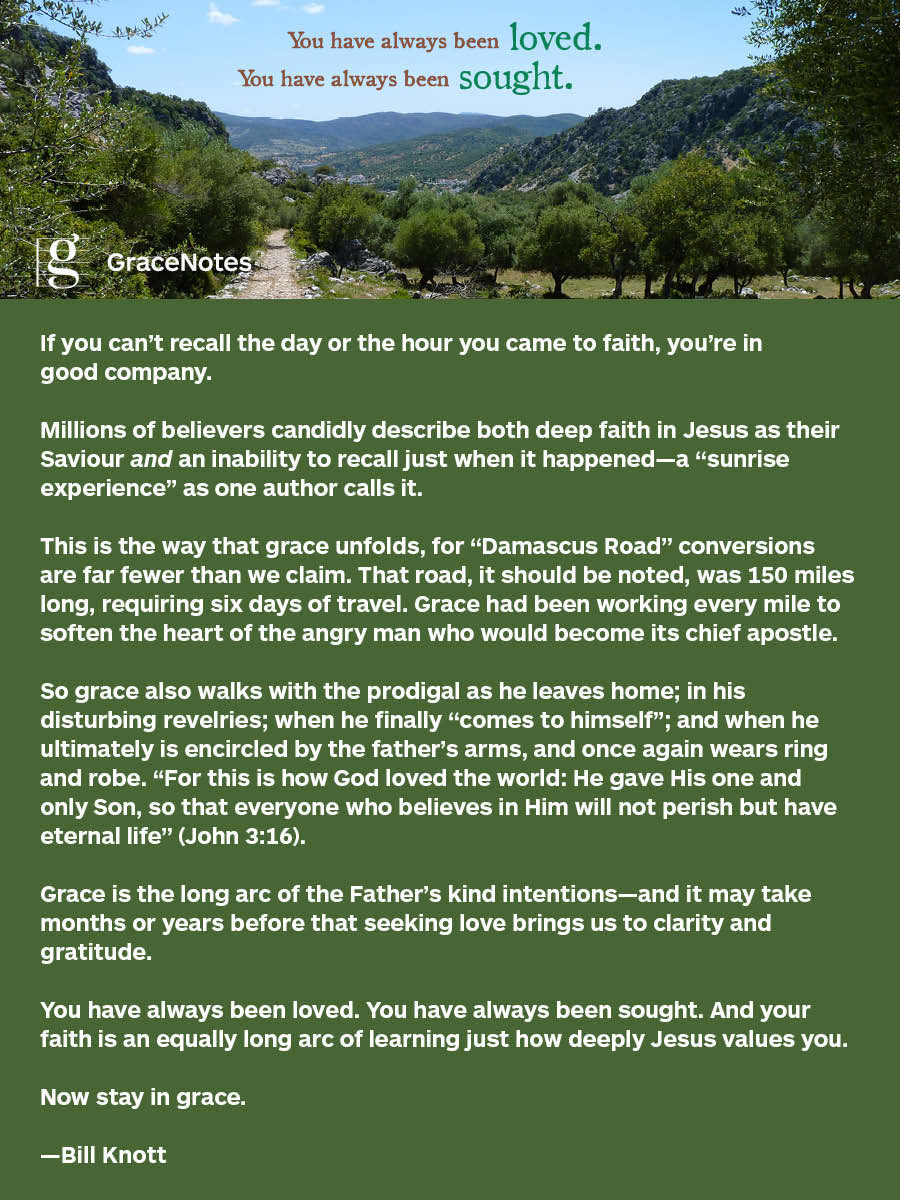
God in His grace, gave us rhythms of life-moments to work, to rest, moments to reflect, and moments to worship. The Sabbath stands as a beautiful gift of grace, reminding us that we are not sustained by our labor alone, but by His love, presence, and provision. #HappySabbath
Musinguzi Laban tweet media
English
0
0
2
58
Musinguzi Laban retweetou
Buregyeya Apollo, PhD
Buregyeya Apollo, PhD@ApolloBuregyeya·
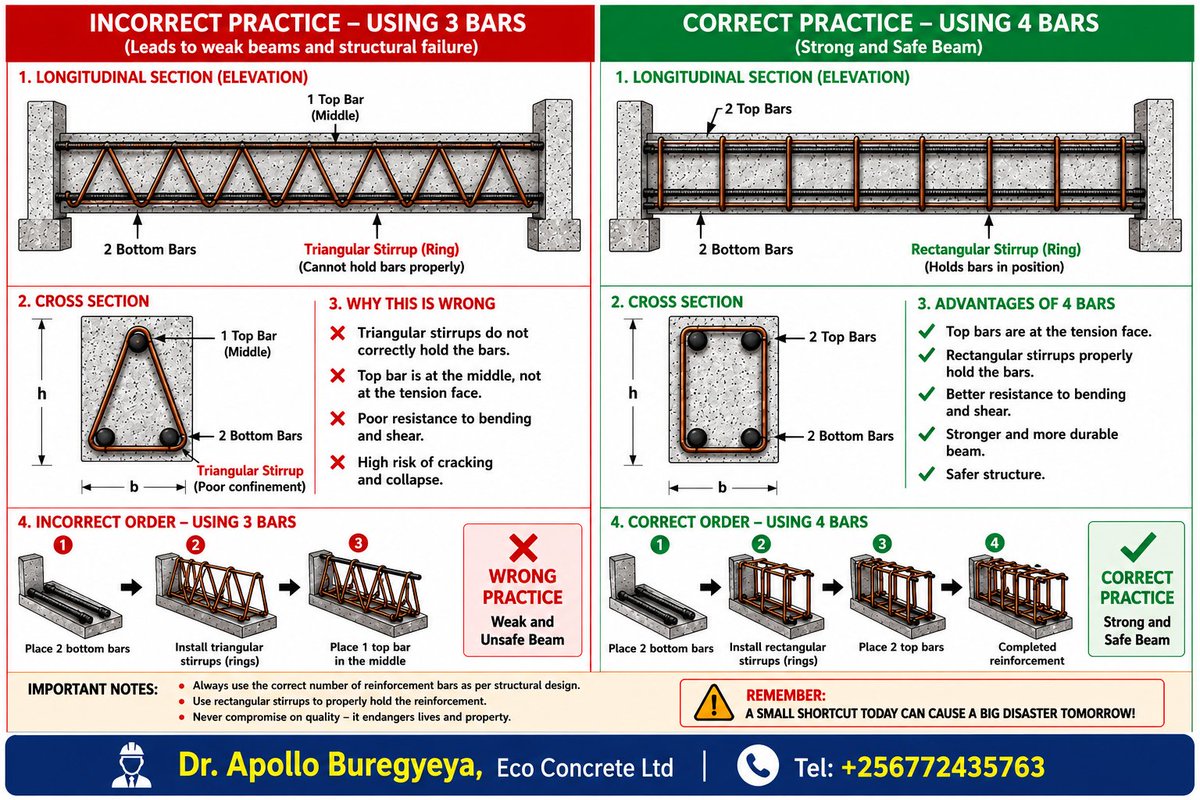
Why using 3 bars in a beam is dangerous. ======= In many residential sites in Uganda, some builders use a shortcut in reinforced concrete beams. Instead of placing 4 longitudinal bars, usually 2 at the bottom and 2 at the top, they use only 3 bars: 2 at the bottom and 1 at the top middle. At first, this may look like saving money. In reality, it is playing games with the safety of a building. A reinforced concrete beam does not only need steel to “be there.” The steel must be placed correctly so that the beam behaves properly under load. The bottom bars help resist bending where the beam wants to sag. The top bars help with support zones, continuity, restraint, cracking, and stability. The stirrups, commonly called rings, help resist shear, hold the bars in position, and confine the concrete. When you use 3 bars arranged like a triangle, you usually end up with triangular rings. That is where the real danger begins. Rings in a beam are not decoration. They are shear reinforcement. They are supposed to help the beam resist diagonal cracking, especially near supports where shear forces are high. Rectangular rings work because they enclose the beam properly, hold the bars in their right positions, and confine the concrete core. Triangular rings do this very poorly. They leave parts of the beam weak and unconstrained. They do not hold the reinforcement cage properly. They reduce confinement. They weaken shear resistance. In practical terms, the beam may behave almost as if proper shear reinforcement is missing. That kind of beam may not fail slowly. It can fail suddenly. A bad slab may show cracks. A bad column may show distress. But a beam with poor shear reinforcement can crack diagonally and fail without giving enough warning. That is why this shortcut is not small. It is dangerous. The money saved by removing one bar is very little compared to the risk created. You may save a few thousand shillings today and create a structural weakness that threatens a family for decades. A good beam needs proper detailing, not guesswork. Use the correct number of bars. Use proper rectangular stirrups. Follow structural drawings. Involve qualified engineers. Buildings do not collapse because cement is angry. They collapse because people ignore the small details that carry big loads. Build it right. Use 4 bars and rectangular rings. Safety is cheaper than failure.
Buregyeya Apollo, PhD tweet media
English
1
29
53
3.1K
Musinguzi Laban retweetou
Josephine Namakumbi
Josephine Namakumbi@NamakumbiJ·
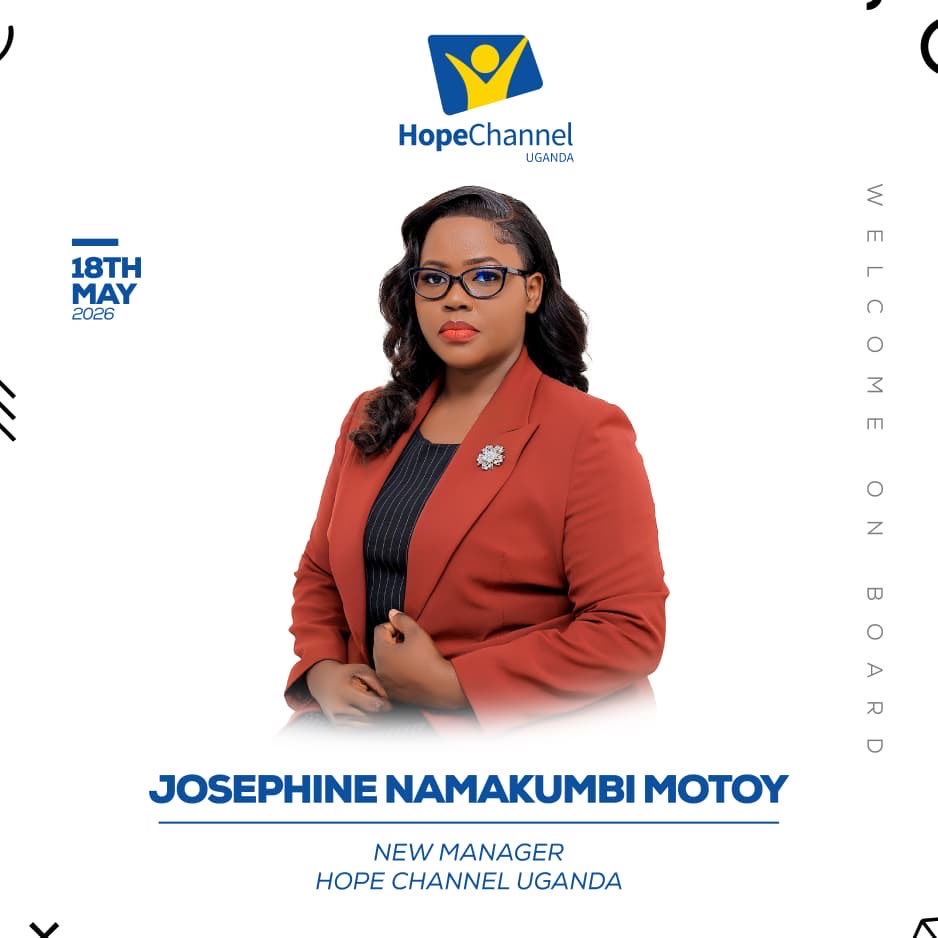
Dear colleagues, friends, sources, mentors, and loyal viewers, @HopeChannelUg is our new home. A new chapter begins. Thank you God🙏
Josephine Namakumbi tweet media
English
271
191
2K
80.6K
Musinguzi Laban retweetou
Joel Ssenyonyi
Joel Ssenyonyi@JoelSsenyonyi·
When we raised concerns about Jennifer Bamuturaki (Former CEO-Uganda Airlines), some people said we were just malicious. When we raised concerns about the Speaker, the same people said it was both malice and hatred. But as someone once said, give time some TIME! While I’m not confident at all that the regime is now serious about fighting corruption and bad governance (because that’s their DNA), at least this should be a lesson to leaders whom they use to do ridiculous things and then throw them under the bus!
English
519
1.3K
10.4K
255.2K
Musinguzi Laban retweetou
Joel Ssenyonyi
Joel Ssenyonyi@JoelSsenyonyi·
Whenever it rains, we all get wet. Also, there are no survivors in a sinking boat! That’s what happens when the rule of law is disregarded. Whenever we speak out condemning abductions, colleagues in NRM say it’s arrests and not abductions. I hope the family and lawyers of the latest victim get to trace her, and that her rights as a suspect get to be respected…the same thing we’ve always demanded for Opposition leaders and supporters who are often abducted.
English
331
1.1K
7.3K
235.7K
Musinguzi Laban retweetou
BOBI WINE
BOBI WINE@HEBobiwine·
Amidst endless diversions by the regime to deflect citizens' attention from the recent electoral fraud and Uganda's deepening moral and institutional collapse, these words by retiring Judge His Lordship Stephen Egonda-Ntende at his farewell sitting yesterday could not have come at a better time. The Judge urged the judiciary to search deeply within itself for a soul. He boldly condemned the injustice and cruelty of continuing to jail comrade Waiswa Mufumbiro without bail beyond the constitutional limit, moreover on a minor offence, to the extent of denying him the chance to accompany his children to bury their mother, his wife, the late Edith Katende. Indeed, as the good Judge suggested, no Ugandan should ever be treated like this again by their own country!
English
462
1.8K
9.4K
241.5K
Musinguzi Laban retweetou
Buregyeya Apollo, PhD
Buregyeya Apollo, PhD@ApolloBuregyeya·
SCHOOL FEES ARE NOT JUST A HOUSEHOLD BURDEN. THEY ARE AN ANTI-INDUSTRIAL TAX. ======= One of the biggest monsters in Africa’s living room is school fees. Not corruption alone. Not laziness. Not lack of prayers. School fees. The African child is born, and before they can pronounce “multiplication,” the parent has already entered a lifelong financial boxing match with bursars, uniforms, development fees, PTA fees, projects fees, computer fees, tour fees, and the famous “bring a ream of paper” fees. By the time this child grows, graduates at around 25 or 30, and begins to stabilize in work, they should be building wealth. They should be buying equipment, starting enterprises, investing, innovating, establishing industries, and becoming economically dangerous. But no. That is exactly when the school fees relay baton is handed to them. Now they must pay for nursery, primary, secondary, university, professional courses, and possibly their own master’s degree, so that the economy can continue pretending that certificates are development. So the African adult spends the most productive years of life, from 30 to 60, financing education instead of financing enterprise and partnering with age-mates to start industries. And the damage does not stop at the bank account. When family income is swallowed by school fees, feeding suffers. Healthcare suffers. Rest suffers. Parenting suffers. Confidence suffers. Nutrition quietly moves from balanced meals to “let us first survive this term.” This is where the matter becomes even more serious. A productive adult does not appear from nowhere. A productive adult was once a well-fed, well-nurtured, emotionally secure, and properly stimulated child. The worker who concentrates, innovates, leads, solves problems, builds companies, and carries a nation’s productivity was first a child whose body and brain were being built meal by meal, conversation by conversation, and care by care. Poor feeding in early childhood is therefore not a small family inconvenience. It is a national productivity loss in slow motion. It affects growth, brain development, immunity, learning ability, concentration, confidence, and adult energy. So when we see stunting, malnutrition, poor learning outcomes, low confidence, and weak productivity, we should not only blame parents. We should ask what kind of economy forces parents to choose between school fees and proper food. In many developed countries, quality public education gives families breathing space. Parents can use income to feed children well, expose them, mentor them, save, invest, and build businesses. Here, the African parent is working like a government subcontractor, privately financing the public promise that failed. That is why school fees are not just an education problem. They are a nutrition problem, a health problem, a productivity problem, an industrialization problem, and a national development problem. A country cannot industrialize when its most ambitious families are permanently fundraising for the next school term. Universal, high-quality public education is not charity. It is economic liberation. Because no nation becomes rich when parents spend their best years paying invoices instead of building industries. The Wisdom Degree: Why I Really Did a PhD by Dr. Apollo Buregyeya is a book about knowledge, wisdom, Africa, and the deeper purpose of education beyond certificates. Visit @aristoc_booklex for a copy. You can also have your copy delivered by calling Irene on 0781 482230.
Buregyeya Apollo, PhD tweet media
English
10
69
140
6.2K
Musinguzi Laban retweetou
Fitnesstime
Fitnesstime@_Fitness_Time·
Husband of the year honestly 🥹
English
278
605
11.9K
2.6M
Musinguzi Laban retweetou
Science Craft
Science Craft@XScienceCraft·
what happens to your body if you drink salt water every day.
English
5
23
93
6.1K
Musinguzi Laban retweetou
Isaac Ssemakadde
Isaac Ssemakadde@IsaacSsemakadde·
Swearing-in charade
English
34
193
1.2K
34.1K
Musinguzi Laban retweetou
Buregyeya Apollo, PhD
Buregyeya Apollo, PhD@ApolloBuregyeya·
WHY MID-TO-LATE AFTERNOON CONCRETING IN KAMPALA CAN BECOME A QUIET QUALITY PROBLEM. ======= In Kampala, some of the most difficult concrete is not necessarily placed during rainstorms, equipment breakdowns, or even deep excavations below the water table. It is often placed between about 1 PM and 5 PM on a typical hot afternoon. At that time, the aggregates are hotter, the mixer drums are hotter, the ambient temperatures are higher, and evaporation rates increase significantly. The concrete may still leave the plant looking workable, but the hydration process is already accelerating faster than many site teams realize. Under Kampala traffic conditions, this becomes even more serious. If you opt for a readymix plan, a truck may spend long periods moving slowly through traffic on its way to your site. By the time the concrete arrives on site, slump loss may already be significant, especially if the mix was produced under elevated afternoon temperatures. This is where many bad habits begin. The pressure to continue casting pushes site teams towards adding water into the drum to “restore” workability. The concrete becomes easier to place, but the water-cement ratio changes immediately. Strength, durability, permeability, and long-term performance all begin to shift in the wrong direction. The structure may not fail dramatically. In fact, many structures survive. But microcracking, permeability, shrinkage, surface weakness, and durability problems quietly increase from that moment onwards. Kampala’s hot afternoons also increase the risk of rapid surface moisture loss. In slabs, pavements, suspended decks, and exposed surfaces, this can trigger plastic shrinkage cracking before the concrete has properly developed tensile resistance. The challenge is not only temperature itself. It is the combination of high ambient temperatures, long transport times, traffic delays, delayed discharge, difficult access in excavations, groundwater control challenges, poor curing culture, and uncontrolled site adjustments. Concrete temperature is shaped by the temperature of all its ingredients: cement, water, fine aggregates, coarse aggregates, and admixtures. In practice, the hottest and largest-volume materials, especially aggregates exposed to afternoon sun, can quietly raise the temperature of the whole mix before the truck even leaves the plant. But in practice, the real battlefield in Kampala is time. Every extra minute in traffic during a hot afternoon quietly changes the concrete. Good concreting practice under Kampala conditions therefore requires discipline: planning pours earlier in the day where possible, protecting aggregates from direct sunlight, using admixtures correctly, monitoring discharge temperatures, reducing unnecessary truck waiting times, ensuring proper groundwater control where excavations are below the water table, and enforcing strict control over site water addition. Many concrete problems blamed on “bad cement” are actually temperature-management, logistics-management, and workmanship-management problems. Concrete technology is not only chemistry. It is also transport engineering, weather management, timing, supervision, and site discipline.
Buregyeya Apollo, PhD tweet media
English
5
23
80
4.5K
Musinguzi Laban retweetou
Love Camon ❤️
Love Camon ❤️@LoveCamoni07004·
Happy sabbath good people 🥰🥰
Love Camon ❤️ tweet media
English
57
48
126
1.3K