What did u learn today?

2.3K posts

What did u learn today?

What did u learn today?

@LearnLLM

Entrou em Ağustos 2022
4.3K Seguindo90 Seguidores
Tweet fixado
What did u learn today?
What did u learn today?@LearnLLM·
Value without innovation tends to focus on value creation on an incremental scale, something that improves value but isn't sufficient to make us stand out in marketplace
English
1
0
5
0
What did u learn today? retweetou
Kyle Chan
Kyle Chan@kyleichan·
We should expect more of these multi-country partnerships involving Chinese EV companies going forward. Driven by a mix of factors: - Global auto industry is shifting to EVs - Chinese EV makers have the tech - Local auto jobs are too important to lose ft.com/content/20a7ea…
English
6
29
92
7K
What did u learn today? retweetou
Physical Intelligence
Physical Intelligence@physical_int·
Our newest model, π0.7, has some interesting emergent capabilities: it can control a new robot to fold shirts for which we had no shirt folding data, figure out how to use an appliance with language-based coaching, and perform a wide range of dexterous tasks all in one model!
English
45
278
2.3K
306.6K
What did u learn today? retweetou
McKinsey & Company
McKinsey & Company@McKinsey·
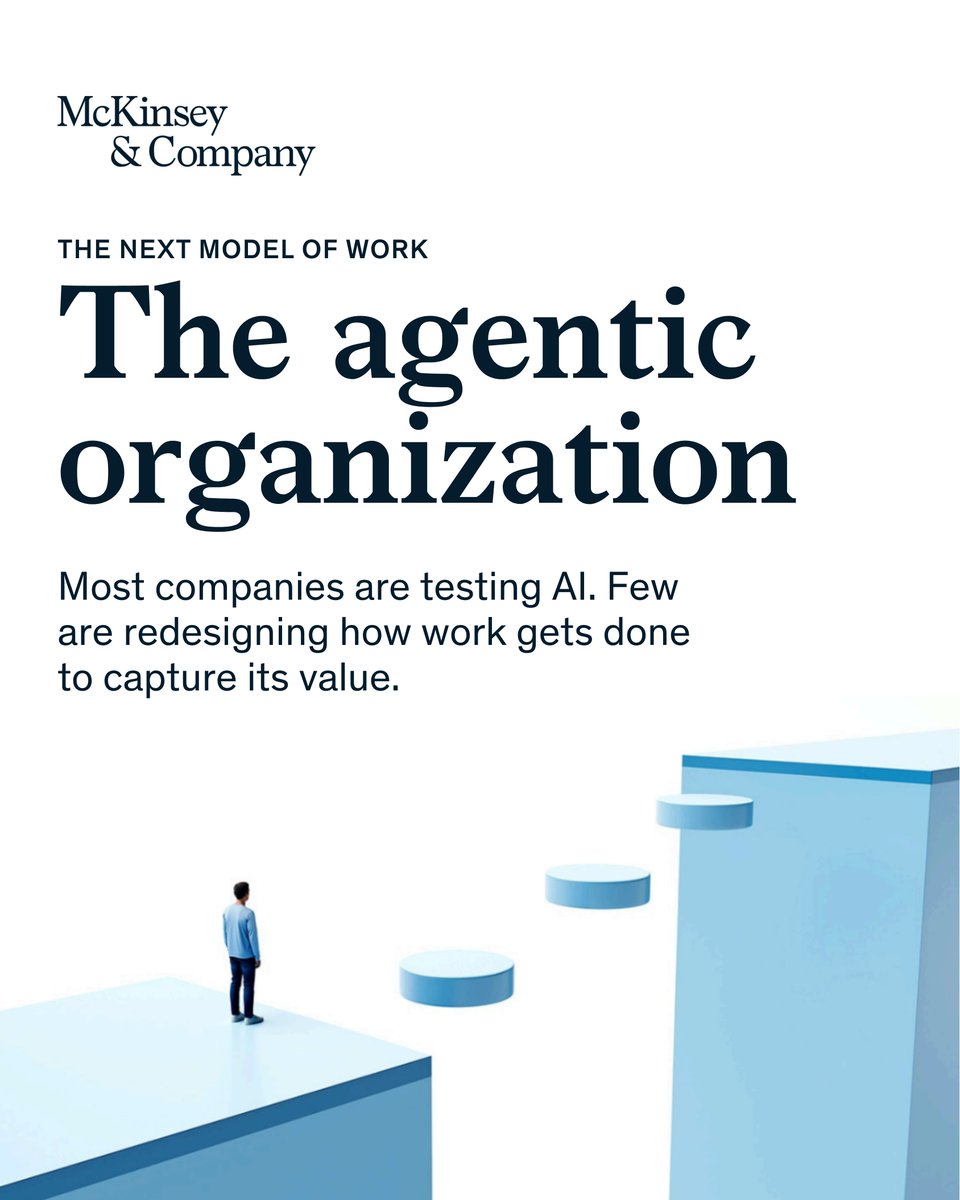
AI is everywhere. But most companies are still stuck in pilot mode. The issue isn’t the tech. It’s that the work itself hasn’t changed. Leaders are starting to rethink workflows, roles, and decisions end to end. That’s where the real value is unlocked. mck.co/4cbNlFI
McKinsey & Company tweet media
English
23
138
661
75.8K
Paddy
Paddy@PaddyArsenal·
Mid April, 6 points clear at the top of the Premier League, into the Champions League semi final and I’m miserable. What a club.
English
102
3.3K
24.9K
630.2K
What did u learn today? retweetou
Tim Denning
Tim Denning@Tim_Denning·
A person who studies pattern recognition will outperform everyone else in their field. Every goal is just a system of inputs and outputs. Once you learn what the top 1% and you apply it with ruthless levels of execution you can mimic most results. You don’t need more information, you need to observe patterns and write them down, then turn them into systems.
English
22
30
247
7K
What did u learn today? retweetou
Dear Son.
Dear Son.@DearS_o_n·
The most dangerous man alive is the one who studies his own weakness more than he studies his enemies.
English
55
425
2.7K
37.4K
What did u learn today? retweetou
Andrew
Andrew@DrewVento·
if that's what your founding engineers look like, you're gonna make it
Andrew tweet media
English
120
320
8.3K
638.8K
What did u learn today? retweetou
a16z
a16z@a16z·
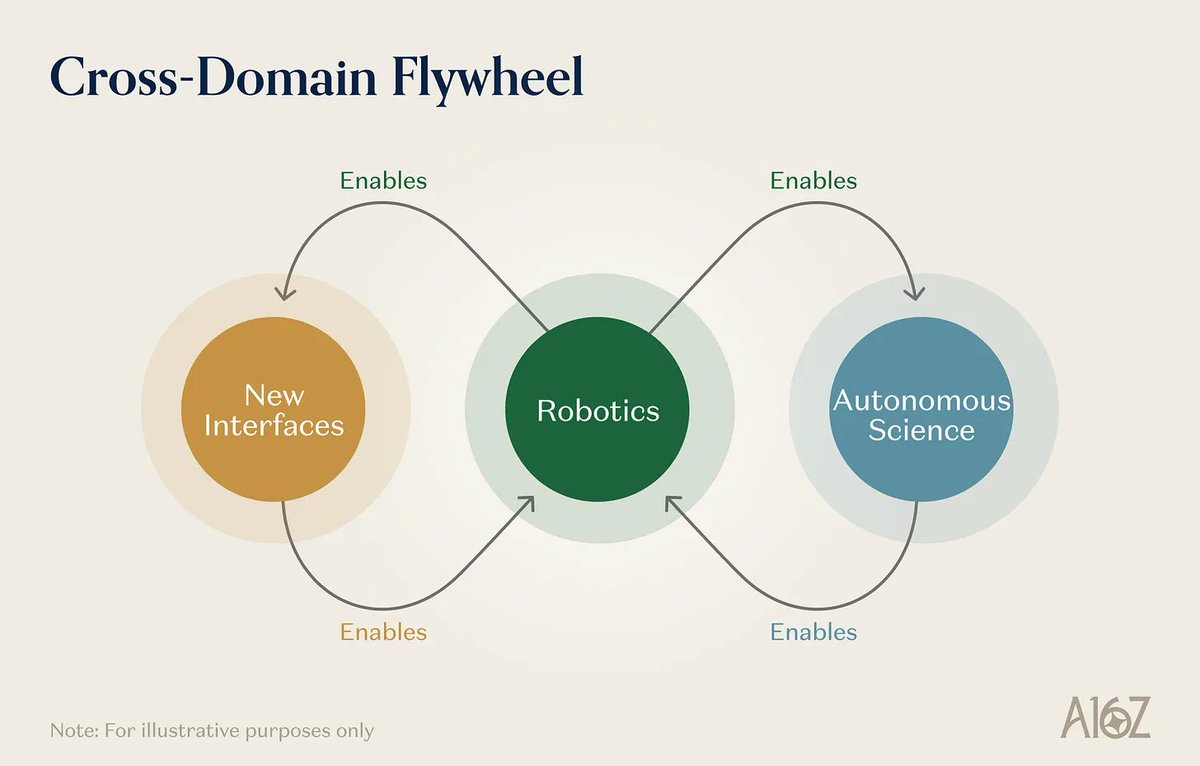
The dominant paradigm in AI today is organized around language and code. But physical AI is maturing concurrently, and the pace of progress over the past 18 months suggests that new fields could soon enter a scaling regime of their own. a16z's Oliver Hsu on robot learning, autonomous science, and new interfaces as instances of an emerging paradigm for physical AI: a16z.news/p/frontier-sys…
a16z tweet media
Oliver Hsu@oyhsu

x.com/i/article/2044…

English
15
67
418
62.3K
What did u learn today? retweetou
Charly Wargnier
Charly Wargnier@DataChaz·
🚨 A Google engineer just automated 80% of his job, and he monitors his new AI workforce with a $2 USB-C chip. He copied a Chinese student who wired the thumb-sized chip to Claude Code in 15 minutes. A blue LED simply blinks when agents work and goes dark when waiting. Now, the engineer just decides whether to let it work. Out of the box, it's packing: > 27 agents > 64 skills > 1,282 security tests You simply stop chatting and start managing. Fun story: Commenters laughed that a toaster has more compute. He ignored everyone and added one line at the bottom: the LED knows before you do. I also added the ace article by @noisyb0y1 that explains this in way more detail
Noisy@noisyb0y1

x.com/i/article/2043…

English
25
72
435
137K
What did u learn today? retweetou
Lukas Ziegler
Lukas Ziegler@lukas_m_ziegler·
JUST IN: @GoogleDeepMind launches Gemini Robotics ER 1.6! 🧠 GDM introduced Gemini Robotics-ER 1.6, a reasoning-first model that enables robots to understand environments through spatial reasoning and multi-view understanding. The model specializes in visual and spatial understanding, task planning, and success detection. It acts as the high-level reasoning model for robots, capable of calling tools like Google Search, vision-language-action models, or any third-party user-defined functions. New capabilities like instrument reading, enabling robots to read complex gauges and sight glasses, discovered through collaboration with Boston Dynamics. Precision object detection and counting, relational logic, motion reasoning, and constraint compliance. The model uses points as intermediate steps to reason about complex tasks. It enables agents to intelligently choose between retrying failed attempts or progressing to the next stage. The model advances multi-view reasoning, understanding multiple camera streams and relationships between them even in dynamic or occluded environments. Super important are the safety improvements. They have included superior compliance with safety policies, better adherence to physical safety constraints (safer decisions about which objects can be manipulated), and improved hazard identification. 🚧 So the high-level planning that calls lower-level execution models, versus the end-to-end visuomotor control approach of models like π0 and GEN-1. It's getting interesting! 🔥 More details here: deepmind.google/blog/gemini-ro… ~~ ♻️ Join the weekly robotics newsletter, and never miss any news → ziegler.substack.com
Lukas Ziegler tweet media
English
5
55
398
23.9K
What did u learn today? retweetou
Ashpreet Bedi
Ashpreet Bedi@ashpreetbedi·
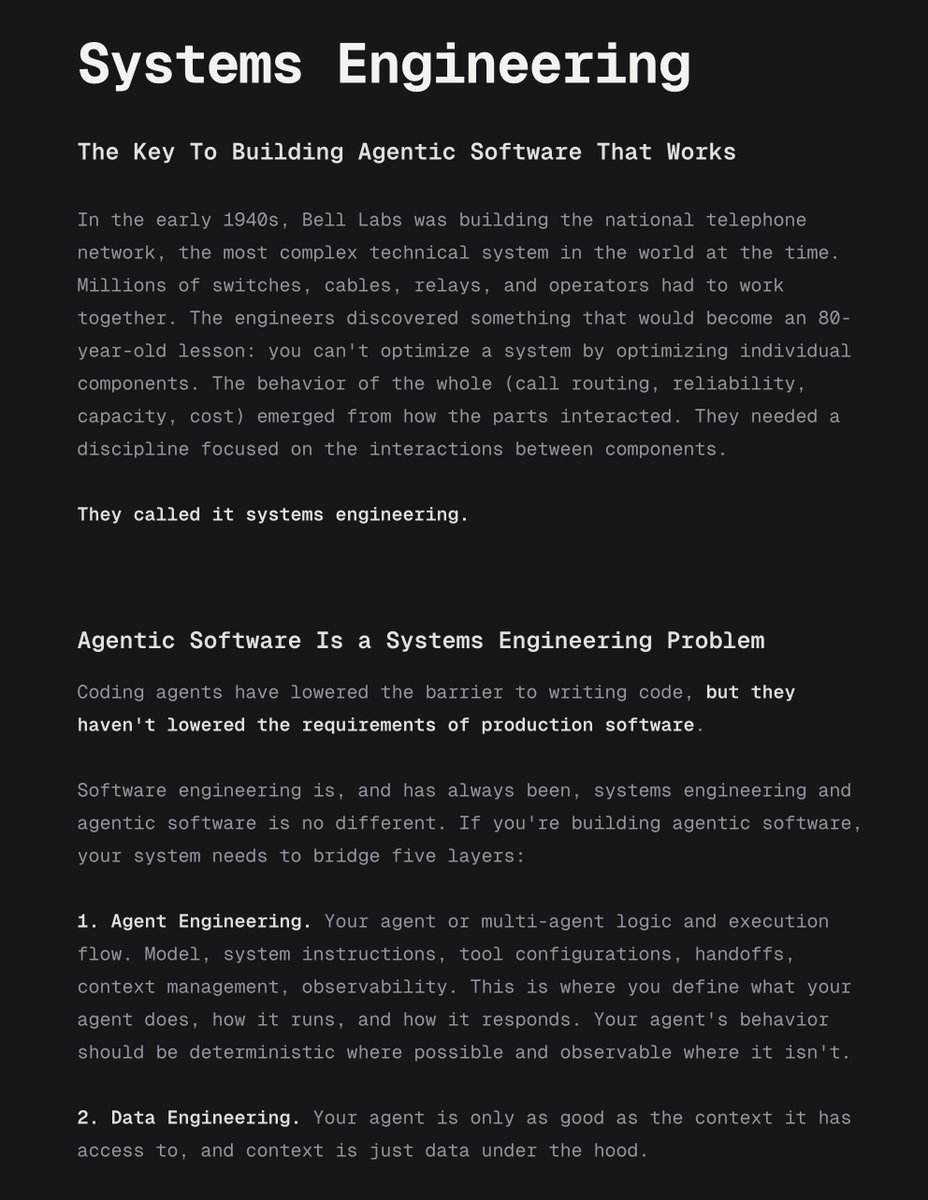
New post: Systems Engineering Coding agents have lowered the barrier to writing code, but they haven't lowered the requirements of production software. Agentic software is just software. The agent replaces business logic. Everything else is the same. ashpreetbedi.com/articles/syste…
Ashpreet Bedi tweet media
English
13
87
722
30.8K
What did u learn today? retweetou
Chris Pisarski
Chris Pisarski@chrispisarski·
one of the best sales advice we picked up during YC is the "McKinsey Model" a lot of deals at early-stage startups die for the same reason: your champion is afraid to advocate for your product if they push for it internally and it doesn't work out, their job is on the line so they never come back to you and hit you with the "we need to align internally first" that's why you need to be their McKinsey consultant: instead of them pitching, you personally take the blame after every demo, send them: - a one-pager - a security doc - an ROI calculator with their numbers - useful context/overview of your industry that can help with what they're struggling with right now - a pre-written slack message they can forward make it as easy as possible for your champion to forward your material without them feeling responsible for integrating your solution or "fighting" for it
English
50
105
2.3K
346.9K
What did u learn today? retweetou
Nicholas Fabiano, MD
Nicholas Fabiano, MD@NTFabiano·
A stronger sense of purpose is associated with a longer life.
Nicholas Fabiano, MD tweet media
English
39
294
2.1K
143.3K
What did u learn today? retweetou
Justin Skycak
Justin Skycak@justinskycak·
Advanced performance is usually just low-level skill executed so automatically that working memory is free for higher-level thinking. Creativity is built on automaticity.
English
0
30
316
5.8K
What did u learn today? retweetou
Justin Skycak
Justin Skycak@justinskycak·
The longer you delay building the life you actually want, the more likely you are to normalize a weaker substitute. Drift hardens into identity faster than people realize.
English
24
778
4.2K
96.8K
What did u learn today? retweetou
Freda Duan
Freda Duan@FredaDuan·
Org Design in the Age of AI I've spent the last few months talking to companies — startups to megacaps — about how AI is changing the way they work. Everyone is adding AI to their workflows. Almost no one is asking why the workflow looks that way in the first place. +++ TODAY Strip a company down and it's three things: people, hierarchy, and information flow. Hierarchy isn't really about authority. It's about information routing — the org is too big for anyone to see everything, so you install managers to aggregate, synthesize, and relay. Meetings, status updates, steering committees, QBRs — all information-routing mechanisms. They exist because moving knowledge between people is expensive. AI makes it cheap. Consider how products get built today. PM writes PRD. Design interprets it into mocks. Engineering interprets mocks into code, estimates "eight weeks," requirements change, PRD gets rewritten. Dev takes months. QA runs regression. GTM preps launch. Mid-sized feature: 3–6 months. The bottleneck was never speed. It was translation cost. PM's intent → document → designer's interpretation → engineer's interpretation → QA's interpretation. Every handoff loses fidelity, requires alignment, generates wait time. AI collapses the translation layers. +++ AI ORG DESIGN PM goes from idea to working prototype in a day. AI generates tests as code is written. An intelligence layer synthesizes customer signals and business metrics in real time — replacing the manager who used to aggregate that weekly. This isn't about each role getting faster. It's the gaps between roles — handoffs, queues, alignment meetings — evaporating. 🔥 Implications: Relay race → basketball game. Small squads, 3–5 people, all skills present, moving simultaneously. Most decisions stay in the squad. Departments → capability atoms. Composable, independent capabilities — collections, identity verification, risk scoring — each combinable with others. PMs become builders. Less time translating ideas for others, more time validating directly. Middle management compresses. The survivors are the ones whose value was always judgment and coaching, not information routing. QA embeds into dev. Quality becomes a guardrail, not a gate. The system generates the roadmap. Jack Dorsey's example: a restaurant's cash flow tightens before a seasonal dip. The system detects it, packages a short-term loan with adjusted repayment, pushes it to the merchant — before they thought to look. No PM decided to build that. The system recognized the moment and composed existing capabilities. Release cycles → continuous flow. Ship daily. Trade big-launch dopamine for relentless, quiet value delivery. +++ The competitive moat shifts from execution speed to learning speed — how fast the org can absorb what AI makes newly possible and restructure around it. Most companies are using AI as a faster horse. The ones that pull ahead will ask: what would we build if we designed this org from scratch today? Full: open.substack.com/pub/robonomics…
Freda Duan@FredaDuan

Org Design & Reorgs I’ve always been fascinated by two things: 1/ how different companies design their org structures, and 2/ what it signals when a company goes through a major reorg or restructuring. --- 1/ Org structure: no one-size-fits-all Broadly, companies sit on a spectrum from centralized to single-GM. Centralized: decision-making, product strategy, and core engineering are tightly controlled at the center. This works best when coherence matters more than speed - a single system, brand, or architecture where fragmentation creates tech debt or UX inconsistency. Single GM: businesses are run as semi-autonomous units with clear P&L ownership. This works when speed, local optimization, and accountability matter more than perfect cohesion. A. Common patterns > Centralized High premium on end-to-end quality, architectural integrity, and brand consistency. Typical in “one-system” products Examples: $Apple, $Airbnb > Single GM Optimized for portfolios of distinct businesses, categories, or geographies. Speed and ownership beat strict coordination Examples: Common in CPG ( $P&G, $Unilever) and multi-country, regulated businesses (often country GMs, e.g., $Revolut) > Hybrid GM / vertical / geo owners paired with shared platform teams (core eng, data, infra, risk, compliance, brand). This only works if leadership is psychologically comfortable giving up control and pushing decisions down to BU leaders Examples: Marketplaces and multi-line fintechs ( $Uber, $DoorDash, $Robinhood, $Coinbase, $Revolut) B. 180-degree org reversals can happen $Robinhood Centralized → GM-led (2022) Arguably a major contributor to the sharp acceleration in product velocity that followed $Square / $XYZ GM-led → centralized after Dorsey returned A classic response when coordination costs explode, architecture degrades, or brand/system coherence becomes the bottleneck after rapid expansion --- 2/ Restructuring as an investment opportunity Major restructurings often create windows to own good companies while sentiment is messy and execution risk is over-discounted. A few that just/ are going through major restructurings: Meta Googl Shopify Apple SpaceX / xAI / Tesla (potentially)

English
20
45
358
83.4K
What did u learn today? retweetou
Tim Denning
Tim Denning@Tim_Denning·
Office jobs are cooked in the next year. A lot of lazy people who forward emails, make spreadsheets, and create PowerPoint decks are going to have to figure out how to do real work. I think this is a good thing. Everyone is going to be forced to become high agency.
English
138
48
865
80K