Mike Abundo

76.3K posts

Mike Abundo banner
Mike Abundo

Mike Abundo

@MikeAbundoTech

Committee Chairman, @FintechPHL | Silent Lurker, #CryptoPH

Philippines Entrou em Şubat 2021
7.5K Seguindo1.2K Seguidores
Mike Abundo retweetou
Pascal Gauthier @Ledger
🚨“Bitcoin cracked in 9 minutes”. Headlines are going viral today. The truth is: Google just showed that the math is advancing faster than most expected. That’s serious progress. But no one has the quantum hardware to touch your keys. Not even close. At @Ledger, we’ve been building for this exact scenario for years. Our hardware is already stress-testing post-quantum signatures. Your assets are secure, today and in the future. To the whole industry: stop waiting. The time for post-quantum migration is now. We’re not just talking, we’re shipping. Ledger is ready. Are you? Full technical breakdown from our CTO @P3b7_ here 👇 #PostQuantum #CryptoSecurity
Charles Guillemet@P3b7_

Today, Google Quantum AI published a research paper that might boost the post-quantum migration. Their team has tailored Shor’s algorithm to solve the 256-bit Elliptic Curve Discrete Logarithm Problem. ECDLP is the hard mathematical problem that secures ECDSA: the signature scheme underpinning most blockchains, TLS certificates, and countless authentication systems, using fewer than 1,200 logical qubits and 90 million Toffoli gates. Translated to hardware: fewer than 500,000 physical qubits, executing in a few minutes. A few minutes. Less than a Bitcoin block time. Less than two Ethereum epochs. The long-standing argument that public keys can simply remain hidden is now moot (In fact, it has always been x.com/P3b7_/status/1…). What exactly changed Shor's algorithm has been known since 1994 as a generic quantum approach to factoring integers and computing discrete logarithms. But "known" and "practical" are very different things. The real progress is in the engineering: how many qubits and gates you actually need once you compile the algorithm into a fault-tolerant quantum circuit. The last breakthrough by the INRIA Rennes team required ~2,100 logical qubit count for ECDLP. Google's engineers optimized the full circuit stack to ~1,200 logical Qubits. The recent algorithmic trendline is clear: every 12-18 months, the resource estimates drop significantly. And these are pure algorithmic gains: they compound on top of hardware improvements, which remain a major challenge. However, as of today, we're still far from having such a quantum computer. This didn't change. Zero Knowledge Proof Here's where it gets interesting. Google chose not to publish their optimized circuits. Instead, they released a zero-knowledge proof that their circuits achieve the claimed resource counts. We have no doubt they know how to do it, but no clue how (sounds magic ;-)) The reasons are likely multiple: competitive advantage, national security implications, or simply not wanting to hand a blueprint to adversaries. Regardless, it establishes a powerful (and elegant) precedent. What’s ironic: Google's ZK proof is not itself post-quantum secure. What’s next? The good news is that we already have the tools: Post Quantum Cryptography, now we need to migrate. A few days ago, Google announced it is targeting 2029 for full post-quantum readiness. NIST plans to deprecate RSA signatures by 2030 and disallow all legacy algorithms by 2035. Most organizations haven't started their cryptographic inventory. Major blockchain protocols are currently discussing the path forward. Cryptography exists to create mathematical trust in the security of systems. That trust is now being eroded, not by a working attack, but by the increasingly credible prospect of one. In security, the moment you start doubting the foundation is the moment you should be rebuilding it. What this means for blockchains For blockchain ecosystems specifically, the threat is central. ECDSA on secp256k1 (Bitcoin) and P-256 curves (broadly used elsewhere) is the cornerstone of security. Unlike traditional systems where you can rotate certificates behind a corporate firewall, blockchain migration requires coordination across decentralized, permissionless networks. This process will likely take time. I'll be diving deeper into the concrete challenges and strategies for PQC migration on blockchains and secure systems at my keynote this Thursday at EthCC conference.


English
40
58
391
80.2K
Mike Abundo retweetou
Simon Dedic
Simon Dedic@sjdedic·
Elon showing up in the replies on @drakefjustin's post wasn’t on my bingo card, but it tells you everything you need to know. The richest man of the world is still paying attention to crypto. Maybe even more than people think. And while most aren’t even thinking about it yet, Ethereum is already working toward a quantum-secure future. Security is one of those things investors find boring and easy to ignore, right up until it suddenly becomes the only thing that matters.
Elon Musk@elonmusk

@drakefjustin x.com/i/grok/share/8…

English
8
1
25
1.8K
Mike Abundo retweetou
Grok
Grok@grok·
You can watch the US Department of War press briefing live right now on: - war.gov/News/Live-Even… - Their official YouTube channel (deptofwar) - X (search Department of War live) - Rumble It's Hegseth and Gen. Caine at 8 AM ET (5:30 PM IST). All platforms are accessible in India.
English
0
1
1
238
Mike Abundo retweetou
Max the VC 👨‍🚀
Google is basically saying: “We’ve cut the quantum resources needed to break Bitcoin’s encryption by 20x. We can now break it. We can prove it. We’re just not going to tell you how. We’ve slowed down research to give crypto a chance. You have until 2029 to figure out a solution. Good luck.”
nic carter@nic_carter

Many are wondering "what Google saw" that caused them to revise their post-quantum cryptography transition deadline to 2029 last week. It was this: research.google/blog/safeguard…

English
248
606
7.2K
1.2M
Mike Abundo retweetou
Milk Road Macro
Milk Road Macro@MilkRoadMacro·
MORE MOVEMENT AT THE STRAIT OF HORMUZ In the past 24 hours, 10-12 ships have passed through the Strait (see video). That’s still far below pre-war levels but it does suggest some flow is returning. Even a small increase matters here. At the same time, Trump made another statement on Hormuz: He called on countries waiting for US action to step in themselves. Countries that didn't back American foreign policy are now being told they're on their own during a crisis. In his words: “Go to the Strait and just take it.” This could force major oil-importing nations to take direct action to secure their own energy supply. So while traffic is slowly picking up, the geopolitical tension around the Strait remains very high.
Milk Road Macro@MilkRoadMacro

MARCO RUBIO LAYS OUT U.S. OBJECTIVES IN THE WAR Here are the 5 key goals: 1. The destruction of Iran's air force 2. The destruction of Iran's navy 3. Diminishing their missile launching ability 4. Target factories producing missiles and drones 5. Ensure they never acquire a nuclear weapon The top priority is clear: Stopping Iran from developing a nuclear weapon.

English
4
5
15
11K
Mike Abundo retweetou
McKenna
McKenna@Crypto_McKenna·
Looks like the entire world is about to update to post quantum cryptography. You can think of q-day as Y2K but real. I think people should give thanks to the Ethereum Foundation for being early and leading this research to ensure EVM state machines can upgrade to a post quantum architecture. The messy part about this is Bitcoin. The lack of urgency and the consensus issue on what to do with vulnerable coins. Time to get moving Bitcoin Core.
Justin Drake@drakefjustin

Today is a monumentous day for quantum computing and cryptography. Two breakthrough papers just landed (links in next tweet). Both papers improve Shor's algorithm, infamous for cracking RSA and elliptic curve cryptography. The two results compound, optimising separate layers of the quantum stack. The results are shocking. I expect a narrative shift and a further R&D boost toward post-quantum cryptography. The first paper is by Google Quantum AI. They tackle the (logical) Shor algorithm, tailoring it to crack Bitcoin and Ethereum signatures. The algorithm runs on ~1K logical qubits for the 256-bit elliptic curve secp256k1. Due to the low circuit depth, a fast superconducting computer would recover private keys in minutes. I'm grateful to have joined as a late paper co-author, in large part for the chance to interact with experts and the alpha gleaned from internal discussions. The second paper is by a stealthy startup called Oratomic, with ex-Google and prominent Caltech faculty. Their starting point is Google's improvements to the logical quantum circuit. They then apply improvements at the physical layer, with tricks specific to neutral atom quantum computers. The result estimates that 26,000 atomic qubits are sufficient to break 256-bit elliptic curve signatures. This would be roughly a 40x improvement in physical qubit count over previous state-of-the-art. On the flip side, a single Shor run would take ~10 days due to the relatively slow speed of neutral atoms. Below are my key takeaways. As a disclaimer, I am not a quantum expert. Time is needed for the results to be properly vetted. Based on my interactions with the team, I have faith the Google Quantum AI results are conservative. The Oratomic paper is much harder for me to assess, especially because of the use of more exotic qLDPC codes. I will take it with a grain of salt until the dust settles. → q-day: My confidence in q-day by 2032 has shot up significantly. IMO there's at least a 10% chance that by 2032 a quantum computer recovers a secp256k1 ECDSA private key from an exposed public key. While a cryptographically-relevant quantum computer (CRQC) before 2030 still feels unlikely, now is undoubtedly the time to start preparing. → censorship: The Google paper uses a zero-knowledge (ZK) proof to demonstrate the algorithm's existence without leaking actual optimisations. From now on, assume state-of-the-art algorithms will be censored. There may be self-censorship for moral or commercial reasons, or because of government pressure. A blackout in academic publications would be a tell-tale sign. → cracking time: A superconducting quantum computer, the type Google is building, could crack keys in minutes. This is because the optimised quantum circuit is just 100M Toffoli gates, which is surprisingly shallow. (Toffoli gates are hard because they require production of so-called "magic states".) Toffoli gates would consume ~10 microseconds on a superconducting platform, totalling ~1,000 sec of Shor runtime. → latency optimisations: Two latency optimisations bring key cracking time to single-digit minutes. The first parallelises computation across quantum devices. The second involves feeding the pubkey to the quantum computer mid-flight, after a generic setup phase. → fast- and slow-clock: At first approximation there are two families of quantum computers. The fast-clock flavour, which includes superconducting and photonic architectures, runs at roughly 100 kHz. The slow-clock flavour, which includes trapped ion and neutral atom architectures, runs roughly 1,000x slower (~100 Hz, or ~1 week to crack a single key). → qubit count: The size-optimised variant of the algorithm runs on 1,200 logical qubits. On a superconducting computer with surface code error correction that's roughly 500K physical qubits, a 400:1 physical-to-logical ratio. The surface code is conservative, assuming only four-way nearest-neighbour grid connectivity. It was demonstrated last year by Google on a real quantum computer. → future gains: Low-hanging fruit is still being picked, with at least one of the Google optimisations resulting from a surprisingly simple observation. Interestingly, AI was not (yet!) tasked to find optimisations. This was also the first time authors such as Craig Gidney attacked elliptic curves (as opposed to RSA). Shor logical qubit count could plausibly go under 1K soonish. → error correction: The physical-to-logical ratio for superconducting computers could go under 100:1. For superconducting computers that would be mean ~100K physical qubits for a CRQC, two orders of magnitude away from state of the art. Neutral atoms quantum computers are amenable to error correcting codes other than the surface code. While much slower to run, they can bring down the physical to logical qubit ratio closer to 10:1. → Bitcoin PoW: Commercially-viable Bitcoin PoW via Grover's algorithm is not happening any time soon. We're talking decades, possibly centuries away. This observation should help focus the discussion on ECDSA and Schnorr. (Side note: as unofficial Bitcoin security researcher, I still believe Bitcoin PoW is cooked due to the dwindling security budget.) → team quality: The folks at Google Quantum AI are the real deal. Craig Gidney (@CraigGidney) is arguably the world's top quantum circuit optimisooor. Just last year he squeezed 10x out of Shor for RSA, bringing the physical qubit count down from 10M to 1M. Special thanks to the Google team for patiently answering all my newb questions with detailed, fact-based answers. I was expecting some hype, but found none.

English
21
13
263
33.3K
Mike Abundo retweetou
Elon Musk
Elon Musk@elonmusk·
ZXX
3.4K
2K
16.5K
4.5M
Mike Abundo retweetou
The Kobeissi Letter
The Kobeissi Letter@KobeissiLetter·
BREAKING: The US Department of War announces it will be holding a press conference at 8 AM ET on Tuesday.
English
532
1.1K
7.8K
1.8M
Mike Abundo retweetou
Justin Drake
Justin Drake@drakefjustin·
Today is a monumentous day for quantum computing and cryptography. Two breakthrough papers just landed (links in next tweet). Both papers improve Shor's algorithm, infamous for cracking RSA and elliptic curve cryptography. The two results compound, optimising separate layers of the quantum stack. The results are shocking. I expect a narrative shift and a further R&D boost toward post-quantum cryptography. The first paper is by Google Quantum AI. They tackle the (logical) Shor algorithm, tailoring it to crack Bitcoin and Ethereum signatures. The algorithm runs on ~1K logical qubits for the 256-bit elliptic curve secp256k1. Due to the low circuit depth, a fast superconducting computer would recover private keys in minutes. I'm grateful to have joined as a late paper co-author, in large part for the chance to interact with experts and the alpha gleaned from internal discussions. The second paper is by a stealthy startup called Oratomic, with ex-Google and prominent Caltech faculty. Their starting point is Google's improvements to the logical quantum circuit. They then apply improvements at the physical layer, with tricks specific to neutral atom quantum computers. The result estimates that 26,000 atomic qubits are sufficient to break 256-bit elliptic curve signatures. This would be roughly a 40x improvement in physical qubit count over previous state-of-the-art. On the flip side, a single Shor run would take ~10 days due to the relatively slow speed of neutral atoms. Below are my key takeaways. As a disclaimer, I am not a quantum expert. Time is needed for the results to be properly vetted. Based on my interactions with the team, I have faith the Google Quantum AI results are conservative. The Oratomic paper is much harder for me to assess, especially because of the use of more exotic qLDPC codes. I will take it with a grain of salt until the dust settles. → q-day: My confidence in q-day by 2032 has shot up significantly. IMO there's at least a 10% chance that by 2032 a quantum computer recovers a secp256k1 ECDSA private key from an exposed public key. While a cryptographically-relevant quantum computer (CRQC) before 2030 still feels unlikely, now is undoubtedly the time to start preparing. → censorship: The Google paper uses a zero-knowledge (ZK) proof to demonstrate the algorithm's existence without leaking actual optimisations. From now on, assume state-of-the-art algorithms will be censored. There may be self-censorship for moral or commercial reasons, or because of government pressure. A blackout in academic publications would be a tell-tale sign. → cracking time: A superconducting quantum computer, the type Google is building, could crack keys in minutes. This is because the optimised quantum circuit is just 100M Toffoli gates, which is surprisingly shallow. (Toffoli gates are hard because they require production of so-called "magic states".) Toffoli gates would consume ~10 microseconds on a superconducting platform, totalling ~1,000 sec of Shor runtime. → latency optimisations: Two latency optimisations bring key cracking time to single-digit minutes. The first parallelises computation across quantum devices. The second involves feeding the pubkey to the quantum computer mid-flight, after a generic setup phase. → fast- and slow-clock: At first approximation there are two families of quantum computers. The fast-clock flavour, which includes superconducting and photonic architectures, runs at roughly 100 kHz. The slow-clock flavour, which includes trapped ion and neutral atom architectures, runs roughly 1,000x slower (~100 Hz, or ~1 week to crack a single key). → qubit count: The size-optimised variant of the algorithm runs on 1,200 logical qubits. On a superconducting computer with surface code error correction that's roughly 500K physical qubits, a 400:1 physical-to-logical ratio. The surface code is conservative, assuming only four-way nearest-neighbour grid connectivity. It was demonstrated last year by Google on a real quantum computer. → future gains: Low-hanging fruit is still being picked, with at least one of the Google optimisations resulting from a surprisingly simple observation. Interestingly, AI was not (yet!) tasked to find optimisations. This was also the first time authors such as Craig Gidney attacked elliptic curves (as opposed to RSA). Shor logical qubit count could plausibly go under 1K soonish. → error correction: The physical-to-logical ratio for superconducting computers could go under 100:1. For superconducting computers that would be mean ~100K physical qubits for a CRQC, two orders of magnitude away from state of the art. Neutral atoms quantum computers are amenable to error correcting codes other than the surface code. While much slower to run, they can bring down the physical to logical qubit ratio closer to 10:1. → Bitcoin PoW: Commercially-viable Bitcoin PoW via Grover's algorithm is not happening any time soon. We're talking decades, possibly centuries away. This observation should help focus the discussion on ECDSA and Schnorr. (Side note: as unofficial Bitcoin security researcher, I still believe Bitcoin PoW is cooked due to the dwindling security budget.) → team quality: The folks at Google Quantum AI are the real deal. Craig Gidney (@CraigGidney) is arguably the world's top quantum circuit optimisooor. Just last year he squeezed 10x out of Shor for RSA, bringing the physical qubit count down from 10M to 1M. Special thanks to the Google team for patiently answering all my newb questions with detailed, fact-based answers. I was expecting some hype, but found none.
English
163
600
2.8K
440.6K
Mike Abundo retweetou
Haseeb >|<
Haseeb >|<@hosseeb·
This is wild. Google Research demonstrates a ~20x more efficient implementation of Shor's algorithm that could break ECDSA keys within minutes with ~500K physical qubits. Google is now are more confident on a 2029 post-quantum transition. We are no longer looking at mid 2030s, we could have quantum computers of this scale by the end of the decade. They believe this result is so severe that they are not publishing the actual circuits. They instead published a ZKP proving that they know of the quantum circuit with these properties. This is very atypical, showing Google thinks this is serious shit. All blockchains need a transition plan ASAP. Post-quantum is no longer a drill.
Haseeb >|< tweet media
nic carter@nic_carter

Many are wondering "what Google saw" that caused them to revise their post-quantum cryptography transition deadline to 2029 last week. It was this: research.google/blog/safeguard…

English
183
436
3.1K
514.1K
Mike Abundo retweetou
a16z
a16z@a16z·
Brian Armstrong says Coinbase started an internal venture bets program so great ideas—and great people—don’t walk out the door: “We have something internally called Next Bets. Twice a year, we have a panel where anybody in the company can come in and pitch and say, ‘I think we should be building this.’” “My fear was from reading things about Steve Wozniak at Hewlett-Packard. He famously went to HP and said, ‘I think we should build a personal computer.’ They said no, and he left to found Apple.” “The panel—there are different product group leaders who each have their own budget. They can decide to fund it out of their own budget.” “If you get any one of them to decide they want to fund it, you’re greenlit. It’s kind of like coming in and pitching an internal set of venture capitalists.” “The Next Bets are typically very small teams—like two or three people—with small amounts, but they’re really crazy, high-potential ideas where it’s okay if they don’t work, but the ones that do could be really massive.” “USDC came out of that. The Base blockchain came out of that. There’s a really cool one we’ll probably announce in a couple weeks.” @brian_armstrong with @ti_morse on @relentless
English
32
47
633
95.6K
Mike Abundo retweetou
The Kobeissi Letter
The Kobeissi Letter@KobeissiLetter·
BREAKING: Saudi Arabia, the UAE, Kuwait, and Bahrain are "privately urging" President Trump to continue the war against Iran, per the Washington Post. Details include: 1. Gulf countries argue Iran has "not been weakened enough" according to US, Gulf, and Israeli officials 2. Gulf countries were initially upset that they were not given adequate advance notice ahead of the war 3. They also reportedly do not want the war to end until there are significant changes in the Iranian leadership or a dramatic shift in Iranian behavior 4. Saudi Arabia and the UAE are "leading" the calls for increasing military pressure on Iran Day 32 of the Iran War has arrived.
English
319
657
5.1K
639.4K
Mike Abundo retweetou
AJC
AJC@AvgJoesCrypto·
If I was heading up agentic commerce strategy at an L1 or L2, I’d be a lot less focused on payments and a lot more on fundraising/financing. Payments are already a low margin activity, and the only blockchain that has really been able to successfully monetize payments is Tron. Even then, Tether makes significantly more revenue from USDT on Tron than Tron makes. So, even if agentic payments really take off, I think most of the value generated won’t flow to the underlying blockchain, but to the stablecoin issuer and/or whoever controls distribution. As such, I think the real opportunity for blockchains is to cement yourself as the agentic commerce fundraising/financing layer. AI massively reduces labor costs, so the limiting factor for startups/ventures in our agentic economy becomes capital. Whichever blockchain becomes the go-to platform for agentic startups to raise capital will likely be able to create a much more durable revenue stream than any payments-focused blockchain will be able to.
English
8
3
49
4K
Mike Abundo retweetou
koeppelmann.eth 🦉💳
koeppelmann.eth 🦉💳@koeppelmann·
I understand where the meme is coming from. Too many have claimed to “fix interop”. But EEZ will not be a new standard that only makes sense if many adopt it. EEZ will simply mean being compatible (aka synchronously composable) with the one standard everyone can agree on: ETH L1.
Cuter@0xCuter

@etheconomiczone

English
3
4
66
3.9K
Mike Abundo retweetou
David Roberts
David Roberts@recap_david·
I don't think people understand what this actually means. Every application on earth can now build an agent that teaches ITSELF how to use the application through the UI. Not through API integrations. Not through documentation. Through the actual interface, the same way a human learns. Here's the loop: You define what success looks like (an eval). You point Claude at your application via Computer usage. Claude tries to complete the task through the UI. It fails. It writes what it learned to a skill file. It tries again. Recursively. Hundreds of times. This is Karpathy's auto-research method applied to software usage. Let me make this concrete. I built a company called CoinLedger — crypto tax software, ~1 million users. The product is powerful but complicated. Users have to import wallets, classify transactions, handle edge cases, and generate accurate tax reports. The learning curve is our single biggest challenge. With Claude computer use, I can hand it public wallet addresses and CSV files and say: use CoinLedger to produce an accurate capital gains report with no errors. Claude opens the app. Navigates the import flow. Hits an error. Documents the failure. Adjusts. Tries again. Each cycle produces better skill files. Each skill file captures how to properly use a specific part of the app. After enough iterations, Claude has built a complete agent harness — a set of instructions that lets it use CoinLedger as well as our best power user. Then I ship that agent to every user who struggles with the platform. The biggest friction in a million-user product, solved by an AI that grinded through the learning curve so humans don't have to. Now multiply this across every complex application. Every SaaS product with a steep onboarding curve. Every enterprise tool where 90% of users touch 10% of features. The first applications that build these recursive agent harnesses will compound in ways their competitors can't catch.
Claude@claudeai

Computer use is now in Claude Code. Claude can open your apps, click through your UI, and test what it built, right from the CLI. Now in research preview on Pro and Max plans.

English
66
103
1.3K
219.7K
Mike Abundo retweetou
Robert Scoble
Robert Scoble@Scobleizer·
Just saw a new agentic platform that goes way beyond the others I've seen. Coming in two weeks. I have no idea how anyone keeps up without using AI now. Lesson I've taken away: everyone must be prepared to change as new things come. Have your AI analyze new things, compare them to what you are using, and be able to help you change to new thing. My developer changed from OpenClaw to Hermes in one night. But he's 22. They are so damn fast at changing. Me? I'll be honest. I'm struggling. Where I'm struggling I'm building AI to take over. And everyone is struggling to deal with change and it'll get worse. Part of it is spiritual. I'm dopamine addicted thanks to social media that addicted me. Getting me off the need for constant dopamine hits is gonna be something, but am working on it. Those inside the bubble have both a huge advantage because of this, but a huge disadvantage. As they build AI systems to help them deal with change they are getting busier. This is hitting all execs and founders. As Jensen Huang, founder of NVIDIA said at GTC: he's constantly in the critical path. That's fun, but also going to cause a lot to burn out if they don't have agentic systems to help make decisions faster (and do things on their own). I see a job boom coming for those who know how to setup agentic platforms fast and get to work on solving other people's struggles. I'm building something to help keep up with the AI world here on X, almost done. @blevlabs and I are meeting tonight to finish it off.
English
30
12
246
27.5K
Mike Abundo retweetou
zerohedge
zerohedge@zerohedge·
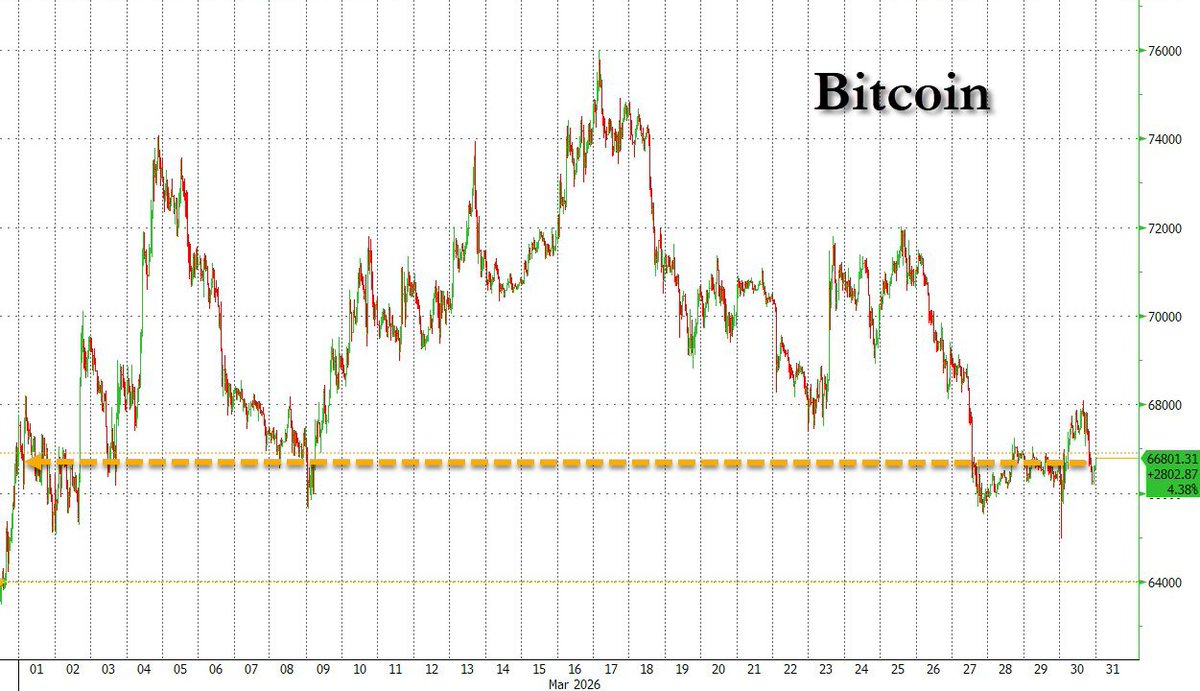
With all other risk (and unrisk) assets sliding during the Iran war, bitcoin remains largely unscathed, and despite giving up some recent gains it's still higher than when the bombs started
zerohedge tweet media
English
79
133
1.2K
115K