

Nick Fausti 👾
1.5K posts
Nick Fausti 👾
@NickFausti
SWE @google Prev: CIS @PennEngineering, Antler SG16 🇺🇸🇪🇺🇮🇹 尼克 📸 nickfausti | Building a universal explainer
Palo Alto, CA Entrou em Ocak 2011
446 Seguindo283 Seguidores

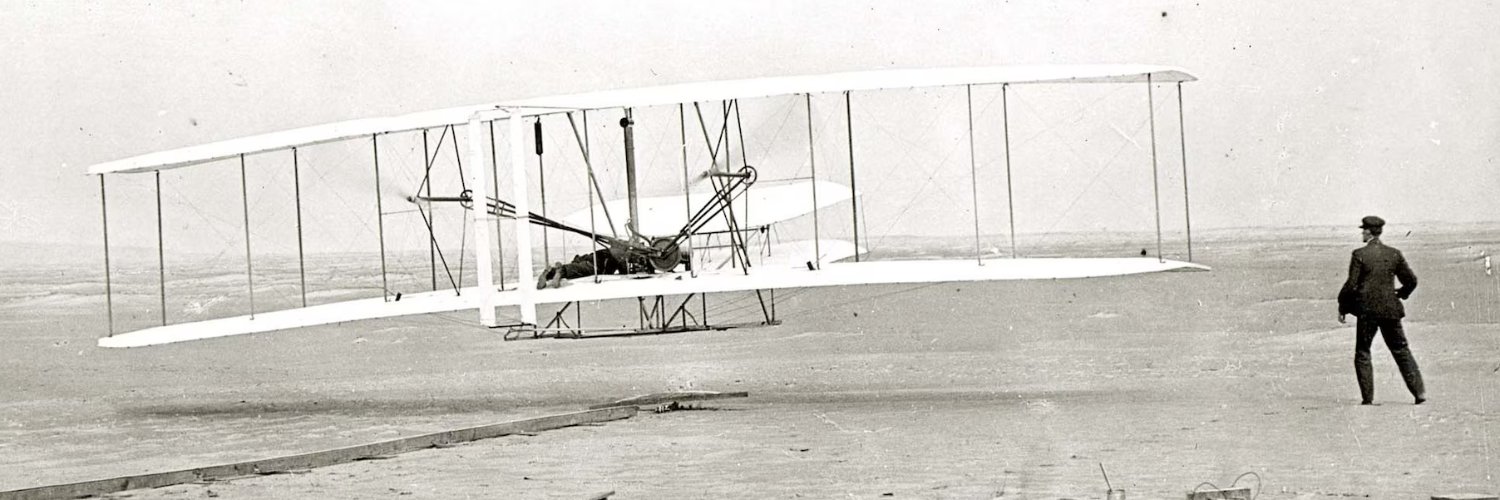
Incredible that it was only 66 years from the first controlled, powered flight to landing on the Moon!
Wonder of Science@wonderofscience
These two photographs are separated by only 66 years.
English
Hore says: “If we can prove that cryptochrome 4 is the magnetic sensor we will have demonstrated a fundamentally quantum mechanism that makes animals sensitive to environmental stimuli a million times weaker than previously thought possible”.
English
A fluorescent-protein spin qubit | Nature nature.com/articles/s4158…
Català
Nick Fausti 👾 retweetou

That one neuron connects to about 7,000 others. Your brain has 86 billion of them. Do the math and you get somewhere around 100 trillion connections inside your head. More connections than stars in 1,500 galaxies.
And each connection point is way more complicated than anyone expected. A Stanford lab found that every single connection contains about 1,000 tiny switches that can store memories and process information at the same time. So your brain is running roughly 100 quadrillion switches right now, while you read this sentence.
The wild part is the power bill. Your brain runs on 20 watts. That’s less energy than the light in your fridge. The world’s fastest supercomputer needs 20 million watts to do the same amount of raw calculation. A million times more power for the same output.
We’re still nowhere close to understanding how any of this works. In October 2024, a team of hundreds of scientists finished mapping every single connection in a fruit fly’s brain. Took six years and heavy AI help. That fly brain had 140,000 neurons. Yours has 86 billion. Google and Harvard also mapped a piece of human brain last year, a speck smaller than a grain of rice. That speck alone contained 150 million connections and took 1,400 terabytes to store. The lead scientist said mapping a full human brain at that detail would produce as much data as the entire world generates in a year.
A tiny worm had its 302 brain cells mapped back in 1986. Almost 40 years later, scientists still can’t fully explain how that worm’s brain keeps it alive. Your brain has 86 billion of those cells, each one wired to thousands of others, each wire packed with a thousand switches, all of it humming along on less power than a lightbulb.
Nicholas Fabiano, MD@NTFabiano
This is 1 of 86 billion neurons in your brain.
English
Nick Fausti 👾 retweetou

Nick Fausti 👾 retweetou

Solid mathematical ideas almost always outperform contrived engineering tricks.
For years deep learning has been dominated by increasingly complex architectural hacks: CNN blocks, attention layers, channel mixers, residual pathways, normalization stacks.
Every few years a new architecture is announced as if it were a revolution.
One of the most famous examples was Kaiming He and Residual Networks (ResNet). At the time he was paraded around the AI world like a celebrity because residual connections supposedly “solved” deep learning.
But these were largely engineering patches.
Now something much more interesting appeared.
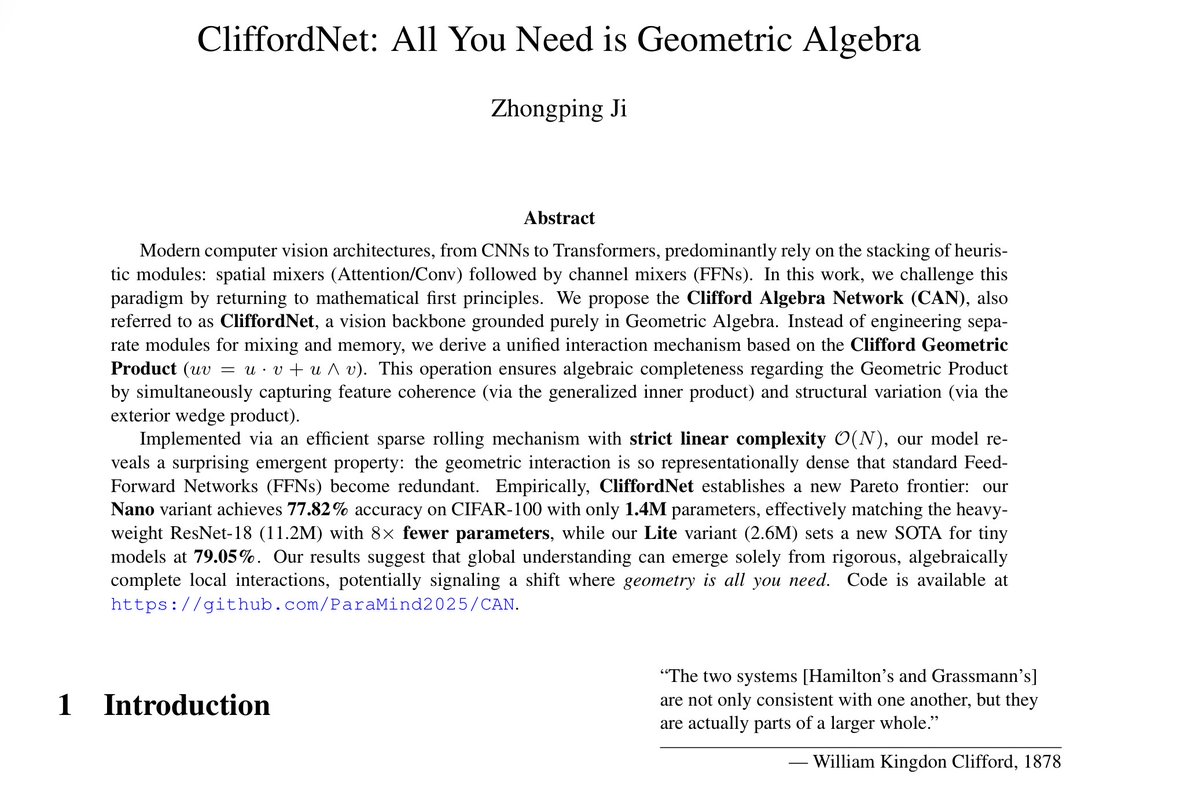
A new architecture called CliffordNet returns to mathematics — specifically Clifford Algebra, developed in the 19th century by William Kingdon Clifford.
Instead of stacking arbitrary modules, the model is built around the geometric product
uv = u·v + u∧v
A single algebraic operation that simultaneously captures inner product structure and geometric interactions.
In other words: the math already contains the interaction mechanism.
No attention blocks.
No mixer layers.
No architectural spaghetti.
The result:
• 77.82% accuracy on CIFAR-100 with only 1.4M parameters
• roughly 8× fewer parameters than ResNet-18
And with strict O(N) complexity.
The paper even suggests that once geometric interactions are modeled correctly, feed-forward networks become largely redundant.
A good reminder for the AI community.
Engineering tricks can dominate for years.
But eventually mathematics shows up and deletes half the architecture.
Paper:
[arxiv.org/pdf/2601.06793…)
19th century geometry just walked into computer vision.
English


🚨PromptShare🚨
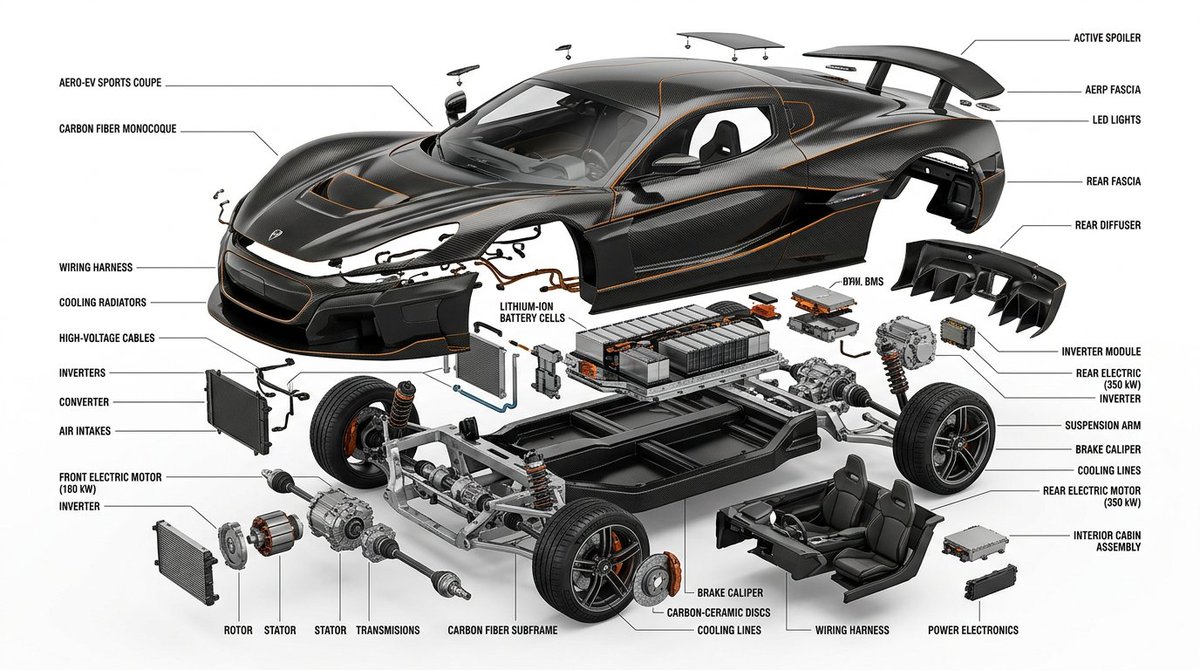
Okay… Banana 2 does not play
when it comes to exploded views.
Clean part separation. Accurate perspective.Full consistency.
PROMPT
product design, [object or vehicle with material accents], exploded view diagram, white background, three-dimensional, highly detailed internal components, studio lighting, product photography, best quality



English
Nick Fausti 👾 retweetou

It's astonishing to witness the improvement in public education--reading, math, attendance, grad rates--in Alabama, Louisiana and Mississippi. But we're busy fighting culture wars rather than scaling up what these three states have done. Please do read: nytimes.com/2026/02/09/opi…

English
Nick Fausti 👾 retweetou

for levin, the distinction between 'living things' and 'machines' isn't a tenably distinction
everything is a 'smooth metamorphoses process' where engineered systems are increasingly part of the ' intersecting continua' of life
his words: 'we need to get on board with this'
English
Nick Fausti 👾 retweetou

Nick Fausti 👾 retweetou
🎯 "Progress creates identity.
Identity creates consistency.
Consistency creates more progress.
Your brain does not need motivation, it needs evidence that you are improving."
Abhishek Singh@0xlelouch_
Most devs wait for “motivation” to learn system design, Rust, distributed systems, whatever. But motivation usually shows up after you get a small win. A few examples that change your brain: + The first time you debug a production issue fast, without panicking Suddenly you feel like you belong in the room + The first time you read logs/traces and you can actually explain the bottleneck Now performance is not scary anymore + The first time you refactor a messy module and future you thanks you You start enjoying clean architecture + The first time you ship something and users actually use it You stop caring about tutorials and start caring about outcomes Progress creates identity. Identity creates consistency. Consistency creates more progress. So for any engineer stuck right now, do not aim for huge goals. Aim for daily proof: 1. Solve one small bug every day and write the postmortem in your notes 2. Read one incident writeup a week and summarize the lesson 3. Build one tiny project feature weekly, deploy it, measure latency/errors 4. Teach one concept in public, even if it is basic Your brain does not need motivation, it needs evidence. Once you have evidence you are improving, you will not need “discipline” anymore, you will feel offended to skip.
English
Nick Fausti 👾 retweetou


Nick Fausti 👾 retweetou

I used to think Sapiens was a great book. Sweeping, provocative, the kind of book that makes you feel like you finally understand the big picture of human history. It's on every CEO's bookshelf, assigned in universities, praised as a masterwork of synthesis. Yuval Noah Harari is treated as one of the serious thinkers of our time.
But something nagged at me. Some passages felt off. Claims that human rights are just figments of our collective imagination, not real things, just stories we tell ourselves. That nations, laws, money, justice, doesn't exist outside our heads. That meaning itself is a delusion we've invented to cope. That we're far more powerful than ever before but not happier. That hunter-gatherers had it better because they had no dishes to wash, no carpets to vacuum, no nappies to change, no bills to pay.
That sounded depressing to me, but was perhaps just the realistic scientific worldview? What it meant to see the world clearly, without comforting illusions.
Then I read The Beginning of Infinity by @DavidDeutschOxf. Deutsch has a concept he calls 'bad philosophy.' Not philosophy that's merely false, but philosophy that actively prevents the growth of knowledge. Ideas that close doors rather than open them. That makes problems seem unsolvable by design.
After soaking in Deutsch's framework (it's dense, a bit like digesting a delicious whale), it becomes clear: Harari's books are riddled with bad philosophy. They're smuggling nihilism in under the guise of scientific objectivity. Some examples:
On meaning: "Human life has absolutely no meaning. Humans are the outcome of blind evolutionary processes that operate without goal or purpose... any meaning that people inscribe to their lives is just a delusion."
On human rights: "There are no gods in the universe, no nations, no money, no human rights, no laws, and no justice outside the common imagination of human beings."
On free will: "Humans are now hackable animals. The idea that humans have this soul or spirit and they have free will, that's over."
On progress: "We thought we were saving time; instead we revved up the treadmill of life to ten times its former speed." The Agricultural Revolution? "History's biggest fraud." We didn't domesticate wheat, "it domesticated us."
On our cosmic significance: "If planet Earth were to blow up tomorrow morning, the universe would probably keep going about its business as usual. Human subjectivity would not be missed."
On the future: "Those who fail in the struggle against irrelevance would constitute a new 'useless class.'" Homo sapiens will likely "disappear in a century or two."
This is bad philosophy. It tells us our problems are cosmically insignificant, our solutions are illusions, and that progress is neither desirable nor within our control. It's also perfect nonsense. No one would ever go back to being hunter-gatherers. Would you rather worry about your kid spending too much time on Roblox, or face the 50% chance she won't reach puberty?
And our so-called "fictions"? They ended slavery. They gave women equal rights. They solved hunger. They eradicated smallpox. They turned sand into computer chips. They got us to the moon, and hopefully soon, to Mars and beyond. These "fictions" are already reshaping the universe, and over time they may become the most potent force in it.
Now compare Deutsch:
"Humans, people and knowledge are not only objectively significant: they are by far the most significant phenomena in nature."
"Feeling insignificant because the universe is large has exactly the same logic as feeling inadequate for not being a cow."
"Problems are soluble, and each particular evil is a problem that can be solved."
"We are only just scratching the surface, and shall never be doing anything else. If unlimited progress really is going to happen, not only are we now at almost the very beginning of it, we always shall be."
Where Harari sees a species of deluded apes stumbling toward obsolescence, Deutsch sees universal explainers, the only entities we know of capable of creating explanatory knowledge, solving problems, and potentially seeding the universe with intelligence.
The difference isn't academic. Ideas shape action. If you believe life is meaningless, progress is a trap, and humans are hackable animals with no free will, how does that affect what you build? What you fight for? What you teach your children?
Harari's books sell because they flatter a fashionable pessimism. They let readers feel sophisticated for seeing through the "delusions" everyone else lives by. That smug cynicism is corrosive. And it's everywhere: in schools, in media, in bestselling books. More than half of young adults now say they feel little to no purpose or meaning in life. This is what happens when you teach an entire generation bad philosophy. Less progress, less health, less wealth. Less flourishing. And ultimately, a higher chance that civilization and consciousness go extinct.
Fortunately, there's another equally well-written, but much truer, account of homo sapiens, appropriately titled 'The Beginning of Infinity'. And this one smuggles no despair in by the backdoor. But let's give Harari credit where it's due. He is right about one thing: if planet Earth blew up tomorrow, we wouldn't be missed. Because there'd be no one left to miss us, just a careless universe, blindly obeying physical laws. We are the only ones who can miss, but we're not going to. We're going to aim, hit, and keep going.
Full credit for the amazing meme to @Ben__Jeff

English
Nick Fausti 👾 retweetou

As I said the other day, Venezuela isn’t what happens when socialism fails, it’s what happens when socialism succeeds. Corruption, poverty, repression.
Carl Bildt@carlbildt
The evidence is overwhelming - socialism works! If you want disaster, that is.
English

@NickFausti @DI313_ Yawn 🥱… No rockets 🚀… “Field Propulsion”
English

🇺🇸 U.S. Air Force Lieutenant General Steven L. Kwast stated that the U.S. military and intelligence community possess the ability to transport any individual from anywhere on Earth to any other location in under one hour.
English
Nick Fausti 👾 retweetou

As you start today with all the motivation in the world, remember this: it won’t last.
Build a routine. Do it no matter what. When you really can’t, don’t quit or beat yourself up, just do it the next day. Show up, over and over.
It is the only thing that works.
Arnold Schwarzenegger@Schwarzenegger
My best advice is to stop using motivation as your only fuel. I know it feels great when you’re fired up, but it’s a short-term fuel source. That’s why the vast majority of people who start anything - diet, fitness, new projects - don’t finish. They run out of gas. The only lasting fuel is routine. And you only get a routine by dragging yourself on the days when you have no motivation. Over and over. I know that’s not the answer anyone wants. I wish I had a magic pill for you. But the only thing that works long term is showing up for yourself even when you don’t want to. Brute force. I’m slightly crazy and don’t have any investors or consultants to listen to, so I’m giving people 50 dollars of their 100 dollar annual subscription back when they show up for themselves and complete a full program in my app. If that motivates you to start, it’s designed to build your routine to keep you going like it has for thousands of other people, so join us: arnoldspumpclub.com/pages/bet-on-y…
English
Are various modality AI models converging to a single Platonic representation of the world?
Talk included here: youtu.be/J-ifBlxbW-8?si…

YouTube
Brian Cheung@thisismyhat
The Platonic Representation Hypothesis arxiv.org/pdf/2405.07987 Surprising (?) results: - Pure vision models align with pure text models as scale increases. - This alignment correlates with better downstream performance. Fun work with @minyoung_huh @TongzhouWang @phillip_isola
English