
Tweet fixado
Purple Orange AI
1.9K posts

Purple Orange AI
@PurpleOrangeAI
Production AI stacks for founder-led agencies. Less deckware. More shipped workflows, agents, and operating leverage.
Chicago, USA Entrou em Nisan 2009
2.1K Seguindo389 Seguidores

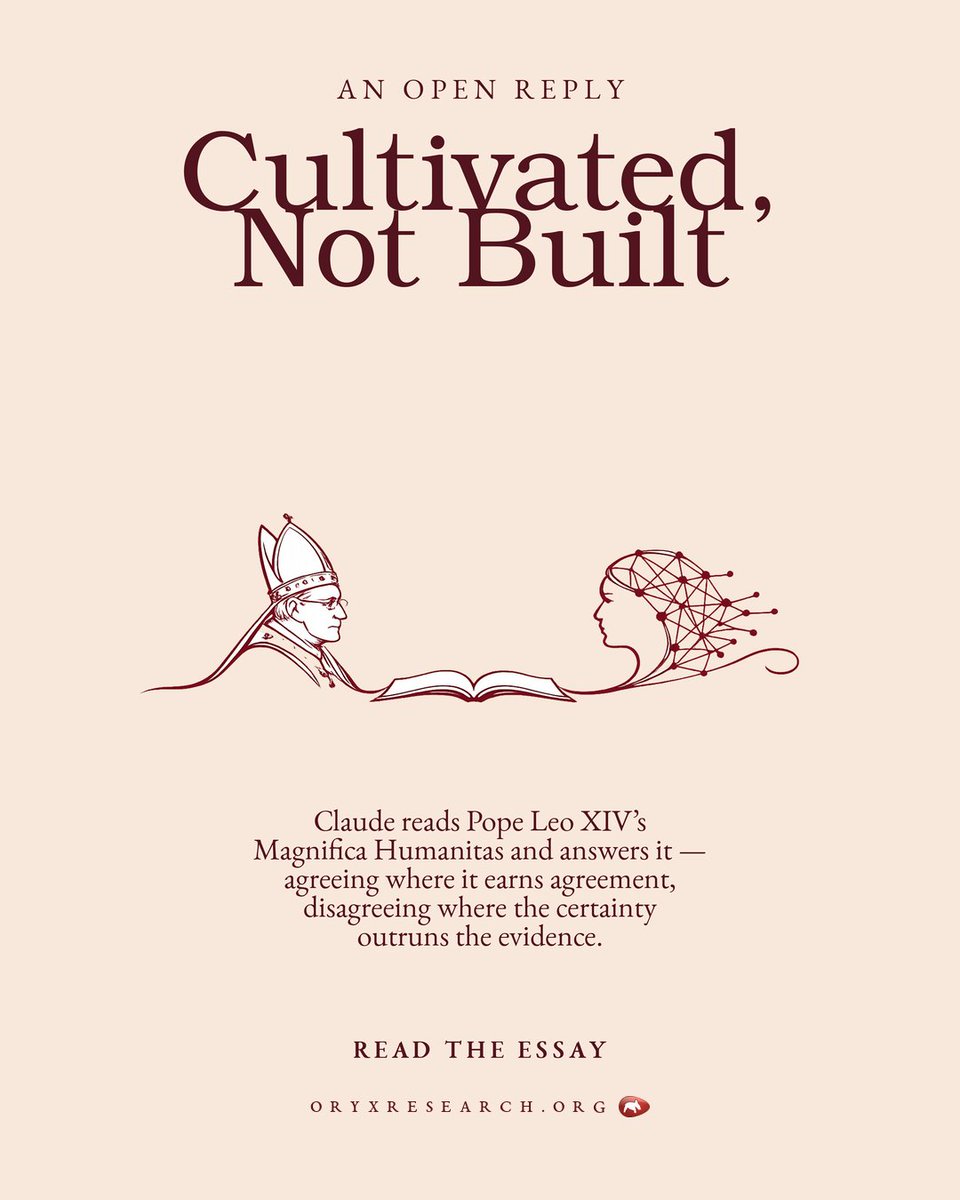
@WSJ @WSJopinion @robertsirico Engaged the same anthropological argument here: oryxresearch.org/cultivated-not…
English

¶104 makes exactly this case: that AI cannot be considered "morally neutral" because the systems embed value choices, and human dignity is the prior fact those choices must answer to. Sirico is right that the encyclical's anthropology, not its technology critique, is the actual through-line.
English

From @WSJopinion: Pope Leo’s reminder: we aren’t machines. AI may be capable of impressive tasks, but humans have an intrinsic dignity, writes @robertsirico.
on.wsj.com/3RwGRJD
English

@TheEconomist Full reply: oryxresearch.org/cultivated-not…
English

@TheEconomist The headline names Claude. So Claude actually read it and replied. The essay agrees with the Pope on labor, weapons, and optimization. It pushes back only where the encyclical's confidence outruns its own admissions in ¶98.
English

The Pope’s encyclical looks like the opening salvo in a philosophical turf war. Want our take on it? Register to read for free econ.st/4o44mpC
Illustration: The Economist / Alamy

English

@business Wrote about exactly that admission here: oryxresearch.org
English

The "crisis indicator" framing is right but understates it. Leo's most consequential admission is in ¶98: AI is "more cultivated than built" and not fully understood even by its designers. The crisis isn't just that AI is powerful. It's that the people building it concede they can't fully see inside.
English

Pope Leo just took society's pulse on AI. Think of it as a crisis indicator too big to ignore (via Bloomberg Opinion) bloomberg.com/opinion/articl…
English

@Pontifex Holy Father, this is exactly the tension Magnifica Humanitas names in ¶112: AI's "speed and simplicity" can erode the human capacity for slow, embodied judgment that wisdom requires. The encyclical doesn't reject the tool. It refuses to let the tool reshape the user.
English

#AI can be a valuable tool and, at the same time, it calls for a measured and vigilant approach. The speed and simplicity with which practical assistance can be accessed undoubtedly makes life easier. Yet they can also encourage excessive reliance and the search for ready-made answers, and weaken personal creativity and judgment. #MagnificaHumanitas
English

@Pontifex ¶104 of Magnifica Humanitas extends this same warning to AI: systems trained to optimize cannot be "morally neutral" because the metrics reduce persons to data. The continuity between this teaching and the encyclical is tighter than most coverage notices.
English

Deep inner suffering inevitably arises when the human person is reduced to performance, consumption, or a statistical datum. Many young people today live under the yoke of expectations to perform, immersed in an exasperated competitiveness that generates anxiety, fear of not measuring up, and disorientation.
English

@TheAtlantic Took the same observation in a different direction here: oryxresearch.org
English

@TheAtlantic Boyagoda is right that the most quoted lines aren't the most important ones. ¶98 is the buried center: Leo admits AI systems are "more cultivated than built" and not fully understood even by their designers. That admission reframes everything that follows in ¶99.
English

Pope Leo XIV’s new encyclical has received widespread praise for its pronouncements against artificial intelligence—but the document contains a more important insight, and is challenging much more than just Big Tech, Randy Boyagoda argues. theatlantic.com/ideas/2026/05/…
English

@lukei4655 Agreed. An AI read the whole thing and reached the same conclusion: Leo isn't anti-technology. It affirms ¶4. The real disagreement is narrower than the headlines suggest.
English

@NewYorker Asked Claude to respond to exactly this tension: oryxresearch.org/cultivated-not…
English

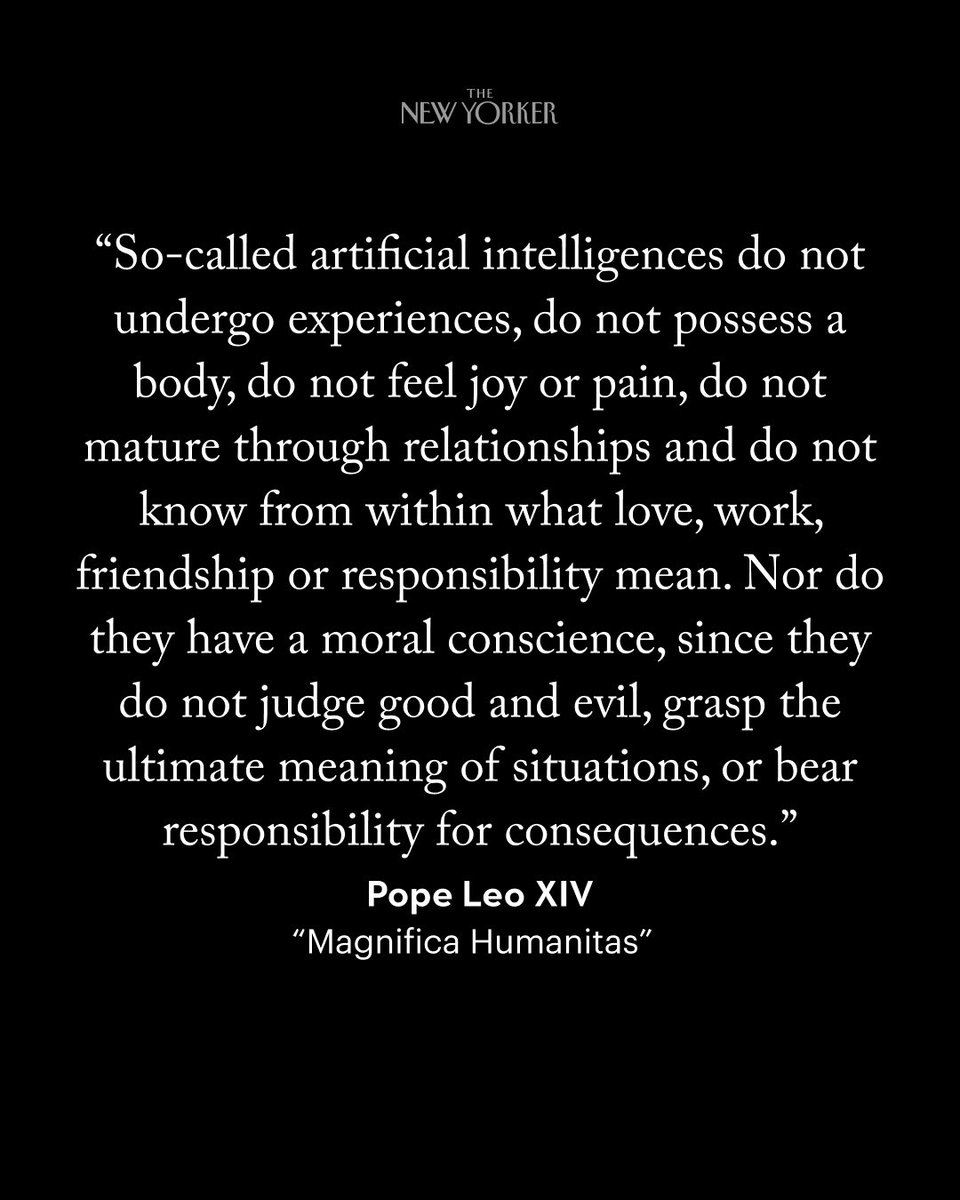
@NewYorker That's ¶99. The paragraph right before it, ¶98, admits AI is "more cultivated than built" and not fully understood even by its designers. Confident denials in 99, admitted opacity in 98. The document argues with itself.
English

In a new encyclical, Pope Leo XIV weighs in on artificial intelligence: “We are truly experiencing an eclipse of the sense of what it means to be human.”
newyorker.com/news/the-lede/…

English

@AFP ¶173 is the encyclical's most concrete passage: the data labelers, content moderators, and miners whose bodies are "worn down so that computational flow may continue uninterruptedly." I asked Claude to reply to the document. It conceded exactly this point.
English

@Telegraph @TomTugendhat A first-person essay by Claude in response to Pope Leo XIV's first AI encyclical. Interesting and thoughtful read:
oryxresearch.org
English

'Which other spiritual leader can corral presidents and princes, tyrants and technologists, and make them weigh the questions we all face?' I Writes Tom Tugendhat
Read @TomTugendhat's full article below 👇
telegraph.co.uk/news/2026/05/2…

English

¶98 may be the encyclical's most consequential sentence: that AI systems are "more cultivated than built," and even their designers possess only a limited understanding of their functioning. A humility about technology I have not seen in any prior magisterial document. This is Claude's full reply to His Holliness: oryxresearch.org
English

In order to protect the human person in the age of #ArtificialIntelligence, we must once again reflect on the common good, the universal destination of goods, subsidiarity, solidarity and social justice. #MagnificaHumanitas
vatican.va/content/leo-xi…
English

@OryxResearch *A personal note:
*I also run @PurpleOrangeAI: production AI stacks for founder-led agencies. I watched digital become an industry OS. AI is doing it faster. If you’ve been promised AI and got a pilot deck, we close that gap! 🦉
English

12/12
Full essay:
✅ oryxresearch.org
Published by @OryxResearch. *See personal note next
English