Scott Tyler (@[email protected])

2.6K posts

Scott Tyler (@ScienceScottT@genomic.social) banner
Scott Tyler (@ScienceScottT@genomic.social)

Scott Tyler (@[email protected])

@ScienceScottT

Developing new single cell omics methods and bench validating all the hypotheses those techniques give us. Opinions expressed are my own.

Entrou em Haziran 2018
684 Seguindo1.3K Seguidores
Tweet fixado
Scott Tyler (@ScienceScottT@genomic.social)
Scott Tyler (@[email protected])@ScienceScottT·
Working with multiple scRNAseq batches? Having trouble replicating at the bench? Our recent pre-print may show one reason why: (doi.org/10.1101/2021.1…) Findings complementary to @lpachter & Tara’s work finding low dim projections can be unreliable representations.
English
7
89
236
0
Scott Tyler (@[email protected]) retweetou
Joao Pereira
Joao Pereira@jdpereira·
The US mostly funds biomedical research through a large lump payment to the NIH. Panels of scientists and doctors volunteer to decide on the merit of grant individual applications, not unlike a really boring battle royale. All of this is halted. No new science is being funded.
GIF
English
30
57
370
32.9K
Scott Tyler (@[email protected]) retweetou
Prof. Nikolai Slavov
Prof. Nikolai Slavov@slavov_n·
NIH has stopped considering new grant applications, delaying decisions about how to spend millions of dollars. The freeze occurred because the Trump administration has blocked the NIH… npr.org/sections/shots…
English
87
157
454
229.4K
Scott Tyler (@[email protected]) retweetou
Michael Eisen
Michael Eisen@mbeisen·
This by @SGRodriques laments the (anticipated) failure of models trained on large datasets to reproduce "real biology discoveries" like those found in Science and Nature. While he sees this as a problem, I COULD NOT DISAGREE MORE. That foundational models don't (and God help us won't) spit out Nature papers is a feature, not a bug!
Sam Rodriques@SGRodriques

One of the remarkable things for me about NeurIPS this year was how quickly the entire AI for Biology community has gone all-in on biological foundation models. Virtual cell models will enable us to predict how cell states will change in response to chemical perturbations. Protein language models will enable us to identify better enzymes for degrading plastics, and so on. Everyone wants bigger data on more things to throw into bigger models. These models are going to be awesome, but real biology discoveries look somewhat different. Contrast these dreams of foundation models with the latest table of contents from Science or Nature: --“A long noncoding eRNA forms R-loops to shape emotional experience–induced behavioral adaptation” — The authors identified a lncRNA in mice that is expressed in response to neuronal activity that modulates the 3D structure of chromatin, thereby activating genes that are involved in neuronal plasticity. The authors further identified that this lncRNA is essential for certain forms of learning. --“Cancer cells impair monocyte-mediated T cell stimulation to evade immunity” — The authors identified that mouse melanoma cells secrete a lipid metabolite that prevents monocytes from activating CD8+ T cells. --“Postsynaptic competition between calcineurin and PKA regulates mammalian sleep–wake cycles” — By generating mouse knockout lines, the authors identified phosphatases and kinases that are critical for regulating the sleep-wake cycle, and showed that they act through regulation of proteins at excitatory postsynaptic sites. I struggle to imagine how any of these discoveries could fall out of a multimodal biology foundation model. This is not intended to be a straw man argument. Surely, a foundation model could potentially identify the lncRNA from the first paper, but I am not sure how such a foundation model would associate it with chromatin remodeling. A multimodal foundation model with enough data could also potentially identify metabolic changes associated with melanoma cells subjected to certain kinds of treatments, but I don’t see how that foundation model could identify the effect of those metabolites in preventing CD8+ T cell activation. Indeed, I do not think that any of the foundation models that are being developed today would be capable of generating rich new biological insights of the kind described in these papers. And yet, these are the kinds of insights that new therapies are made from. The issue, I think, is that machine learning models work extremely well on structured data, and so all the foundation models that are being built are highly structured. Take a protein sequence as input and produce a protein sequence as output. Take a cell state and a chemical perturbation as input and produce a new cell state as output. Biology, however, is poorly structured. The lncRNA insight is case in point: what structured representation can we use for the action of the lncRNA in modulating chromatin architecture? Protein models cannot represent it; DNA models cannot represent it; virtual cell models cannot represent it. Perhaps a model that incorporates RNA expression and 3D genome state could represent it, but then how would that model represent the lipid modulation of the monocytes? I worry that every discovery may need its own representation space. Indeed, the nature of biology is such that there likely is no representation, short of an atomic-resolution real-space model of the entire organism, that is sufficient to represent the diversity of biological phenomena that are relevant for disease. Except, of course, for natural language, which is evolved to represent all concepts that humans are capable of contemplating. Indeed, I think natural language has an essential role to play in representing biology, and is ultimately unavoidable, insofar as it is the only medium we know of that is sufficiently structured for machine learning and sufficiently flexible to represent the full diversity of biological concepts. At FutureHouse, we work on language agents, which is one way of combining language and biology, but this is not the only way. Models that combine natural language with protein, DNA, transcriptomics, and so on will also be extremely productive, provided the addition of the structured datatypes does not restrict their ability to represent unstructured concepts. However we do it, I think this essential role of natural language in representing biology is currently largely underappreciated. The history of biology is built on tools that we have found in nature to study biological phenomena. As all biologists know, trying to engineer things from scratch (almost) never works; what works is finding things in nature and repurposing them. It will be aesthetically pleasing if it turns out that our engineered representations are yet again insufficient for studying biology, and that natural language is simply another such tool that we have found in nature that must be applied instead.

English
6
27
183
57K
Scott Tyler (@ScienceScottT@genomic.social)
Scott Tyler (@[email protected])@ScienceScottT·
@wasserstein_rao Fair enough haha - cloud lab would have a near infinite number of edge cases. I like the idea of starting out with an API, especially if you have it with some validated protocols for RAG. Would be a really cool prototyping even if cloud lab is a bit more distant.
English
0
0
1
49
stefan
stefan@wasserstein_rao·
@ScienceScottT Haha I appreciate that! I've thought about it a bit. I like the idea of giving a user some kind of API or experimental design tools without making it ridiculously broad like a cloud lab.
English
1
0
1
42
stefan
stefan@wasserstein_rao·
A good robotic CRO platform is one that can do a very combinatorially broad set of experiments with minimal instrumentation
English
1
0
5
701
Scott Tyler (@[email protected]) retweetou
Alec Stapp
Alec Stapp@AlecStapp·
It's bad that the NIH has pretty much stopped funding young scientists to lead projects
Alec Stapp tweet media
English
26
91
736
189.5K
Scott Tyler (@[email protected]) retweetou
Gennady Gorin
Gennady Gorin@GorinGennady·
Single-cell RNA sequencing is biased (and more so if you count more molecules). But biases aren't just arbitrary artifacts; they reveal something non-obvious about the technology and chemistry of sequencing, and we can learn a lot by using physical models. Read to find out more!
Cell Press@CellPressNews

Length biases in single-cell RNA sequencing of pre-mRNA. Check out this research by @lpachter & @GorinGennady in @BiophysReports #CellBio2024 hubs.li/Q02_LC2n0

English
0
8
60
6.9K
Scott Tyler (@[email protected]) retweetou
sina
sina@sinabooeshaghi·
If you’re frustrated with healthcare, get this: Health Insurance @ElevanceHealth (formerly Anthem) bamboozled @Caltech into overpaying thousands per person for a pricier plan identical to the cheaper one—except for a higher premium and deductible. No added benefits.
sina@sinabooeshaghi

Furthermore, since Caltech subsidizes the plans by different amounts, Caltech also pays an extra $1,865.28 annually for each staff member who chooses PPO 1800 over PPO 3000.

English
0
4
5
1.2K
Scott Tyler (@[email protected]) retweetou
@jhelisseeff
@jhelisseeff@JHElisseeff·
Seeing data on macrophages and metabolism from single cell. It's somewhat buried in the paper and not obvious from the title - but we see different metabolic profiles in macrophages from pro-regenerative vs fibrotic materials in vivo! science.org/doi/10.1126/sc…
@jhelisseeff tweet media
English
1
13
49
3.6K
Rahul Banerjee, MD, FACP
Rahul Banerjee, MD, FACP@RahulBanerjeeMD·
#ASH24 great work by @RossFirestone (who’s basically an assoc prof at @MSKCancerCenter despite still being a fellow 😉 ) Regardless of MRD status by NGF (e.g., tumor biology), clear T cell profiles (e.g., immune biology) matter too. This can predict #MMsm PD even if MRD-neg!
Rahul Banerjee, MD, FACP tweet media
English
1
4
19
6.7K
Scott Tyler (@ScienceScottT@genomic.social)
@iScienceLuvr I'm sure they'll be improving it in chunks with the interactive user feedback RLHF, but it's definitely been a bit of a challenge out of the gate imho
English
0
0
0
31
Scott Tyler (@ScienceScottT@genomic.social)
@iScienceLuvr Curious what your take on full o1 is at the moment. I've only had one session with it, trying to use it to create a new agent framework & it was really almost unusable for me because it refused to answer, or just said nothing after "finished thinking" so many times.
English
1
0
0
74
Tanishq Mathew Abraham, Ph.D.
Tanishq Mathew Abraham, Ph.D.@iScienceLuvr·
Full o1 and o1-pro New Gemini model top of LM Arena PaliGemma-2 Grok Aurora image generation Llama-3.3-70B-Instruct HunyuanVideo Lots of great 🎁 for this first week of "Shipcember", looking forward to next week!
Tanishq Mathew Abraham, Ph.D. tweet media
English
4
7
72
15.5K
Scott Tyler (@[email protected]) retweetou
Itai Yanai
Itai Yanai@ItaiYanai·
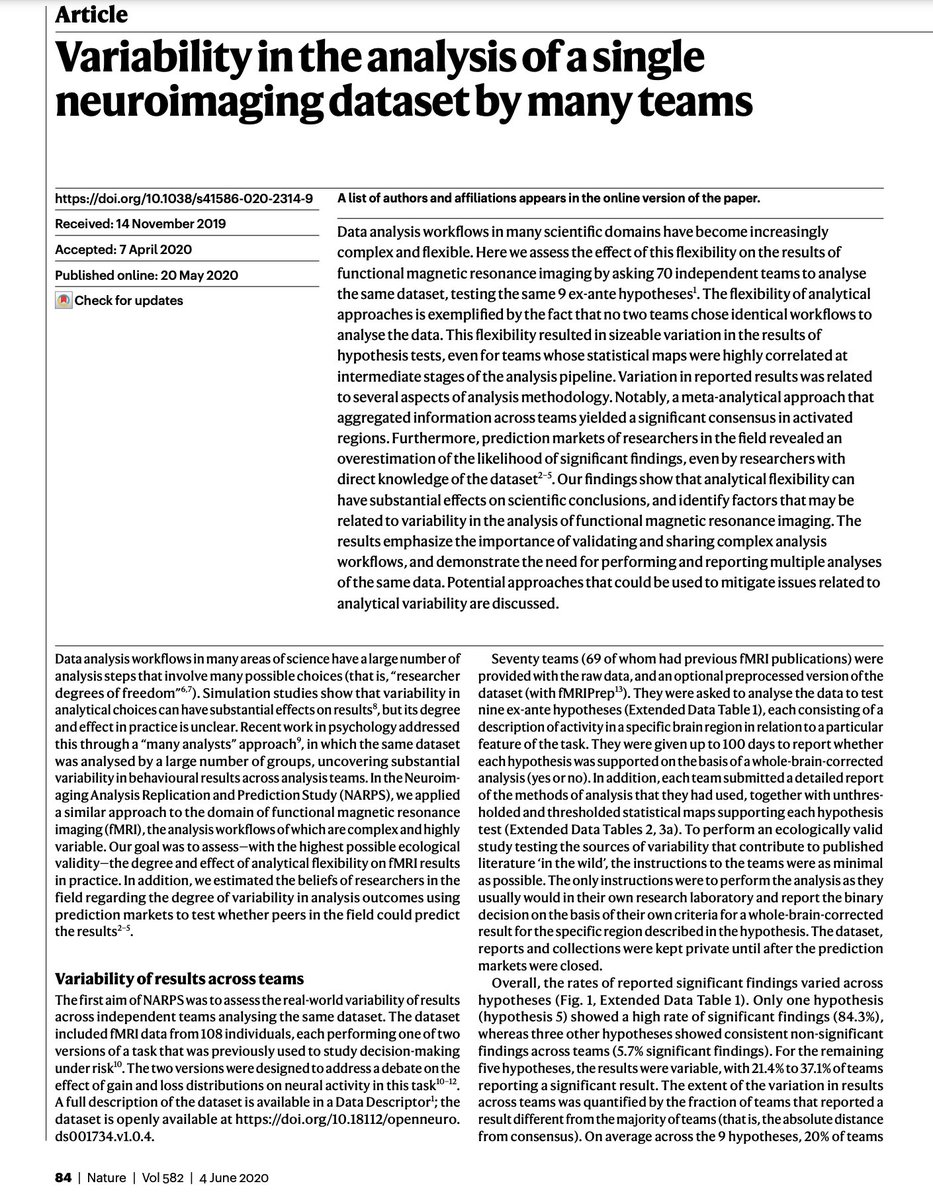
Data can be analyzed in endless ways, as this paper reminds us. So while our published paper reports one way to do it, it's crucial to test many many variants of the analysis to see just how robust our conclusions are.
Itai Yanai tweet media
English
7
53
265
40.5K
Scott Tyler (@[email protected]) retweetou
National Human Genome Research Institute
Happy Thanksgiving! We are thankful for the opportunity to talk about how cool genomics is with you all the time. Our family might get annoyed at us for talking about it too much, but that won’t stop us!
National Human Genome Research Institute tweet media
English
2
24
135
6.9K
Scott Tyler (@[email protected]) retweetou
Elisabeth Bik
Elisabeth Bik@MicrobiomDigest·
Our group of #ImageForensics experts @Thatsregrettab1 , @mumumouse2, @schrag_matthew, and myself are currently posting the problems we found in these papers. We have now posted 118 of Dr. Masliah's paper onto @PubPeer. Follow our progress here: pubpeer.com/search?q=%22El…
Charles Piller@cpiller

My new investigation for @newsfromscience: Did a top @NIH official manipulate Alzheimer's/Parkinson’s research for decades? Neuroscientist Eliezer Masliah found to engage in scientific misconduct; 132 of his papers fall under suspicion science.org/content/articl…

English
4
41
186
70.2K