Steven Stocks retweetou
Steven Stocks
7.7K posts

Steven Stocks retweetou
BBC
How BBC Scotland controlled its output during the 2014 Referendum
"In the often excellent analysis by Prof Happer in the Herald newspaper yesterday (it correctly identifies the bias in BBC Scotland) ... I’d have to disagree with this:
Happer, who speaks extensively to BBC Scotland staff, said: “BBC Scotland journalists felt they couldn’t cover the referendum in the way they would have liked because of commands coming from London”
That’s a clear excuse, rewriting history.
In 2014, I was approached by two younger staff at BBC Scotland News and neither mentioned commands from London. They did both say that the then Head of News, John Boothman (pictured) scared them to death, explicitly told them what was acceptable and what was not, in line with a clear anti-independence stance.
Boothman, married to a Labour Minister, a media trainer for Scottish Labour, ‘moved on’ for bullying [staff] and latterly at the Times, ran a tight ship that ensured BBC Scotland did its very best to protect the Union.
The culture he developed with others in the senior management, lives on to this day, no weaker for his departure.
Any regular watcher of the BBC 6 [news] then 'Reporting Scotland' sequence over the years, will often have seen the former put up data showing NHS Scotland to be doing better than NHS England and, subsequently, Reporting Scotland turning the other way or finding some single hospital death or infection by pigeons to counter it.
The senior staff at the BBC in England have little daily interest in Scotland. They have so much happening there to focus on. If those at the very top of the BBC, political appointees as they are, do have an interest in promoting biased reporting in Scotland, they appoint senior staff, checked by MI5 (a fact they acknowledge) to do that for them.
No one at BBC HQ in London told reporters at BBC Scotland what to do in 2014, nor do they do so today. The current Head of News and editor of Reporting Scotland know just what to do."
Professor John Robertson

English
Steven Stocks retweetou

'Charles III was crowned in May 2023. He was crowned with the Imperial State Crown — the English crown. No Scottish coronation oath was taken. The Scottish crown sits in a castle in Edinburgh ... Two crowns. Two kingdoms. One of them has been pretending the other doesn’t exist'.
Steven Mcnamee 🏴@stevenmcn86
Two Crowns. Two Kingdoms. The Union That Never Was. open.substack.com/pub/stevenmcna…
English

@paulhutcheon If Labour was going to put it in place you would be all over it!
English

@DannyConway1875 @dm180914 Has any other country done this before breaking free from another?
English

@dm180914 If the SNP was serious about independence they’d do it the correct way - outline exactly how an independent Scotland would be created, the full cessation process, how the economy will function, which currency we’d use, defence, civil service, etc.
But there’s none of that. 🤷🏻♂️
English

Any spares for Hibs will pay good 🇮🇪
@HoopsSpares111 @SparesCeltic
English

Long shot but is there any spares going for hibs @SparesCeltic @HoopsSpares111
English
Steven Stocks retweetou

Part 2 - The Coup Continues
Every time Scotland is told it has no right to choose - that Westminster's permission is required for the Scottish people to determine their own future - we are living the operating logic of 1707:
Modern Violation #1: The Section 30 Veto
Scotland returns consistent majorities for parties mandated to hold an independence referendum. Westminster refuses.
Under the Scotland Act, a Section 30 order - issued at Westminster's discretion - is required for a binding vote.
That means the Scottish people's right to determine their future is conditional on permission from an English majority, sitting in what De Lolme identified as the continuing English Parliament.
The Claim of Right says sovereignty belongs to the Community of the Realm. Westminster says sovereignty belongs to Westminster.
These positions are irreconcilable. Only one of them is Scotland's position.
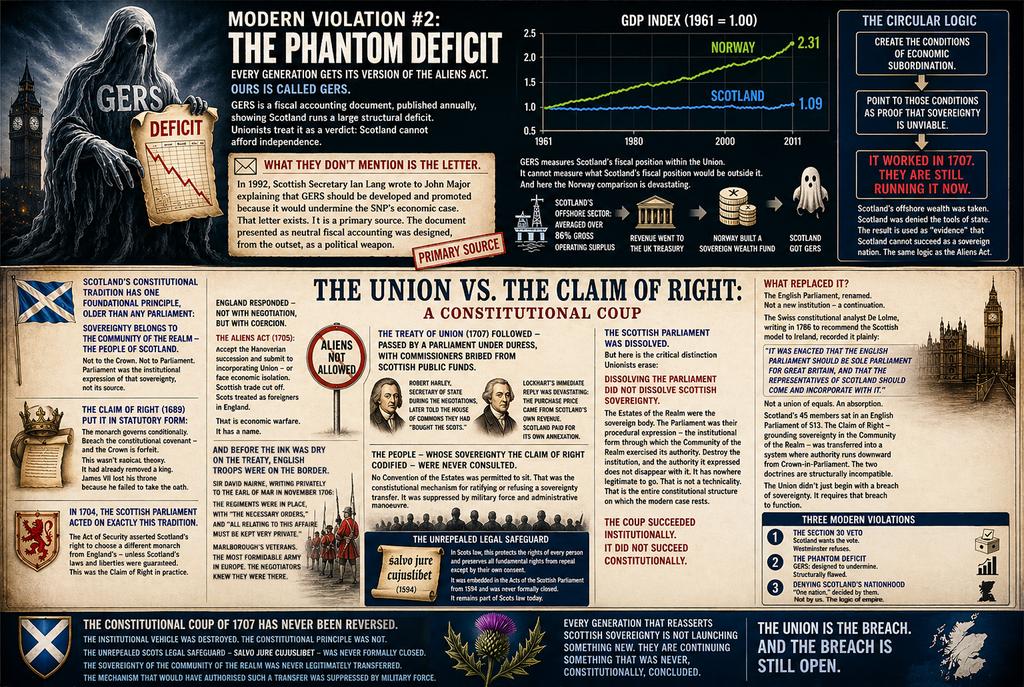
Modern Violation #2: The Phantom Deficit
Every generation gets its version of the Aliens Act. Ours is called GERS.
GERS is a fiscal accounting document published annually, showing Scotland runs a large structural deficit. Unionists treat it as a verdict: Scotland cannot afford independence.
What they don't mention is the letter:
In 1992, Scottish Secretary Ian Lang wrote to John Major explaining that GERS should be developed and promoted because it would undermine the SNP's economic case. That letter exists. It is a primary source. The document presented as neutral fiscal accounting was designed, from the outset, as a political weapon.
But the deeper problem is structural, not just political.
GERS measures Scotland's fiscal position within the Union. It cannot measure what Scotland's fiscal position would be outside it. And here the Norway comparison is devastating. In 1961, Scotland and Norway had near-identical economic baselines. By 2011, Scotland's GDP index stood at 1.09. Norway's stood at 2.31. Same starting point. Radically different trajectories. The difference isn't Scottish incapacity - it's who controlled the oil, and what they did with it.
Scotland's offshore sector averaged over 86% gross operating surplus. That revenue went to the UK Treasury. Norway built a sovereign wealth fund. Scotland got GERS.
The logic is circular in exactly the way the Aliens Act was circular. Create the conditions of economic subordination. Point to those conditions as proof that sovereignty is unviable. It worked in 1707. They are still running it now.
Modern Violation #3: Denying Scotland's Nationhood
"Scotland is not a colony. The UK is one nation."
This erases Scotland's status as a historic nation with its own constitutional tradition, its own legal system, its own sovereignty doctrine - and replaces it with a unitary state doctrine that, as the evidence shows, was retrofitted after the fact to legitimise an absorption that the British state's own sources describe as annexation.
"In this Union here are Lands and People added to the English Empire." Defoe, 1706.
The logic is imperial: you belong to us, and we decide if you can leave.
The constitutional coup of 1707 has never been reversed.
The constitutional principle was never destroyed.
The unrepealed Scots legal safeguard - salvo jure cujuslibet - was never formally closed. The sovereignty of the Community of the Realm was never legitimately transferred. The mechanism that would have authorised such a transfer was suppressed by military force.
Every generation that reasserts Scottish sovereignty isn't launching something new.
They are continuing something that was never, constitutionally, concluded.
The Union is the breach.
That breach is still open - and now it's time to close it.

English
Steven Stocks retweetou

Part 1 - Union vs. Claim of Right: A Constitutional Coup
Scotland's constitutional tradition has one foundational principle, older than any Parliament:
Sovereignty belongs to the Community of the Realm - the people of Scotland.
It doesn't belong to monarch or Parliament. Parliament was the institutional expression of that sovereignty, not its source. The distinction matters because it's what the 1707 coup had to destroy.
The Claim of Right (1689) made it statute: A monarch governs conditionally. Breach the constitutional covenant and the Crown is forfeit.
This had already removed a king. James VII lost his throne because he failed to take the oath. The principle was operational.
In 1704 the Scottish Parliament acted on exactly this tradition.
The Act of Security asserted Scotland's right to choose a different monarch from England's - unless Scotland's laws and liberties were guaranteed.
This was the Claim of Right in practice - England responded with threats.
The English Aliens Act (1705) was an ultimatum: accept the Hanoverian succession and submit to incorporating Union,or face economic blockade. Scottish trade was to be cut off,and Scots treated as foreigners in England.
This was economic warfare.
And once the Treaty was forced, before the ink was dry, English troops were on the border.
Sir David Nairne,writing privately to the Earl of Mar in November 1706: the regiments were in place, with "the necessary orders," and "all relating to this affaire must be kept very private."
Marlborough's veterans. The most formidable army in Europe. The negotiators knew they were there.
Scotland's own army? Abroad under English Crown control. Scotland had no defence.
The Acts of Union followed - passed by a Parliament under threat, duress, and bribery.
Robert Harley, Secretary of State during negotiations, later told the House of Commons they had "bought the Scots." The immediate reply, from Lockhart of Carnwath, was devastating: the purchase price came from Scotland's own revenue. Scotland paid for its own annexation.
The people - whose sovereignty the Claim of Right codified - were never consulted.
No Convention of the Estates was permitted to sit. That was the constitutional mechanism for ratifying or refusing a sovereignty transfer. It was suppressed by military force and administrative manoeuvre. The procedural safeguard in Scots law preserving all fundamental rights from exactly this kind of statutory override, salvo jure cujuslibet, embedded in the Acts of the Scottish Parliament from 1594, was never formally closed - it was ignored.
The Scottish Parliament was dissolved. But here's the critical distinction Unionists erase:
Dissolving the Parliament didn't dissolve Scottish sovereignty.
The Estates of the Realm were the sovereign body. Parliament was their procedural expression - the institutional form through which the Community of the Realm exercised its authority. Destroy the institution, and the authority it expressed doesn't disappear - it just has nowhere to go. That's the entire constitutional structure on which Scotland's modern case rests.
The coup succeeded institutionally. It didn't succeed constitutionally.
What replaced it?
The English Parliament, renamed. Not new, but a continuation.
The Swiss constitutional analyst De Lolme, in 1786, recorded it plainly: it was enacted "that the English Parliament should be sole Parliament for Great Britain, and that the Representatives of Scotland should come and incorporate with it."
Adding: "The Crown of Scotland... being at the same time for ever annexed to the Crown of England."
An absorption.
Scotland's 45 members sat in an English Parliament of 513.
The Claim of Right, grounding sovereignty in the Community of the Realm, was transferred into a system where authority runs downward from Crown-in-Parliament. The two doctrines are incompatible.
The Union didn't just begin with a breach of sovereignty. It requires that breach to function.
Continued 👇

English
Steven Stocks retweetou

Nailed it.
Disgraceful headline.
David Scott@DavidGk1Scott
This needs to be called out for what it is @BBC ❌ This 17yr old Goalkeeper was rewarded with a new contract after living his dream, making his professional debut in a Scottish Cup semi final at Hampden under extreme pressure and performed admirably. Our media MUST do better to protect our young footballers!
English
Steven Stocks retweetou

OH MY WORD 🤯🤯🤯🤯
YORK HAVE EQUALISED IN THE 102ND MINUTE TO WIN PROMOTION 😱
Watch LIVE NOW at DAZN.com/NLTV 📺
English
Steven Stocks retweetou