
Tweet fixado

Most people in DeFi just chase high APR but nobody really talks about how fast those rates can change.
You enter at like 12% APR, then the market moves and suddenly it’s 30%+. same position, but now everything is off.
That’s basically the problem @TermMaxFi is solving.
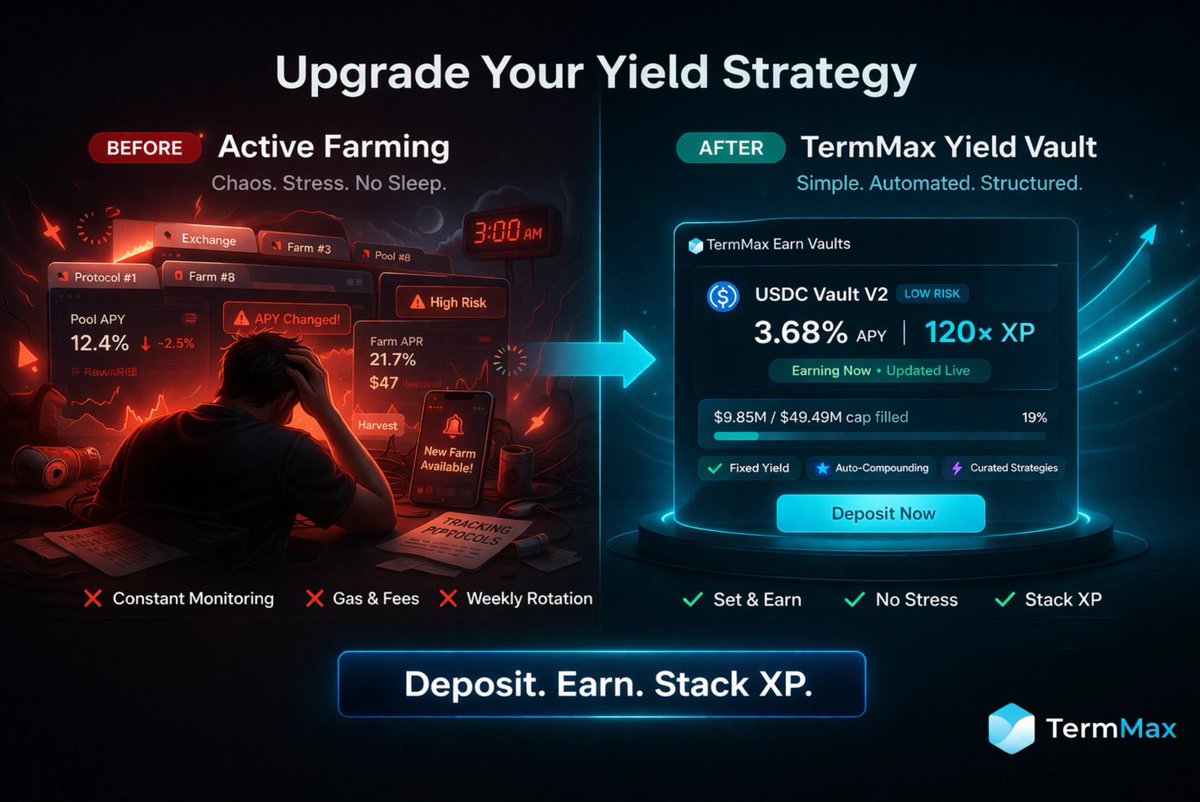
Instead of floating rates, you get fixed APR. What you see when you enter is what you keep, no surprises later.
It’s actually pretty simple:
~ Lenders lock in their yield from the start
~ Borrowers lock in their cost immediately
~ You can even open leveraged positions in one go
And this it’s not just an idea anymore, it’s already live and running on multiple chains ETH, BNB, Arbitrum, Base, X layer B2 Network. with 800K+ active wallets and $64M+ TVL
With the Base integration, users can now borrow against assets like Coinbase-related collateral at fixed rates, which is a big step for more serious capital entering DeFi.
Plus, if you like trading, you can long/short with leverage, and even trade some assets without liquidation on BNB chain, plus you earn points while trading too.
<<< ABOUT THE TOKEN $TMX >>>
$TMX has a fixed supply of 1B, no inflation.
Only 20% is circulating at TGE,
15% is allocated to the community with no vesting or linear unlock,
You can stake $TMX to get sTMX, and as usage grows fees, borrowing, trading, rewards flow back to stakers.
So instead of just holding, you’re actually plugged into the growth
English