David Elliot Berman

949 posts

David Elliot Berman banner
David Elliot Berman

David Elliot Berman

@_DavidBerman

Assistant Professor @SetonHall. Former: @AnnenbergPenn @MIC_Center. Platforms, policy, political economy.

New Jersey, USA Entrou em Ekim 2012
1.3K Seguindo364 Seguidores
David Elliot Berman retweetou
Suzie Dawson
Suzie Dawson@Suzi3D·
I'm going to keep saying it until people get it. AI *is* mass surveillance. All AI. Not some. All. By design and by default. x.com/heygurisingh/s…
Guri Singh@heygurisingh

🚨 Stanford just analyzed the privacy policies of the six biggest AI companies in America. Amazon. Anthropic. Google. Meta. Microsoft. OpenAI. All six use your conversations to train their models. By default. Without meaningfully asking. Here's what the paper actually found. The researchers at Stanford HAI examined 28 privacy documents across these six companies not just the main privacy policy, but every linked subpolicy, FAQ, and guidance page accessible from the chat interfaces. They evaluated all of them against the California Consumer Privacy Act, the most comprehensive privacy law in the United States. The results are worse than you think. Every single company collects your chat data and feeds it back into model training by default. Some retain your conversations indefinitely. There is no expiration. No auto-delete. Your data just sits there, forever, feeding future versions of the model. Some of these companies let human employees read your chat transcripts as part of the training process. Not anonymized summaries. Your actual conversations. But here's where it gets genuinely dangerous. For companies like Google, Meta, Microsoft, and Amazon companies that also run search engines, social media platforms, e-commerce sites, and cloud services your AI conversations don't stay inside the chatbot. They get merged with everything else those companies already know about you. Your search history. Your purchase data. Your social media activity. Your uploaded files. The researchers describe a realistic scenario that should make you pause: You ask an AI chatbot for heart-healthy dinner recipes. The model infers you may have a cardiovascular condition. That classification flows through the company's broader ecosystem. You start seeing ads for medications. The information reaches insurance databases. The effects compound over time. You shared a dinner question. The system built a health profile. It gets worse when you look at children's data. Four of the six companies appear to include children's chat data in their model training. Google announced it would train on teenager data with opt-in consent. Anthropic says it doesn't collect children's data but doesn't verify ages. Microsoft says it collects data from users under 18 but claims not to use it for training. Children cannot legally consent to this. Most parents don't know it's happening. The opt-out mechanisms are a maze. Some companies offer opt-outs. Some don't. The ones that do bury the option deep inside settings pages that most users will never find. The privacy policies themselves are written in dense legal language that researchers people whose job is reading these documents found difficult to interpret. And here's the structural problem nobody is addressing. There is no comprehensive federal privacy law in the United States governing how AI companies handle chat data. The patchwork of state laws leaves massive gaps. The researchers specifically call for three things: mandatory federal regulation, affirmative opt-in (not opt-out) for model training, and automatic filtering of personal information from chat inputs before they ever reach a training pipeline. None of those exist today. The uncomfortable truth is this: every time you type something into ChatGPT, Gemini, Claude, Meta AI, Copilot, or Alexa, you are contributing to a training dataset. Your medical questions. Your relationship problems. Your financial details. Your uploaded documents. You are not the customer. You are the curriculum. And the companies doing this have made it as hard as possible for you to stop.


English
27
3.3K
8.3K
152.8K
David Elliot Berman retweetou
The Atlantic
The Atlantic@TheAtlantic·
“At some point over the past 15 years, kids stopped reading”—but that’s because not enough teachers are asking them to, Walt Hunter writes: theatlantic.com/ideas/2026/02/…
English
8
32
98
17.8K
David Elliot Berman retweetou
Ethan Mollick
Ethan Mollick@emollick·
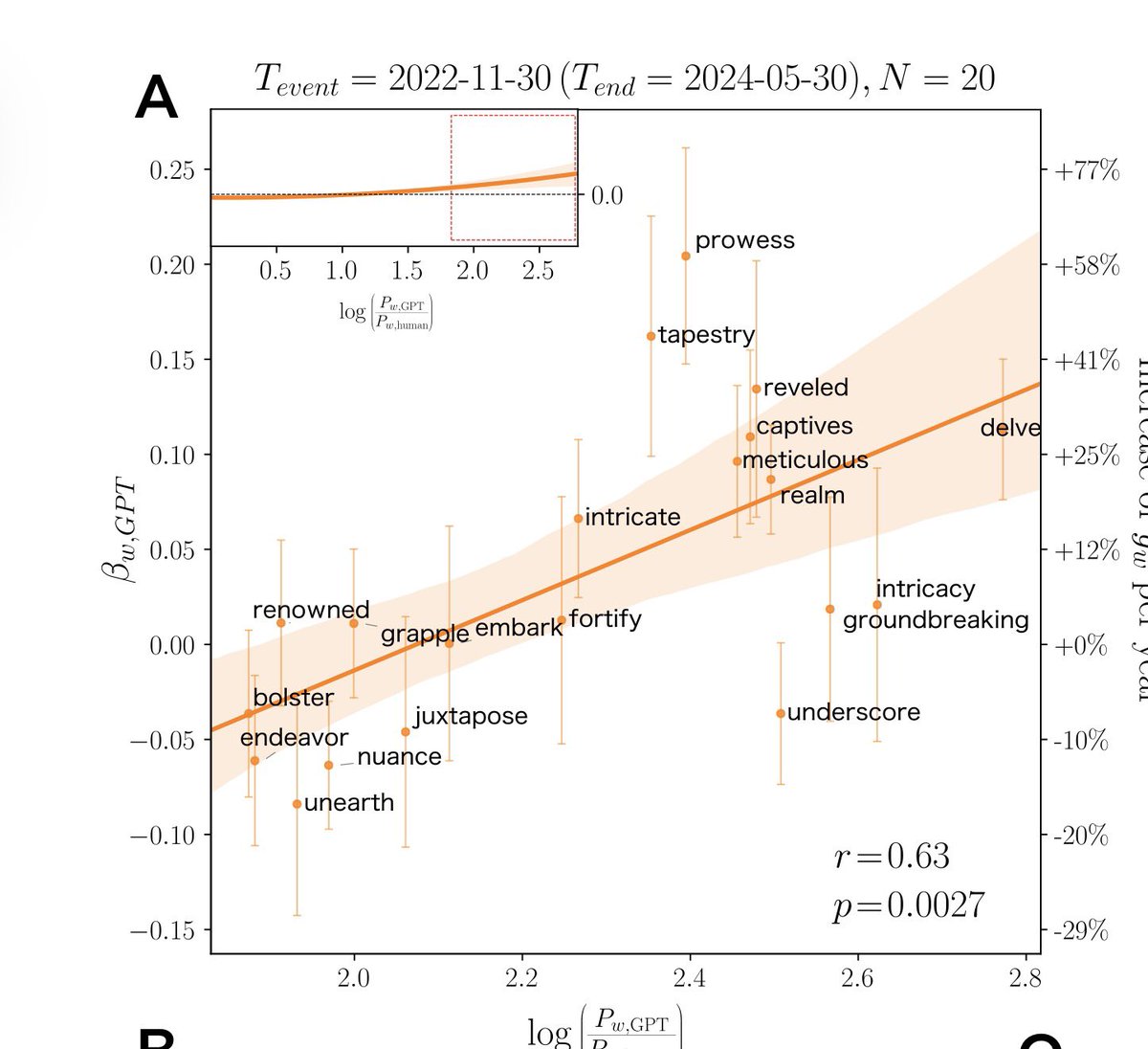
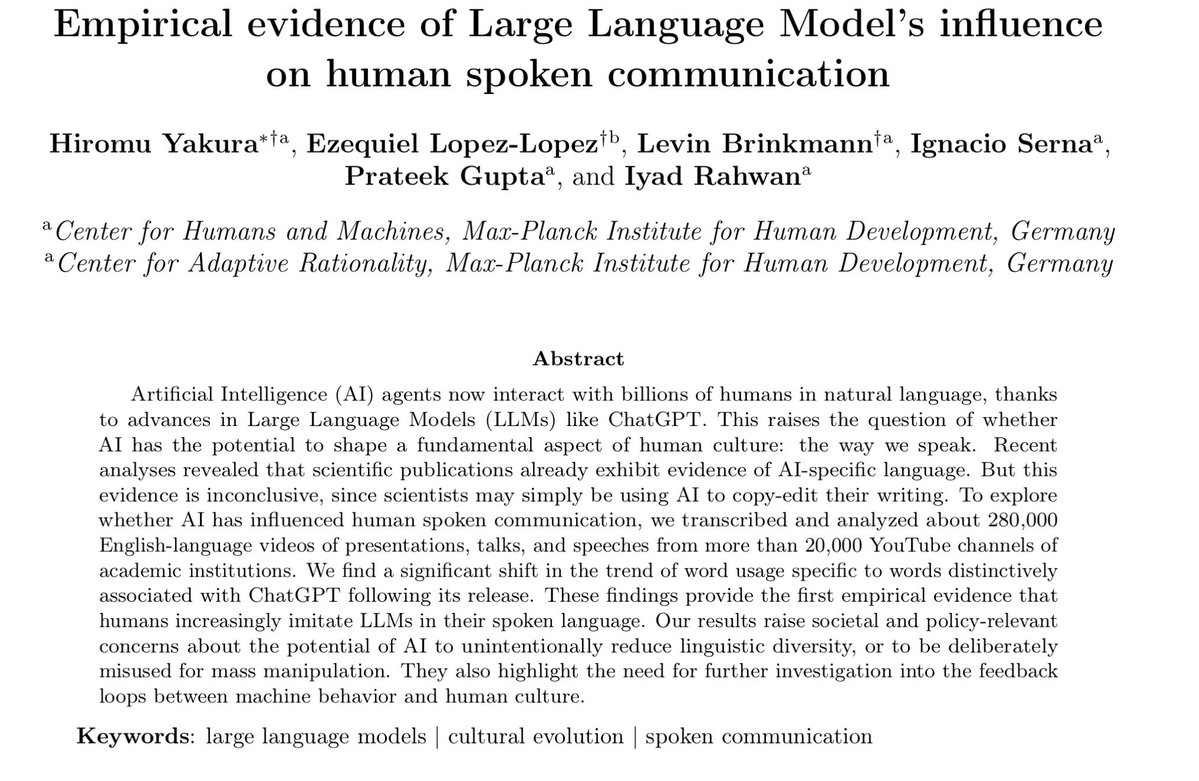
Everyone is starting to sound like AI, even in spoken language Analysis of 280,000 transcripts of videos of talks & presentations from academic channels finds they increasingly used words that are favorites of ChatGPT Model collapse, except for humans arxiv.org/pdf/2409.01754…
Ethan Mollick tweet mediaEthan Mollick tweet media
English
168
505
2.6K
401.1K
David Elliot Berman retweetou
Matthew H. Young
Matthew H. Young@matthenryyoung·
The earnest term paper written in the fevered haze of a caffeine and nicotine fueled all-nighter — of greater worth to me than the entire cumulative output of generative AI.
English
5
55
450
10.9K
David Elliot Berman retweetou
Malcolm Harris
Malcolm Harris@BigMeanInternet·
The thing about AI I want to press people on is why capital feels compelled to invest in AI *in particular* and to the exclusion of everything else.
English
68
134
1.5K
79.7K
David Elliot Berman retweetou
Leigh Giangreco
Leigh Giangreco@LeighGiangreco·
It’s a loss for humanity as a whole that we are losing cultural critics with keen eyes and sharp wits, then getting nothing in return but AI slop and influencers who ask Pedro Pascal what it’s like to be the Internet’s daddy
English
11
645
4.3K
87.7K
David Elliot Berman retweetou
Tyler Austin Harper
Tyler Austin Harper@Tyler_A_Harper·
Every day an ostensibly serious person describes how they use ChatGPT—to write pretty passages, to rattle off fun hallucinated historical slop to them in the car—and it really is as though they’ve voluntarily hung a big, public sign around their neck that says: “I’m illiterate.”
Sam Adler-Bell@SamAdlerBell

so my despair really never comes from fear of AI's potential — though I think it is considerable — but that so many self-understood aesthetes and cultural gatekeepers are perhaps already essentially illiterate

English
15
54
705
35K
David Elliot Berman retweetou
Kassia Oset
Kassia Oset@KassiaOset·
This article title goes extremely hard
Kassia Oset tweet media
English
54
1.4K
12.9K
562.4K
David Elliot Berman retweetou
MIC Center
MIC Center@MIC_Center·
Excited to announce our Pennsylvania Broadband Research Institute's $1.2M award to partner with the City of Philadelphia to evaluate and support their NTIA-funded initiative to create a more digitally empowered city. @PSUBellisario @_DavidBerman tiny.cc/bx07001
English
1
2
2
288
David Elliot Berman retweetou
Jason Koebler
Jason Koebler@jason_koebler·
After months of digging and reporting, I have learned where Facebook's bizarre AI spam (like "Shrimp Jesus") comes from, who is making it, how it works, and how it is monetized. Turns out Meta is directly paying people to spam FB with this stuff 404media.co/where-facebook…
English
59
2.1K
5.9K
967.7K
David Elliot Berman retweetou
A.J. Bauer
A.J. Bauer@ajbauer·
We can't joke or snark our way out of what's happening now or what comes next. Organize your friends, coworkers, neighbors — look out for them. Take care of one another. Less time online. More time building and cultivating communities of care.
English
2
259
923
77.1K
David Elliot Berman retweetou
Victor Pickard
Victor Pickard@VWPickard·
Come work with us at the MIC Center! We have an opening for a postdoctoral researcher who focuses on the political economy of broadband, digital equity, and the future of local media infrastructures. Please spread the good word! asc.upenn.edu/research/cente…
English
0
25
37
9.4K