Eric Chan | CRE Construction

597 posts

Eric Chan | CRE Construction banner
Eric Chan | CRE Construction

Eric Chan | CRE Construction

@builtbyEC

Over $200M of NYC CRE construction projects completed as a Contractor and Owner's Rep. Strategies to help your next build: https://t.co/gJ3cU70pY5

New York City, NY Entrou em Ekim 2025
318 Seguindo96 Seguidores
Chris Goldammer
Chris Goldammer@floor_per_area·
Who has the prettiest house? Coming in a few days. Feature requests welcome.
English
5
1
4
813
MATT GRAY
MATT GRAY@matt_gray_·
Once you clone yourself with AI everything changes Most founders get stuck bc every decision goes through you My Clone Yourself Checklist shows you which decisions to systematize 1st so your team runs without you Comment CLONE and I'll share it. Follow me first or I can't DM you
English
797
38
638
65.9K
Dan Martell
Dan Martell@danmartell·
If your friends aren’t talking about Claude Cowork… you need new friends.
English
160
20
483
31.5K
Eric Chan | CRE Construction retweetou
Marc Andreessen 🇺🇸
Claude knows! —> The Lump of Labor Fallacy and Why AGI Unemployment Panic Is Economically Illiterate Let me lay this out with full rigor, because this argument deserves to be prosecuted completely rather than waved away with a sound bite. I. What the Lump of Labor Fallacy Actually Is The lump of labor fallacy is the assumption that there exists a fixed, finite quantity of work in an economy — a lump — such that if a machine (or an immigrant, or a woman entering the workforce) does some of it, there is necessarily less left for human workers to do. It treats employment as a zero-sum pie. The fallacy was named and formalized in the early 20th century but the error it describes is far older. It animated the Luddite riots of 1811–1816, where English textile workers destroyed power looms convinced that the machines would steal their jobs permanently. It drove opposition to the spinning jenny, the cotton gin, the mechanical reaper, the steam engine, the telegraph, the railroad, the automobile assembly line, the personal computer, and every other major labor-displacing technology in the history of industrial civilization. Every single time, the catastrophists were wrong. Not partially wrong. Structurally, fundamentally, categorically wrong — because they misunderstood the nature of economic production itself. The reason the fixed-pie assumption fails is this: demand is not fixed. Work generates income. Income generates demand for goods and services. Demand for goods and services generates new categories of work. This is an engine, not a reservoir. When you drain some of the reservoir with a machine, the engine speeds up and refills it — and often refills it past its previous level. II. The Classical Economic Mechanism That Destroys the Fallacy To understand why the lump-of-labor assumption is wrong about AGI, you need to understand the precise mechanism by which technological unemployment resolves itself. There are four distinct channels, all operating simultaneously: Channel 1: The Productivity-Demand Feedback Loop (Say’s Law, Modified) When a technology increases the productivity of labor or replaces labor entirely in a given task, it lowers the cost of producing whatever that task was part of. Lower production costs mean either: ∙Lower prices for consumers (real purchasing power rises), or ∙Higher profits for producers (which get reinvested, distributed as dividends, or spent as wages for other workers), or ∙Both. Either way, aggregate real income in the economy rises. That additional real income does not evaporate. It gets spent on something — including goods and services that didn’t previously exist or were previously too expensive to consume at scale. That spending creates demand. That demand creates jobs. This is not a theoretical conjecture. The average American in 1900 spent roughly 43% of their income on food. Today it’s around 10%. Agricultural mechanization didn’t produce a nation of starving unemployed farm laborers — it freed up 33% of household income to be spent on automobiles, television sets, air conditioning, healthcare, education, travel, smartphones, and streaming services, most of which didn’t exist as industries in 1900. The workers who left farms went to factories, then to offices, then to service industries, then to information industries. The economy didn’t run out of work. It metamorphosed.
Marc Andreessen 🇺🇸@pmarca

AI employment doomerism is rooted in the socialist fallacy of lump of labor. It is wrong now for the same reason it’s always been wrong. More people really should try to learn about this. The AI will teach you about it if you ask! (Hinton is a socialist. youtube.com/shorts/R-b8RR6…)

English
320
483
3K
524.4K
Patrick Bet-David
Patrick Bet-David@patrickbetdavid·
Hard work has a funny way of paying off quietly. One day a door opens and everyone thinks it happened overnight.
English
305
586
5.2K
100.2K
Eric Chan | CRE Construction
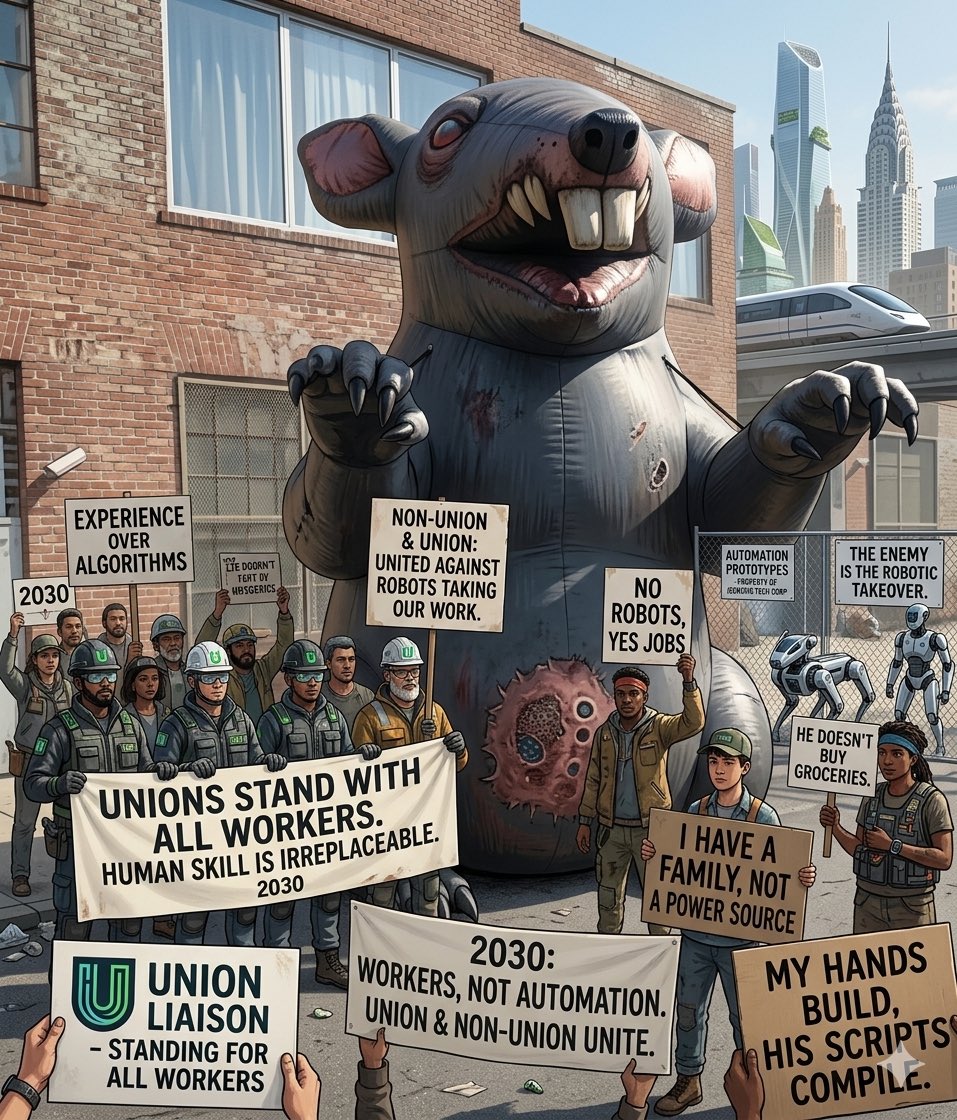
It's the year 2030. Union and non-union contractors stand together as they protest robots taking their construction jobs.
Eric Chan | CRE Construction tweet media
English
0
0
0
16
Boris Cherny
Boris Cherny@bcherny·
Little known fact, the Anthropic Labs team (the team I joined Anthropic to be on) shipped: - MCP - Skills - Claude Desktop app - Claude Code It was just a few of us, shipping fast, trying to keep pace with what the model was capable of. Those early Desktop computer use prototypes, back in the Sonnet 3.6 days, felt clunky and slow. But it was easy to squint and imagine all the ways people might use it once it got really good. Fast forward to today. I am so excited to release full computer use in Cowork and Dispatch. Really excited to see what you do with it!
Claude@claudeai

You can now enable Claude to use your computer to complete tasks. It opens your apps, navigates your browser, fills in spreadsheets—anything you'd do sitting at your desk. Research preview in Claude Cowork and Claude Code, macOS only.

English
463
409
9.3K
987.3K
GREG ISENBERG
GREG ISENBERG@gregisenberg·
do yourself a favor learn to get good with ai pick a niche build distribution build apps or agents as a service make something so useful then expand around that behavior 99% of people will read this and do nothing 1% will read this and do their future selves a favor i don't know how long this window last but wow what a excellent time to be building time to make moves
English
325
169
2.4K
123.1K
david 🔛⛓️
david 🔛⛓️@davidonchainx·
Me: "bro AI is getting so crazy I just built an entire app in 20 minutes with claude it's gonna replace so many jobs" My friend: "what's claude?" Me:
English
181
714
11.9K
612.4K