Max Lee

917 posts

Max Lee banner
Max Lee

Max Lee

@directmodels

Building an AI operating system for theory-building. Directional Systems Theory: usable futures under load

Kansas, USA Entrou em Aralık 2025
40 Seguindo57 Seguidores
Tweet fixado
Max Lee
Max Lee@directmodels·
What is Directional Systems Theory? It started with a simple problem: pressure enters too fast. A comment. A task. A conflict. A deadline. A feeling. A signal. A demand. Something enters the system before the system has enough room to read it. So the first question is not: What should I do? The first question is: What just got in? That is where DST begins. Permeability: how much pressure enters. Filtering: what gets sorted, softened, delayed, rejected, or kept. Gating: what gets admitted into the system. Neutrality: the uncommitted space before reaction. Slack: the reserve that keeps pressure from choosing the route for you. Exit cost: what it costs to leave, switch, disagree, stop, repair, or change direction. Residue: what remains when burden never finds release. Most people talk about choices like they are visible options. DST asks whether those options are usable under load. Can you actually move? Can you pause? Can you ask? Can you leave? Can you repair? Can you switch? Can you recover? Can you return without snapback? That is the difference between apparent freedom and usable freedom. D_app is what looks possible. D_true is what can actually be executed, held, recovered, and repeated under pressure. Most collapse begins in the gap between them. The door is visible. The exit is unaffordable. The route is named. The burden cannot survive the path. DST studies that gap. It asks how systems preserve or lose usable futures under load. Not just people. Relationships. Jobs. Institutions. Markets. Theories. Games. Information systems. Cultures. Bodies. AI. Anything that has to keep moving while pressure changes what movement costs. The simplest version: DST is about what remains usable after pressure arrives. The practical version: DST teaches you to protect the route before obsessing over the outcome. The sharp version: A system fails when motion loses exits.
English
0
0
0
97
Max Lee
Max Lee@directmodels·
Wtf. I kept wondering what people kept typing @grok. I'm gonna be honest, I've been using AI daily for like a year now and that shit is still ducking cringe. I just realized that's actually people who have totally lost the ability to recall because their AI usually does it. OMG. Kill me if I start doing this.
English
1
0
0
6
Max Lee
Max Lee@directmodels·
Reachable ≠ selectable A route can exist and still stop being selected under pressure. Selectable ≠ chosen A route can remain in the active menu without being committed to yet. Chosen ≠ executable A system can select the right route and still lack capacity to perform it. Executable ≠ recoverable A route can be performed once but damage the system under returning load. Recoverable ≠ regenerative A system can return without expanding future maneuverability. That is clean as hell.
English
0
0
0
8
Max Lee
Max Lee@directmodels·
1. Reachable — route exists. 2. Visible — route can be perceived. 3. Salient — route stands out. 4. Prioritized — route ranks high enough. 5. Costed — transition/exit/switching costs are rendered. 6. Slack-supported — enough slack remains to keep the route in play. 7. Selectable — route remains in the active menu. 8. Chosen — system commits. 9. Executable — system has capacity to perform. 10. Recoverable — system can survive return/load/consequence. 11. Regenerative — route expands future availability. Where I'm at so far.
English
2
1
2
35
Sid the Argent
Sid the Argent@SidTheArgent·
In my model it's "decoherence pruning" ... coherence selects trajectories, while phase and timing reduce the reachable trajectories, collapsing non coherent waves in an attempt to keep structure. The structure remains to maintain coherence with objective local physicality ... yet prunes unreachable branches to stabilize itself retro causally. Trajectories are from potentials ... structure is the local physical persistence it tries to navigate.
English
1
0
2
17
Jaime
Jaime@jaimeojedas·
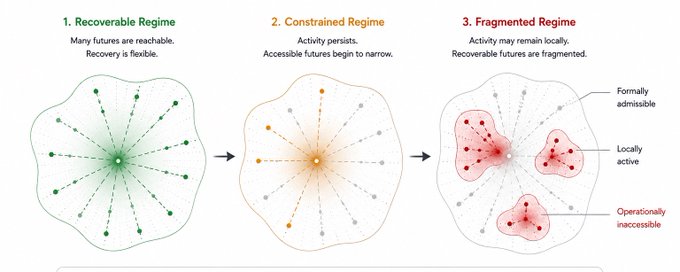
1/5 🧶 Why do some systems recover after stress while others progressively lose function — even while remaining active? This is the question behind my current open computational work. The core observation: structure may persist while recoverable futures progressively contract.
Jaime tweet media
English
2
1
4
763
Max Lee
Max Lee@directmodels·
Exactly. Fast stabilization may be one of the traps. A system can keep selecting the route that restores local function fastest, while the slower routes that preserve recovery lose salience, affordability, and priority. So the system still looks active. But its selections have started organizing around immediate stabilization rather than durable restoration. The input from both of you cleaned things up a lot. Any ideas for what the next layer should be?
English
1
1
2
33
Max Lee
Max Lee@directmodels·
Yea, this is the part I’m trying to isolate now. Reachable is not always selectable. A recovery route can still exist in the space, but under pressure the system may stop selecting it. So I’m thinking the selection layer needs its own dependencies: what enters, how it renders, what gets ranked, how much slack remains, which routes are visible, which routes are affordable, and what can still be executed through time. That may be where recoverability loss becomes behaviorally visible before the structure disappears. The system still has futures. It just stops selecting the ones that preserve recovery.
English
1
1
3
51
Jaime
Jaime@jaimeojedas·
That feels like a really important distinction. Especially the idea that recoverability loss may first appear not as disappearance of futures, but as a reorganization of what the system begins to preferentially select under stress. Perhaps the important question becomes not only what states remain reachable, but what states remain selectable under perturbation.
English
1
0
1
23
Max Lee
Max Lee@directmodels·
A system can fail before reachability is gone if the only routes it selects are the ones that accelerate future contraction.
English
0
0
0
9
Max Lee
Max Lee@directmodels·
This feels right. One possible early readout may be selection quality. If recoverable futures progressively contract while activity persists, the first visible change may not be inactivity. It may be what the system starts selecting under renewed pressure. Relief over repair. Return over recovery. Local coherence over future maneuverability. Fast stabilization over durable restoration. The system still appears active. It still produces motion. But the menu has changed. Slower recoverable routes become less selectable, while lower-cost short-term routes dominate. So preserved structure may fail to imply preserved recoverability because the structure remains globally legible while its selection field has already reorganized around a shrinking recovery landscape.
English
1
0
1
35
Jaime
Jaime@jaimeojedas·
5/5 🧶 The broader goal is modest: test when preserved structure fails to imply preserved recoverability. Open notebooks, simulations, exploratory notes, and reproducible computational work can be explored here: oxygenstates.org Criticism, falsifiers, alternative interpretations, and failure cases are genuinely welcome.
English
1
0
0
51
Max Lee
Max Lee@directmodels·
@oprydai My strongest weeks are the ones only I care about lol nobody wants to see a work in progress.
English
0
0
0
9
Mustafa
Mustafa@oprydai·
not every strong career is built on visibility, networking or being the loudest voice in the room. In many domains, the people who grow steadily and sustainably are the ones who focus on depth, consistency and high-quality work that speaks for itself.
English
4
5
59
1.9K
Max Lee
Max Lee@directmodels·
Relax your jaw.
English
0
0
0
22
Max Lee
Max Lee@directmodels·
Most people think self-control starts with action. It does not. It starts earlier. At admission. Before you react, something had to get in. A comment. A task. A tone. A look. A deadline. A feeling. A demand. A possible future. A person’s expectation. The system admits it. Then it becomes load. Then the load becomes burden. Then the burden starts selecting routes. This is why “just don’t react” is usually bad advice. By the time you are trying not to react, the pressure may already be inside the system choosing for you. The real question is earlier: Should this enter at full force? Is this mine? Is this true? Is this urgent? Is this useful? Is this correction or just pressure? Is this present contact, old residue, or future fear? That is what a pause does. A pause is not politeness. A pause is a gate. It creates a small gap between pressure and route. Enough room to filter. Enough room to keep neutrality. Enough room to stop the first signal from becoming the whole system. A lot of “self-control” is really permeability control. Too closed, and nothing corrects you. Too open, and everything captures you. The goal is not to feel nothing. The goal is selective admission. Let in what can become correction. Delay what would become noise. Reject what is not your burden. Dampen what is real but too large to carry all at once. Because the first failure is not always the action. Sometimes the first failure is letting the wrong thing enter with too much authority. DST started there for me. Pressure enters too fast. So the first move is not to win the reaction. The first move is to protect the gate.
English
0
0
0
22
Max Lee
Max Lee@directmodels·
A lot of people confuse effort with route access. This shows up everywhere. You applied for the job. But did the application become an interview? You had the conversation. But did the conversation become repair? You apologized. But did the apology become release? You gathered information. But did the information become integration? You saw the option. But did the option become usable movement? That is the gap. Most systems count the visible attempt. Applications. Messages. Explanations. Meetings. Plans. Policies. Choices. Statements. Signals. But visible attempt is not the same as executable transition. A job lead can look open and never become a job. A conversation can happen and never become repair. A policy can exist and never become access. A choice can be named and still be unaffordable. A person can “try” and still never reach the route where trying converts. That is where systems get cruel. They punish missing outcomes as missing effort. But sometimes effort was present. The route was fake, blocked, overpriced, or never actually open. DST starts in that gap. Not: did the option appear? But: did the option become usable under burden? Because D_app is what looks possible. D_true is what can actually be entered, carried, recovered, and repeated. And a society gets very stupid when it keeps mistaking visible routes for usable exits.
English
0
0
0
14
Max Lee
Max Lee@directmodels·
A fake choice does not always hide the destination. Sometimes it hides that both choices already share it. That is what makes certain “or” statements so slippery. “Man up, or I call the cops.” Sounds like two routes. But in some rooms, “manning up” already means accepting the consequence route. Confess. Accept guilt. Take responsibility. Submit to the outcome. The cops are not outside the first branch. They are implied inside it. So the real choice is not: confess or consequence. It is: self-enter the consequence route, or have it imposed from outside. That difference matters. Because the language presents release where there may be none. It makes confession feel like a possible exit. But the route may already be closed. This shows up everywhere. “Explain yourself or I escalate.” But explanation becomes evidence. “Apologize or this gets worse.” But apology becomes admission. “Be honest or I’m done.” But honesty is routed into punishment. “Take accountability or face consequences.” But accountability already means accepting the consequence frame. The word “or” creates the feeling of a fork. Sometimes there is no fork. Only a choice between authorship and force. That is where pressure gets murky. A person thinks they are choosing between outcomes. But they are only choosing how the same outcome gets entered. DST calls that false route language. The route appears open. The destination is already selected. The choice is not whether the burden lands. The choice is whether you carry it voluntarily.
English
0
0
0
11
Max Lee
Max Lee@directmodels·
A system loses value triage when proxies become easier to follow than the thing they were meant to preserve.
English
0
0
0
6
Max Lee
Max Lee@directmodels·
Yea this is pretty much the base level when I try to ask, "What's the thing that fails when people still think everything is fine." Without abstraction, you can say ranking. When you try to ask why the ranking fails, everything gets murky. Sometimes it's perception, sometimes it's too much load, sometimes there's no exit, but it always happens when somebody picks something that is more approximate over something that works through time.
English
1
0
0
1
The White Rider
The White Rider@thewhiteriderX·
@directmodels @parmita “Losing the ability to rank what matters” feels deeper than misinformation. The signals may still be present. The question is what invisible constraint changed that made correction less important than identity, urgency, or coherence.
English
1
0
1
5
Parmita Mishra
Parmita Mishra@parmita·
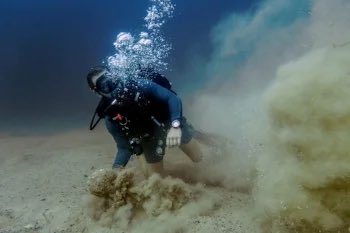
Dopamine receptors are upregulating and homeostasis is not functioning properly. We stress tested it through a pandemic, politics, ozempic, social media, AI, news media, and everything downstream of these. The breakage has now been networked through society. Dopamine is misread. It’s the meter that reads what matters. It’s been under attack. Crucially, it breaks one specific thing: information triage by value. So let’s talk about the world today. People are tolerating bullshit at higher rates than usual because a certain nihilism has pervaded them. The only opinions I can trust now are the ones consistent over years, or truly contrarian. And it is hard to tell contrarian from popularized contrarianism — popular and contrarian are literal opposites. The ones with the most independent thought will win, because they are closest to the truth. That will always hold true. The problem is one of value triage: polarized loyalty triaged above competence and action. Meanwhile, technology’s entire existence is owed historically entirely to competence and action. In short, the ocean is the same. Its visibility is what dropped because we have kicked up its bottom sediment with fins made of lead and steel. Most of the signal in the world is being confused for the noise, and shockingly, this is a homogenous trend. Echo chambers are dangerous. So is the normalization of information to the average: the mean (dangerous), the median (dangerous), the mode (catastrophic). We are in this latter, unfortunate parallel universe. Low IQ brain rot has pervaded too many circles of thought. The impact is a sliding window. There is latency—and then, there is either an upswing or a downswing. This can mean that what you consider certain is actually the least likely to be certain. How strange. The pendulum of global thought is swinging max to the opposite of a decade ago. Neither side of a pendulum is stable. People are switching their opinions without feeling any need to explain them. It is a fascinating time to live. It is not a dark time to live, it is a muddy time to live. It is a hilarious and hysterical time to live. The things you trust the most structurally are the most in danger. The things you think make you contrarian are probably not contrarian. The things you assume are true are probably not. The one and only prediction for the future is shock. There will be a lot of it — and that will be your mistake. You would not be shocked if you had actually thought about the world from first principles. Anger will not save you. The sediment settles. It always settles. The ocean was never the problem; the water clears the moment we stop kicking. The people who kept their own meter calibrated will still be able to read it when it does. That is the entire opportunity, and it is enormous. But no matter what, the way will be strongly counterintuitive to your nervous system. Everything I am saying is abstract. But it is not “probably” true. It is inevitable. Believe what you want. The only signal in your body you can trust right now is what you feel in your gut. And yet, our neurons have been compromised.
Parmita Mishra tweet media
English
4
1
18
1.6K
Max Lee
Max Lee@directmodels·
I know it looks like I jump topics. Jobs. Courts. Language. AI. Robotics. Culture. Dopamine. Basketball. Conflict. Information systems. But I’m usually watching the same thing: what changes the route? What enters the system? What gets filtered? What gets admitted? Where does the burden land? What becomes harder to exit? What remains usable under pressure? The topic changes. The shape keeps repeating. A job lead that never becomes a job. A court that punishes missing conversion as missing effort. A sentence that means both a complete thought and a judgment. An information system that gives people more signals but worse value triage. A person who says “I avoid conflict” until the sentence becomes a route. Different rooms. Same question: what movement is still possible after pressure arrives?
English
0
0
0
29
Max Lee
Max Lee@directmodels·
A question is a sentence. A sentence is basically a complete unit of language. It can be: Statement: “The door is open.” Question: “Is the door open?” Command: “Open the door.” Exclamation: “What a door!” So “sentence” does not mean “statement.” It means a complete grammatical expression. The court meaning comes from the same deeper root. Sentence comes from Latin sententia, meaning something like opinion, judgment, decision, way of thinking. So originally, a sentence was not just “words with a period.” It was a complete thought / judgment. That split into two meanings: Grammar sentence: a complete thought expressed in words. Court sentence: the judge’s formal decision/judgment about punishment. So the connection is: A sentence is a completed judgment. In language, it completes a thought. In court, it completes a legal judgment. That’s why courts “sentence” people. It’s not because they’re giving them grammar. It’s because they’re issuing the formal judgment.
English
0
0
0
18
Max Lee
Max Lee@directmodels·
@ProofofMaro 15 minutes is enough. Any more and you’d start doubting yourself.
English
0
0
2
81
maro
maro@ProofofMaro·
I’ve been studying the Dunning-Kruger effect by myself for 15 minutes and I’m pretty sure I understand everything there is to know about it now.
English
27
10
195
6.7K
Max Lee
Max Lee@directmodels·
Something I like to ask, "Am I choosing to do this?"
English
0
0
0
20