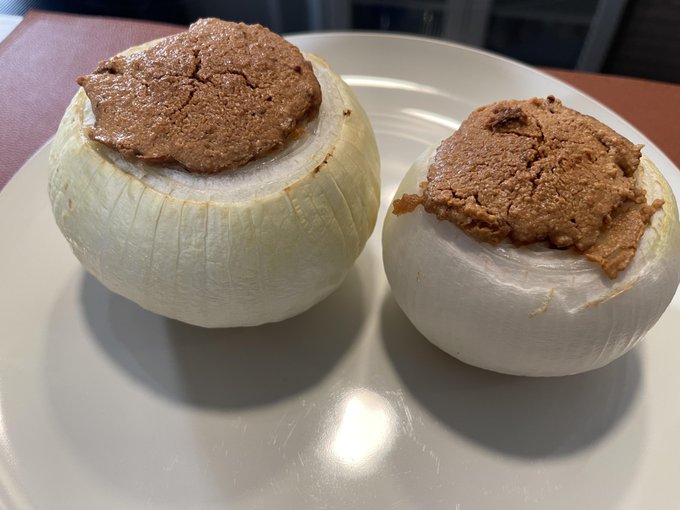
During the Depression, onions were a common and easily grown and stored vegetable. So, they were readily available and, most importantly, free.
Meanwhile, peanut butter was also inexpensive. So, the Bureau of Home Economics devised the recipe for peanut butter-stuffed onions as an easy way for American homemakers to feed their families.
The recipe for this curious dish was published in many 1930s newspapers and magazines. It eventually found its way onto American dining tables as a healthy, tasty, simple, and low-cost meal that could be served any time of the day.
The mishmash consisted of baked onions with peanut butter filling mixed with stale bread crumbs. These ingredients came together and created a distasteful and disliked dish that people only ate to fill their hungry stomachs.
I spent a lot of my design career doing zero-to-one work building products and brands from scratch.
I’d like to share a tool I call a “Brand Decalogue”
A Brand Decalogue is a list of words that capture the feelings, emotions and benefits that a customer experiences when intracting with any aspect of your brand or company.
The key to a great Brand Decalogue is to choose words that are opinionated. Words with a strong point-of-view protect the brand against the compromise and dilution that can happen with group think.
Your Brand Decalogue is your source of truth, the measuring stick as you develop ideas.
Lets make a Brand Decalogue for a fictitious Chocolate Bar Company:
1. Write every word you can think of that captures the essence and spirit of these chocolate bars - imagine the feelings that wash over people when they eat this amazing chocolate or when they see the packaging for the first time or when a friend tells another friend about how good these chocolate bars are - write as many as you can (at least 100).
2. Initially you may hit the common words that we would all think of like Chocolaty, Delicious, Smooth, Mouth-Watering, etc. thats ok, write them down and get them out.
3. Keep pushing into unique words that will set this apart from the hundreds of chocolate bars and will help us form decisions as we develop our brand.
4. Reduce the list to 10 key words - If I was making a new chocolate bar company here is a word list I may choose to build a brand around:
1. Lush
2. Onomonopia
3. Enigmatic
4. Bespoke
5. Gratitude
6. Unmistakable
7. Monozukuri
8. Radical
9. Euphoric
10. Simple
A few thoughts on these words: I chose Onomonopia because I want our marketing copy and perhaps chocolate bar names to taste like the words sound - I want to make sure we include all 5 senses when we create this brand. I added the Japanese concept of Monozukuri which encompasses the entire process of creation, from the conception of an idea to the execution of a masterpiece to guide our manufacturing.
The other words are more straight forward but also challenging when combined together - how would you create an unmistakable product that is simple yet enigmatic? An interesting design challenge.
Once we have our 10 words we can dive in to creating the rest of our Brand Codes (Visual identity, tone of voice, digital presence, marketing concepts, sales copy, etc.) always coming back to these words and comparing our creations to see if they fit within these words.
For example, you have an email campaign going out to your customers - have we stayed true to our Brand Decalouge? Does it feel Simple, full of Gratitude and somehow Radical? You get the picture.
We can and should return to our Brand Decalouge - our ten commandments if you will - for all the work we create - and btw, you can always change and swap out terms as you evolve and grow your thinking. It's just a tool after all, not set in stone :)
I would love to hear your feedback and if you found this helpful please feel free to share it with others.
If you are building something right now and would like some help in building your brand shoot me a DM!
I love this quote from Alan Kay in "Seven Concurrency Models in Seven Weeks":
Reading this hit me like a ton of bricks. What connects the modules is more important than the modules themselves.
In other words, the wiring of our organizations!
Alan Kay, the designer of Smalltalk and father of object-oriented programming, had this to say on the essence of object orientation:[29] I’m sorry that I long ago coined the term “objects” for this topic because it gets many people to focus on the lesser idea. The big idea is “messaging” … The Japanese have a small word—ma—for “that which is in-between”—perhaps the nearest English equivalent is “interstitial.” The key in making great and growable systems is much more to design how its modules communicate rather than what their internal properties and behaviors should be.
Every time I've been hiring recently, it's been for Senior roles, and I always get asked about more Junior opportunities.
Well, that time has come, and we're looking for a Security Engineer at Reddit.
For every Friday deployment, you should need to put $100 in a tip jar. If your release causes an issue, the on-call engineer takes the money in the jar.
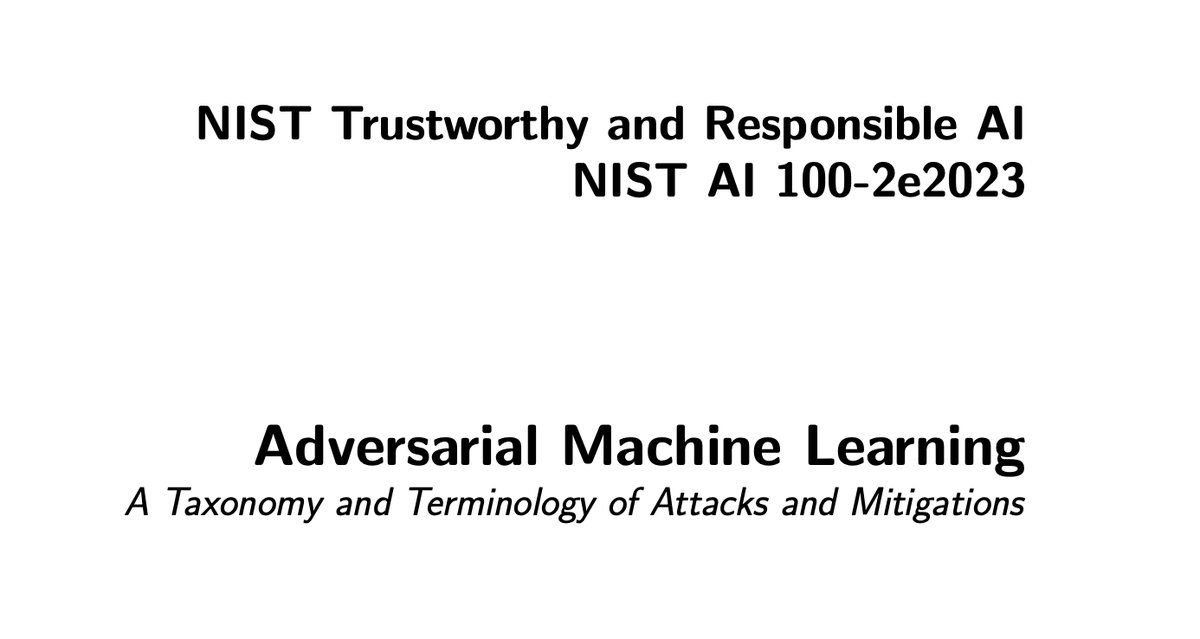
🚨 Massive AI Security Release 🚨
@NIST just put out the best AI Security Publication that I've ever seen.
It is 106 pages of deep, technical content. It references real-world practical attacks. In this thread is the link and I'm going to cover a few highlights. 👇
My parents had to put their dog down two years ago and it’s been really hard on them. Unfortunately my stepdad,
Rick, has found the worst way to cope: feeding a one-year old raccoon and letting him live on their porch. His name is Little Rick aka Rickoon. And by “feeding” him,
My friend @AliAbdaal made $4,600,593 on the internet in 2022.
His "Rule of 3" framework makes any content instantly memorable.
Here's how it works (with a ChatGPT prompt to help you create "Rule of 3" content in seconds):
Midjourney version 6 was released two hours ago, and it's incredible.
I compared it to the previous version 5.2 across 15 very different image categories.
Here are the results:
I built the $50M company that forever changed YouTube.
It's called Jubilee and it's clocked 5 BILLION views and 9M subs on YT.
100's of channels have copied us, and MrBeast tried to poach half my team.
How much $$$$ it makes, how we constantly go viral, and how I built it 👇🧵
"There are nearly 600K unfilled cybersecurity jobs in the U.S. right now, and about 3.5M open roles globally, says Lisa Gevelber, Google’s chief marketing officer for the Americas"
This is because all the openings are entry level positions requiring 5 yrs experience.
My Anti-To-Do List:
(the things I want to avoid on a daily basis)
1. Do not complain about anything.
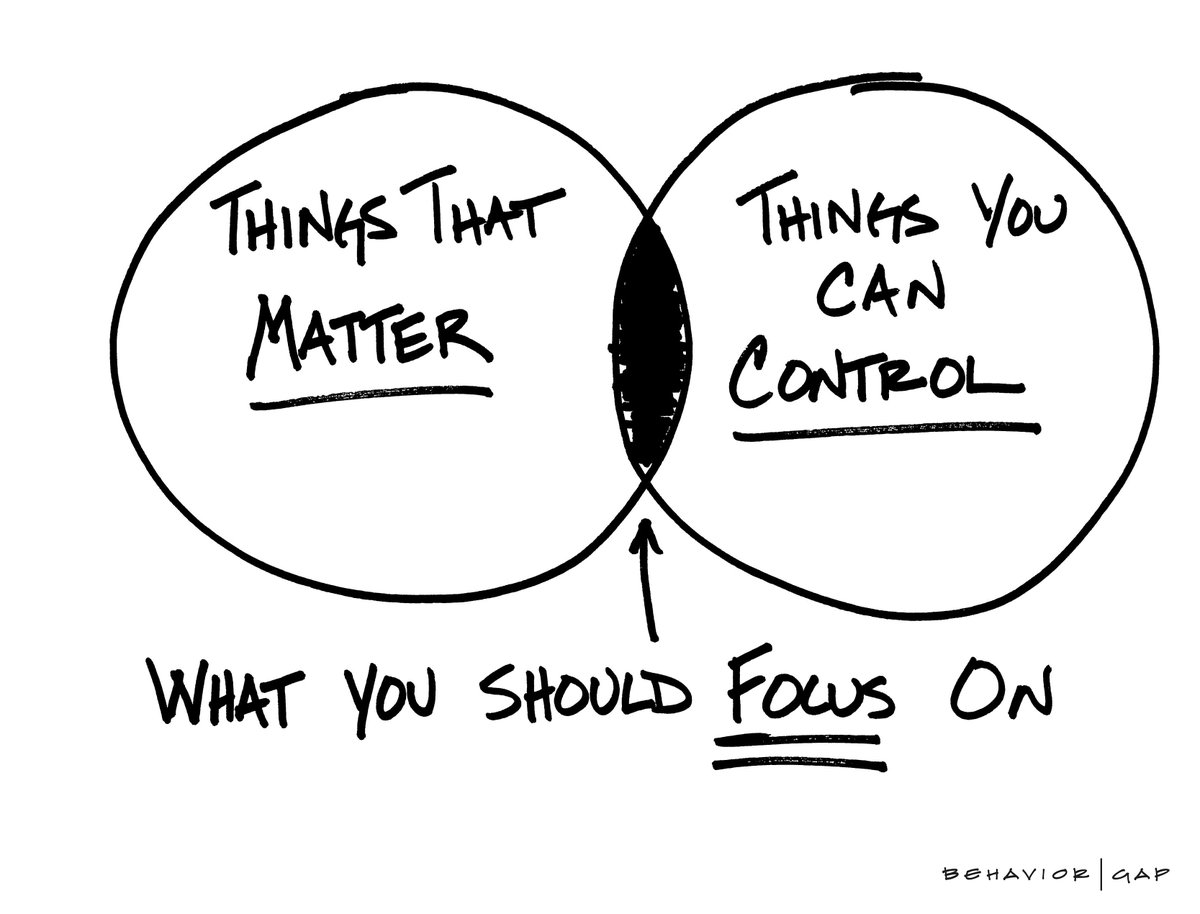
If the thing is within your control, then go do something about it. If the thing is out of your control, then it's just a waste of energy to complain about it.
2. Do not allow negative people to steal your energy.
Stop avoiding difficult conversations. Growth requires discomfort. Maintain a growth mindset in all of your relationships and embrace the need to remove toxicity from your life.
3. Do not allow more than 2 hours of inactivity.
Get up and go for a walk. Do a few pushups or lunges. Move your body and feel the rush of new energy and creativity.
4. Do not "graze" on low-value tasks.
Parkinson's Law says that work expands to fill the time allotted for its completion. When you don't set fixed windows for managing low-value tasks (like email), you end up "grazing" on them (spending all day doing them slowly and inefficiently). Create short, discrete windows for processing low importance tasks.
5. Do not become an ostrich.
An ostrich will bury its head in the sand to avoid danger. A lot of humans behave the same way when they encounter new information that challenges their existing beliefs or views. They care more about being right than finding the truth. Embrace new information that forces you to change your mind.
6. Do not have your phone out when your kid is trying to play with you.
When you are working, work hard. When you are playing, play hard. Strive to bring present, focused energy in all areas of life. Never let your phone come between you and your kid.
Note to Self: Focus on this, as it's the one you struggle with the most!
7. Do not hit the snooze button.
It's not about sleep, it's about stacking evidence that you are the captain of your ship.
8. Do not say yes to things under the assumption of having more time for them in the future.
You won't have more time in the future. If you wouldn't want to do the thing tomorrow, don't say yes to doing it a month from now.
9. Do not take calls or video meetings without a clear purpose.
Calls or video meetings without any clear agenda or purpose are where your joy and energy go to die. If it can be an email, it should be an email.
Note to Self: Embrace in-person meetings without a clear purpose, as these end up being some of the most interesting discussions.
10. Do not check your phone within the first 15 minutes of waking up (or the last 15 minutes before going to bed).
We have enough technology addiction in our lives. Create space—give yourself a few fixed windows of intentional tech avoidance to breathe.
11. Do not allow comparison, envy, or jealousy to enter your headspace.
When you feel it creeping in, default to curiosity instead: Ask what that person is doing that you can learn from.
12. Do not fall victim to the algorithm vortex.
The algorithm will encourage you to create content exclusively for its pleasure, but if you lose the soul in the work along the way, you'll never be able to stay in the game long enough to win. Create things you would want to consume and avoid checking metrics for 24 hours.
13. Do not text or check social media throughout the course of the day.
Establish fixed windows when you will read and reply to messages. Put your phone on Do Not Disturb mode. Turn on Grayscale Mode to make the icons and notifications less appealing for the "just a quick check" during the course of the day.
***
To create your Anti-To-Do list, sit down and write down the things you are struggling with personally and professionally.
Use my list as a spark to get the ideas flowing, but make changes, additions, or subtractions as necessary.
The list is intended to be dynamic, so don't worry too much about the starting point. It can be as few as 3-5 high-priority items.
Just as you have your To-Do List in front of you during the course of the day, I would recommend having your Anti-To-Do List in front of you as well.
As you avoid the daily actions on the list, check them off.
There will be good days and bad days, that's just part of the game. Every day you achieve 100% compliance with your Anti-To-Do List, give yourself a moment to appreciate the win.
Remember: Each day is an opportunity to stack new evidence in favor of the person you want to become.
. @kelseyhightower in yesterdays space you said something that really stuck with me and I was hoping you could say more about it. You said some seniors actually just have a lot of tech exp but don’t know how to grow others. How does a strong senior grow the mid/jrs around them?
Building a business just got 10x easier in the last 7 days.
I used GPT3 to scale my SaaS business
Now custom GPTs have rigged the whole game!
Here are 15 golden GPTs to accelerate your next startup 🧵