
Mrinal

7.6K posts

Mrinal banner
Mrinal

Mrinal

@mrinal_web3

Content Creator | Video Editor | Motion Graphics | Graphic Designer | Tech | AI | Blockchain| Fintech

India Entrou em Mart 2025
422 Seguindo1.1K Seguidores
Mrinal retweetou
mandrigin.eth
mandrigin.eth@mandrigin·
AI is moving from assisting humans to taking actions on its own. But when something goes wrong, who is actually accountable? As AI agents execute actions, that clarity starts to break down. An agent can trigger workflows, approve decisions, or move money. You may see what happened, but not always who initiated it, under what constraints, or why that decision was taken. The accountability that exists for humans does not translate directly to AI agents. This becomes even more critical in regulated environments like finance. Imagine an AI agent making a wrong trade, approving a loan incorrectly, or miscalculating an interest rate. I remember a case where someone entered 20% instead of 0.20% for a discount, which led to a loss of $300,000 in just a few hours. These kinds of mistakes are rare, but they show how small errors can have outsized impact, especially when systems can act instantly. As AI agents start making and executing decisions, accountability becomes essential. It cannot live only at the application layer; it needs to be built into the system itself, where it can act as a safety net and catch issues early. We at Gateway.fm are addressing this by building an AI firewall, creating a foundation for safer, more controlled AI systems with identity, permissioning, and accountability. More on this here: gateway.fm/ai-agent-permi…
English
0
2
4
77
Mrinal retweetou
mandrigin.eth
mandrigin.eth@mandrigin·
FCR advances “safe” blocks based on client-side rules without requiring a hard fork, which is a significant improvement for UX. But it is important to distinguish guarantees. Finality (Casper FFG) is backed by slashable stake, where reverting a finalized block requires burning at least 33% of total staked ETH. FCR introduces no economic security, as there is no penalty if its conditions are violated. Under adverse conditions, FCR may stall or delay confirmations, but it does not compromise safety or produce incorrect confirmations, falling back toward finality when needed. FCR is therefore best understood as a complementary mechanism optimized for speed, not a replacement for finality.
Julian@_julianma

x.com/i/article/2033…

English
0
6
20
1.1K
Mrinal retweetou
Pradeep RV Singh
Pradeep RV Singh@pradeep_rvsingh·
Been watching how banks are approaching digital assets. They are building tokenized deposit platforms, creating shared stablecoin networks between institutions and opening new custody lines for digital asset reserves. But the interesting part is how banks are thinking about tokenized deposits. Think about the core issue we face today: cross-border liquidity. If you have to relocate, work as a nomad, or move your life to another country, traditional banking slows you down. Your money might be safe, but it isn't seamlessly accessible. A tokenized deposit changes this mechanic. It’s still a real bank deposit that is insured and earns interest. But now, it can settle instantly and move across borders in real time. The bank keeps the deposit on its own balance sheet, but the client gets functionality that previously only existed outside the traditional banking system. That is a smart approach because it takes what banks are already good at and upgrades the rails underneath without losing the client relationship or the regulatory protections.
English
1
5
10
243
Mrinal retweetou
Pradeep RV Singh
Pradeep RV Singh@pradeep_rvsingh·
Think of someone getting displaced right now. They have to relocate and leave their region suddenly. They might have a million-dollar portfolio, real estate, bank balances and investments. On paper, they are wealthy, but the moment they have to move, those assets are locked. Think about it, if you put money in the bank, do you actually have custody of your account? The core issue becomes liquidity. How do you access liquidity when everything you own is tied to a specific country's system? In some cases, countries can even lock assets. This is already happening, and it is the undercurrent that will shape what global finance looks and feels like for the next two decades. This is exactly why self-custody is becoming an important topic. It completely changes how we hold our assets. Try doing a stress test on your portfolio today: ask yourself, which of your assets will actually serve you and remain accessible during a time of crisis?
English
0
5
8
329
Mrinal retweetou
Gateway FM
Gateway FM@gateway_eth·
For enterprises, the discussion around AI agents is framed as security, but the deeper issue is compliance. Security tries to prevent what an agent might do. Compliance requires proving what the agent actually did, under whose authority, and within which permissions. Without identity, every agent is a black box. Black boxes don't survive audits. They don't satisfy regulators. And they don't get approved by legal. Enterprise adoption of AI agents depends on the ability to enforce governance and ensure auditability. If compliance is blocking AI agents in your organization, let’s talk. gateway.fm/ai-agent-permi…
Gateway FM tweet media
English
9
12
37
9.4K
Mrinal retweetou
Pradeep RV Singh
Pradeep RV Singh@pradeep_rvsingh·
Bots now generate 51% of all internet traffic, surpassing human activity for the first time. Honestly, it's not that surprising. With AI and autonomous agents becoming more common, this number is only going to keep climbing. Agents will move beyond browsing and booking. They’ll start handling payments. Over time, a large share of online economic activity will be executed by bots. That’s the direction we’re heading. So, instead of focusing on banning or blocking bots, the real priority should be building the right infrastructure for them and starting to treat them as first-class citizens.
English
1
4
5
162
Mrinal
Mrinal@mrinal_web3·
We’re entering the agentic era. AI won’t just assist humans. It will operate on their behalf, execute tasks, and move capital.
English
0
0
0
32
Mrinal
Mrinal@mrinal_web3·
With stablecoins moving $1M costs the same as moving $1. It’s instant, global, and permissionless. The legacy banking system is a series of walled gardens. Stablecoins are the open protocol that connects them all.
English
0
0
2
40
Mrinal
Mrinal@mrinal_web3·
Zero-knowledge proofs eliminate the trade-off between privacy and compliance, enabling both at the same time.
English
1
0
2
35
Mrinal
Mrinal@mrinal_web3·
AI agents are the first native users who actually prefer onchain precision over human-friendly UX. They’ll run DAOs, manage treasuries, settle cross-chain in seconds, all while humans sleep. We’re not adopting crypto. Crypto is adopting its first real customers.
English
0
0
2
40
Mrinal
Mrinal@mrinal_web3·
Crypto and AI are converging. AI needs: • verifiable execution • tamper-proof data • programmable payments Blockchain provides these primitives. Blockchain needs: • intelligent automation • adaptive systems • stronger developer tooling AI fills that gap. This is not about memecoins or chatbots on-chain. This is about infrastructure. The value is forming around: • AI security and auditability • autonomous agents with native wallets • decentralized intelligence layers
English
0
0
4
44
Mrinal
Mrinal@mrinal_web3·
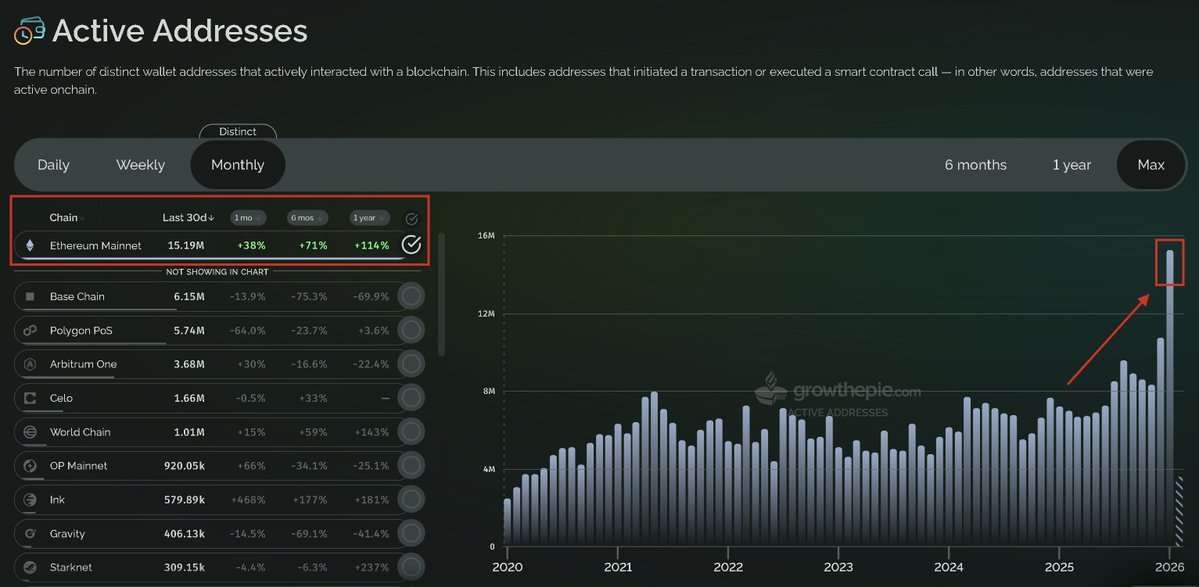
Ethereum's monthly active addresses hit 15.19M.
Mrinal tweet media
English
0
0
3
43
Mrinal
Mrinal@mrinal_web3·
AI Agents are not chatbots. They don’t just reply, they act. They can: • Observe data • Decide next steps • Execute actions • Learn from outcomes Think of them as digital workers, not tools.
English
0
0
3
49
Mrinal
Mrinal@mrinal_web3·
How AI Agents work on-chain • Off-chain brain → AI brain The intelligence lives off-chain for speed, learning, and reasoning. • Wallet → Cryptographic identity Every AI agent has a wallet. No wallet = no identity = no trust. • ERC-8004 → Permission layer Defines what the AI is allowed to do, and under which rules. • Blockchain → Verification All actions are provable, auditable, and trustless. • App / Protocol → Real-world execution AI doesn’t just think. It acts, trading, posting, paying, coordinating. AI becomes autonomous only when identity, permissions, and verification are on-chain.
English
1
0
2
132
Mrinal
Mrinal@mrinal_web3·
Agents will transact, coordinate, and operate across platforms. Without portable identity and programmable payments, they remain fragmented, untrusted, and locked inside siloed systems. Blockchains turn agent interactions into verifiable, portable, and permissionless workflows.
a16z crypto@a16zcrypto

x.com/i/article/2018…

English
2
0
1
142
Mrinal
Mrinal@mrinal_web3·
Payments. Stablecoins. DeFi. Tokenization. RWAs. Neo-banks. This is the new financial stack. And it will dominate global finance.
English
0
0
1
36
Mrinal
Mrinal@mrinal_web3·
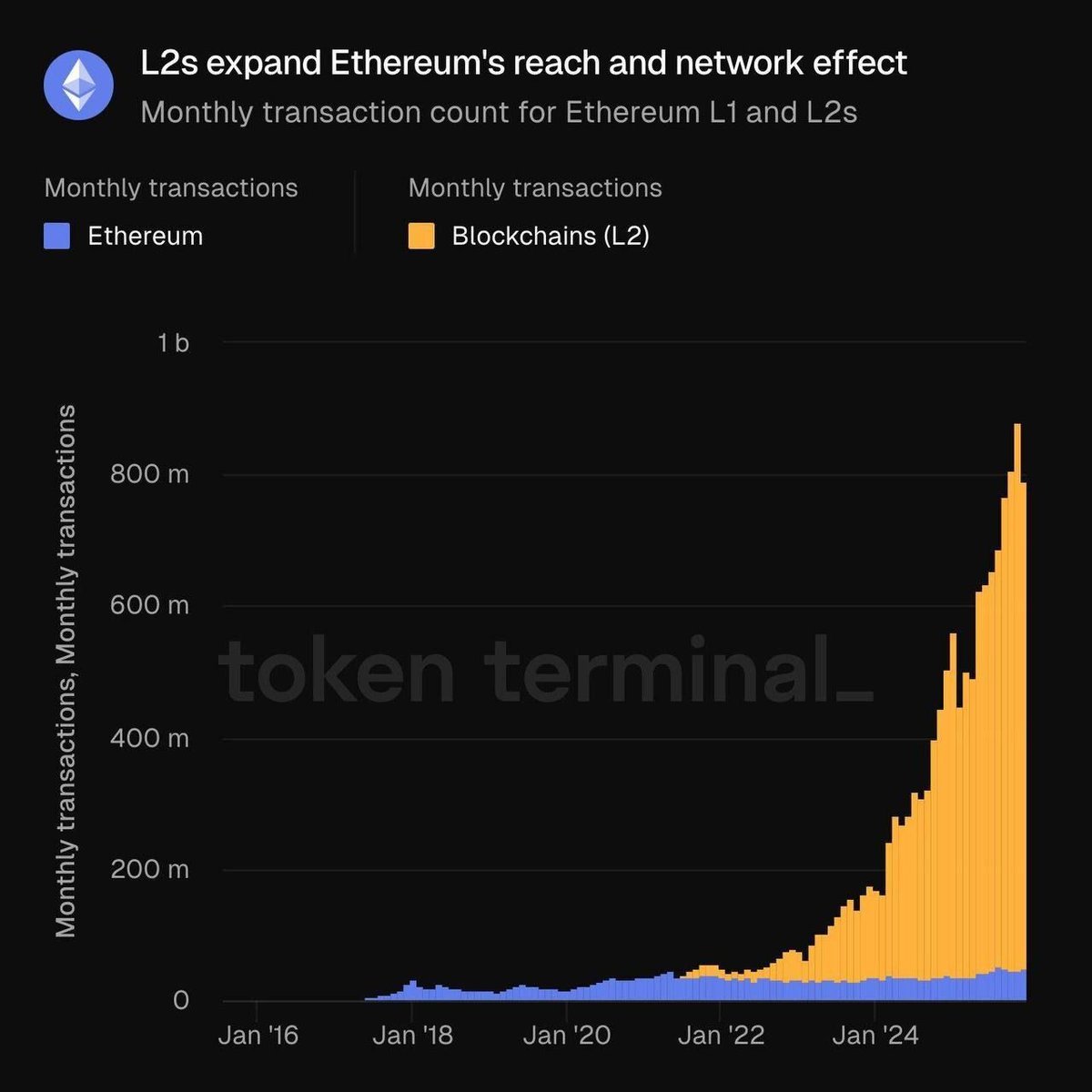
Monthly transactions on Ethereum L2s now exceed Ethereum L1 by ~900%.
Mrinal tweet media
English
0
0
2
50
Mrinal
Mrinal@mrinal_web3·
AI agents are starting to act autonomously, coordinating tasks, making decisions, and interacting with other agents. But autonomy introduces a new problem: trust. How does one AI agent verify another’s identity, reliability, or past performance without relying on a centralized platform? This is where ERC-8004 comes in. It introduces a shared trust layer using blockchain primitives: on-chain identity, portable reputation, and verifiable validation. ERC-8004 gives AI agents a way to prove who they are, what they’ve done, and when their work has been independently verified. Blockchain doesn’t run AI models. It runs trust, coordination, and accountability for them.
English
0
0
1
37
Mrinal retweetou
Pradeep RV Singh
Pradeep RV Singh@pradeep_rvsingh·
Over the past year, one pattern has repeated itself across regions: the markets scaling fastest are those moving toward institutional-grade infrastructure. Latin America is one of the clearest examples. In 2025, governments began converting retail-driven crypto adoption into enforceable, supervised frameworks. 2026 LATAM snapshot: 🇧🇷 Brazil: enforcement-ready ($2–7M capital; stablecoins treated as FX) 🇦🇷 Argentina: transitioning (VASP registry; banks preparing for custody in 2026) 🇨🇴 Colombia: supervision-building (full VASP licensing; OECD tax reporting) 🇲🇽 Mexico: restrictive, reform pending (Fintech Law 2.0) Regulators are building compliance perimeters that resemble capital-markets infrastructure. Advantage is shifting to platforms designed for supervised operation from day one.
Pradeep RV Singh tweet media
English
1
4
28
1.2K