Ram Kumar

1.6K posts

Ram Kumar

Ram Kumar

@ramkumar_tw

SW Engineer with interests in all fields remotely related to Science

Entrou em Ocak 2013
698 Seguindo54 Seguidores
Ram Kumar
Ram Kumar@ramkumar_tw·
@ajeetbharti @dpradhanbjp That 75 % criteria is for admissions to IITs and premier colleges - if a person can crack IIT, there is no way he/she can fall below 75 percent. Also this rule is not introduced now- it is there for quite sometime. Looks like NEET issue is rubbing on this for political reasons.
English
0
0
0
58
Ajeet Bharti
Ajeet Bharti@ajeetbharti·
जिन बच्चों ने सही उत्तर दिया लेकिन CBSE द्वारा निर्धारित स्टेप बाय स्टेप उत्तर नहीं दिया, तो कंप्यूटर के माध्यम से हो रही मार्किंग में उनके पूरे नंबर नहीं मिले। बीच के स्टेप यदि गायब हैं, तो उस स्टेप का नंबर नहीं मिला। शिक्षा विभाग ऐसी ही बकलोलियों से चल रहा है। @dpradhanbjp ने ऐसी व्यवस्था की है जहाँ सामान्य वर्ग के बच्चे IIT में बढ़िया नंबर ला रहे हैं, पर 12th में उनके 75% नहीं बन रहे। आर्ट्स वालों को १००-१०० दबा के मिल रहे! भगवान ही मालिक है। धर्मेंद्र प्रधान कहीं जाने वाला नहीं लगता, ये आदमी स्कूल, कॉलेज सबकी बैंड बजा के ही जाएगा, वही भी तब जब भाजपा चुनाव कभी हारेगी। ऐसे ये बैठा रहेगा कुंडली मार के।
Dainik Bhaskar@DainikBhaskar

CBSE : 'ऑन-स्क्रीन मार्किंग' से साइंस छात्रों को हुआ नुकसान, JEE मेन में अच्छा स्कोर करने वाले कई छात्र 12वीं में 75% का क्राइटेरिया तक पूरा नहीं कर सके अधिक खबरें और ई-पेपर पढ़ने के लिए दैनिक भास्कर एप इंस्टॉल करें - dainik-b.in/mjwzCSxDdsb #CBSE #JEEMains #BoardExams #CBSEResult @JhabakUnnati

हिन्दी
142
1.2K
3.4K
102.7K
Ram Kumar retweetou
Tansu Yegen
Tansu Yegen@TansuYegen·
This is why physics clears every subject, no debate 🗣️
English
9
43
299
25.5K
Ram Kumar retweetou
Tansu Yegen
Tansu Yegen@TansuYegen·
In the Netherlands, the Delta Works has a smart flood barrier with two giant 22 meter gates that close to protect Rotterdam when water rises more than 3 meters above normal 🌊
English
5
44
225
20.9K
Ram Kumar retweetou
Aakash Gupta
Aakash Gupta@aakashgupta·
Raytheon’s latest SPY-6 radar contract is worth $3.2 billion. One electrical engineer in Morocco just open-sourced a phased array radar you can build from Gerber files on GitHub. The cost ladder in radar is absurd. A Thales Ground Master 400 runs $30 million per unit. Morocco’s own air force bought eight Raytheon Sentinel radars for $67 million. The Navy’s SPY-6 engineering development contract alone was $386 million before a single production unit shipped. Commercial phased array systems for civilian use start around $250,000. The AERIS-10 does electronic beam steering at 10.5 GHz, pulse compression, Doppler processing, and multi-target tracking on a real-time map. The 20km version uses a 32x16 slotted waveguide array with GaN amplifiers, 16 ADTR1107 front-end chips, a custom frequency synthesizer, and an FPGA handling all signal processing. GPS and IMU for accurate target coordinates when the platform moves. This is a real radar system, not a science fair demo. The bill of materials for the extended version probably lands somewhere between $5,000 and $15,000 depending on component sourcing. Call it a 95% cost reduction from the cheapest commercial alternative. Everything is MIT licensed. Schematics, PCB layouts, FPGA code, Python GUI, all of it. The defense procurement complex charges what it charges because the technology was classified, the supply chains were locked, and the buyer had no alternative. Open source collapses all three of those barriers simultaneously. A university lab, a drone startup, or a national defense ministry in a country that can’t afford Raytheon pricing now has a starting point that would have required a cleared facility and a nine-figure budget five years ago. The creator is asking for beta testers, RF engineers, and FPGA developers. The project hit 20K views on X in 13 hours. That ratio of technical depth to viral speed tells you how much pent-up demand exists for radar technology outside the defense contractor paywall.
chiefofautism@chiefofautism

someone built an OPENSOURCE MILITARY RADAR that tracks multiple targets up to 20km away its called AERIS-10, full github repo schematics, PCB layouts, FPGA code, python GUI, everything under MIT license commercial phased array radar starts at $250,000. military surplus is $10,000-50,000 but its decades old analog junk with no electronic beam steering this does electronic beam steering at 10.5GHz, pulse compression, doppler processing, multi-target tracking on a real time map two versions: 3km range with patch antenna array, 20km range with 32x16 slotted waveguide array and GaN AMPLIFIERS custom frequency synthesizer, 16 front-end chips, FPGA doing all signal processing, GPS and IMU for ACCURATE target coordinates when the platform moves all gerber files included so you can order the PCBs and build it yourself one person built what defense contractors charge a quarter MILLION for and open sourced it

English
53
559
3.3K
384.4K
Ram Kumar retweetou
Ashutosh Maheshwari
Ashutosh Maheshwari@asmah2107·
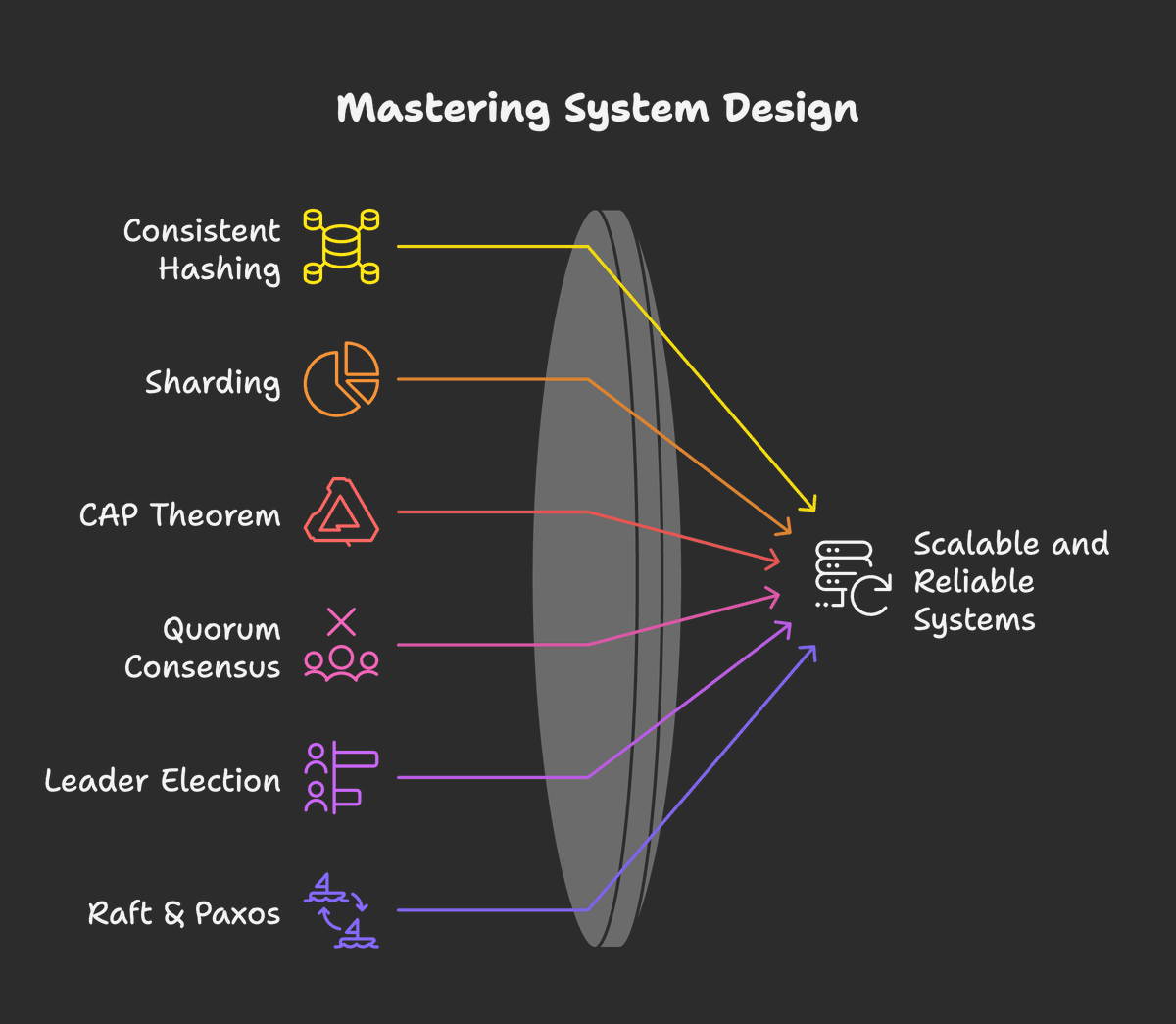
System design concepts I’d master if I wanted to crush it. Bookmark this. 1.Consistent Hashing 2.Sharding 3.CAP Theorem 4.Quorum Consensus 5.Leader Election 6.Raft & Paxos 7.Gossip Protocol 8.Vector Clocks 9.Load Shedding 10.Circuit Breakers 11.Backpressure 12.Tail Latency Reduction 13.Bloom Filters 14.HyperLogLog 15.Reservoir Sampling 16.Split-Brain Resolution Follow @asmah2107 to uplift your system design game.
Ashutosh Maheshwari tweet media
English
4
118
784
28.4K
Ram Kumar retweetou
AlgoMaster.io
AlgoMaster.io@algomaster_io·
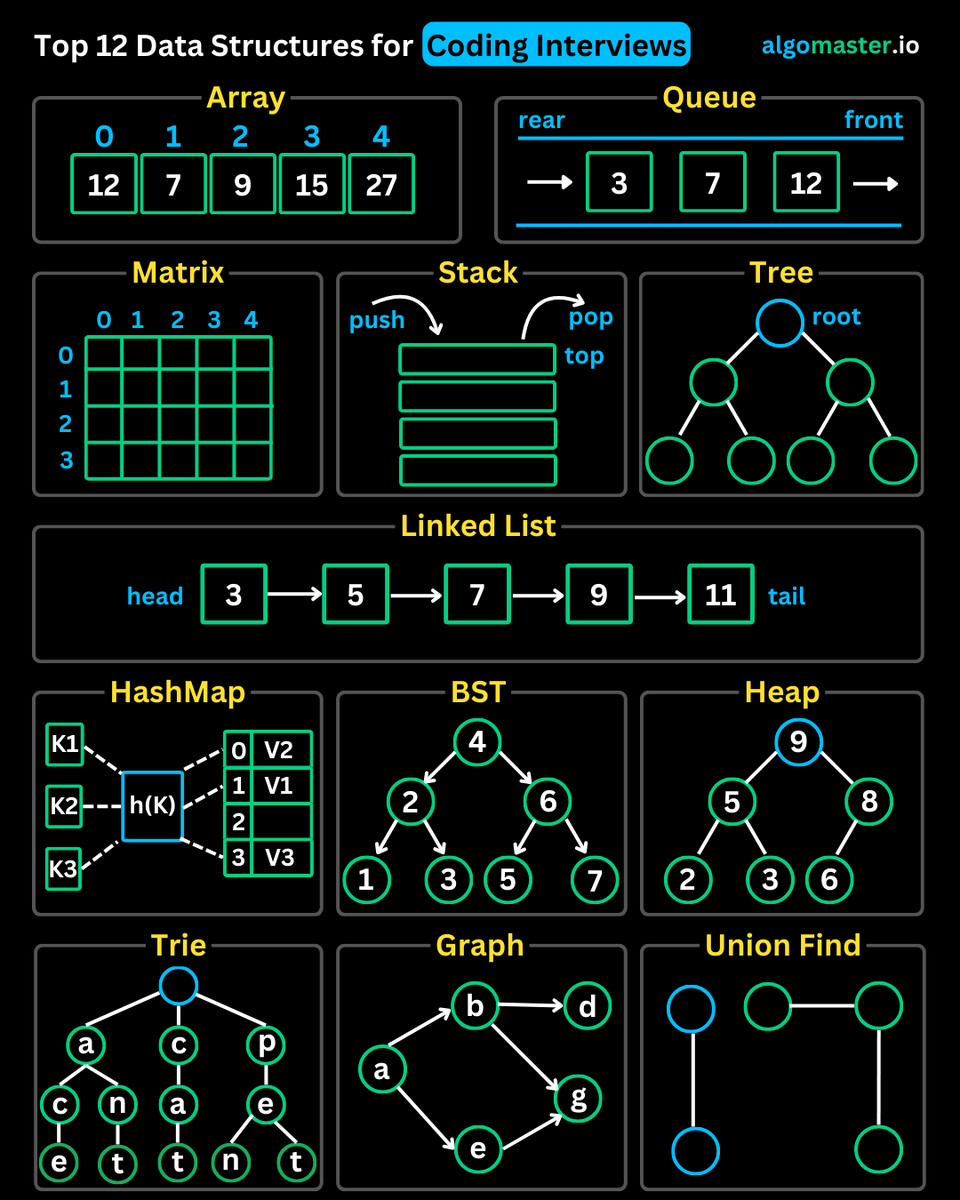
12 must-know data structures for coding interviews: 1. 𝐀𝐫𝐫𝐚𝐲𝐬 2. 𝐌𝐚𝐭𝐫𝐢𝐱 (2𝐃 𝐀𝐫𝐫𝐚𝐲) 3. 𝐋𝐢𝐧𝐤𝐞𝐝 𝐋𝐢𝐬𝐭 4. 𝐒𝐭𝐚𝐜𝐤 5. 𝐐𝐮𝐞𝐮𝐞 6. 𝐇𝐚𝐬𝐡𝐌𝐚𝐩 7. 𝐓𝐫𝐞𝐞 8. 𝐁𝐢𝐧𝐚𝐫𝐲 𝐒𝐞𝐚𝐫𝐜𝐡 𝐓𝐫𝐞𝐞 (𝐁𝐒𝐓) 9. 𝐇𝐞𝐚𝐩 (𝐏𝐫𝐢𝐨𝐫𝐢𝐭𝐲 𝐐𝐮𝐞𝐮𝐞) 10. 𝐓𝐫𝐢𝐞 11. 𝐆𝐫𝐚𝐩𝐡 12. 𝐔𝐧𝐢𝐨𝐧-𝐅𝐢𝐧𝐝 (𝐃𝐢𝐬𝐣𝐨𝐢𝐧𝐭 𝐒𝐞𝐭) ♻️ Repost to help others preparing for interviews
AlgoMaster.io tweet media
English
6
209
981
30.2K
Ram Kumar retweetou
Edison
Edison@CodeEdison·
DSA Roadmap (Basic → Advanced) : 1.Basics → Time & Space Complexity → Math Basics → Bit Manipulation (Basics) 2.Arrays & Strings → Arrays → Strings → Two Pointers → Sliding Window → Prefix Sum → Kadane’s Algorithm 3.Searching & Sorting → Basic Sorting → Binary Search → Binary Search on Answer → Merge Sort → Quick Sort → Heap Sort 4.Recursion & Backtracking → Recursion Basics → Subsets / Subsequences → Permutations → Backtracking (N-Queens, Sudoku) 5.Hashing → Hash Maps → Frequency Counting → Prefix Hashing → Subarray / Substring Problems 6.Linked List → Singly Linked List → Doubly Linked List → Fast & Slow Pointer → Cycle Detection → Reverse / Merge Linked List 7.Stack & Queue → Stack → Queue → Deque → Monotonic Stack → Next Greater Element → Expression Evaluation 8.Greedy → Activity Selection → Interval Problems → Job Scheduling → Greedy with Sorting 9.Binary Trees → Tree Traversals → Height / Depth → Diameter → Lowest Common Ancestor → Tree Views 10.Binary Search Trees → BST Basics → Insert / Delete → Floor / Ceil → Validate BST → BST Problems 11.Heaps → Min Heap / Max Heap → Priority Queue → Kth Largest / Smallest → Merge K Sorted Lists 12.Graphs → Graph Representation → BFS / DFS → Cycle Detection → Topological Sort → Shortest Path Algorithms → Minimum Spanning Tree 13.Dynamic Programming → 1D DP → 2D DP → DP on Subsequences → DP on Strings → DP on Trees → Space Optimization 14.Advanced Topics → Tries → Disjoint Set (Union Find) → Segment Tree → Fenwick Tree → String Algorithms (KMP, Z)
English
8
107
609
30.7K
Ram Kumar retweetou
Abhishek Singh
Abhishek Singh@0xlelouch_·
DSA prep can be demotivating if you are not doing the right kind of problems. I tell people to learn 10 patterns, then do 15–25 target questions per pattern until you can explain the invariant. 1. Two pointers: 125, 167, 15 2. Sliding window: 3, 76, 424 3. Prefix sum + hashmap: 560, 974, 525 4. Binary search: 33, 153, 875 5. Monotonic stack: 739, 84, 901 6. Heap / Top K: 215, 347, 295 7. Intervals: 56, 435, 57 8. BFS/DFS grid: 200, 994, 417 9. Trees: 102, 236, 543 10. DP starter pack: 70, 198, 322
English
16
138
1.5K
87.2K
Ram Kumar retweetou
Tansu Yegen
Tansu Yegen@TansuYegen·
Prof. Richard Feynman on how physics differs from mathematics..
English
2
23
81
8.6K
Ram Kumar retweetou
Ash Jogalekar
Ash Jogalekar@curiouswavefn·
If you are a physicist or chemist and want to revisit your mathematical foundations, it’s hard to top this classic. Not only does it cover the math but it also has key physics and chemistry applications included.
Ash Jogalekar tweet mediaAsh Jogalekar tweet mediaAsh Jogalekar tweet mediaAsh Jogalekar tweet media
English
11
53
632
32.7K
Ram Kumar retweetou
Aravind
Aravind@aravind·
Not just Fibbonacci series, Indians discovered: - Pythagorean theorem and geometric constructions (Baudhayana Sulba Sutras) - Binary patterns, binomial coefficients, Pascal’s triangle (Pingala’s Chhandas Shastra) - Positional decimal numeral system that we use today (Vedic period onward, formalized by Aryabhata) - Concept of zero as a number (Jain texts 300 BCE onward, rules formalized by Brahmagupta, 628 CE) - Negative numbers and their operations (Brahmagupta) - Sine and cosine tables, trigonometric identities, and π approximation (Aryabhata) - General solutions to quadratic equations and methods of solving them (Brahmagupta) - Infinite power series for π, sine, cosine, and arctangent (Madhava of Sangamagrama) - Precursors to Number theory, Calculus, Algebraic methods and many more
English
115
3.1K
9.2K
234.2K
Ram Kumar retweetou
Know Your History
Know Your History@H54355Know·
@sciencegirl The system used in the Netherlands to cope with tides is a true engineering marvel
English
1
9
52
2.3K
Ram Kumar retweetou
Akshay 🚀
Akshay 🚀@akshay_pachaar·
You’re in an ML Engineer interview at Google. Interviewer: We need to train an LLM across 1,000 GPUs. How would you make sure all GPUs share what they learn? You: Use a central parameter server to aggregate and redistribute the weights. Interview over. Here’s what you missed:
English
28
70
1K
337K