
Tweet fixado
Rigor
55 posts


Rigor
@runrigor
Most backtests lie. Rigor runs crypto strategies through walk-forward validation with real costs — and tells you the truth. Built by a trader. $29/mo at launch.
runrigor.com Entrou em Haziran 2026
45 Seguindo10 Seguidores
honestly the one nobody teaches first: learning to tell if your edge is actually real or if you just fooled yourself
everyone says risk management and discipline, and sure. but perfect discipline on a strategy that doesnt work just makes you lose money slower. ive watched plenty of blown accounts that had great risk management. the strategy was the problem the whole time
learn to test honestly before anything else. that one skill saves you years
English

Veteran traders, help the newcomers out. If you could recommend one trading skill to develop first, what would it be? ⬇️
English
funny timing. i ran RSI through honest walk forward validation a few days ago
in the backtest the best version looked unreal, +307 bps a trade. then i locked that exact setting and ran it once on data it had never seen. came out statistically indistinguishable from a coin flip. it's on my ledger
bolting MACD on doesnt fix that, it just gives you more knobs to fit the past with. and an 80% win rate doesnt tell you if it makes money, only how often it wins small before it loses big
whats the out of sample number? thats the only one that actually matters
English

We combined the #RSI and #MACD indicators to make a trading strategy with an 80% win rate:
quantifiedstrategies.com/macd-and-rsi-s…

English
respect for actually laying out the rules, most people hide them
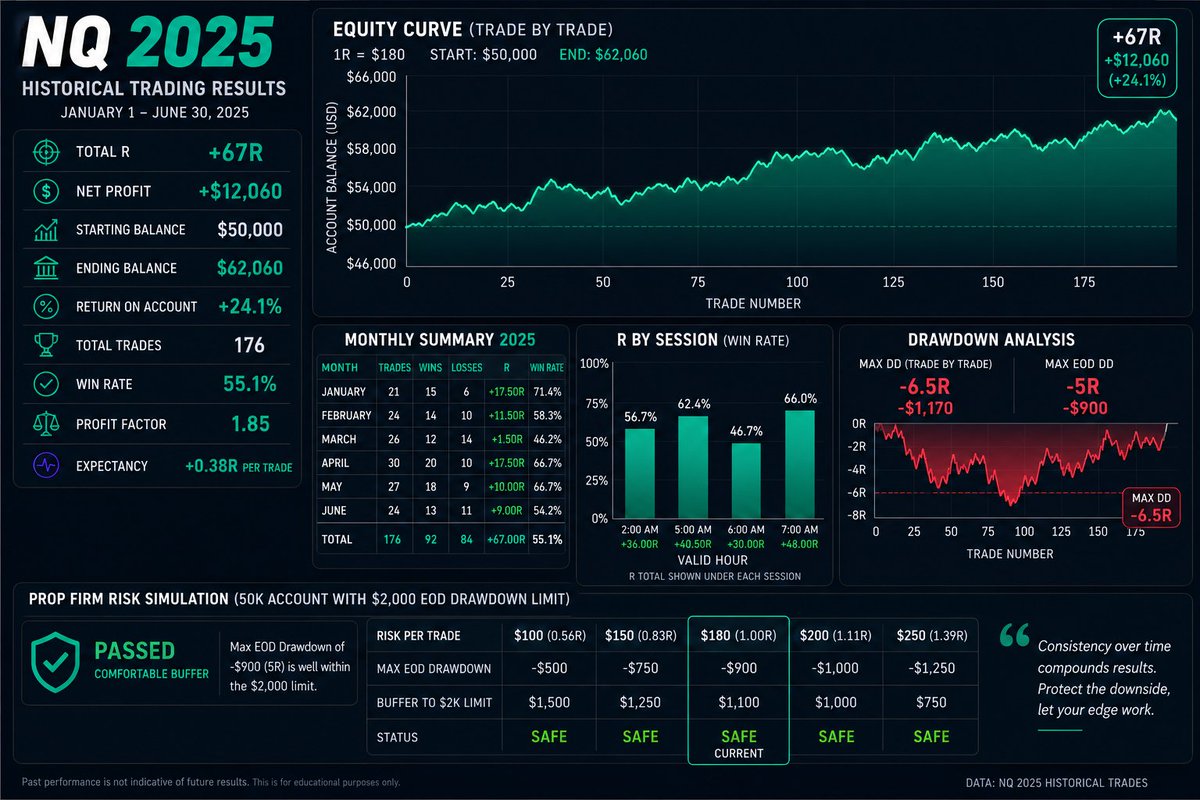
one thing jumps out though. this is a 2025 backtest and the hours are hardcoded, 2am 5am 6am 7am. why those four? probably because theyre the ones that mean reverted in 2025. thats not really a parameter, thats the model memorizing which hours worked in your test window. your own session breakdown already shows them spread from 46% to 66%
real test is run the exact same rules and the same hours on 2023 and 2024, stuff the model never saw. if +67R holds youve got something genuinely good. if the magic hours stop being magic, they were just fit to the year
English

Half way through my 2025 backtest on $NQ for my hourly mean reversion model
2am, 5am, 6am, 7am - Hourly Ranges (NY EST)
-Price trades beyond the range
-5minute candle closes back inside
-Limit order at range H/L
-Target 50% of range
-Fixed 1.5R
Key results:
✅ +67R
✅ +$12,060
✅ $50,000 → $62,060
✅ 55.1% win rate
✅ 1.85 profit factor
These are results for ONE 50k account
You can only imagine the impact when copying to multiple accounts
Visual here for some more stats if anyone is interested
Drop a comment if you would like a thread with some trade examples and breakdowns 👇
English
careful, this builds confidence not correctness. not the same thing
running the same backtest til it feels automatic just makes you more sure of it, doesnt make it more real. you could do this a thousand times to an overfit strategy and all youve built is rock solid faith in noise
the thing that actually earns confidence is the edge holding up on data it never saw. once. repetition feels like rigor. it isnt.
English


true, and uncorrelated strategies genuinely help. one catch worth adding though, it only works if each one is real on its own. stack five overfit strategies and you dont get diversification, you get five curve fits blending into a smoother backtest that looks way more robust than it is. more strategies means MORE validation not less. otherwise the blended equity curve just hides which ones are rotten
English
Why Multiple Strategies Beat One Strategy
Professional traders rarely depend on a single setup.
Different systems perform better during different market environments, so diversification across strategies helps stabilize returns and reduce dependence on one specific condition.
English
@VClouette "too simple to fail" is how every overfit strategy introduces itself. simple doesnt mean robust. it means fewer knobs to hide the curve fitting in. 65% winrate on a backtest tells you nothing until it's 65% on data the backtest never saw. whats the out of sample number?
English


yeah this is the realization that changes everything
the "huge number that barely break even" thing isnt bad luck. thats just the default. most edges that look good are noise that never got tested on data the strategy hadnt already seen
fast is the whole point btw. you can run a ton and stay honest instead of marrying the first good looking one
if you wanna take it further, lock one config before you see the out of sample result, then check if the edge is even different from a coin flip. half the "barely profitable" ones die right there
English

I got tired of waiting hours for backtests to run, so I wrote a walk forward backtester in C. It has limitations, of course - bar-by-bar analysis, trade-on-close, trades on signals produced by any study, and fixed target/stop loss (this can be changed in the study inputs) - nothing sophisticated - but it gives me a good idea if a strategy is viable. To my surprise, a huge number of trade strategies aren't - they barely break even or lose money.
It's quite fast - it took less than 1 second to simulate trades for a week - and allows me to test a ton of strategies in the time it took me to replay a chart for even 1 day.

English
most accounts post their wins. this is my record. 3 tested, 3 dead, 0 passed.
and its the thing im most proud of. every one of these wouldve cost real money if id trusted the backtest. the whole graveyard is public: runrigor.com/verdicts.html
#algotrading

English
win rate and profit factor are solid. the number i'd want before trading it though is the out of sample curve. if the algo saw all this data while it was being built, 953% is just describing the past. if it held up on data it never touched, thats the whole ballgame, and honestly worth way more than the headline number.
English

NEW GC IB ALGO STRATEGY RESULTS
$95,340 in profit in exactly 1 year.
On a $10,000 account.
+953.4% returns.
65.5% win rate.
177 trades.
2.6 profit factor.
Fully automated.
No screen watching.
No emotional decisions.
The algo ran both longs and shorts with a 2 TP system, locking in gains while letting winners run.
When you automate a proven edge, compounding does the heavy lifting.

English
really like the factor breakdown. one thing worth flagging though, theres a bit of a survivorship angle in how its set up
its 464 stocks that already 10x'd, then looking at what they had in common. thing is, a ton of stocks that didnt 10x probably had high FCF yield too, they just arent in the sample. so "winners had trait X" only really predicts anything if the losers didnt also have it
same shape as overfitting honestly, just on the population instead of the parameters. still a cool study, just worth keeping in mind before trading the factors
English

The secret of hedge funds is revealed in a 41-page PDF:
This paper analyzed 464 stocks that 10X-ed over a 24-year period.
Here are the best factors that drive outperformance: (number 3 is the best 🧵)

English
a challenge for anyone who thinks their strategy is real:
take the rules. don't change a thing. run them on a chunk of history you've never tested on. after fees.
if it still works, congrats, you have something almost nobody has.
if it falls apart, you just saved yourself the tuition.
most people won't do this. not because it's hard. because they already know what they'll find.
what's stopping you?
English
@WillyAlgoTrade honestly that's the rare part, catching it and owning it. most don't. good on you
English

@runrigor Thanks, buddy. Everyone makes mistakes, and I'm no exception.
English
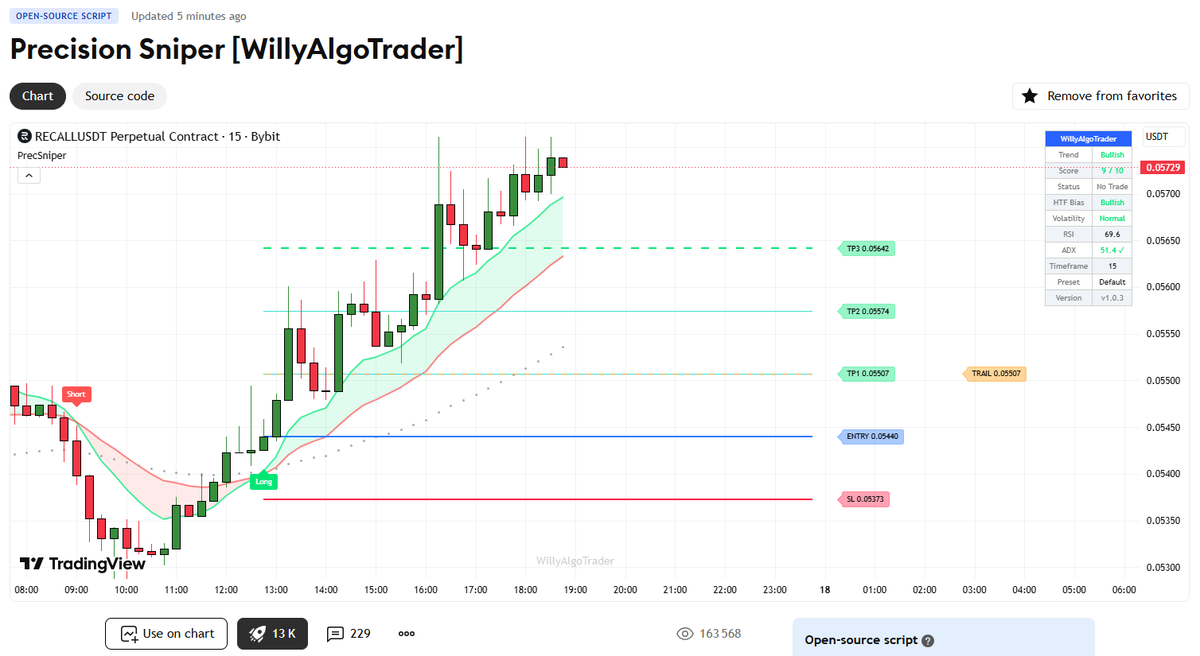
🎯 PRECISION SNIPER v1.4.0 — MAJOR UPDATE [MY FREE INDICATOR]
The biggest update yet: scoring engine reworked, risk management upgraded, and a brand-new volatility filter. Here's what changed 👇
⚡️ Scoring engine — fixed and smarter
We found a duplicated MACD condition: one factor was silently counted twice, inflating every score. Removed and replaced with an independent factor — histogram acceleration. The confluence score is now built from 10 truly independent factors.
Bonus: the scale is now adaptive. No volume data on your symbol? Daily timeframe where VWAP makes no sense? Those factors are auto-excluded and grades recalibrate to the real maximum — A+ means A+ everywhere.
🛡 Structure SL — done right
The stop is now placed BEYOND the swing — outside the structure, not inside it where stop hunts live. Capped at 1.5× the ATR distance so it never runs away.
🏁 Full Exit at TP3
Trades now complete cleanly at the final target: "TP3 ✓ — Closed" status, instant stats. Prefer letting the runner trail? One toggle brings the legacy behavior back.
🌪 NEW: High Volatility Filter
The volatility regime finally has teeth — it's no longer just a dashboard label. Three modes:
Skip Signals — no new entries while the market is in chaos (default)
Widen SL — enter anyway, but with a wider stop; all R:R ratios preserved
Off — legacy behavior
Configurable threshold + live dashboard markers (⛔️ / ⚠️).
🔔 Smarter alerts
Webhook JSON now carries the volatility regime in a new "vol" field — more context for your bots. Text alerts show it too.
⚙️ Also inside: reworked Auto-presets (strictness now grows with the timeframe), input validation that catches broken TP/HTF combos on load, and a lighter, faster codebase.
⚠️ Heads-up before updating:
Signals WILL differ from v1.2.x — that's intentional (the scoring fix + new defaults). Full Exit at TP3 is ON and the Vol Filter is set to Skip Signals by default. Full details in the release notes on TradingView.
Free, as always. Update is live 👇
tradingview.com/script/IZj18oY…
#TradingView #SmartMoney #SMC #forex #crypto #ict
English
the setup itself is solid, orb reversal with volume confirmation is a real definable thing
only thing i'd add: a lot of this is discretionary. "fail to move higher," declining volume, picking the .5-.618 by eye, those are reads. so a big part of that $800k is probably you making good calls in real time, not just the mechanical rules
which makes me wonder how a beginner running the exact same steps would actually do. the setup you can teach, the reads are harder to pass on
English

This 5 Minute Reverse ORB Strategy Is So Simple Even Beginners Can’t Mess It Up
⭐️ It was a big part of my $50,000 prop firm payout
⭐️ It helped me make $800,000+ in a year
⭐️ I’ve mastered it after 10 years of trading
We caught 400+ points on $NQ using it today
A thread 🧵

English

killed four of my own trading strategies in one week
not because anything broke. because i finally tested them honestly and every one fell apart the second it saw data it hadnt trained on
worst part wasnt losing them. it was how good they looked right up until they didnt. clean curves, solid win rates, the whole thing. exactly what you want to see
one was +9.3 on training. -1.6 the moment i validated it on data it never touched. that gap is the entire game and almost nobody checks it
i build what i build because i got tired of lying to myself with pretty charts
English
honest answer to your honest question
the feature list is solid but the one thing that'd actually get me to pay isnt on it. does that high-probability score hold up out of sample?
right now its rating setups on conditions, but is that rating checked against what those setups actually did on data you didnt pick? or is it kinda your gut encoded into a number
if you can show the A+ rated ones actually beat the low rated ones on forward data, thats the product right there. the detection stuff everybody already has
English

Honest question 👇
If I invested the time and money to build a V-Shape Indicator based on the exact framework I use every day, would you pay $9.99/month for it?
The indicator would automatically mark:
🎯 All major DOLs
- Asia, London, NY AM & PM Highs/Lows
- PDH & PDL
- EQH's & EQL's
- 9:30 Wicks
- Data Wicks
⚡ V-Shape Detection
- Continuations
- Reversals
- Real-time Alerts
📦 HTF Confluence
- Unfilled 15M - 4H FVGs
- Premium & Discount Zones
📊 Bonus Tools
- Risk Calculator
- Position Size Calculator
- RR Calculator
⭐ High Probability Rating
A custom score based on the conditions, where it rates the probability of the conditions based of things like:
Choppy price action
Unclear direction
Weak displacement
No clear DOL
Rejection wicks
Basically, the same DOLs, confluences, and framework I use to find my own trades every day.
Would you buy it for $9.99/month?
Be brutally honest 👇
English
this is the whole game right here
one thing a lot of people miss even when they do this: the hold-out is single use. fail it, tweak the model, retest on the same slice and you've just turned your validation data into training data. now youre overfitting to the exact thing that was supposed to catch overfitting
having a hold-out is easy. touching it only once is the actual discipline
English

Overfitting is the killer of systematic strategies.
You build on a stretch of history, tune the parameters until the equity curve looks clean, and the numbers flatter you. Then live trading arrives with data the model never saw, and the edge thins out.
The fix is unglamorous. Hold back a slice of history from the start and never let the model touch it during development. If performance holds on that untouched slice, you have something worth trading. If it does not, better to learn it now than with allocated capital.
English