Stage Two Research

2.3K posts

Stage Two Research banner
Stage Two Research

Stage Two Research

@stage2research

The world is in the process of fundamentally changing. The old playbooks won't work going forward. We show you how to thrive in this new world. Formerly west4.
Entrou em Mart 2021
6.7K Seguindo4.5K Seguidores
Stage Two Research
Stage Two Research@stage2research·
Been working on this free $TAO subnet scoring system: It scores every Bittensor subnet on fundamentals, momentum, value, and risk using live on-chain data. It ranks all of them and gives you a simple BUY/SELL/HOLD/ WATCH score. Updates every 5 min. Free to use. Will backtest as more data comes in. indicators.stagetworesearch.com/subnetscores
English
1
0
3
173
Stage Two Research retweetou
Santiago
Santiago@svpino·
What will happen when OpenAI, Anthropic, and Google raise the price to access their latest models by 10x?
English
316
89
732
111.8K
Stage Two Research
Stage Two Research@stage2research·
I’m launching Stage Two Research today. We’re entering a new stage driven by AI acceleration and institutional decay. Most commentary is noise. Stage Two delivers clear and actionable reports, frameworks, dashboards, and investment ideas to help you thrive in the new world. Free newsletter: stagetworesearch.com
Stage Two Research tweet media
English
10
0
20
524
Stage Two Research
Stage Two Research@stage2research·
@politicalmath "Tell me you've never used Claude Code without telling me you've never used Claude Code."
English
0
0
1
52
PoIiMath
PoIiMath@politicalmath·
I just wrote about how Anthropic is the worst AI company because they make these promises that are clearly aimed at CEOs and their goal is to get them to lay off 40% of their workforce and replace them with Anthropic products But their promises are false
Chubby♨️@kimmonismus

In 3 to 6 months AI will write about 90% of all code. In about 12 months (1 year!) AI will write 100% of all code. That’s coming from Dario Amodei, CEO Anthropic. So year looking bad for several people and looking good for self-developing AI

English
129
165
2K
88.5K
Stage Two Research
Stage Two Research@stage2research·
This it's not X, it's Y writing style is the most obvious AI writing tell.
Stage Two Research tweet media
English
1
0
3
127
Cointelegraph
Cointelegraph@Cointelegraph·
🔥 NOW: Bitcoin may be nearing a historic bear market bottom as key indicators flash undervaluation, per Bloomberg.
Cointelegraph tweet media
English
151
205
1.2K
75.2K
Stage Two Research retweetou
The Kobeissi Letter
The Kobeissi Letter@KobeissiLetter·
BREAKING: A record 104.3 million Americans are now "outside" of the labor force. These are individuals who are neither employed nor actively looking for work, including retirees, students, stay-at-home parents, and discouraged workers. This exceeds the 2020 pandemic peak by 600,000 when nearly the entire economy was shut down. Since the 2008 Financial Crisis, the number of people not in the labor force has surged +25.7 million and +35.1 million since 2000. As a % of the labor force, this metric stands at 61.2%, the highest level since the 1970s, excluding the pandemic. All while the US population stands at a record 342.5 million, up +61.4 million since January 2000. Cracks in the labor market are spreading.
The Kobeissi Letter tweet media
English
493
2.2K
7.4K
871.3K
Stage Two Research
Stage Two Research@stage2research·
"This time is different" usually ends in tears.
Stage Two Research tweet media
English
2
0
9
77
Stage Two Research
Stage Two Research@stage2research·
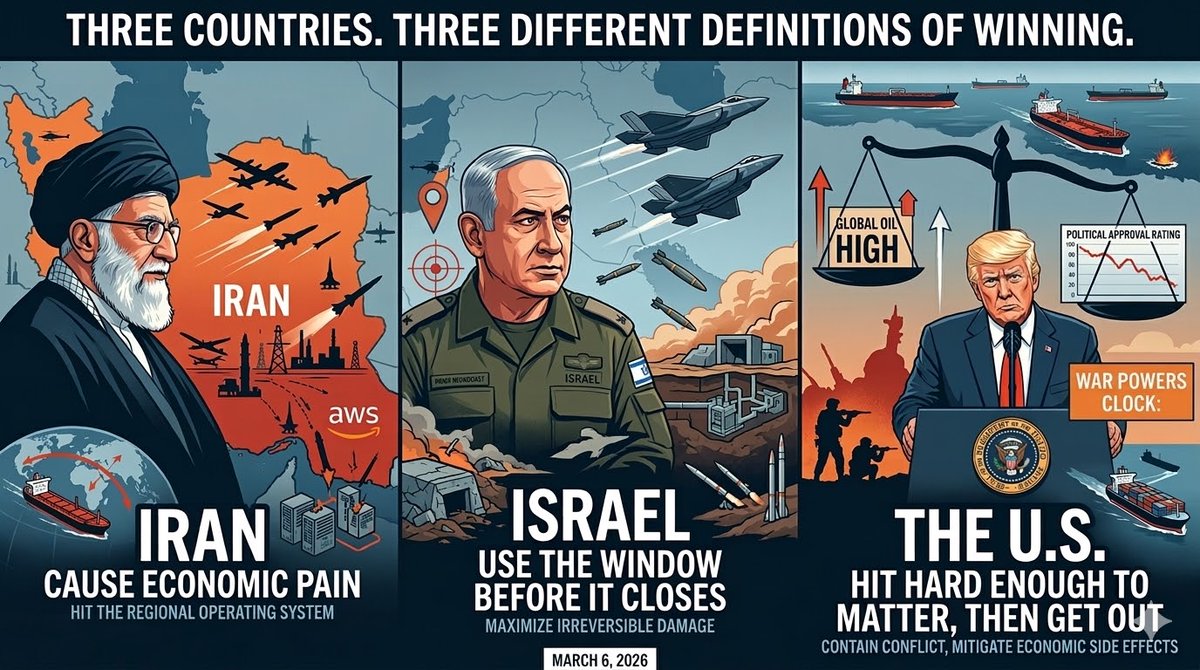
Most analysis of this war focuses on military strength. That misses the real dynamic. Iran, Israel, and the United States are not fighting for the same outcome. Each country has a different definition of victory and those conflicting incentives may determine how long the war lasts and how dangerous it becomes. Iran: cause economic pain: At first glance, Iran’s actions looks irrational. Why fire at Qatar, the UAE, Bahrain, Kuwait, airports, ports, and regional infrastructure when that risks turning more countries against you? Because Iran isn’t trying to “win” the war militarily. It’s trying to make the war economically unbearable. The real targets are the pressure points of the anti-Iran coalition: Gulf states that host U.S. bases, move a huge share of the world’s oil and LNG, insure shipping, and anchor the region’s financial and logistics system. Reuters reported tanker traffic through Hormuz fell to zero on March 5 from 37 on February 27, and Qatar said Iranian attacks targeted civilian infrastructure including its international airport. This is a bid to hit the operating system of the region. If this war continues to escalate, Iran’s next targets could be critical infrastructure. Reuters has reported that some AWS data centers in the UAE and Bahrain were damaged in drone strikes, and that the Gulf is in the middle of a massive AI and cloud buildout worth tens of billions of dollars. Gulf states are also highly dependent on desalinated water, and there were reports of desalination plants struck overnight. If this pattern continues, the war could increasingly shift toward attacks on the systems that keep daily life and commerce running—power, water, data, ports, and energy infrastructure. The goal would not be territorial gains, but to steadily raise the economic and political cost of the war for the entire region. Israel: use the window before it closes: Israel expects that its window to do irreversible damage to Iran may be closing. Trump is supportive now, but U.S. politics, Gulf pressure, and war fatigue can all turn fast. That means Israel’s strategy is to compress as much destruction as possible into the time it has: missile launchers, underground production sites, command networks, and anything that allows Iran to rebuild. Regime change may be an aspiration, but the more realistic goal is to leave Iran permanently weaker even if the regime survives. And unlike the U.S. or the Gulf states, Israel is the only major player whose incentives tolerate a longer war if it keeps weakening Iran. That creates a structural risk: Israel may continue escalating the scope of targets or operations to keep the campaign going while the political window remains open. The U.S.: hit hard enough to matter, then get out: America’s goal is narrower and far less stable than Israel’s. The White House said on March 6 that U.S. military objectives could be achieved in four to six weeks, while Defense Secretary Pete Hegseth has emphasized that Washington is not expanding its military objectives. The House vote on March 5 bought Trump room to continue operations, but only until the War Powers clock runs toward late April, when the domestic political fight could intensify. The deeper problem is that the war is already colliding with several of Trump’s other priorities. Disruption around the Strait of Hormuz has pushed energy prices higher, which feeds directly into inflation risk, supply chain stress, and shipping costs — exactly the economic pressures the administration has been trying to bring down. Gulf instability also threatens investment flows, aviation routes, and global energy markets at a moment when the White House wants economic stability heading into the next political cycle. That creates a strategic tension inside the U.S. position. Washington wants to hit Iran hard enough to restore deterrence and support Israel, but it also needs the conflict contained and short-lived before the economic and political side effects begin to outweigh the military gains. How this most likely plays out: 1) Hard campaign, then dirty de-escalation — 45% The U.S. and Israel keep pressing for a few more weeks, do major damage to missiles, launchers, and underground sites, then take a messy off-ramp once the economic and political costs rise further. This fits the White House’s stated four-to-six-week objective window and the late-April War Powers pressure point in Washington. 2) Israel pushes harder for regime fracture and the U.S. gets pulled deeper — 25% This is the “window is closing, do more now” case. If Israel believes U.S. support will weaken soon, the rational move is to maximize damage immediately. That raises the odds of mission creep, especially if Iran keeps hitting regional assets or U.S. personnel. 3) Faster ceasefire after one more burst of escalation — 15% If Iran’s firing rate keeps falling and its ability to disrupt shipping deteriorates faster than expected, all sides may grab a face-saving pause. This outcome is helped by weak U.S. public support, Gulf frustration, and the inflation risk from prolonged disruption. 4) Regional economic war and longer Hormuz shock — 15% Instead of a short campaign, the conflict drags on for months. Iran keeps the Strait of Hormuz intermittently dangerous with drones, mines, and shipping harassment, while Israel continues periodic strikes and regional actors like Hezbollah open additional fronts. The war becomes a slow-burning regional conflict where the main impact is sustained disruption to energy markets, shipping, and global inflation rather than territorial gains. A much wider escalation involving major powers — a true “WW3-type” scenario — remains possible but low probability. Investing implications Oil will likely be much higher when markets open, but I wouldn’t chase it from there. Oil has already repriced sharply, Barclays says Brent could test $120 if tensions persist, and that makes the trade more path-dependent than the alternatives below. 1) RTX Best fit for the base case. Reuters reports the White House is pushing RTX and other defense firms to raise output as stockpiles are drawn down, and a new $50 billion supplemental defense package is expected. This can work even if the war cools because replenishment demand survives the ceasefire. 2) ITA Cleaner than picking a single contractor. ITA is a broad aerospace-and-defense ETF designed to track U.S. aerospace and defense equities, which makes it the simplest way to own the replenishment and rearmament theme without single-name risk. 3) CIBR This is the best second-order expression. Reuters reports U.S. banks are already on high alert for Iran-linked cyberattacks, and CIBR tracks the Nasdaq CTA Cybersecurity Index. That gives you exposure to the asymmetric part of the war that can persist even if the air campaign slows. 4) AVAV This is the higher-beta version of the same thesis. AeroVironment just announced a $186 million U.S. Army order for next-generation Switchblade systems. Even if this war cools, the lesson that cheap autonomous strike systems matter is not going away. 5) GLDM Best hedge if you want protection without chasing oil. GLDM is designed to reflect the price of gold bullion. It could start to catch a safe haven bid as the war continues.
Stage Two Research tweet media
English
1
0
7
136
Stage Two Research
Stage Two Research@stage2research·
Good take. I'm already seeing this unfold
John Rush@johnrushx

Despite everyone saying everything is easy now with AI, it is much, much harder. AI basically takes away 99% of the job that was always easy (time-consuming but still easy). And the 1% was hard. Now, everyone competes on this 1%. It means: > every minute of work is super intense now. You can't take it easy by spending a few hours reading emails or moving the div or writing a function... > the sheer load on our brains is gonna be insane, most brains gonna overheat and collapse > the stress levels gonna go 100x, because now you have to make an important decision every minute, vs every week in the past > we gonna see monopolies formed in all niches, because every niche gonna have the smartest and most capable person win it and hold that position for a long time > people that can't handle this(99%) gonna be mostly watching/learning/simulating, but practically absent from the real competition (just like the gap between top athletes and the rest in any of the sports. e.g. take top10 boxers and put them against top1000 (which is still 0.00001% of the athletes), the fight gonna look like a lion vs dog puppy > most people gonna think they have a chance to be in 1% so they will invest a lot into their education and networking, both segments becoming the fastest growing and doing 100x (everyone will be spending 10% of their monthly income on education) > networking becomes super important, because for rich people that's the safest way to place their kids into the right circles, because ai brings true meritocracy and now suddenly 8 billion people can compete on anything, so being born in a rich family doesn't bring any serious advantage if one plays any of the competitive game, so the rich kids gonna mostly go into politics and non meritocratic orgs(gov connected corporations, regulated corporations, etc) What to do? - learn 4h a day - act 8h a day - find a niche that's small enough that you can dominate and monopolize it - narrow it down by the location/auidence/anything-else

English
0
0
5
148
Stage Two Research
Stage Two Research@stage2research·
This was good. Trump and Iran will likely be motivated to make a deal sooner rather than later. The missing piece from this is Israel. As Rubio suggested, they were the ones that initiated the attack. They will want the conflict to continue until regime change, at minimum, is achieved. So, there's a risk that this could last longer and get escalated further than you'd expect if you just look at it from Trump's perspective.
The Kobeissi Letter@KobeissiLetter

x.com/i/article/2026…

English
0
0
3
154