Tiago Pimentel

1.1K posts

Tiago Pimentel banner
Tiago Pimentel

Tiago Pimentel

@tpimentelms

Postdoc at @ETH_en. Formerly, PhD student at @Cambridge_Uni.

Brasília, Brazil Entrou em Kasım 2009
312 Seguindo1.8K Seguidores
Tweet fixado
Tiago Pimentel
Tiago Pimentel@tpimentelms·
Tokenisers are a vital part of LLMs, but how hard is it to find an optimal one? 🤔 Considering arbitrarily large alphabets, prior work showed this is NP-hard. But what if we use bytes instead? Or strings like a, aa, aaa, ...? In our new paper, we show this is still hard, NP-hard!
Tiago Pimentel tweet media
English
3
9
42
5.6K
Tiago Pimentel retweetou
Yonatan Belinkov
Yonatan Belinkov@boknilev·
Funding opportunity for PhD students for 4 month visits in Israeli universities. Contact if you're interested in an internship with me. Focus areas: Interpretability and controllability of LLMs, AI safety, multi-agent communication, AI for Science. azrielifoundation.org/fellows/visiti…
English
0
16
65
7.2K
Tiago Pimentel
Tiago Pimentel@tpimentelms·
@miniapeur After rejecting a request, most conferences give you an option to request a reduced load. This shows up in OpenReview itself. I often do that, since I review/AC for way more conferences than I should 😅
English
0
0
4
564
Mathieu
Mathieu@miniapeur·
As far as I know, we cannot choose the exact number of papers we review at top conferences. This means I review much less than I would actually like to. I would sincerely be happy to review two papers for each top conference (ICLR, NeurIPS, ICML, AISTATS, etc.), but being asked to review five to seven papers per conference is far too much.
English
3
4
46
9.4K
Tiago Pimentel
Tiago Pimentel@tpimentelms·
@mariusmosbach @icmlconf As an AC, I really dislike (purely) LLM-generated reviews. They have very little content, but still extend over a thousand words, which takes a long time to read. At least without LLMs, lazy reviewers are succinct 😅
English
1
0
8
670
Marius Mosbach
Marius Mosbach@mariusmosbach·
💭 @icmlconf review content quality is really concerning... Seems like we have reached a stage where not using LLMs makes reviews even worse (and lazy) than heavily LLM assisted ones.. Don't have a good solution but this really feels like reviewing has to change fundamentally..
English
4
3
57
5.7K
Tiago Pimentel retweetou
Valentin Hofmann
Valentin Hofmann@vjhofmann·
📢 Life update 📢 After a wonderful time at @allen_ai, I've joined @CisLmu at @LMU_Muenchen as a tenure-track assistant professor in NLP. Thrilled to be back in Europe and to start a lab in Munich's flourishing AI ecosystem! 🎉
Valentin Hofmann tweet media
English
39
16
320
16.3K
Tiago Pimentel retweetou
Dimitri von Rütte
Dimitri von Rütte@dvruette·
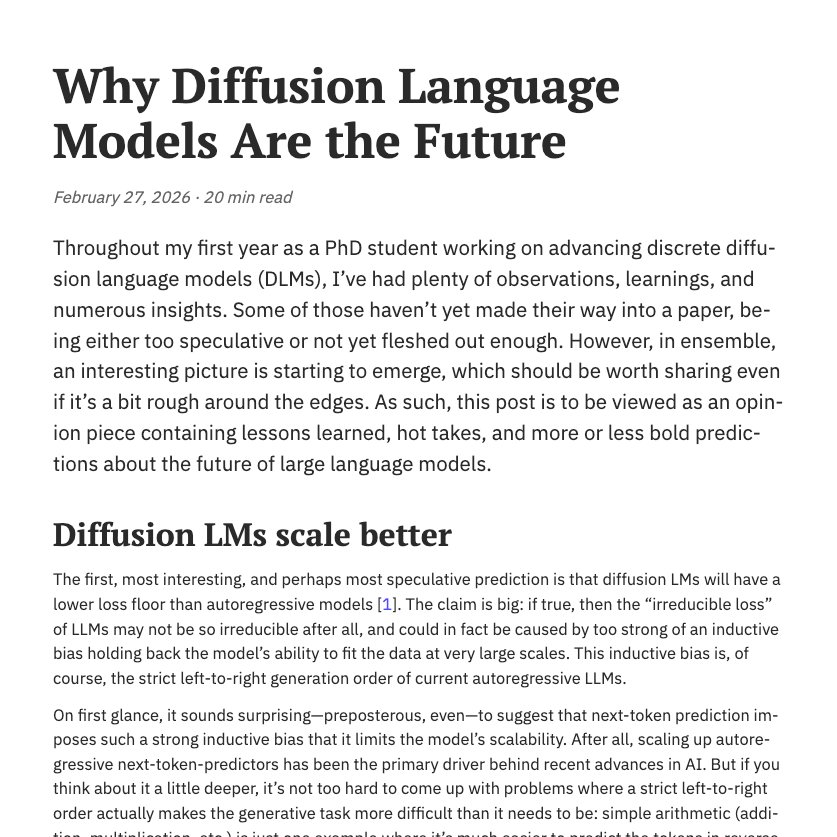
there, I said it. diffusion LLMs are the future! I'll be back in a couple of years to collect my "I told you so" award.
Dimitri von Rütte tweet media
English
44
104
905
212.5K
Tiago Pimentel retweetou
Clara Isabel Meister
Clara Isabel Meister@clara__meister·
What if your tokenizer could tell you your text's language? We're excited to introduce 𝗨𝗻𝗶𝗟𝗜𝗗: a simple, data-efficient method for language identification (LID) that builds on the UnigramLM tokenization algorithm. 📄 arxiv.org/abs/2602.17655
English
1
11
65
4.1K
Ari Holtzman
Ari Holtzman@universeinanegg·
The current standard in MechInterp appears to be: X is necessary to Y, if ablating it makes Y vanish X is sufficient for Y, if you insert it and Y appears where it wouldn't have previously But I feel like most such evidence doesn't capture selecitivity: does X effect other stuff? Is Y just downstream of that other stuff? Many evals include something like "does model perplexity go up on unrelated data" or "does the model still do well on MMLU". This seems entirely insufficient (no pun intended) Where is the leakage? One issue is that behaviors (i.e. Ys) are often poorly defined enough that we are really seeing necessity or sufficiency to some subset of Y, often not the same subset for necessity and sufficiency. How can we clean this all up? Surely there's someone more cogent who's written about this issue in MechInterp? (Plenty of Philosophers of Science worry about this but LLMs are a tad strange because of how easy they are to manipulate while preserving the original...)
English
4
4
106
5.4K
Tiago Pimentel retweetou
Christopher Potts
Christopher Potts@ChrisGPotts·
This is such a thoughtful post – thank you! The framing reveals that I must be out of step with the discourse. I have never thought of the possibility of non-linear features as an objection to mech-interp! We used mech-interp tools to find and characterize the onions that you so thoughtfully discuss. The closest I have come to this objection is Sutter et al. 2025 (arxiv.org/abs/2507.08802), which is certainly important but which I read as a call to action rather than an objection to the mech-interp project. Your post clarified for me that the crux of all of this (for me) is that if magnitude superposition occurs at all, in present or future models, I want to be sure we have tools for reliably detecting it. (Your arguments already help me see better why we didn't find onions in Transformers, but rather only in RNNs – the Transformer has more representationally efficient ways of storing position!)
English
1
5
64
7.8K
Tiago Pimentel
Tiago Pimentel@tpimentelms·
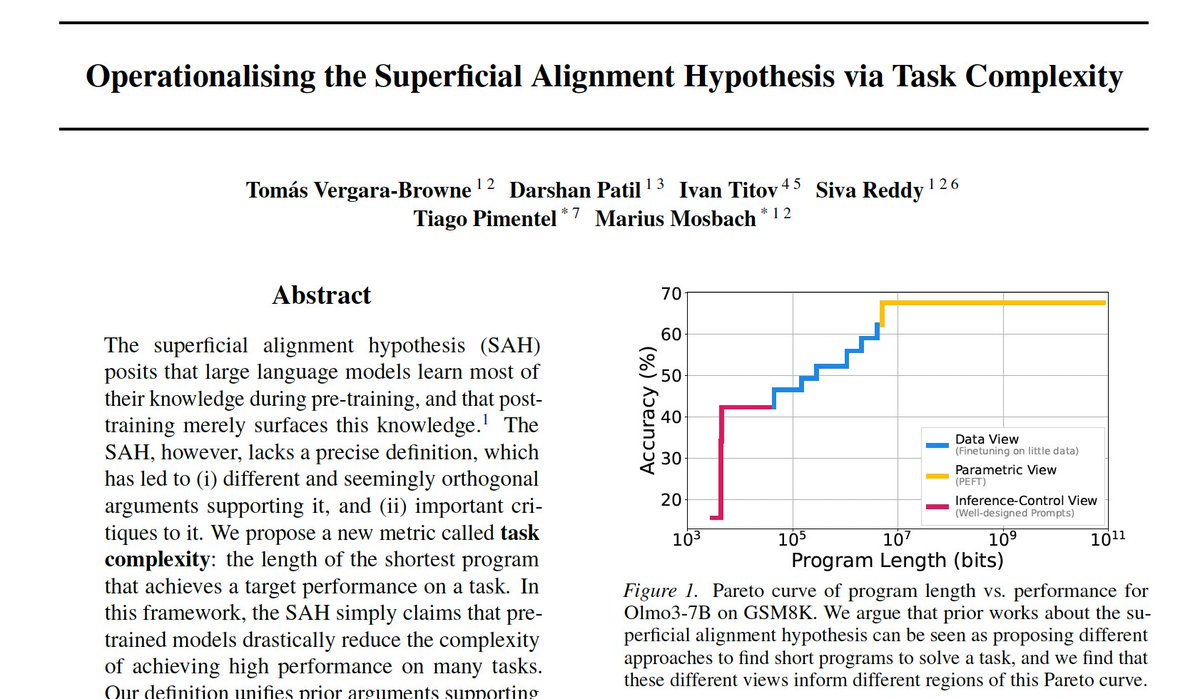
checkout our new paper about the superficial alignment hypothesis :) we use algorithmic information theory to formalise this hypothesis, we unify prior work on the topic, and show how post-training affects it! follow @tvergarabrowne for more great work like this in the future!
tom@tvergarabrowne

first paper of the phd 🥳 the Superficial Alignment Hypothesis (SAH) argues that pre-training adds most of the knowledge to a model, and post-training merely surfaces it. however, this hypothesis has lacked a precise definition. we fix this.

English
0
3
20
2.8K
Tiago Pimentel retweetou
Marius Mosbach
Marius Mosbach@mariusmosbach·
Check out our new preprint on the superficial alignment hypothesis (SAH). 👇 We operationalize the SAH via the length of the shortest program that achieves a certain performance on a task, unifying previous views on the SAH and showing how post-training affects "superficiality".
tom@tvergarabrowne

first paper of the phd 🥳 the Superficial Alignment Hypothesis (SAH) argues that pre-training adds most of the knowledge to a model, and post-training merely surfaces it. however, this hypothesis has lacked a precise definition. we fix this.

English
2
2
8
743
Tiago Pimentel retweetou
tom
tom@tvergarabrowne·
first paper of the phd 🥳 the Superficial Alignment Hypothesis (SAH) argues that pre-training adds most of the knowledge to a model, and post-training merely surfaces it. however, this hypothesis has lacked a precise definition. we fix this.
tom tweet media
English
9
45
235
31.5K
Tiago Pimentel
Tiago Pimentel@tpimentelms·
Looking for an emergency reviewer for an ACL submission about reasoning in large vision–language models 😁 please DM me if you are interested in doing it! The theoretical deadline is *very* short: today (February 14th) AoE, but ok if 24h or even 48h late!
English
0
2
3
577
Tiago Pimentel
Tiago Pimentel@tpimentelms·
I am looking for an emergency reviewer for an ACL submission about RoPE 😁 Please DM me if you wanna do it! The deadline is quite short, though, already on February 14th AoE!
English
0
2
2
813
Tiago Pimentel retweetou
Dimitri von Rütte
Dimitri von Rütte@dvruette·
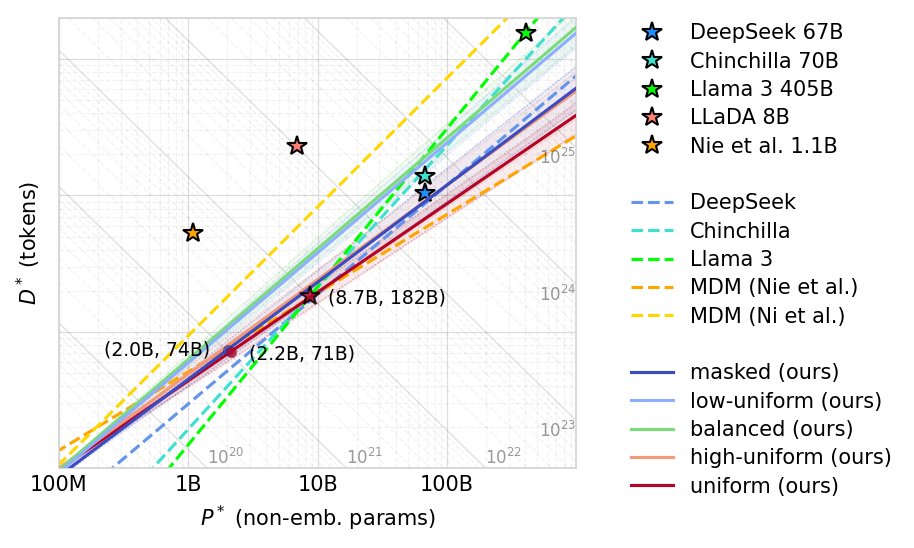
🚨 NEW PAPER! (this is a big one; 3B and 10B models included) Masked diffusion LLMs are getting a lot of attention. They outperform other diffusion types (such as uniform diffusion) at small scales. But what if I told you that uniform diffusion actually scales better? 🧵👇
Dimitri von Rütte tweet media
English
8
42
214
53.7K
Tiago Pimentel retweetou
Aryaman Arora
Aryaman Arora@aryaman2020·
the major flaw of “pragmatic interpretability” imo: the problems that this approach wants to work on are the same problems posttraining researchers work on, except posttraining researchers don’t have to restrict themselves to specific research methodologies (e.g. interp)
English
10
1
112
19.4K