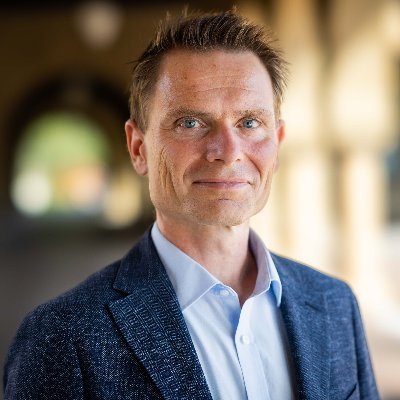
Eduard Storm

1.3K posts

Eduard Storm

Eduard Storm

@EdTheStorm

Obacht: Summer Child here. Also an Economist with focus on Labor, using ML & NLP. PostDoc Researcher & Head of Junior Research Group @IHS_Vienna.

Vienna, Austria Присоединился Temmuz 2009
507 Подписки288 Подписчики
Eduard Storm ретвитнул

ROCKWOOL Foundation Berlin
ROCKWOOL Foundation Berlin@RF_Berlin·
🆕 Chapter of the Handbook of Labor Economics in our Discussion Paper Series: @DAcemogluMIT, Fredric Kong, and Pascual Restrepo review recent advances in the task model and show how it can be used to understand recent trends in the labor market. rfberlin.com/research/tasks…
ROCKWOOL Foundation Berlin tweet media
English
1
3
10
565
Eduard Storm
Eduard Storm@EdTheStorm·
📢 We’re Hiring! Doctoral Researcher (f/m/d) – Labor Economics & Data Science 💡 Are you interested in how global megatrends are reshaping labor markets? 📈 Do you have a background in Economics or related STEM field? 🖥️ Do you enjoy working with large-scale data, combining econometrics + data science methods? hashtag#ML hashtag#NLP If you answered 3x "YES!" and want to develop your dissertation around above research agenda – then this could be the perfect opportunity for you: We at the @IHS_Vienna are looking for two Doctoral Researchers to join my team in the newly established Junior Research Group "Skill Demand during Structural Change". At IHS, we offer: ✔ Comprehensive mentoring and support for your PhD in Economics ✔ Dedicated research time and international collaboration opportunities ✔ A vibrant research environment with excellent opportunities for further career development – and all of that in the heart of Vienna: one of the world’s most liveable cities (lnkd.in/euJZtYgr) ✔ Flexible work arrangements in a family-friendly institute 📅 Application deadline: March 7, 2025 (application@ihs.ac.at) 📍 Location: Vienna, Austria 💰 Salary: €2,684 gross/month paid out 14x a year (30h/week) 🔍 More details & application: lnkd.in/egzuWgmC 📩 Questions? Feel Free to DM or Reach out to me: eduard.storm@ihs.ac.at If you or someone in your network is interested, feel free to share or tag them! RTs also appreciated🙂
English
0
4
8
909
Eduard Storm ретвитнул
Karsten Müller
Karsten Müller@KarstenMueIIer·
🚨 New Paper and Public Good🚨 "The Global Macro Database: A New International Macroeconomic Dataset", joint with @chenzix, Mohammed Lehbib, and Ziliang Chen. We built the most comprehensive macro database ever—covering 243 countries from 1086-today, integrating 110 sources. 🧵
Karsten Müller tweet media
English
17
421
1.5K
227.2K
Eduard Storm
Eduard Storm@EdTheStorm·
📢 Kleiner Reminder für meine fellow Expats! 🇩🇪 🗳️ Demokratie lebt vom Mitmachen – und eure Stimme zählt! 🗳️ Falls noch nicht geschehen, könnt ihr euch als Auslandsdeutsche noch bis Sonntag, den 2. Februar 2025 ins Wählerverzeichnis eintragen lassen. Ohne Bürokratie-Marathon – einfach per E-Mail! Wahnsinn, oder? 😉 📩 Hier geht’s direkt zum Antragsformular: bundeswahlleiterin.de/mitteilungen/b…
Deutsch
0
0
0
75
Eduard Storm ретвитнул
Mathias Huebener
Mathias Huebener@MathiasHuebener·
Bist du ein Geek in der Politikevaluation? 🤓 Dann hast du noch wenige Tage Zeit, dich auf eine spannende Postdoc Stelle in unserer Bildungsgruppe am BiB zu bewerben! 👇
Bundesinstitut für Bevölkerungsforschung (BiB)@bib_bund

📢 Wir suchen Verstärkung, gerne RT! #ScienceJobs #PostDoc Wo? Berlin oder Wiesbaden Was? Wissenschaftliche Evaluation des Startchancenprogramms Wieviel? E14 TVöD Bund, befristet bis 2030 Wir freuen uns auf sehr Bewerbungen bis zum 04.02. 👇 bib.bund.de/DE/Institut/St…

Deutsch
0
5
11
838
Eduard Storm ретвитнул
Frank Thelen
Frank Thelen@frank_thelen·
Dear @elonmusk , As a German entrepreneur, I am deeply grateful for the entrepreneurial inspiration you provide to millions around the globe, myself included. Your bold vision and relentless drive to build and grow companies like Tesla, SpaceX and X push us daily to think bigger, work harder and take the calculated risks needed to effect transformative change. While I may not always agree with your stance on U.S. politics, I recognize and respect your right as an American citizen, influential business leader and trusted advisor to President Trump, to make your voice heard in your home country. However, I must respectfully disagree with your recent endorsement of Germany's AfD party! Like you, I strongly believe Germany needs to cut red-tape, get rid of "woke" ideologies and adopt a very different immigration policy. However, a closer examination of AfD's platform and statements from party leaders like Björn Höcke and Tino Chrupalla reveals an agenda rooted not only in far right nationalism but also in a collectivist ideology that prioritizes rigid group identity over individual freedom and market-based principles. Additionally, Moreover, Alice Weidel's proposals, such as dismantling existing wind energy infrastructure and questioning Germany's NATO membership 
— going so far as to suggest that Germany is merely a "slave to the USA" — come across as excessively radical. In this election the AfD would not strengthen Germany; rather, it would weaken 
us even further! Fortunately, we have parties and people perfectly equipped to steer Germany towards a bright 
future. The center-right CDU/CSU and the pro-business, market-oriented FDP. I would encourage you to speak with CDU leader Friedrich Merz and FDP head Christian Lindner to better understand their strategies for reducing red tape, spurring innovation and promoting sustainable growth. As one of the world's most influential entrepreneurs, your words carry immense weight. Many of your German employees, customers and fellow startup founders are understandably disappointed 
— or even shocked — by your support of the AfD. I respectfully ask you to reconsider this stance and instead advocate for more constructive, forward-looking parties. You could make a profound difference in shaping Germany's path in the years ahead. Thank you for your time and consideration. Sincerely, Frank For everyone reading this: If this resonates with you, hit repost to trigger the X algorithm! ;-)
English
1.3K
847
3.7K
1.1M
Eduard Storm ретвитнул
Stefanie Stantcheva
Stefanie Stantcheva@S_Stantcheva·
🚨 New data alert! Curious about how people really understand inflation—its causes, impacts & what governments should do about it? 📊 You can dive into the data from our project "People's understanding of inflation" here: socialeconomicslab.org/research/publi… Excited to see new analyses!
English
5
42
145
12.7K
Eduard Storm ретвитнул
Martin Werding
Martin Werding@MartinWerding·
Ich suche eine*n wissenschaftliche*n Mitarbeiter*in für meinen Lehrstuhl für Sozialpolitik und öffentliche Finanzen an der RUB. Spannende Aufgaben, tolles Umfeld. Bewerben bis 17.02., Start ab dem Sommersemester. Hier geht es zur Ausschreibung: jobs.ruhr-uni-bochum.de/jobposting/e4a…
Deutsch
4
15
27
5K
Jorge Pérez Pérez
Jorge Pérez Pérez@jorpppp·
🚨New dataset alert 🚨 In collaboration with a stellar team at Banxico, Harvard, the World Bank, and ITAM, we built a dataset of demographics and labor market variables at the local-labor-market level for Mexico! Download here: banxico.org.mx/DataSetsWeb/da… #EconTwitter #Mexico
Jorge Pérez Pérez tweet media
English
10
260
964
83.3K
Eduard Storm ретвитнул
Joachim Voth
Joachim Voth@joachim_voth·
What is the meaning of life? What would you remember as bringing satisfaction, meaning, and purpose to your life? These are the modest questions that David Lagakos, Stelios Michalopoulos and I try to answer by "interviewing" over 1,400 Americans. We don't get to talk to them
Joachim Voth tweet media
English
4
48
168
31.5K
Eduard Storm ретвитнул
Bernie Sanders
Bernie Sanders@BernieSanders·
When I started talking about Oligarchy, many people didn't understand what I meant. Well, that's changed. When the 3 wealthiest men in America sit behind Trump at his inauguration, everyone understands that the billionaire class now controls our government. We must fight back.
Bernie Sanders tweet media
English
29.3K
56K
372.8K
14.5M
Eduard Storm ретвитнул
Anton Korinek
Anton Korinek@akorinek·
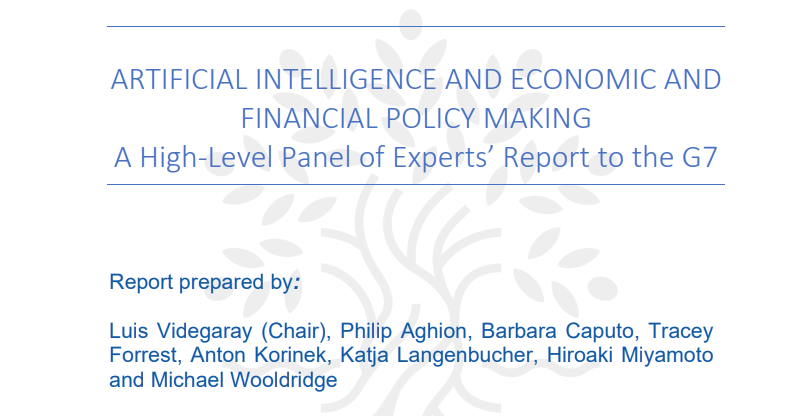
1/ 🆕 I was honored to serve on a 𝗚𝟳 𝗛𝗶𝗴𝗵-𝗟𝗲𝘃𝗲𝗹 𝗣𝗮𝗻𝗲𝗹 𝗼𝗳 𝗘𝘅𝗽𝗲𝗿𝘁𝘀 on “AI and Economic and Financial Policymaking” alongside @LVidegaray @wooldridgemike and other great collaborators. Our report is now available 🌐 #EconTwitter
Anton Korinek tweet media
English
5
79
392
123.5K
Eduard Storm ретвитнул
WeLaR
WeLaR@ProjectWeLaR·
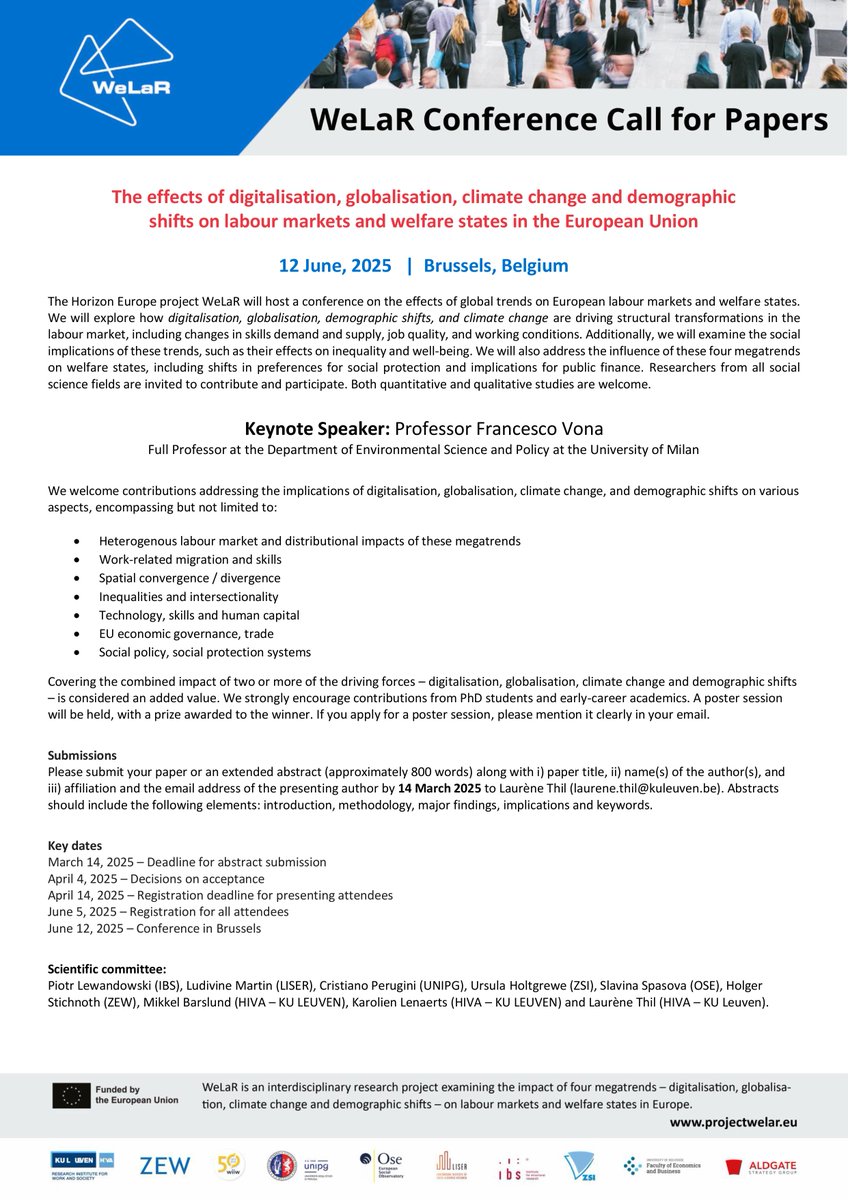
📢 #CallForPapers: WeLaR is seeking papers for 12 June 2025 conference in Brussels: "The effects of digitalisation, globalisation, climate change & demographic shifts on labour markets & welfare states in the EU." 🗓️Abstract deadline: 14 March ➡️Detalis: bit.ly/3Wm0R0X
WeLaR tweet media
English
1
8
14
986
Eduard Storm ретвитнул
Nick Bloom
Nick Bloom@I_Am_NickBloom·
At the American Economics Association I gave an overview on Working from Home trends, facts, figures and research. If anyone is interested here are the slides. Free to share, use for teaching, discussions etc. dropbox.com/scl/fi/m0d5rtg…
Nick Bloom tweet media
English
7
47
240
22.6K
Eduard Storm ретвитнул
Daron Acemoglu
Daron Acemoglu@DAcemogluMIT·
A summary of my thinking on shared prosperity, work and AI in ten bullet points. This is partly motivated by the fact that I have received questions from several people on these issues, and I feel like it may be useful to lay out my thinking in simple terms in one place. We are also about to have a new administration in the United States, so perhaps it’s a good time to think about some aspirations (even though I view it very unlikely that the incoming administration will move us in this direction). 1. Shared prosperity is key. By shared prosperity I mean economic growth from which most groups (e.g., men vs. women, different ethnic groups, different education groups, different regions, etc.) benefit more or less in the same way (e.g., their incomes growing at similar rates). Economic growth that just enriches one group greatly and generates only small benefits for many other groups is not shared prosperity. This is mostly an ethical precept, but it can also be justified because a peaceful, harmonious society does require shared prosperity. It is also a realistic one. It does not require that all inequalities are wiped away at one fell swoop. 2. Shared prosperity cannot be achieved just with redistribution. It needs to be rooted in the labor market, in (good) jobs and in wage growth. The safety net and some amount of redistribution are important. But these are not sufficient to generate shared prosperity. Even in social democratic Nordic countries, where redistribution is most robust, it is not the source of shared prosperity. Wage and employment growth have been much more important historically. Redistribution-based shared prosperity doesn’t make political economic sense either: if some portion of the population is continuously impoverished, they wouldn’t have the political power to ensure that robust redistribution remains. Moreover, even if we had a system where pre-tax inequality was growing a lot but there was enough redistribution to ensure the disposable incomes of all demographic groups grew robustly, it would have other serious problems. People without jobs and those whose pre-tax incomes were not growing wouldn’t feel that they were contributing to society. Worse, we would head towards a truly two-tier society with just some fraction of the population flourishing economically and receiving all the social status as they are the source of all earnings and tax revenues out of which others are receiving redistribution. 3. AI is here to stay and will be very impactful. I have little doubt that AI will be a defining technology for our future. It can also deliver significant productivity benefits, though I think whether it will do so or not is contingent on how we develop it, and its full effects will take a while to be materialized. There is a lot of uncertainty about AI’s effects. In my opinion, it is also difficult to know what AGI (artificial general intelligence) would mean and when it may arrive, and this adds to the uncertainty about AI. In sum, we cannot think of the future of work and shared prosperity without understanding AI’s impact. 4. AI’s direction can be pro-worker or anti-worker. A basic pillar of my thinking and my research is that all technologies are malleable – meaning that they can be developed in many different ways, with very different consequences about who wins and who loses. This is doubly and triply true for AI, which is a broad, flexible technological platform. AI can be developed for prediction tasks; it could be developed for generating text and images; it can be used as an informational tool, etc. In all of these cases, AI can be more anti-worker (meaning that it focuses on automating tasks and disempowering workers) or pro-worker (meaning that it can become an information technology for enabling workers to perform their tasks better and to be able to branch into more sophisticated and new tasks). How AI will be developed is a choice. 5. Currently it is being developed as an anti-worker technology. The main way in which companies are thinking of monetizing AI is by automation and more powerful digital ads, and neither of which would contribute to a pro-worker agenda. Moreover, the way in which foundation models are developed and trained is shaped by the expectation and desire to reach AGI. But AGI would mean more automation – if AI can achieve general intelligence and perform almost all tasks as well as most humans, then it will take away these tasks from humans. This current path will therefore lead to job displacement and lower wages, and is thus inconsistent with shared prosperity. 6. To redirect it, you need policies. Putting the previous two points together, we can conclude that while there was a direction for AI consistent with shared prosperity, we are not pursuing it. Moreover, the industry will not suddenly change direction. Therefore, there needs to be an intervention, and this can only come from government policies (across the world) to encourage new directions and also put regulations to prevent the more harmful uses of AI (some of which are synergistic with the anti-worker direction). 7. To redirect it, you need competition. New technologies especially radically new directions typically come from new companies, not established incumbents. This is doubly so when the incumbents we are talking about are the largest corporations humanity has ever seen. Hence, the pro-worker AI agenda should be symbiotic with agenda of increasing competition and breaking the hold of the existing powerful incumbents on the tech sector and the direction of AI. 8. To redirect it, you need different architectural choices. Perhaps even more controversially, redirecting AI may need architectural choices. To put it simply, pro-worker AI need to be an information tool in the hands of workers. This is impossible unless AI provides reliable, understandable and real-time information to workers in a range of occupations. The current architecture of AI (partly fueled by AGI dreams) is about AI acting autonomously and has also led to a black box structure of AI. Instead, the pro-worker direction AI needs the tools to provide advice to human decision-makers (rather than make autonomous decisions), and the best autonomous decisions are not necessarily the best advice/recommendation/information to workers. Moreover, pro-worker AI needs to be understandable by human decision-makers, which is not possible with current black box structure of foundation models complemented with fine-tuning and other kinds of ex post training of pre-trained models. Stepping back, in an ideal world government intervention should be neutral towards different technological choices. After all, entrepreneurs and innovators know which technologies to develop and how to develop them much better than bureaucrats and lawmakers. But in certain situations where different directions of technologies have major social consequences (for example, in the choice of fossil-fuel versus green technologies), then government intervention may need to impact technology and design choices as well. Nevertheless, it is important that this is done in the most minimalist possible way, so that innovation incentives and choices are not impacted beyond the extent necessary for a more socially beneficial direction to emerge. 9. All of this requires democracy. Since the current direction is chosen and supported by the largest and most powerful corporations in the world, only robust democratic pressure can lay the foundations of a redirection. 10. The Catch-22: AI endangers democracy. Tech choices in the past, especially those surrounding social media, have been damaging to democracy and active political participation of the citizenry. The same is likely to be true for AI, and even more so. First, AI is likely to be a very powerful technology for manipulation, and this can exacerbate platform choices that can make money while discouraging democratic citizenship. Second, the current ethos in the AI sector is quite anti-democratic, with leading technologists and entrepreneurs believing that experts (themselves) should be empowered to make all key decisions and democratic processes get in the way of the necessary AI acceleration. This not only creates a Catch-22 (we need democracy to redirect AI, but AI has already damaged democracies) it also suggests that redirecting AI will be very difficult. But I still believe it’s not completely hopeless.
English
15
175
514
102.8K