

Round Robin
1K posts


Voilà une réponse qui retourne son propre argument contre lui: il décrit le symptôme et le prend pour la cause.
Vous venez de décrire la conséquence en croyant décrire la cause.
Oui, une femme ne se contentera pas d'un homme médiocre, et personne ne le lui demande. Mais d'où sortent tous ces hommes médiocres? Ils ne sont pas tombés du ciel.
Pendant trente ans, on a expliqué à des générations de garçons que leur ambition était de l'arrogance, leur force de la violence, leur désir une agression et leur instinct de protection un reste de "patriarcat". On a appris aux hommes à s'excuser d'exister. Cette idéologie castre psychologiquement les hommes, puis s'étonne qu'il n'en reste plus de solides.
Vous ne décrivez pas la nature des hommes. Vous décrivez le produit d'un logiciel défaillant.
Et la PMA n'est pas la preuve que les femmes n'ont plus besoin des hommes. C'est le symptôme le plus coûteux d'un pacte brisé. Une civilisation qui a besoin d'une clinique pour se reproduire n'a pas libéré les femmes, elle a sous-traité ce qui était autrefois une histoire d'amour.
Meilleure culture, meilleur futur@culturefutur_22
@brivael Ce que vous ne comprenez pas, peut-être parce que vous ne comprenez pas les femmes, c’est qu’une femme préférera rester célibataire plutôt que d’être avec un homme médiocre. Ça explique aussi le recours de plus en plus fréquent à la PMA.
Français
@apterfinancial @PolymarketMoney Tout ça serait calculé alors ?
Français

@PolymarketMoney Oversubscribed is what every hot IPO reports, so ignore that. $SPCX closes its book Wednesday, the same day as CPI. The largest listing ever is pricing into the week's biggest macro print, and a hot inflation number would sour risk at the worst moment.
English

$SPCX Nasdaq IPO is reportedly well oversubscribed.
SpaceX is expected to close its IPO books after market close on Wednesday.


English
2.17T is a small market cap comparing to the potentiel.
Bullish.
Polymarket Money@PolymarketMoney
JUST IN: Polymarket traders are pricing SpaceX's IPO closing market cap at $2.17T, implying a 23% day 1 pop.
English
@brivael " le monde appartient à ceux qui construisent sans demander la permission "
Français
@RegardsS0ciaux @brivael En tous cas ils sont les premiers avec leurs CPU/GPU
Ils pourraient bien gagner sur le terrain de l' inférence locale une fois qu'un modèle satisfaisant soit disponible à l'achat ou sous licence
Français

@brivael C’est souvent toute la force d’Apple.
Ne pas être les premiers.
Attendre que la technologie mûrisse.
Puis l’intégrer dans un écosystème déjà massif et fluide.
Apple ne gagne pas toujours la course à l’invention.
Ils gagnent souvent la course à l’usage.
Français
Apple attend tranquillement cette technologie devienne mature pour l’intégrer dans l’iPhone.
Il n’y a AUCUNE valeur long terme à faire des modèles, c’est un play d’infrastructure.
Google et xAI vont gagner ce play.
Google sur terre.
xAI dans l’espace.
Et Apple va intégrer tranquillement.
Bastien Gares@bastiengares
Et à côté tu as Apple qui n’arrive même pas à nous sortir un modèle 😩
Français


Elon Musk on recruiting: Being a good person matters just as much as having a high IQ.
Jamie Dimon: “From when you started to today, what lessons have you learned, how have you changed both as a leader and as a person?”
Elon: “Well, I think I'm probably more chill than I used to be.
I'm way more laid back than I used to be. I'm still not that laid back, but, you know, more than I used to be, for sure.
One of the things I found over time is that in terms of recruiting people to the company or having people work at the company, their intellectual capabilities matter a lot, but it also matters if they have a good heart. It's not just about whether somebody has a certain IQ or whatever, but are they a good person. That matters a lot.
I guess I've learned a lot, although I feel like I still have a lot to learn and make a lot of mistakes. Maybe the future AI will say, not bad for a human.”
Source: Elon Musk Interviewed by Jamie Dimon at JPMorgan, June 5, 2026
English

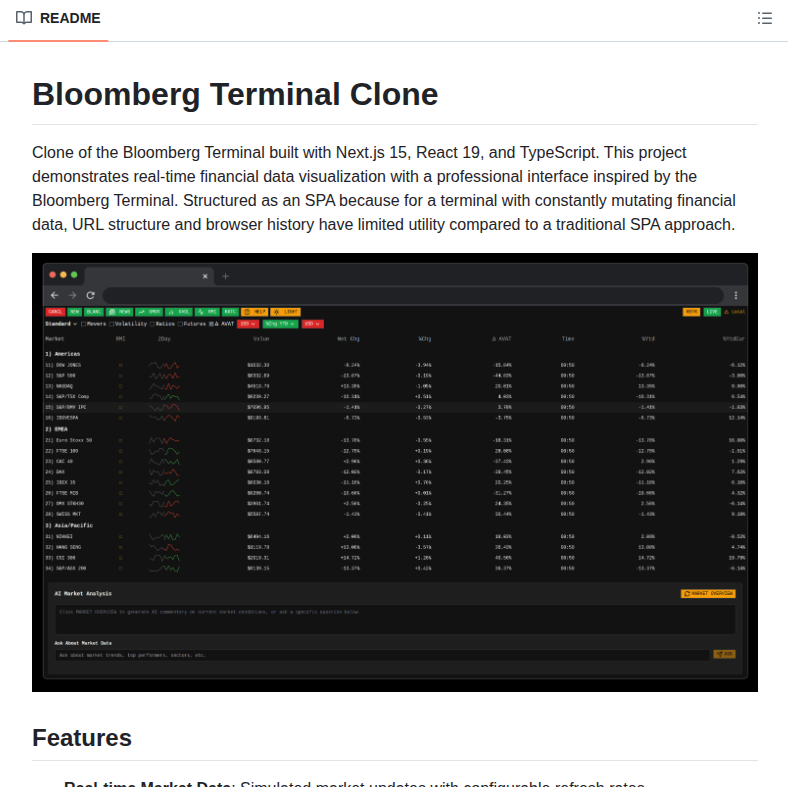
This guy made a Bloomberg Terminal clone.
Then open sourced it (for free).
Get it here:
English
@PaulMoreiraPLTV Bon, sûr, c un crack en prog
Mais de là à "changer le monde"
Français

@bigaiguy Merci pour cet article.
Faites une recherche sur internet, images , vous verrez qu'il est Japonais en fait
Français

A French engineer who lives quietly in Paris has spent 30 years writing software that the entire internet now runs on without knowing his name.
He wrote the code that streams every YouTube video, every Netflix show, every TikTok clip. He wrote the code that runs the virtual servers underneath AWS, Google Cloud, and Microsoft Azure. He calculated more digits of pi than anyone in history. He has no Twitter. He has no marketing. He just keeps shipping.
His name is Fabrice Bellard.
Here is the story, because almost nobody outside the systems programming world knows what one man has built.
Fabrice was born in 1972 in Grenoble, France. He studied at École Polytechnique, the top French engineering school. He never went to Silicon Valley. He never built a startup empire. He just wrote code.
In 2000 he started a project called FFmpeg, an open-source multimedia framework for encoding, decoding, and streaming video. He was 28. The project did one thing nobody else had done well. It handled every video and audio format that existed, in one library, on every operating system. He led it himself for years.
Today FFmpeg is the invisible engine of the internet. YouTube uses it. Netflix uses it. VLC uses it. Chrome and Firefox use parts of it. Every Android phone, every iPhone, every smart TV, every video editing tool you have ever touched runs FFmpeg somewhere underneath. If you have watched a video on a screen in the last 20 years, Fabrice's code processed it.
He was not done.
In 2003 he started QEMU, a machine emulator and virtualizer. He wrote it solo until version 0.7.1 in 2005. QEMU lets you run any operating system on any other operating system. It became the foundation of modern virtualization. KVM, the Linux kernel hypervisor, runs on top of QEMU. Every major cloud provider, AWS, Google Cloud, Microsoft Azure, IBM Cloud, runs virtual machines on infrastructure built around it. The Quick Emulator is the most cited piece of cloud infrastructure code on Earth.
He kept going.
In 2001 he won the International Obfuscated C Code Contest with a small C compiler that grew into TCC, the Tiny C Compiler. TCC can compile and boot a Linux kernel from source in under 15 seconds. In 2004 he calculated the most digits of pi ever computed at the time, using a personal desktop computer and an algorithm he derived himself called Bellard's formula. In 2011 he wrote a complete PC emulator in pure JavaScript that runs Linux in your browser, a project called JSLinux that engineers still cannot believe is real.
In 2019 he released QuickJS, a small but complete JavaScript engine that fits where V8 cannot. In 2021 he released NNCP, a neural network based lossless data compressor that immediately took the lead on the Large Text Compression Benchmark.
Then he turned his attention to large language models. He built TextSynth Server, a web server with a REST API for running LLMs locally. He released ts_zip and ts_sms, compression utilities that use language models to compress text and short messages at ratios traditional algorithms cannot reach. He released TSAC, a very low bitrate audio compression system. In December 2025 he released Micro QuickJS, a new JavaScript engine for microcontrollers, separate from QuickJS, designed for environments with almost no memory.
Fabrice co-founded a telecom company called Amarisoft in 2012, where he serves as CTO. Amarisoft builds 4G and 5G base station software used by carriers and labs around the world. He has been running it for over a decade while continuing to ship personal projects from his own home page at bellard dot org
He has no Twitter. He has no Instagram. He gives almost no interviews. His personal website is a flat list of projects with no styling, no fonts, no marketing copy. Just titles and links.
A quiet French engineer who never moved to Silicon Valley wrote the code that quietly runs the internet.
He is still shipping.

English


@HunterAllen4 I've seen it like 45 minutes ago
And now, it displays a +81% already !
English
@TW_trades_ It has to consolidate first to the level seen in April, before the FOMO
English


🏡 Looking for a few remote workers / builders to spend a month together in a villa in Sicily or Sardinia.
I'm planning to rent a villa somewhere near the coast. Location still TBD, but I've already found a few solid options.
The idea is simple:
• 4-5 people max
• Fast internet is non-negotiable
• Private rooms
• Work during the day
• Dinners, beach, hikes, gym, random conversations after work
• No party house, no startup-bro circus
Estimated cost is around €800/month per person for accommodation. Food, flights, car rental, etc. would be separate.
I'm a software engineer building SaaS products remotely and I've realized working alone from cafés all the time gets old. It would be nice to create a small group of interesting people who enjoy building things, working remotely, and occasionally touching grass.
If you're a founder, developer, designer, marketer, freelancer, or just someone doing meaningful remote work, drop a comment or DM.
Planning for 1 month initially. 🌊💻
English
@diapsalmata_0x Usually, as soon as they opt, if it's been up , they take the profit.
Here, during this weekend, this accumulation will be taken as soon as NY opens.
It's like this for months!
English

gonna wait for NY open to actually think about positioning on btc.
English