Give A Little Bit(coin)

7K posts

Give A Little Bit(coin) banner
Give A Little Bit(coin)

Give A Little Bit(coin)

@GiveALittleBit3

A little Bit of this, a little Bit of that #BTC npub1ej68v9kkzzrckeu4c839fey2zsmmv2axfe0hfypsqqmumv2h6ueqf96yzv

Chinada Присоединился Haziran 2021
2.1K Подписки212 Подписчики
Give A Little Bit(coin)
Give A Little Bit(coin)@GiveALittleBit3·
Canada has been going down the wrong track for a long time 60 - 75 years...by the time enough started to revert from their myopia to really recognize that, it was already too late to stop...much less turn around. #AgeOfDeception
James Lindsay, anti-Communist@ConceptualJames

As I fly out of another trip to Canada, this time Toronto, I just feel compelled to say how shocking it is that so many people have to recognize that Canada is likely already beyond repair on so many issues. They see the train running towards a cliff, and there are no brakes.

English
0
0
0
12
Give A Little Bit(coin) ретвитнул
Vesper
Vesper@vesperdigital·
𝗩𝗶𝗻𝘁𝗮𝗴𝗲 𝗧𝗿𝘂𝗱𝗲𝗮𝘂 - 𝟮𝟬𝟬𝟭 Never before seen footage of Justin as a teacher at a teachers conference. Try not to hurl 🤣🤣🤣
English
412
530
1.7K
218.9K
Give A Little Bit(coin) ретвитнул
JayGen 𝕏 er🇨🇦
JayGen 𝕏 er🇨🇦@JayGenXer·
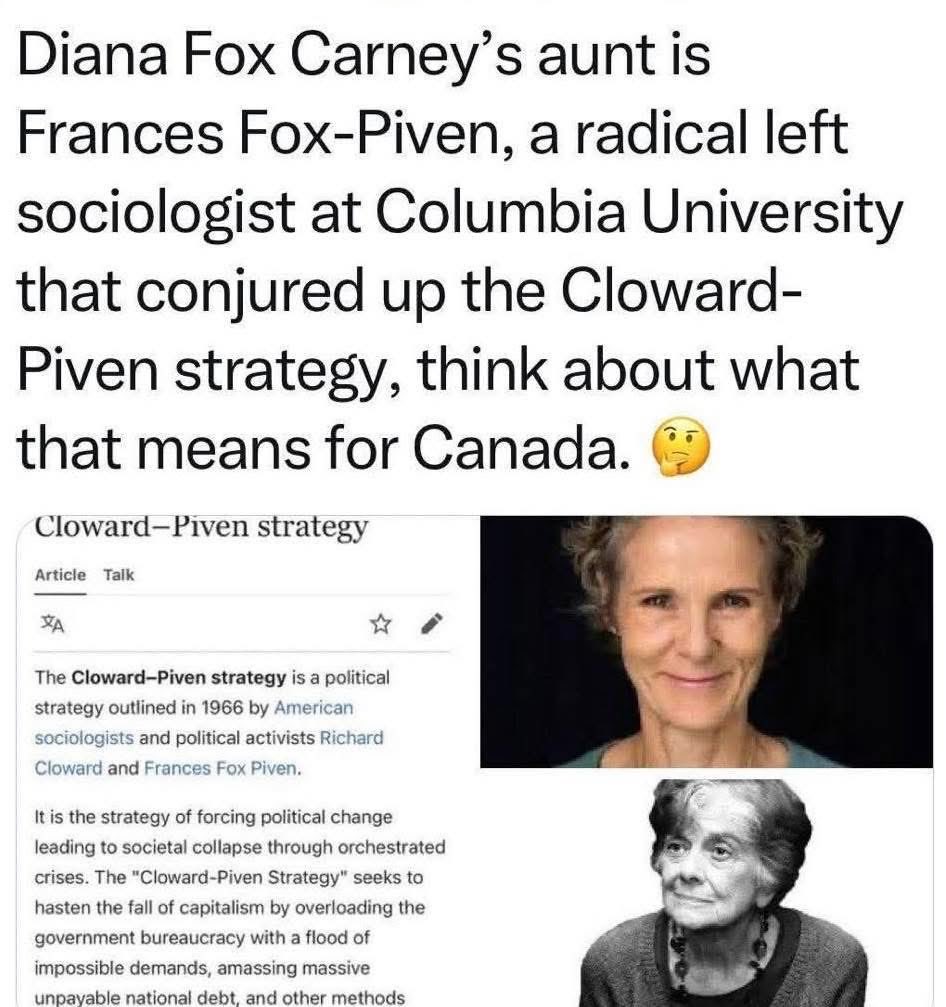
This is the family tree they don’t want you to see. Diana Fox Carney’s aunt is Frances Fox-Piven — the radical leftist who co-created the **Cloward-Piven Strategy**. The plan? Overload the government with impossible demands, crash the system, create chaos, and “rebuild” it under total control. Now her nephew-in-law is Prime Minister of Canada. Coincidence? Or is this exactly why Carney is comfortable with managed decline, open borders, exploding debt, and turning Canada into a pressure cooker? The strategy is playing out in real time. Canadians better wake up fast. What do you think — coincidence or master plan? Drop it below 👇 #cdnpoli #Carney #ClowardPiven
JayGen 𝕏 er🇨🇦 tweet media
English
267
2.7K
4.5K
87K
Give A Little Bit(coin) ретвитнул
Furkan Gözükara
Furkan Gözükara@FurkanGozukara·
Canada is undergoing a controlled demolition. Elites in the City of London are intentionally flooding the country with millions of immigrants to asset strip the nation and destroy the Canadian middle class.
English
196
1.8K
6.3K
342.7K
Give A Little Bit(coin) ретвитнул
Brane
Brane@Branech·
Puisque cette vidéo de la presse chinoise a été interdite en France, remettons-en une couche au nom de la liberté d’expression. ✊📢
Yves Pozzo di Borgo@YvesPDB

La vidéo de la presse chinoise montrant l’explosion du meeting privé présidé par @netanyahu qui indique sa probable mort à d’abord été interdit du @X aux États Unis et vient d’être interdit sur @XFrance et Europe ! Jusqu’à Quand nos dirigeants vont continuer à nous mentir?

Français
500
4K
11K
1.5M
Give A Little Bit(coin) ретвитнул
Joe Tippens
Joe Tippens@JoeTippen·
The Overlooked Miracle Drug for Cancer? Why Big Pharma Fears Fenbendazole "Fenbendazole has at least 12 proven anti-cancer mechanisms in vitro and in vivo," wrote cancer researcher Dr. William Makis "So why are there no Fenbendazole clinical trials for cancer? The answer seems rather obvious: it’s very cheap, it’s safe, and it seems to be very effective. Fenbendazole is not going to make anyone rich, and in cancer treatments, that is a non-starter." "What an enemy of the people," Joe Rogan responded. "They're preventing information and preventing people from using things that save them."
English
0
915
2.6K
65.1K
Give A Little Bit(coin) ретвитнул
The Reclamare
The Reclamare@TheReclamare·
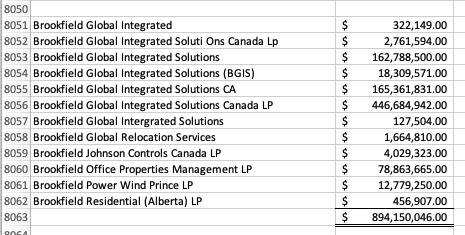
I took 2015-2025 CDN financial data, made individual files for all payments by year, purpose, Ministry, recipient, then merged them into one file, and merged them into single sums From 2015 to 2025 Brookfield companies received $900 million from Canadian taxpayers
The Reclamare tweet media
The Reclamare@TheReclamare

I don't think we have any idea how intertwined Brookfield is within the Government of Canada In one accounting book alone they received over $500 million from the Liberal Govt I have three more accounting books to go through

English
120
1.5K
2.6K
275.7K
Give A Little Bit(coin)
Give A Little Bit(coin)@GiveALittleBit3·
This is a masterclass from the Master Strategist himself. He lays out the case for STRC, MSTR & BTC in a plain, clear and understandable manner so that only a moron wouldn't get it. Must watch/listen.
Michael Saylor@saylor

I discuss $BTC price action, the rise of Digital Money and Digital Credit like $STRC, debunk the latest quantum FUD, and explain why companies like $MSTR are accelerating global Bitcoin adoption with @NatBrunell.


English
0
0
0
17
Give A Little Bit(coin) ретвитнул
Jim McMurtry
Jim McMurtry@JimMcMurtry01·
BC HRT Commissioner made $320,720 in 2023. Barry Neufeld, who lives in a trailer park, has a small pension. Kasari Govender has an Indian father, so she benefits as an equity-hire. She says she champions equality but slapped a $750,000 fine on Barry who’s barely surviving.
Jim McMurtry tweet media
English
301
802
2.4K
52.9K
Give A Little Bit(coin) ретвитнул
Alberta 51 Project
Alberta 51 Project@Ab51_Project·
Elite capture at the highest levels. PEI was infiltrated! Property purchases, money laundering through monastery and others. Chinese military involvement, fraud... Charges laid. Federal government SHUT DOWN THE COURT CASE!
English
83
1.3K
1.8K
27.3K
Give A Little Bit(coin) ретвитнул
Murray 🇺🇸
Murray 🇺🇸@Rothbard1776·
Listen to me carefully. When you are in Charlie Kirk’s position, these are the questions you are not allowed to ask. These are the answers you are not allowed to give. Watch this video and remember: > Charlie’s public and private efforts to secure the release of the Epstein files > Charlie’s opposition to antisemitic “hate speech” laws > Charlie reportedly refusing a $150M donation for TPUSA from Bibi > Charlie declining Netanyahu’s recent invitation to visit Israel > Charlie’s decision to begin and continue platforming Israel-critical voices like Tucker Carlson and Dave Smith at TPUSA [he even mentioned bringing Candace back]. > Charlie’s text messages accusing Jewish donors of playing into into all the stereotypes after they pulled donations for his refusal to ban Tucker from TPUSA > Charlie’s text messages to his pro-Israel handlers stating that he was forced to abandon the pro-Israel cause. > Charlie questioning suspicious financial activity within TPUSA and ordering the establishment of “DOGE” committee to investigate the organization’s finances one week before he was shot. > Charlie privately back-channeling the White House to express concerns about pursuing regime change or getting pulled into a drawn out war in Iran by the Military Industrial Complex. It’s evident that Charlie Kirk was beginning to adopt a true America First position, which meant he was beginning to challenge the entire power structure of the political and economic system. He did this while sitting atop the largest youth conservative organization in the United States with thousands of chapters all across college campuses. He had a gargantuan social media footprint. He was 31 years old with extraordinary political aspirations and a tireless work ethic. He was a devoted Christian who couldn’t be blackmailed. He had the hearts, minds and ears of nearly every young conservative in the country who would’ve been the next generation of political leaders, academics, journalists, lawyers, business leaders, voters, activists, etc. … and he was distancing himself from the existing establishment. This is what gets you removed from the political chessboard. Some may even call it “neutralized”.
English
110
1.4K
4.2K
124K
Give A Little Bit(coin) ретвитнул
Richard Gage, AIA, Architect
Richard Gage, AIA, Architect@RichardGage_911·
[RG911Team] It’s all starting to make sense now. 1) When legendary stock trader @maxkeiser interviewed investment banker Jim Rickards in 2014, Keiser said Howard Lutnick’s firm Cantor Fitzgerald was placing big put options on the 9/11 airlines days before the attack. 2) Alex Brown, an investment firm previously run by CIA head Buzzy Krongard, purchased most of these put options. (This is documented in the 9/11 Commission Report.) 3) 658 Cantor Fitzgerald employees died on 9/11, as their HQ was on the top floors of the North Tower. 4) Lutnick claims he survived 9/11 because he took his son to his first day of kindergarten that day and arrived late to work. No available records from NYC public or private schools indicate a kindergarten school year started on 9/11/01. 5) Lutnicks’ wife, Edie, was a lawyer with an office on the 101st floor of the North Tower. She claims an appointment she had that morning in the Towers was cancelled at the last minute, leading her to sleep in late and saving her life. 6) The Epstein files have revealed Lutnick’s close ties with Jeffrey Epstein, who was well connected to leaders in the CIA and Israel’s defense and intelligence services. We don’t know exactly who told Lutnick’s firm about what was coming, but we do know this: It’s a big club, and we’re not in it.
English
321
3.8K
10.2K
370.6K
Give A Little Bit(coin) ретвитнул
Liz Churchill
Liz Churchill@liz_churchill10·
This is how they infiltrate…
Liz Churchill tweet media
English
258
2.6K
6.7K
97.9K
Give A Little Bit(coin) ретвитнул
George Noble
George Noble@gnoble79·
Remember this scene in The Big Short? Jamie Shipley and Charlie Geller have bet everything against the housing market. They've been bleeding for months, wondering if they're wrong. Then they flip on CNN and see it: New Century Financial - the second-largest subprime lender in America - has filed for bankruptcy. "It's starting." That was April 2, 2007. New Century wasn't the crisis. It was 1% of the problem. But it was the first domino. 4 months later, BNP Paribas froze 3 funds citing "complete evaporation of liquidity." 18 months after that, Lehman was dead. I'd encourage you to watch that scene today. Because we JUST got our New Century moment in private credit: Blue Owl Capital - $307 billion in assets under management - just permanently halted investor redemptions at its retail private credit fund, OBDC II. Investors will NEVER AGAIN redeem shares from this fund. On January 25th, I wrote that private credit was showing cracks at the exact moment Wall Street wanted to open it up to your 401(k). 3 weeks later, here we are. The timeline follows a pattern anyone who's been around markets long enough recognizes: Through the first 9 months of 2025, OBDC II investors withdrew $150 million - up 20% year over year. Meanwhile, Blue Owl execs publicly assured investors there was "no meaningful pressure" on their asset base. But there was. And they're now facing a federal class-action lawsuit for saying otherwise. In November, they attempted a merger that would have forced OBDC II investors into a publicly traded fund trading at a 20% discount to NAV. Effectively confiscating a fifth of their capital. Blue Owl's own CFO conceded investors "could take a potential haircut." The stock dropped 11% in 8 days. They killed the deal. Now they've abandoned the pretense entirely. PERMANENT halt. Fire-selling $1.4 billion in loans across three funds. Investors get roughly 30% of NAV back through quarterly distributions - on Blue Owl's schedule, not theirs. One delightful detail: Blue Owl's co-CEOs have pledged $1.9 billion of their OWN company shares as collateral for personal loans - proceeds used, in part, to acquire the Tampa Bay Lightning. The stock is down 33% this year. That collateral has literally shed $260 million since January. Founders leveraging company stock for hockey teams while retail investors queue up for their own money. Wall Street's version of noblesse oblige. But here's what matters: This isn't about Blue Owl. Blue Owl is a symptom. The disease is a $3.4 TRILLION private credit industry built on opacity, conflicts of interest, and the polite fiction that illiquid assets can offer liquid redemptions. Morningstar DBRS reports the trailing default rate has risen to 4%, up from 2.8% a year ago. Downgrades outpacing upgrades. Outlook negative. UBS warns defaults could reach 13% if AI disrupts the software companies making up 17% of BDC loan portfolios. Payment-in-kind loans (where borrowers can't pay cash interest and simply pile it onto the debt) have surged past 11% of BDC income. When your borrowers are paying you with IOUs, the word "income" deserves quotation marks. And the government's response? Open YOUR 401(k) to private credit. Trump's executive order directed regulators to do exactly that. They want to "democratize" an asset class whose flagship retail product just permanently locked investors out. The KKRs. The Blackstones. The Apollos. Everyone loaded up on private credit is exposed. When the tide goes out, you find out who's swimming naked. In April 2007, New Century went bankrupt. Most of the financial world shrugged. 17 months later, Lehman made the point impossible to ignore. And Blue Owl permanently halted redemptions TODAY. AVOID PRIVATE CREDIT AVOID PRIVATE EQUITY Because it's starting...
George Noble@gnoble79

In August, President Trump signed an executive order titled "Democratizing Access to Alternative Assets for 401(k) Investors." The order directs regulators to make it easier for your retirement savings to flow into private credit, private equity, and other "alternative" assets. The Department of Labor quickly rescinded Biden-era guidance that had discouraged these investments in retirement plans. Apollo. Blackstone. Goldman Sachs. State Street. They're all racing to launch private credit products for your 401(k). But here's the problem: Private credit is showing cracks at the exact moment they want to open it up to retail investors. Just this week, BlackRock TCP Capital - one of the largest publicly traded private credit funds - plunged 17% after disclosing a 19% writedown on its net asset value. The biggest drop in almost six years. This is BlackRock. The world's largest asset manager. $14T in assets. If they're taking hits like this, what chance does your 401k have? Let me walk you through what's actually happening in this market... Private credit has ballooned to over $2T in assets. For years, it was the domain of sophisticated institutional investors - pension funds, endowments, insurance companies. These investors have teams of analysts, lawyers, and risk managers to evaluate complex deals. Your average 401k participant doesn't have any of that. And the timing couldn't be worse. The IMF's 2025 Financial Stability Report found that 40% of private credit borrowers now have NEGATIVE free cash flow. That's up from 25% in 2021. Goldman Sachs data shows 15% of borrowers can no longer generate enough cash to fully cover their interest payments. UBS forecasts that private credit defaults could climb by 3 percentage points in 2026 - outpacing leveraged loans and high-yield bonds. Meanwhile, payment-in-kind loans - where struggling borrowers defer interest by adding it to their debt balance - have surged from 7.4% in 2021 to over 11% today. When a company can't pay interest in cash, that's not a sign of health. It's a sign of stress being disguised. Then came September's wake-up call: Auto parts maker First Brands collapsed with $8B in off-balance-sheet financing that wasn't properly disclosed to lenders. Subprime auto lender Tricolor imploded amid allegations it pledged the same loans as collateral to multiple creditors. Both received clean audits shortly before they cratered. First Brands' term loans went from 90 cents on the dollar to under 15 cents in weeks. JPMorgan's Jamie Dimon put it bluntly: "When you see one cockroach, there are probably more." Here's what makes this dangerous: Private credit is lightly regulated, less transparent, and difficult to value accurately. The managers making the loans are often the same ones valuing them. They have every incentive to delay recognizing problems. The DOJ has already issued warnings about "creative" marks and questionable valuation practices. Banks aren't insulated either. They've lent over $2.2T to non-bank financial institutions. When problems surface in private credit, banks feel it too. And now they want to put this in YOUR retirement account. The pitch is that private credit offers "higher returns" and "diversification." But the data doesn't support the sales pitch: Recent research shows pension funds increasing exposure to private markets have actually seen depressed returns compared to simple stock and bond portfolios. The 50 largest US pension funds averaged just 7.4% returns over the past decade. A basic 60/40 portfolio beat many of them. The real beneficiaries are fund managers charging 2% fees on assets that can't be easily valued or sold. My view really hasn't changed: AVOID PRIVATE CREDIT When sophisticated institutional investors start pulling back - and they are - the last thing you want to do is rush in. Stay in liquid, transparent, low-cost investments for your retirement. Don't be the exit liquidity.

English
212
903
4.4K
1.5M
Give A Little Bit(coin) ретвитнул
George Noble
George Noble@gnoble79·
In August, President Trump signed an executive order titled "Democratizing Access to Alternative Assets for 401(k) Investors." The order directs regulators to make it easier for your retirement savings to flow into private credit, private equity, and other "alternative" assets. The Department of Labor quickly rescinded Biden-era guidance that had discouraged these investments in retirement plans. Apollo. Blackstone. Goldman Sachs. State Street. They're all racing to launch private credit products for your 401(k). But here's the problem: Private credit is showing cracks at the exact moment they want to open it up to retail investors. Just this week, BlackRock TCP Capital - one of the largest publicly traded private credit funds - plunged 17% after disclosing a 19% writedown on its net asset value. The biggest drop in almost six years. This is BlackRock. The world's largest asset manager. $14T in assets. If they're taking hits like this, what chance does your 401k have? Let me walk you through what's actually happening in this market... Private credit has ballooned to over $2T in assets. For years, it was the domain of sophisticated institutional investors - pension funds, endowments, insurance companies. These investors have teams of analysts, lawyers, and risk managers to evaluate complex deals. Your average 401k participant doesn't have any of that. And the timing couldn't be worse. The IMF's 2025 Financial Stability Report found that 40% of private credit borrowers now have NEGATIVE free cash flow. That's up from 25% in 2021. Goldman Sachs data shows 15% of borrowers can no longer generate enough cash to fully cover their interest payments. UBS forecasts that private credit defaults could climb by 3 percentage points in 2026 - outpacing leveraged loans and high-yield bonds. Meanwhile, payment-in-kind loans - where struggling borrowers defer interest by adding it to their debt balance - have surged from 7.4% in 2021 to over 11% today. When a company can't pay interest in cash, that's not a sign of health. It's a sign of stress being disguised. Then came September's wake-up call: Auto parts maker First Brands collapsed with $8B in off-balance-sheet financing that wasn't properly disclosed to lenders. Subprime auto lender Tricolor imploded amid allegations it pledged the same loans as collateral to multiple creditors. Both received clean audits shortly before they cratered. First Brands' term loans went from 90 cents on the dollar to under 15 cents in weeks. JPMorgan's Jamie Dimon put it bluntly: "When you see one cockroach, there are probably more." Here's what makes this dangerous: Private credit is lightly regulated, less transparent, and difficult to value accurately. The managers making the loans are often the same ones valuing them. They have every incentive to delay recognizing problems. The DOJ has already issued warnings about "creative" marks and questionable valuation practices. Banks aren't insulated either. They've lent over $2.2T to non-bank financial institutions. When problems surface in private credit, banks feel it too. And now they want to put this in YOUR retirement account. The pitch is that private credit offers "higher returns" and "diversification." But the data doesn't support the sales pitch: Recent research shows pension funds increasing exposure to private markets have actually seen depressed returns compared to simple stock and bond portfolios. The 50 largest US pension funds averaged just 7.4% returns over the past decade. A basic 60/40 portfolio beat many of them. The real beneficiaries are fund managers charging 2% fees on assets that can't be easily valued or sold. My view really hasn't changed: AVOID PRIVATE CREDIT When sophisticated institutional investors start pulling back - and they are - the last thing you want to do is rush in. Stay in liquid, transparent, low-cost investments for your retirement. Don't be the exit liquidity.
English
19
62
252
932.2K
Give A Little Bit(coin) ретвитнул
Mike Vlach
Mike Vlach@mikevlach·
Jesus’ identity as the true and ultimate Israelite means the eventual salvation and restoration of the nation—not Israel’s irrelevance. The Representative Head restores the corporate people. See Isaiah 49:3–6; Romans 15:8.
English
10
23
101
3.3K
Give A Little Bit(coin) ретвитнул
C3
C3@C_3C_3·
Remember this genius? The Bud Light marketing Vice President Alissa Heinerscheid that thought it was a great idea to have a man in a dress sell beer to other men. Anheuser-Busch is closing down factories now. Go Woke. Go Broke.
English
2K
4K
36.4K
909K