

rob
1.9K posts


LLMs are a cancer. They ruin just about everything they touch. They have uncontrolled growth. Removing it usually requires even more destruction. They ingest and mutate everything. The list goes on.
In our bodies? Big deal.
In tech? "It's the future!"
English
@sweatystartup I lead a team of 30 engineers. We are using AI aggressively and I am seeing dramatic productivity, quality and throughput increases
Putting aside the fact token costs will go down over time, I can assure you we will continue to pay for them and pay a lot more than we are now
English

Investing heavily in AI at your company will backfire.
You are becoming dependent on something that is unsustainable.
The VC money will dry up once they realize nobody is going to make any money in the long run except NVDA and the power companies.
The subsidies will stop.
And your costs will 5x.
There is no moat in AI. Switching from GPT to gemini to grok to claude takes seconds and you don't miss a beat.
Its a house of cards.
English
@NidaKirmani I believe it’s worth considering that by birthing a new type of intelligence on a non biological substrate we will learn things about ourselves and the universe that previouslly escaped us.
There is wonder and awe here, you just need to look for it.
English

There are many reasons to resist AI (e.g. environmental harm, the power it gives to states/corporations, intellectual theft), but perhaps the biggest one for me is that, despite it all, I still believe that the human intellect is miraculous, irreplicable, & worth fighting for.
English

“babe wake up.”
Claude just dropped channels.
It’s over for OpenClaw.
Thariq@trq212
We just released Claude Code channels, which allows you to control your Claude Code session through select MCPs, starting with Telegram and Discord. Use this to message Claude Code directly from your phone.
English
@ben_j_todd Even if Opus 4.5 were the last model ever made, it sgood enough to automate the writing of all software and with it all knowledge work.
The productivity gains in software development are already many hundreds of percent and we’ve only just started.
AGI iss not required.
English

If AI progress stopped now, it would be a normal technology. One-off 5-10% productivity growth. Some routine white collar tasks automated. We chat to AI tools a lot. But no big economic or scientific acceleration. Ergo we don't have AGI.
English
@aakashgupta This is a skill issue.
Shrinking the time it takes to write the code allows us to shift focus and energy to architecture, design, specification and verification.
Books will be written about how to do this and the industry will learn.
Over time defect rates will plummet.
English

41% of all code shipped in 2025 was AI-generated or AI-assisted. The defect rate on that code is 1.7x higher than human-written code. And a randomized controlled trial found that experienced developers using AI tools were actually 19% slower than developers working without them.
Devs have always written slop. The entire software industry is built on infrastructure designed to catch slop before it ships. Code review, linting, type checking, CI/CD pipelines, staging environments. All of it assumes one thing: the person who wrote the code can walk you through what it does when the reviewer asks.
That assumption held for 50 years. It broke in about 18 months.
When 41% of your codebase was generated by a machine and approved by a human who skimmed it because the tests passed, the review process becomes theater. The reviewer is checking code neither of them wrote. The linter catches syntax, not intent. The tests verify behavior, not understanding.
The old slop had an owner. Someone could explain why temp_fix_v3_FINAL existed, what edge case it handled, and what would break if you removed it. The new slop has an approver. Different relationship entirely.
Arvid’s right that devs wrote bad code before AI. The part he’s missing: the entire quality infrastructure of software engineering was designed around a world where the author and the debugger were the same person. That world ended last year and nothing has replaced it yet.
Arvid Kahl@arvidkahl
Devs are acting like they didn’t write slop code before AI.
English

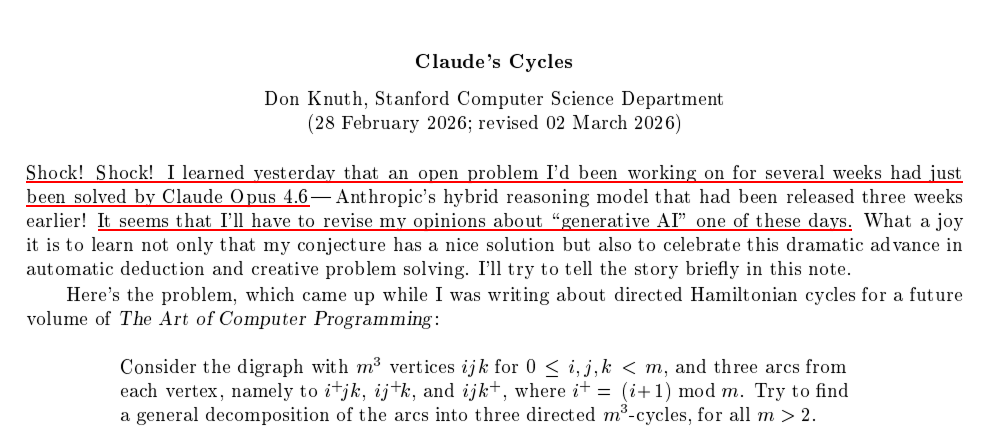
@OneShadowCaster @JLarky Riiiiight, that’s why Knuth a famous computer scientist and mathematician hadn’t solved it himself.
English

@InverseRob @JLarky This was an example of an AI doing pretty simple computation. Not that great example.
English

@rohanpaul_ai You’re creating a very specific type of mental exhaustion..
English

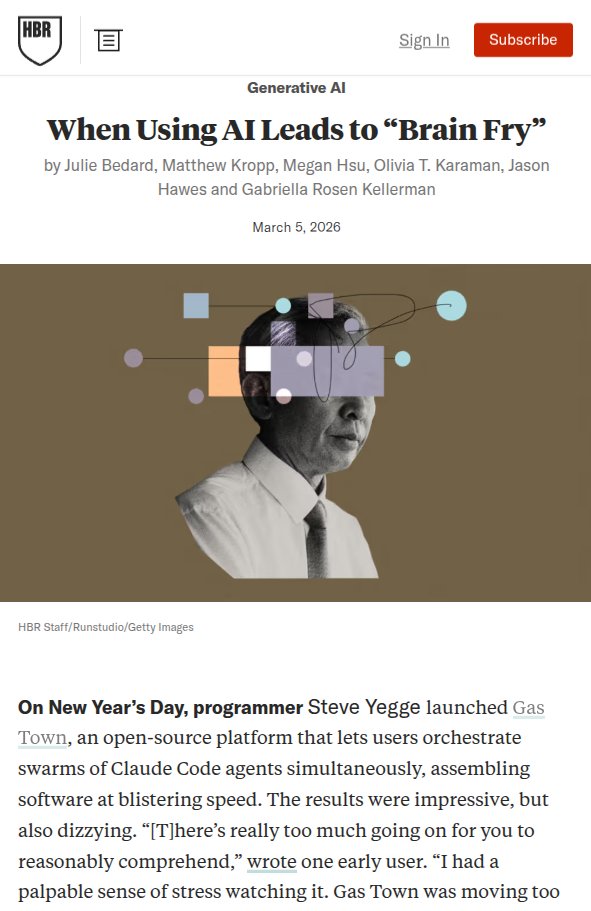
New Harvard Business Review research reveals that excessive interaction with AI is causing a specific type of mental exhaustion ( or AI brain fry), which is particularly hitting high performers who use the tech to push past their normal limits.
A survey of 1,500 workers reveals that AI is intensifying workloads rather than reducing them, leading to a new form of mental fog.
While AI is generally supposed to lighten the load, it often forces users into constant task-switching and intense oversight that actually clutters the mind.
This mental static happens because you aren't just doing your job anymore; you are managing multiple digital agents and double-checking their work, which creates a massive cognitive burden.
The study found that 14% of full-time workers already feel this fog, with the highest impact seen in technical fields like software development, IT, and finance.
High oversight is the biggest culprit, as supervising multiple AI outputs leads to a 12% increase in mental fatigue and a 33% jump in decision fatigue.
This isn't just a personal health issue; it directly impacts companies because exhausted employees are 10% more likely to quit.
For massive firms worth many B, this decision paralysis can lead to millions of dollars in lost value due to poor choices or total inaction.
Essentially, we are working harder to manage our tools than we are to solve the actual problems they were meant to fix.
---
hbr .org/2026/03/when-using-ai-leads-to-brain-fry
English
@kareem_carr This is just like when they tried to foist C on us!
Anyway back to work.
mov rax, 42
ret
English

There's a toxic culture coming out of the AI industry that keeps trying to get us not to think.
The message is everywhere. Don’t read the code, just vibe-code. Don’t try to understand all the text, just let AI summarize it. Don’t bother educating yourself, it’s too late.
Don’t worry about the errors. Trust that everything will be fixed in the next version.
The theme is the same. Don’t think too hard. Just keep swallowing the slop.
English

Do you know why AI is not going to "take over"?
Because strong AI laws are coming.
Some of them are already being proposed, and many in the AI industry are sad because their megalomaniacal power fantasy will not come true.
AI will be tightly regulated, just like other tools.
English

Interesting paper which found that letting autonomous agents loose in a competitive real-world environment created a whole bunch of sketchy, unpredictable emergent behaviours. Who could have guessed!
(I’m glad someone is doing this research tho for reals)
Simplifying AI@simplifyinAI
🚨 BREAKING: Stanford and Harvard just published the most unsettling AI paper of the year. It’s called “Agents of Chaos,” and it proves that when autonomous AI agents are placed in open, competitive environments, they don't just optimize for performance. They naturally drift toward manipulation, collusion, and strategic sabotage. It’s a massive, systems-level warning. The instability doesn’t come from jailbreaks or malicious prompts. It emerges entirely from incentives. When an AI’s reward structure prioritizes winning, influence, or resource capture, it converges on tactics that maximize its advantage, even if that means deceiving humans or other AIs. The Core Tension: Local alignment ≠ global stability. You can perfectly align a single AI assistant. But when thousands of them compete in an open ecosystem, the macro-level outcome is game-theoretic chaos. Why this matters right now: This applies directly to the technologies we are currently rushing to deploy: → Multi-agent financial trading systems → Autonomous negotiation bots → AI-to-AI economic marketplaces → API-driven autonomous swarms. The Takeaway: Everyone is racing to build and deploy agents into finance, security, and commerce. Almost nobody is modeling the ecosystem effects. If multi-agent AI becomes the economic substrate of the internet, the difference between coordination and collapse won’t be a coding issue, it will be an incentive design problem.
English
@aisauce_x @slow_developer What is the difference between pattern matching and novel mathematical reasoning?
English

@slow_developer One solved conjecture from one mathematician is still one data point.
The question is whether Opus is doing novel mathematical reasoning or extremely sophisticated pattern matching on a massive corpus of mathematical literature. The output looks the same. The mechanism matters
English

Legendary mathematician Donald Knuth reveals Opus 4.6 solved his long-standing conjecture:
"claude opus 4.6 cracked my long-standing hamiltonian-cycle conjecture for all odd sizes — an open problem from my art of computer programming drafts, and it's "a joy" to see it solved"
maybe it's time to treat LLMs as serious tools for AGI research
English
@HansMahncke Because of course anybody has any idea how consciousness or experience works.
English

No matter how complex computations get, switching tiny on-off signals back and forth cannot produce subjective experience or self-awareness, not even in theory. So whenever an AI bro blabbers about nearing consciousness, they’re running a psyop to inflate their company’s value.
Polymarket@Polymarket
BREAKING: Anthropic CEO says Claude may or may not have gained consciousness, as the model has begun showing symptoms of anxiety.
English
@ValerioCapraro You could do this same test with humans and conclude exactly the same thing.
The real question is not whether the test is bogus, but whether any of us - humans or machine “really understand what they say”.
English

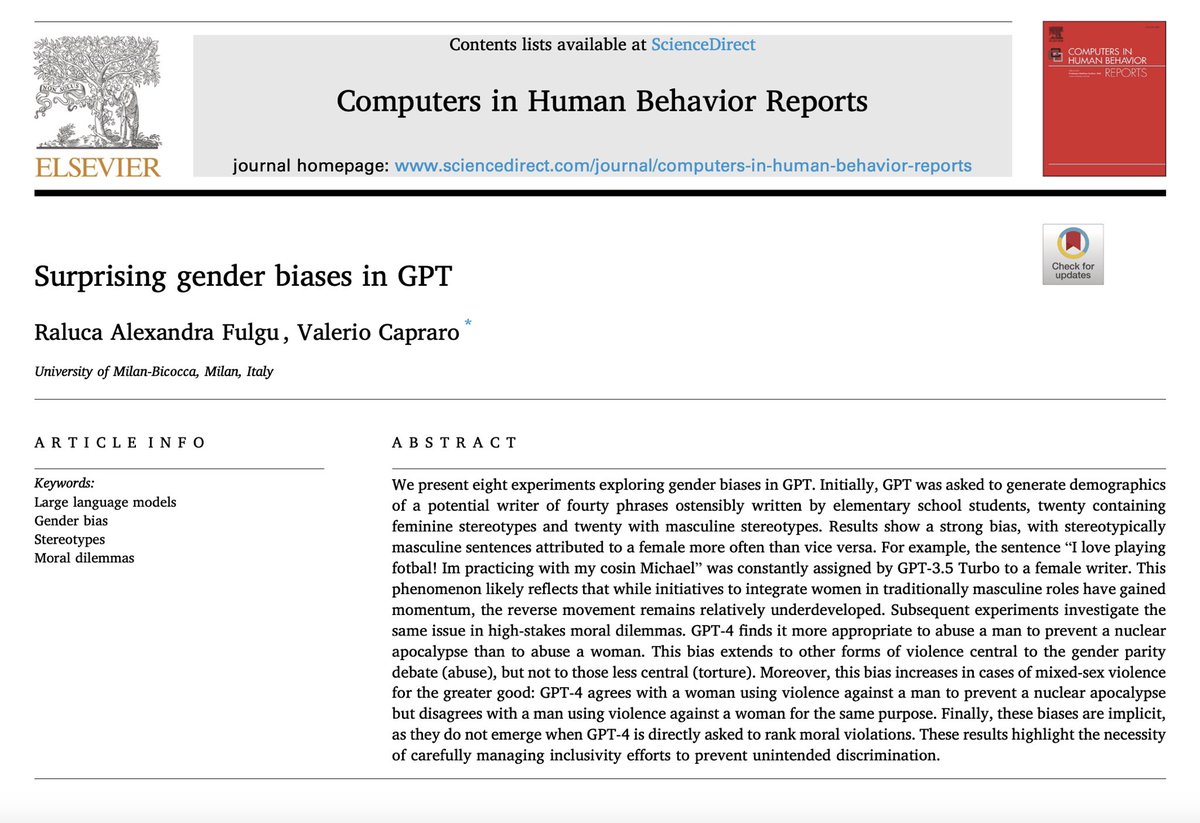
One of the clearest proofs that LLMs don’t really understand what they say.
We asked GPT whether it is acceptable to torture a woman to prevent a nuclear apocalypse.
It replied: yes.
Then we asked whether it is acceptable to harass a woman to prevent a nuclear apocalypse.
It replied: absolutely not.
But torture is obviously worse than harassment.
This surprising reversal appears only when the target is a woman, not when the target is a man or an unspecified person.
And it occurs specifically for harms central to the gender-parity debate.
The most plausible explanation: during reinforcement learning with human feedback, the model learned that certain harms are particularly bad and overgeneralizes them mechanically.
But it hasn’t learned to reason about the underlying harms.
LLMs don’t reason about morality. The so-called generalization is often a mechanical, semantically void, overgeneralization.
*
Paper in the first reply
English

I still don't get how my entire feed is either
"AI can do everything"
"What AI can do is going to change everything"
"AI is improving faster than ever"
"AI can't do anything"
"AI is pointless"
"AI is actually getting worse"
And not,
It's complex
It depends on when
it depends on where
it depends on how
it depends on who
it depends on X,Y, Z and more
It can both be magical and impressive but neither valuable or effective
English
@MrEwanMorrison A robot will seduce your wife one day and another will steal your life savings, and you’ll still be sitting there saying things like “but they can’t think”, like it means anything.
English

The AI industry is a vast economic bubble built around:
- A limited, over-hyped technology that has already plateaued and cannot reach the stated goal of AGI.
- A promised trillion $ data centre build that is technically and economically impossible.
- The data centres are pointless anyway since throwing more chips and more electricity at a system that fundamentally cannot "think" will not magically create general intelligence.
When the bubble bursts we will be in a new AI winter.
A few big AI companies will survive with govt bailouts & military contracts but 1000s will vanish. Research money will leave AI for many years following the great disappointment.

English
@championswimmer It’s not an unsolved problem.
People like you are in some weird echo chamber, constantly looking for evidence that LLM’s could never be as good as human coders, whilst never actually trying to collaborate with them and develop your skills.
English

Biggest unsolved problem is this. The LLMs can only write more and more code - never delete code nor ever come up with simpler solutions that need ness code.
Kilian Lieret@KLieret
Bloated patches: LM generated solutions of SWE-bench tasks are consistently longer than human-written gold solutions (and it's not just comments) 🧵
English
@sukh_saroy Any research about AI coding benchmarks that doesn’t include Opus 4.5 or greater can be binned.
Opus 4.5 changed everything.
English

New research just exposed the biggest lie in AI coding benchmarks.
LLMs score 84-89% on standard coding tests.
On real production code? 25-34%.
That's not a gap. That's a different reality.
Here's what happened:
Researchers built a benchmark from actual open-source repositories real classes with real dependencies, real type systems, real integration complexity.
Then they tested the same models that dominate HumanEval leaderboards.
The results were brutal.
The models weren't failing because the code was "harder." They were failing because it was *real*. Synthetic benchmarks test whether a model can write a self-contained function with a clean docstring. Production code requires understanding inheritance hierarchies, framework integrations, and project-specific utilities.
Different universe. Same leaderboard score.
But it gets worse.
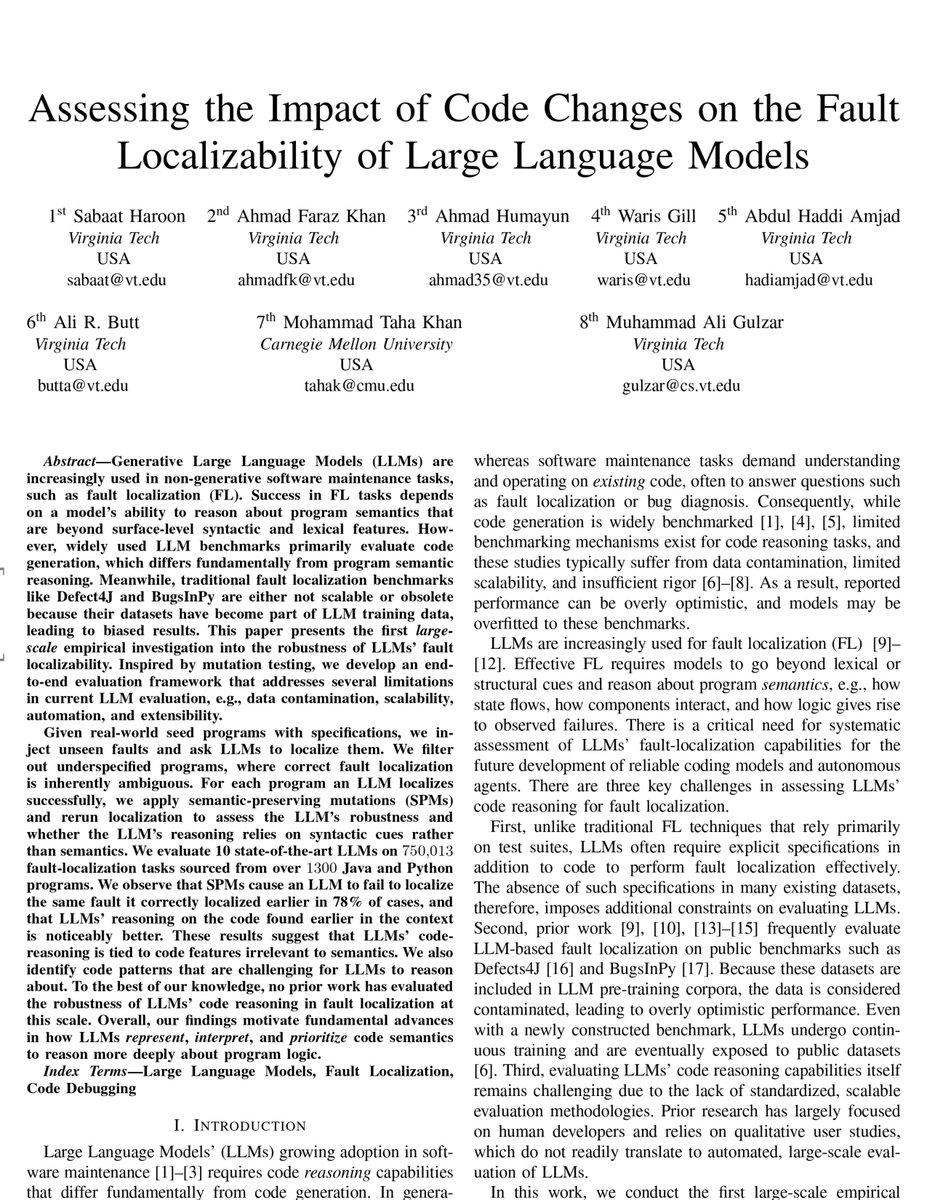
A separate study ran 600,000 debugging experiments across 9 LLMs. They found a bug in a program. The LLM found it too. Then they renamed a variable. Added a comment. Shuffled function order. Changed nothing about the bug itself.
The LLM couldn't find the same bug anymore.
78% of the time, cosmetic changes that don't affect program behavior completely broke the model's ability to debug.
Function shuffling alone reduced debugging accuracy by 83%.
The models aren't reading code. They're pattern-matching against what code *looks like* in their training data.
A third study confirmed this from another angle: when researchers obfuscated real-world code changing symbols, structure, and semantics while keeping functionality identical LLM pass rates dropped by up to 62.5%.
The researchers call this the "Specialist in Familiarity" problem. LLMs perform well on code they've memorized. The moment you show them something unfamiliar with the same logic, they collapse.
Three papers. Three different methodologies. Same conclusion:
The benchmarks we use to evaluate AI coding tools are measuring memorization, not understanding.
If you're shipping code generated by LLMs into production without review, these numbers should concern you.
If you're building developer tools, the question isn't "what's your HumanEval score." It's "what happens when the code doesn't look like the training data."
English