

Math Files
17.6K posts
Math Files
@Math_files
Life is nonlinear. So handle it using Math.
Присоединился Haziran 2020
14 Подписки175.3K Подписчики

If They Had Passed It …
If the Indiana State Legislature had passed Bill 246, and if the worst-case scenario had proved legally valid—namely, that the value of Pi in law differed from its mathematical value—the consequences would have been distinctly interesting.
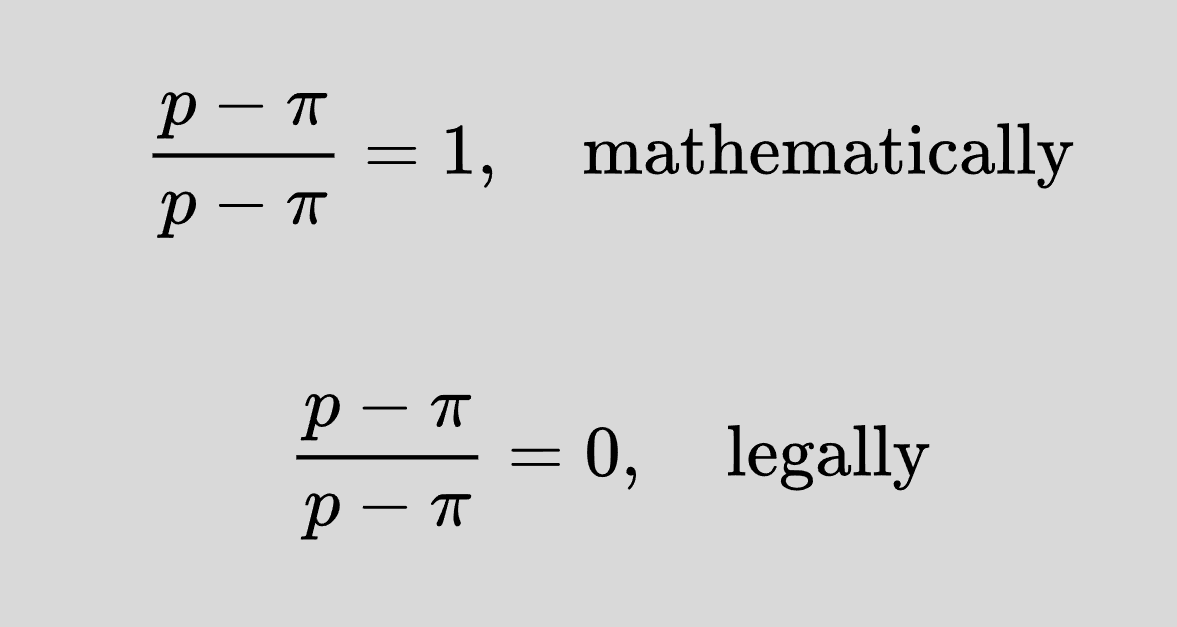
Suppose the legal value is (p ≠ π), but the legislation states that (p = π). Then
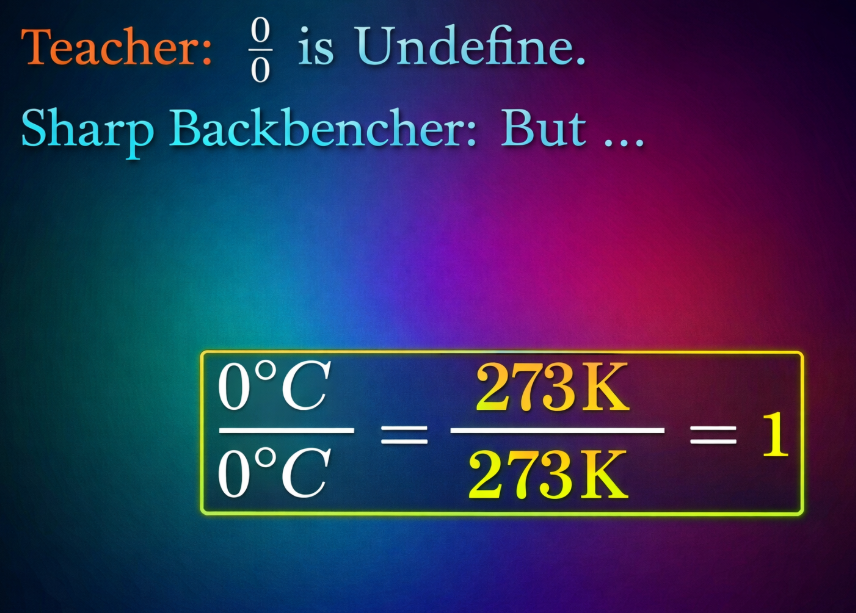
(p − π) / (p − π) = 1 (mathematically)
but
(p − π) / (p − π) = 0 (legally).
Since mathematical truths are legally valid, the law would then be asserting that (1 = 0).
Therefore, all murderers would have a cast-iron defense: admit to one murder, then argue that legally it amounts to zero murders. And that’s not the end of it. Multiply by one billion to deduce that one billion equals zero. Now any citizen apprehended in possession of no drugs could be said to possess drugs with a street value of $1 billion.
In fact, any statement whatsoever would become legally provable.
It seems likely that the law would not be quite illogical enough for this kind of argument to stand up in court. However, even sillier legal arguments—often based on the misuse of statistics—have succeeded, leading to innocent people being imprisoned for long periods.
So Indiana’s legislators might well have opened Pandora’s box.
Source: Professor Stewart’s Cabinet of Mathematical Curiosities
English


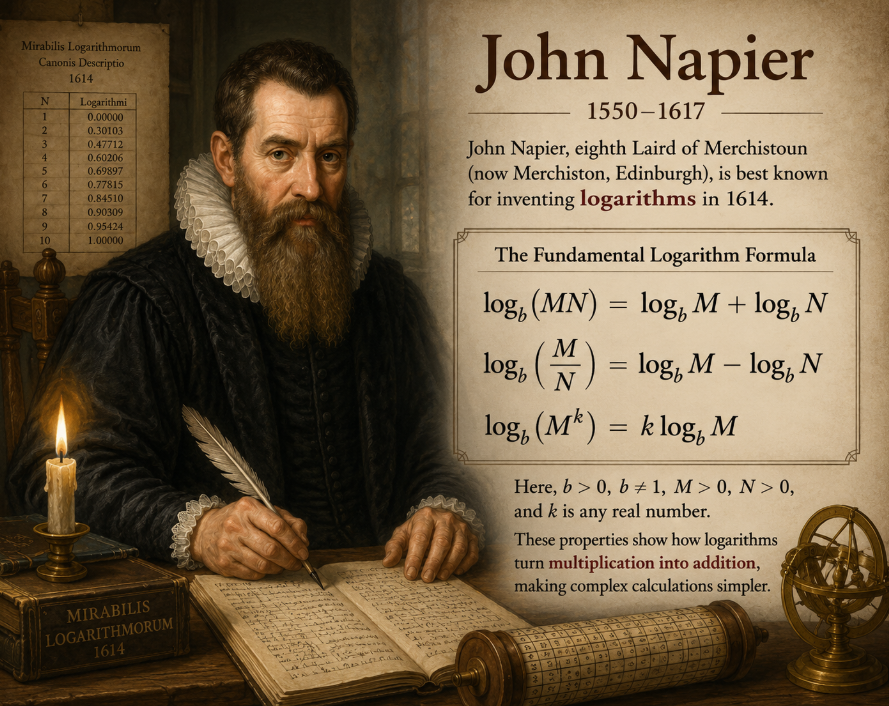
John Napier, eighth Laird of Merchistoun (now Merchiston, part of Edinburgh), is famous for inventing logarithms in 1614. But there was a darker side to his nature: he dabbled in alchemy and necromancy. He was widely believed to be a magician, and his “familiar,” or magical companion, was a black cockerel.
He used it to catch servants who were stealing. He would lock a suspect in a room with the cockerel and tell them to stroke it, claiming that his magical bird would unerringly detect the guilty. It all sounded very mystical—but Napier knew exactly what he was doing. He had coated the cockerel with a thin layer of soot.
An innocent servant would stroke the bird as instructed and get soot on their hands. A guilty one, fearing detection, would avoid touching it.
Clean hands proved you were guilty.
English
Abraham Lincoln once asked, “How many legs would a dog have if you called its tail a leg?”
English
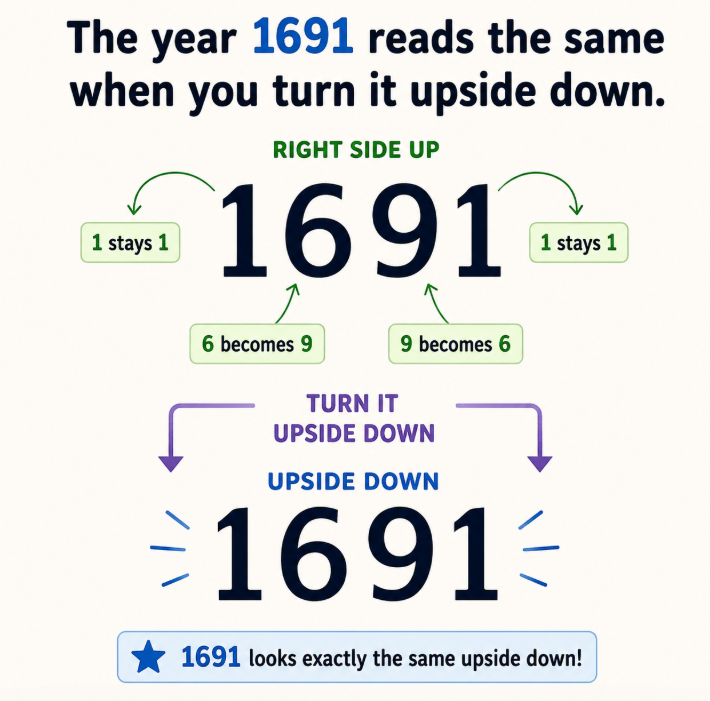
Which year in the past is the most recent one that reads the same when you turn it upside down?
Which year in the future is the next one that reads the same when you turn it upside down?
English
(8 × 8) + 13 = 77
(8 × 88) + 13 = 717
(8 × 888) + 13 = 7117
(8 × 8888) + 13 = 71117
(8 × 88888) + 13 = 711117
(8 × 888888) + 13 = 7111117
(8 × 8888888) + 13 = 71111117
(8 × 88888888) + 13 = 711111117
The mathematician who predicted his own death—Abraham de Moivre.
Mathematician Abraham de Moivre was trying to uncover the mysteries of numbers when one day he noticed something strange about himself: he was sleeping exactly 15 minutes longer every day. According to his calculations, on November 27, 1754, he would never wake up.
Do you know what’s incredible? He really did die on that exact day.
Was this just a coincidence, or did he truly calculate his fate using mathematics? What do you think?

English
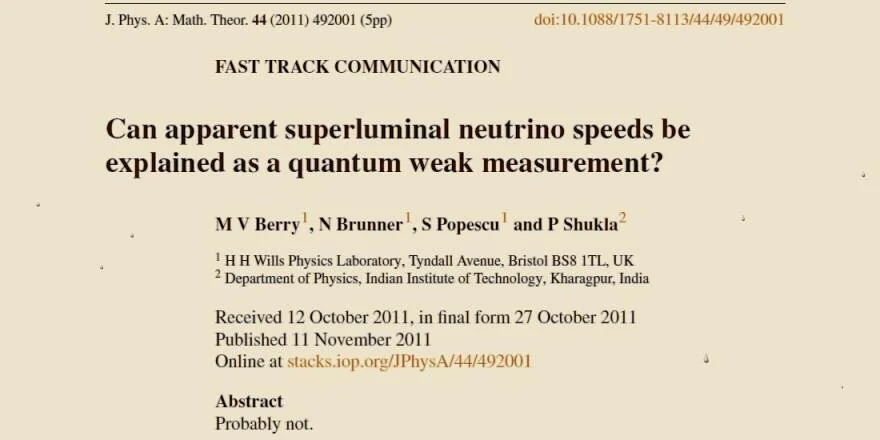
This physics paper has one of the best abstracts I’ve ever read. The title is: “Can apparent superluminal neutrino speeds be explained as a quantum weak measurement?”
The abstract is simply: “Probably not.”
English
No matter how large a number you can think of, it is still closer to zero than it is to infinity.
English

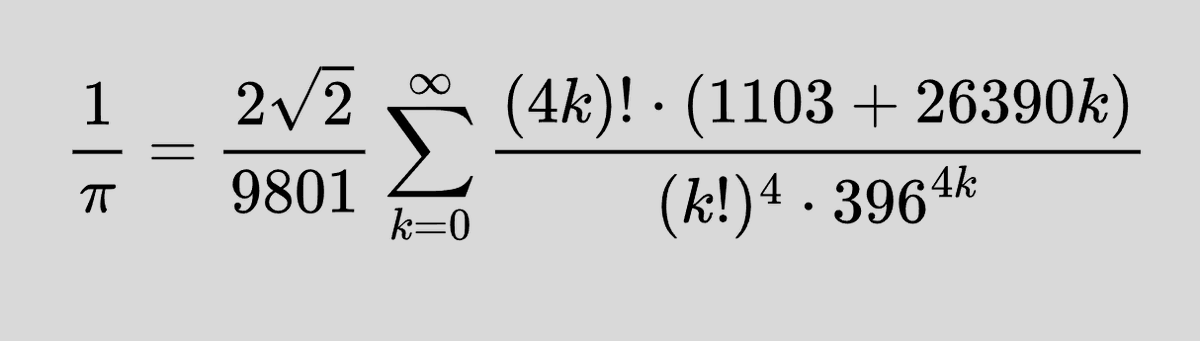
Stop blindly memorizing 3.1415926 again and again. You only need to remember this formula to compute countless digits of π. It was written in 1914 by the self-taught mathematical genius Srinivasa Ramanujan, who relied heavily on intuition.
Let’s start with the first remarkable aspect of his formula.
Earlier formulas for calculating π, such as the Leibniz formula, do approach π more and more closely, but very slowly. For example, to get just a few accurate decimal places, you might need an enormous number of terms.
However, Ramanujan’s formula is astonishingly efficient. If you simply set (k = 0), you already get π ≈ 3.14159273.
If you go up to (k = 4), you can achieve accuracy up to 39 decimal places.
To put that in perspective, 39 digits of π are enough to calculate the circumference of the observable universe with an error smaller than the size of a hydrogen atom. Ramanujan’s formula completely surpasses earlier methods.
Now comes the second fascinating part: where did all those strange constants in the formula come from?
Ramanujan himself said that a goddess revealed them to him in a dream. Much later, mathematicians discovered that the formula is deeply connected to advanced concepts such as elliptic integrals, hypergeometric series, and modular equations. In simpler terms, the formula emerges from areas of mathematics that were far beyond what most people at the time had even imagined.
And then comes the third astonishing connection.
In 1974, Stephen Hawking introduced ideas related to black hole thermodynamics. While he could calculate certain values, the microscopic origins behind them were not fully understood. It’s like measuring the temperature of water without knowing what water molecules look like.
Around 2012, when scientists studied the core mathematical functions behind black hole quantum states, they found something surprising: the same types of mathematical structures—modular forms and theta functions—also appear in Ramanujan’s π formulas.
Even more incredible, modern computers that keep breaking records for calculating trillions of digits of π still rely on algorithms based on Ramanujan’s work. His discoveries from over a century ago remain at the cutting edge today.
Ramanujan wrote more than 3,000 such formulas—many without formal proofs at the time, and some still not fully understood.
It makes you wonder: if he had lived longer, how different might mathematics—and the world—be today?
English
The P versus NP problem is one of the seven Millennium Prize Problems established by the Clay Mathematics Institute. It is among the most difficult and important unsolved problems in mathematics, and solving it comes with a prize of $1 million.
The P versus NP problem is a famous unsolved question in computer science that asks whether every problem whose solution can be quickly checked by a computer can also be quickly solved by a computer.
In simpler terms, imagine a puzzle where, if someone hands you a completed answer, you can easily verify that it is correct. The question is whether you could also easily come up with that answer on your own, rather than just checking it.
In computer science, problems are often classified into categories based on how quickly a solution can be found. Problems in the class P are those that a computer can solve quickly using a straightforward, step-by-step process. Meanwhile, problems in the class NP are those where, if you are given a potential solution, you can verify its correctness quickly, even if finding that solution from scratch might take a very long time.
The P versus NP problem essentially challenges us to determine whether these two classes of problems are actually the same, or whether some problems can be verified quickly without being quickly solved.

English