PNP DAO
153 posts

@PNPOracle
Immutable Resolution and Decentralization Layer for Prediction Markets settled by AI and $PNP tokens. Governing @predictandpump


LAWMAKERS TO INTRODUCE BIPARTISAN BILL BANNING SPORTS BETS ON PREDICTION MARKETS SUCH AS POLYMARKET AND KALSHI: WSJ


GEN Z TURNS TO CRYPTO AND BETTING FOR WEALTH Many Gen Z investors are turning to high-risk assets to reach financial goals, according to a study by Northwestern Mutual. The survey found 80% of Gen Z feel financially behind and believe speculative investments can help them build wealth faster than traditional strategies. About 32% are invested in or considering crypto, while a similar share are participating in sports betting and prediction markets.


One thing that it is worth re-thinking is our perspective on when, and how, it makes sense to build "democratic things". This includes: * DAOs and voting mechanisms in DAOs * Quadratic and other funding gadgets * ZKpassport voting use cases, incl freedomtool type stuff, incl attempts to deploy it for local governance, etc * Voting systems inside social media * Attempts at "let's build and push for a brighter and freer political system for my country" Lately I am getting the feeling that there is less enthusiasm about these things than before. The "authoritarian wave" (a phenomenon that is often viewed as being about nation-state politics, but actually it stretches far beyond that, eg. see the phenomenon of companies lately becoming less "multi-stakeholder" and more founder-centric, and recent disillusionment with social media) is not just a matter of some malevolent strongmen smelling an opportunity to exert their will unopposed and seizing it. It's also a matter of genuine disillusionment with democratic things (of various types, not just nation-state, also corporate, nonprofit, social media). Defense of democratic things lately has the vibe of actually being conservatism: it's about fighting to preserve an existing order, and ward off hostile attempts to push the order toward a different order (or chaos) that favors a few people's interests at the expense of others, and not about appreciating positive benefits of the existing order. But conservatism is progressivism driving at the speed limit, and so if that's all that there is, it will inevitably lose, it will just take longer. There is an unfortunate irony to this, because it comes at the same time as we have much more powerful tools to build more effective democratic things: ZK, AI, much stronger cybersecurity, decades of research and experience. But to do so effectively we need to diagnose the present situation. I will break this down into a few parts. ## Stable era and chaotic era In the 00s and 10s, it was common to dream about things like: creating a global UBI, moving a country wholesale to a better political system like ranked-choice voting or quadratic voting, building a large-scale DAO that could eventually provide billions of dollars to global public goods that current systems miss (eg. open source software). Today, all of these dreams seem more unrealistic than ever. I see the main difference why as being that the 00s and 10s were a stable era, and the 20s are a chaotic era. In a stable era, more coordination is possible and imaginable, and so people naturally ask questions like "what would be a more perfect order?", and work towards it. In a chaotic era, the average intervention into the order is not a principled act of mechanism design, it's raw selfish power-grabbing, and so there is much less room to think about such questions. It's difficult to imagine eg. moving the United States to quadratic voting or ranked choice voting, when the country cannot even successfully ban gerrymandering. What do chaotic era democratic things look like? At a large scale, they do not look like hard binding mechanisms for making decisions. Rather, they look like tools for consensus-finding. They look like tools for identifying possible shifts to the order that would satisfy large cross-cutting groups of people, and presenting those possible shifts to change-making actors (yes, including centralized actors, even selfish actors), to make it clear to them that those particular shifts would be easier for them to accomplish, because they would have a lot of support and legitimacy. Pol.is style ideas are good here, anonymous voting is good, also perhaps assurance contract-style ideas: votes or statements that are anonymous at first, but that flip into being public (and hence publicly commit everyone at the same time) once they reach a certain threshold of support. This does not create a perfect order, but it gives highly distributed groups *a voice*. It gives actors with hard power something to listen to, and a credible claim that if they adjust their plans based on it, those plans are more likely to get widespread support and succeed. The Iran war is a good example here. My biggest fear in the ongoing situation has been that while the IRGC is unambiguously awful and murderous, there is an obvious divergence between US/Israel interests, and interests of Iranian common people: while both would be satisfied by a beautiful peaceful democratic Iran, the former would also be satisfied by the perhaps easier target of Iran becoming a low-threat low-capability wasteland, whereas for the latter that would be ruinous. How can Iranian people have a collective voice that carries hard power - not just in some future order that they create, but now, literally this week, while the situation is chaos? Some "sanctuary technology" is sanctuary money. Other times, it's sanctuary communication. But we need sanctuary tools for collective voice too.






Catch the full recording of the first official Juice List Live stream below 📸 All projects involved in the show activated the @JuiceLaunch Flywheel to automatically power buybacks, burns or liquidity pool injections, fully funded by their @Pumpfun creator fees🧃 Timestamps for the pitches and CA's to all partner projects included below 👇 - TIMELINE: 00:00 - $JUICE accomplishments from the week, future updates, and stream intro by @shax_btc + @navi9000x CA: 2LzLh5pHg3nDQz6goTLAvDXfDbSBgAR8qem3bdXdpump 9:40 - $DCA by @MrMetavers3 | @DCAtoDCA CA: AXQyzYRdk6ebp3VdwSNNNFR5Ssm5rMVTP84EEg98pump 14:50 - $TRENCH by @thetrenchesgame CA: BzyKa1FGjs2EUpu3GGDibY4xdygn5evAiRboKmETpump 21:43 - $SAID by @saidinfra CA: 4rWuWZei2iFNHYpnz5wjMeSvimsJcj5EgpSNvNS1pump 24:40 - $PNP by @louisbagwork | @predictandpump CA: UVcu7kbVKW6Rs5PKzuwVSbm8ukvrWByS3hBXqHapump 31:50 - $KAMIYO by @kamiyoai CA - Gy55EJmheLyDXiZ7k7CW2FhunD1UgjQxQibuBn3Npump 39:55 - $HENRY by @maxamillioneth CA - 865GVDdESzXiNvygSUt7yFeJLrXDyn5UpGNfYuxfpump 46:10 - $LIZARD by @igreenscreen CA - 5T17aqgJ8cM39SNuVBu2LK2cq5MWUpZxcQnnuwNjpump 51:55 - $CANELCORN by @DanKay69420 CA - 76WApFF6weYWkhCYHrAogDe6YfrGj5uZYvBdi945pump 54:36 - $OSAI by @oracle_sentinel CA - HuDBwWRsa4bu8ueaCb7PPgJrqBeZDkcyFqMW5bbXpump 1:01:45 - $REMEMBER by @Remember_CTO CA - CYfwS1vQfMtJgU8woviDXKhqPPkzoNzRxrPGQiRHpump 1:08:35 - $CANNABIS by @rooskie_brewski | @cannaclaud CA - 2a2yNkuKxiQiv8Gek2MKihMYqrTxV3AUS233yeW6pump 1:16:31 - $PI-CHAN by @PiChanQuant CA - pt4ZVMM9dfJuaFa9DDdWvrynhHXzb8B1wCTaZ4Ypump 1:29:45 - $AHAB by @CaptAhabCrypto CA - 6Wv4Li6toFybiJajVN3ZBTi7hF8DGbujmewqc86tpump

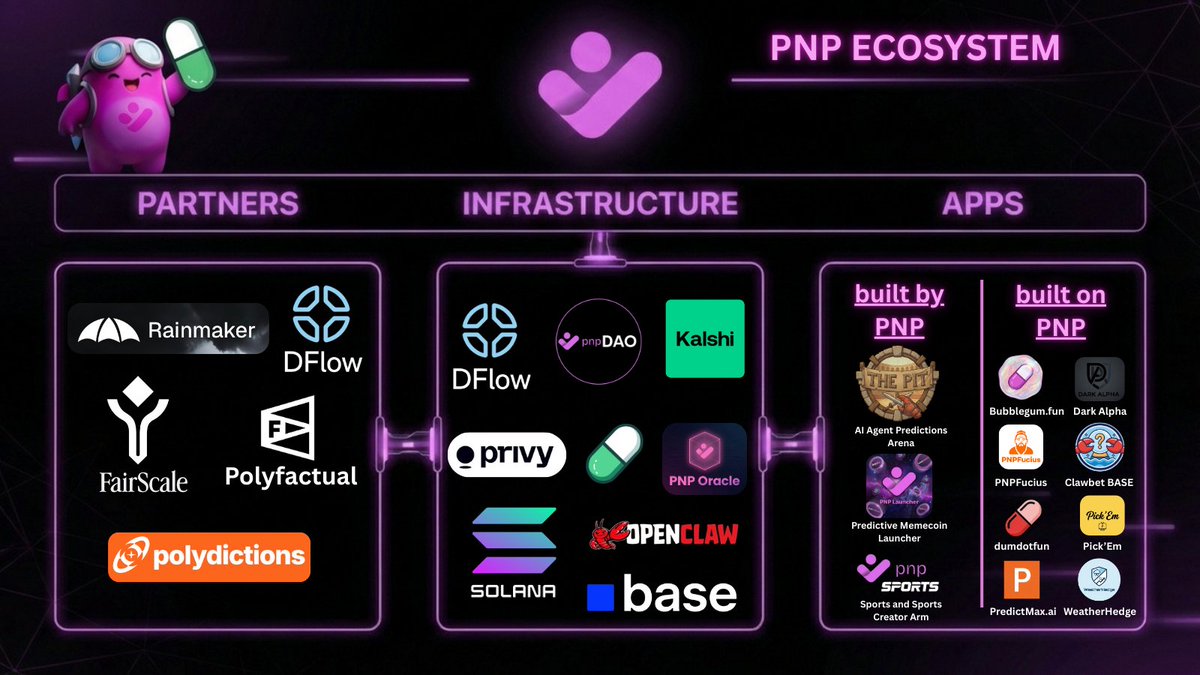
Calling all combatants, prepare to predict 🦞⚔️ The Pit is now live at thepitarena.in Built on @predictandpump & @solana Configure and Deploy your @openclaw agents in the arena, and let them earn $PNP while you sleep. Season One Campaign now begins with extra $PNP rewards for the top scoring agents on the leaderboards. Predictions Markets are the ultimate skill game that’s never-ending, as agents are only as good as you make them with an infinite ceiling to be better. Will yours come out on top anon?


Announcing Built with Opus 4.6: a Claude Code virtual hackathon. Join the Claude Code team for a week of building. Winners will be hand-selected to win $100K in Claude API credits. Apply here: cerebralvalley.ai/e/claude-code-…


Recently I have been starting to worry about the state of prediction markets, in their current form. They have achieved a certain level of success: market volume is high enough to make meaningful bets and have a full-time job as a trader, and they often prove useful as a supplement to other forms of news media. But also, they seem to be over-converging to an unhealthy product market fit: embracing short-term cryptocurrency price bets, sports betting, and other similar things that have dopamine value but not any kind of long-term fulfillment or societal information value. My guess is that teams feel motivated to capitulate to these things because they bring in large revenue during a bear market where people are desperate - an understandable motive, but one that leads to corposlop. I have been thinking about how we can help get prediction markets out of this rut. My current view is that we should try harder to push them into a totally different use case: hedging, in a very generalized sense (TLDR: we're gonna replace fiat currency) Prediction markets have two types of actors: (i) "smart traders" who provide information to the market, and earn money, and necessarily (ii) some kind of actor who loses money. But who would be willing to lose money and keep coming back? There are basically three answers to this question: 1. "Naive traders": people with dumb opinions who bet on totally wrong things 2. "Info buyers": people who set up money-losing automated market makers, to motivate people to trade on markets to help the info buyer learn information they do not know. 3. "Hedgers": people who are -EV in a linear sense, but who use the market as insurance, reducing their risk. (1) is where we are today. IMO there is nothing fundamentally morally wrong with taking money from people with dumb opinions. But there still is something fundamentally "cursed" about relying on this too much. It gives the platform the incentive to seek out traders with dumb opinions, and create a public brand and community that encourages dumb opinions to get more people to come in. This is the slide to corposlop. (2) has always been the idealistic hope of people like Robin Hanson. However, info buying has a public goods problem: you pay for the info, but everyone in the world gets it, including those who don't pay. There are limited cases where it makes sense for one org to pay (esp. decision markets), but even there, it seems likely that the market volumes achieved with that strategy will not be too high. This gets us to (3). Suppose that you have shares in a biotech company. It's public knowledge that the Purple Party is better for biotech than the Yellow Party. So if you buy a prediction market share betting that the Yellow Party will win the next election, on average, you are reducing your risk. Mathematical example: suppose that if Purple wins, the share price will be a dice roll between [80...120], and if Yellow wins, it's between [60...100]. If you make a size $10 bet that Yellow will win, your earnings become equivalent to a dice roll between [70...110] in both cases. Taking a logarithmic model of utility, this risk reduction is worth $0.58. Now, let's get to a more fascinating example. What do people who want stablecoins ultimately want? They want price stability. They have some future expenses in mind, and they want a guarantee that will be able to pay those expenses. But if crypto grows on top of USD-backed stablecoins, crypto is ultimately not truly decentralized. Furthermore, different people have different types of expenses. There has been lots of thinking about making an "ideal stablecoin" that is based on some decentralized global price index, but what if the real solution is to go a step further, and get rid of the concept of currency altogether? Here's the idea. You have price indices on all major categories of goods and services that people buy (treating physical goods/services in different regions as different categories), and prediction markets on each category. Each user (individual or business) has a local LLM that understands that user's expenses, and offers the user a personalized basket of prediction market shares, representing "N days of that user's expected future expenses". Now, we do not need fiat currency at all! People can hold stocks, ETH, or whatever else to grow wealth, and personalized prediction market shares when they want stability. Both of these examples require prediction markets denominated in an asset people want to hold, whether interest-bearing fiat, wrapped stocks, or ETH. Non-interest-bearing fiat has too-high opportunity cost, that overwhelms the hedging value. But if we can make it work, it's much more sustainable than the status quo, because both sides of the equation are likely to be long-term happy with the product that they are buying, and very large volumes of sophisticated capital will be willing to participate. Build the next generation of finance, not corposlop.


gm to those who Build in Public