

Pascal
16.2K posts
Pascal
@PascalmetaX
Writer // Crypto Maxi and Data Enthusiast
Присоединился Mart 2020
2.2K Подписки2.3K Подписчики

IRISH POLICE JUST CRACKED A BITCOIN WALLET EVERYONE THOUGHT WAS GONE FOREVER.
Within the crypto world, the long-standing mantra has always been: no keys, no access, and the funds are gone.
That was until the Criminal Assets Bureau in Ireland broke that rule in a very public way.
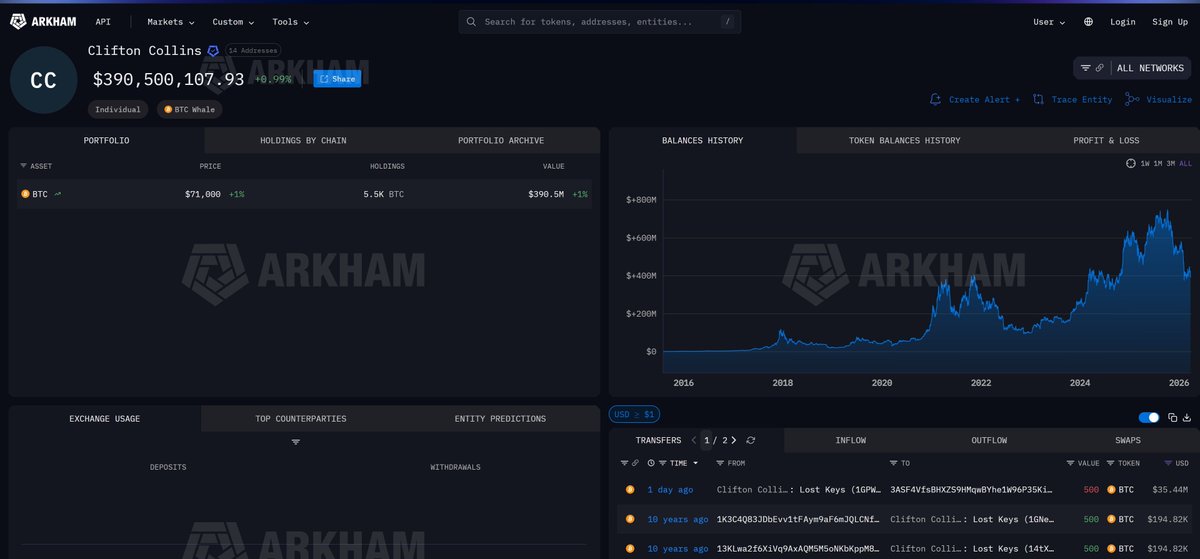
On Tuesday, at 12:51 UTC, a wallet titled "Clifton Collins: Lost Keys" on Arkham Intelligence sent 500 Bitcoin to Coinbase Prime. This was the first movement from the wallet in over a decade.
The Criminal Assets Bureau, in cooperation with the European Cybercrime Centre at Europol, verified the transfer, stating, "The technical support provided was 'highly complex decryption resources vital to the success of the operation.'" The 500 Bitcoin sent out is valued at approximately $35 million.
The story behind the case is the stuff of crypto legend. A former beekeeper and cannabis grower from Dublin, named Clifton Collins, purchased 6,000 Bitcoin in 2011 and 2012 with cannabis money, which was then valued at mere dollars per Bitcoin.
He stored his Bitcoin in 12 different wallets, with the keys printed on a sheet of A4 paper and stored in the aluminum cap of a fishing rod case in his rented property in Galway.
In 2017, Collins was arrested for cannabis possession in his car, and while he was serving his sentence, his rented property was cleared out by the landlord, with the fishing rod case ending up in a landfill site, along with the keys and the fortune.
In 2020, the High Court in Ireland confiscated the entire 6,000 Bitcoin, which was valued at approximately €53 million at the time, with the court ruling that the Bitcoin should be confiscated from Collins.
However, without the keys, the ruling could not be enforced, and the authorities were left with a fortune they could not spend, as the price of Bitcoin rose over the next five years.
Currently, Collins has 14 addresses under his control, with an estimated 5,500 Bitcoin remaining, valued over $391 million. One wallet down, eleven to go.
No word has come from Europol regarding the method used for decryption. Speculations point towards either a weak password for an encrypted backup file, which was compromised through brute force, or a flaw in the key generation tool used by Collins, which allowed law enforcement officials to derive the output on their own.
However, the message sent out is clear: for criminals, the days of having a laptop confiscated with an encrypted wallet are over.
The age of state-level blockchain forensics has dawned.
If the same method is used for unlocking the remaining 11 wallets, the Irish will have pulled off the largest digital asset seizure in the nation’s history, starting from an initial amount of $30,000 in drug money and escalating to a fortune valued over $391 million.

English
Pascal ретвитнул

Pascal ретвитнул
⚡️TETHER IS BUILDING AI THAT LIVES ON YOUR DEVICE. A BREAKTHROUGH IS COMING THIS WEEK.
Tether just put the industry on notice. On March 15, CEO Paolo Ardoino posted that the company's AI division will release a "true breakthrough" before the week ends.
For anyone still treating Tether as just a stablecoin issuer, that framing is now outdated.
Tether has spent more than a year building QVAC, a platform designed to run AI models entirely on consumer devices without cloud servers or API keys.
The goal is straightforward: AI that runs privately on your laptop, phone, or GPU, with no data leaving your device and no dependence on OpenAI, Google, or any centralized infrastructure.
The product has been moving fast. QVAC Workbench version 0.4.1 shipped on March 11 with a redesigned interface, expanded document format support for retrieval-augmented generation, and performance fixes for Android devices including Samsung and Pixel 10.
A live demonstration earlier this month showed QVAC running on a standard laptop GPU, using the Model Context Protocol to interact with third-party tools including Asana, handling automated workflows and task management entirely offline.
The technical foundation underneath all of this is serious.
Tether's QVAC Fabric LLM, released in December 2025, is the first production-ready framework capable of full LLM inference and LoRA fine-tuning across mobile GPUs including Qualcomm Adreno and ARM Mali.
That means model training on smartphone-class hardware, a capability that did not exist in any public framework before this. The entire stack is open-source under the Apache 2.0 license.
The commercial moves back it up. Tether invested in Eight Sleep at a $1.5 billion valuation in March 2026, integrating QVAC's on-device processing into the sleep technology company's AI health platform.
Its QVAC Genesis II dataset now covers 148 billion tokens across 19 academic domains, making it the largest publicly available synthetic educational resource built specifically for AI pre-training.
Tether has confirmed that QVAC's architecture will eventually integrate Bitcoin and USDT, enabling AI agents to transact autonomously using digital assets.
That is the end state: a network where AI agents reason, act, and pay, entirely outside corporate cloud infrastructure.
Tether controls over $186 billion in USDT supply. It is now spending those profits to challenge the AI establishment.
The breakthrough announcement this week will show how far along that challenge actually is.

CryptoMoney@cryptomoney_x
🚨 ICYMI: Tether, the issuer of the world’s largest stablecoin Tether (USDT) with a $184B market cap, is preparing to unveil a major AI development from its QVAC division this week.
English


@Phoenixx_xyz The next one you should do is how this guy just did charity of $50M to Aave… burst my head
English

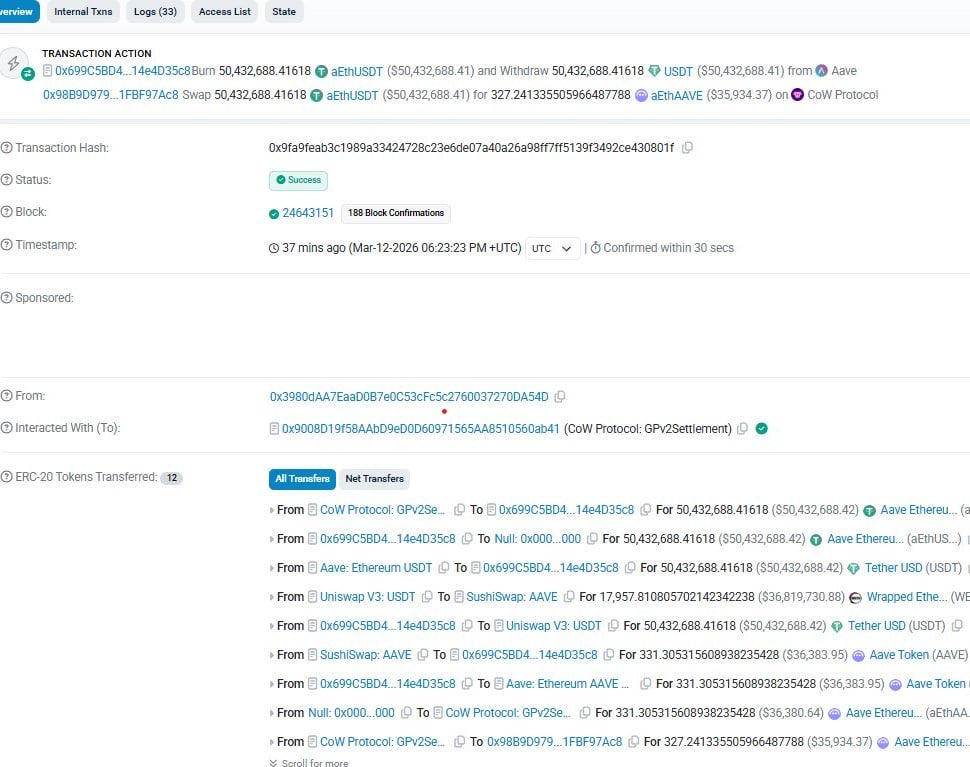

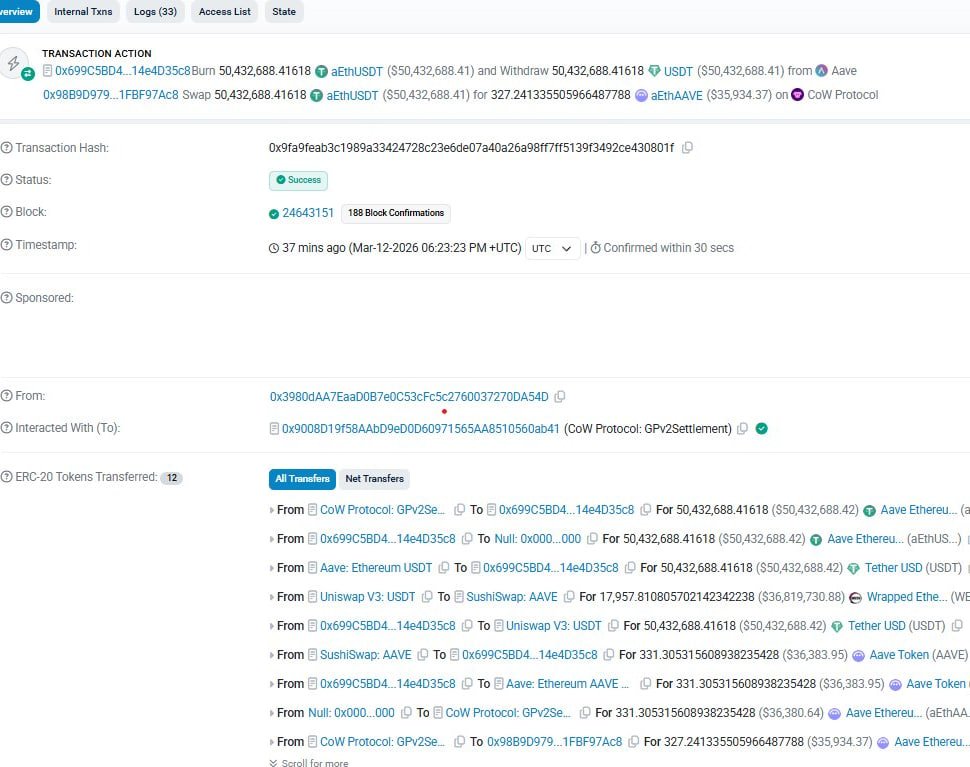
🚨 UPDATE: A $50M USDT trade through CoW Swap resulted in severe slippage as user received just 324 $AAVE.
$600K in fees to be refunded, says Aave founder Stani Kulechov.

English
@0xWenMoon Can this person come out actually. This can’t be happening
English

@StaniKulechov What could actually be done about this?
What will happen to all that money? Damn
English

Earlier today, a user attempted to buy AAVE using $50M USDT through the Aave interface.
Given the unusually large size of the single order, the Aave interface, like most trading interfaces, warned the user about extraordinary slippage and required confirmation via a checkbox. The user confirmed the warning on their mobile device and proceeded with the swap, accepting the high slippage, which ultimately resulted in receiving only 324 AAVE in return.
The transaction could not be moved forward without the user explicitly accepting the risk through the confirmation checkbox.
The CoW Swap routers functioned as intended, and the integration followed standard industry practices. However, while the user was able to proceed with the swap, the final outcome was clearly far from optimal.
Events like this do occur in DeFi, but the scale of this transaction was significantly larger than what is typically seen in the space.
We sympathize with the user and will try to make a contact with the user and we will return $600K in fees collected from the transaction.
The key takeaway is that while DeFi should remain open and permissionless, allowing users to perform transactions freely, there are additional guardrails the industry can build to better protect users. Our team will be investigating ways to improve these safeguards going forward.
English
Pascal ретвитнул
A whale accidentally sent 126,000 TON ($220,000 USDT) to a scammer.
Normally, that money would have been gone forever. But a few hours later, the scammer sent 116,000 TON ($203,000 USDT) back to the whale.
He kept 10,000 TON ($17,000 USDT) and labelled it as “compensation.”
He even left a note on the public chain that said: “Sorry, this is too much. Take it back. I know it’s hard-earned.”
How did the whale lose the money in the first place?
The whale was preparing to send a large amount of TON, as usual, to another wallet.
But the scammer had already set a trap using something called “wallet poisoning.”
Scammers watch the blockchain and track active wallets that frequently send money to the same addresses. These could be exchanges, friends, or other wallets owned by the user.
Then they create fake wallet addresses that look almost identical to real ones.
The first few and the last few characters match.
At a quick glance, the address looks identical.
Next, the scammer sends a tiny transaction to the target wallet, sometimes just a few cents. This small transaction appears in the wallet’s history.
Now the fake address sits in the victim’s recent transactions.
Later, when the victim wants to send any amount, they may copy an address from their transaction history instead of carefully checking it.
That is exactly what happened here.
The whale copied the wrong address and accidentally sent 126,000 TON to the scammer.
Luckily for him, instead of disappearing with the entire amount, the scammer returned most of it.
Some people online are calling him an honest thief.
Others believe he returned the funds because large transactions on public blockchains can sometimes be traced.
Either way, cases like this are extremely rare.
Always double check the full wallet address before clicking send.
Because once a transaction is confirmed on the blockchain, there is usually no way to reverse it.
Stay SAFU with your funds.
AN HONEST SCAMMER OR A LUCKY WHALE?


English
Pascal ретвитнул
🚨 U.S. LOST JOBS IN FEBRUARY. MARKETS ARE REACTING FAST.
The Soft Landing Narrative Is Breaking.
The February jobs report was far beyond a disappointment. It led to a lot of disruption
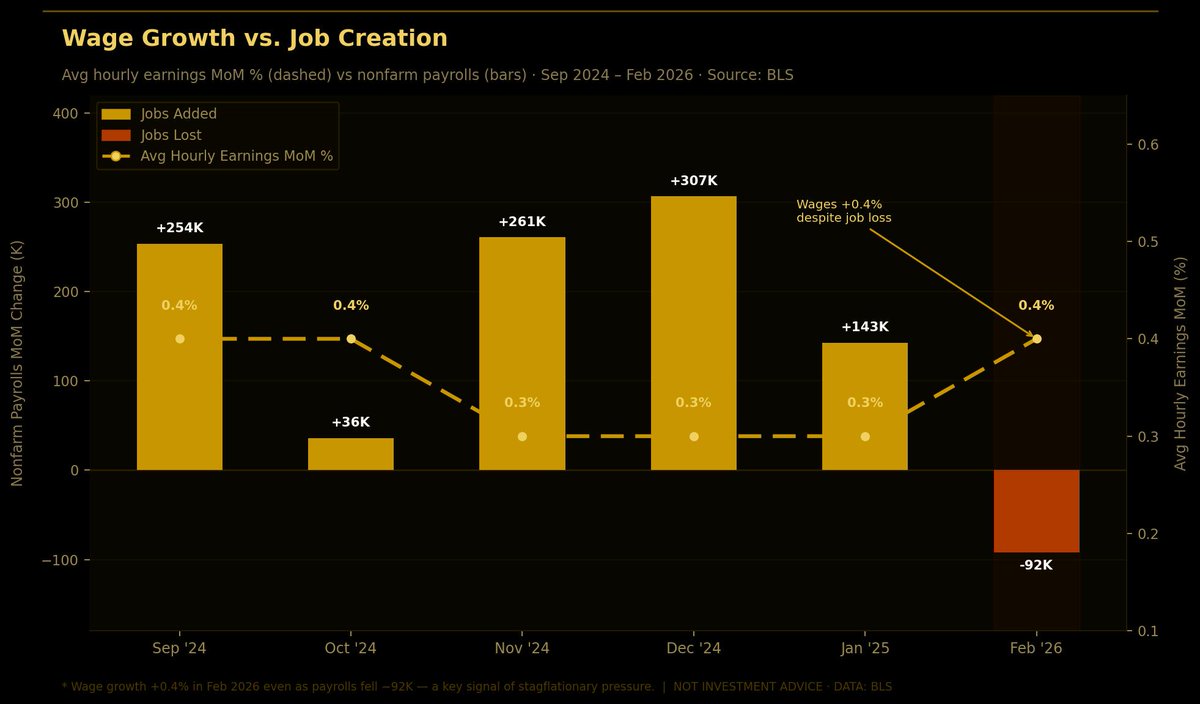
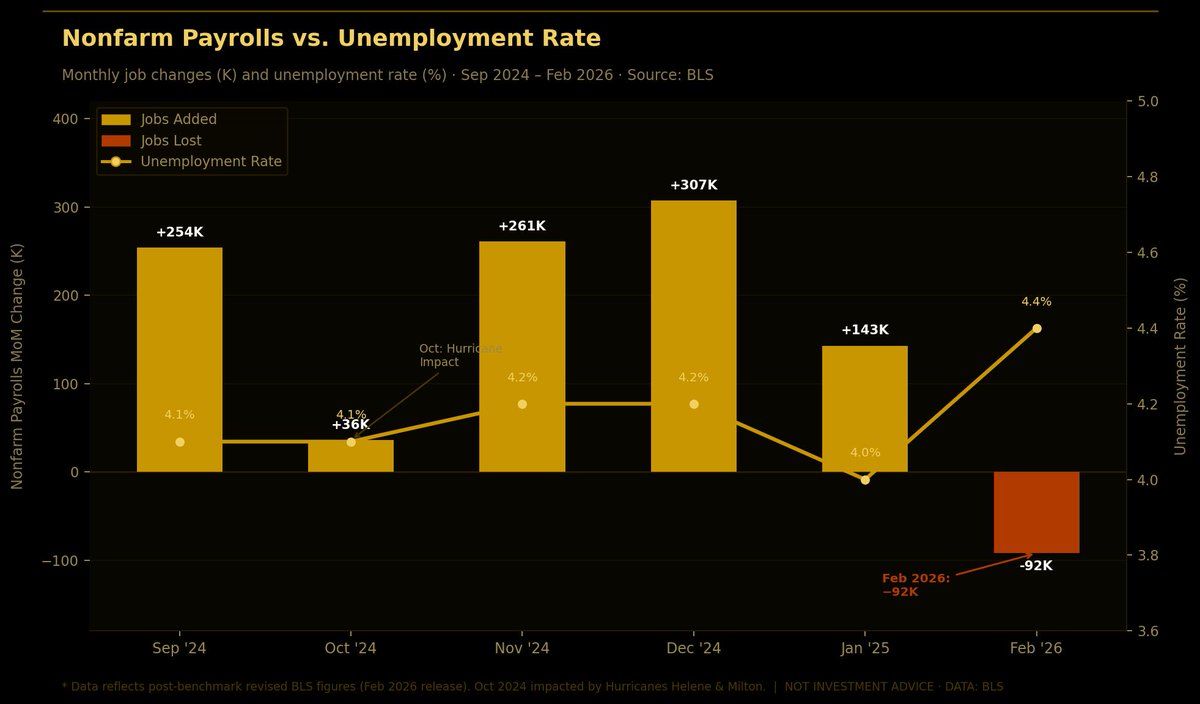
The United States economy lost 92,000 jobs in February.
This is not a slowing labor market; this is a contraction.
The unemployment rate has risen to 4.4%, surpassing the predicted rate of 4.3%, and the overall picture painted by these numbers is one that policymakers have spent the better part of two years trying to avoid.
What makes this jobs report particularly ominous is not the loss of jobs, but what has accompanied it.
Average Hourly Earnings increased by 0.4% month-over-month, even as jobs declined.
Jobs are being lost, but wages are still growing. This is not a trend; this is a contradiction, and it is this contradiction that the Federal Reserve has feared the most throughout this entire rate-tightening process.
A normal jobs market would see job losses decrease consumer spending, which would decrease inflation.
This right here is not a normal jobs market.
The markets, of course, responded with no hesitation whatsoever.
The Dow Jones declined by 1.20%, the S&P 500 declined by 1.19%, the Nasdaq declined by 1.57%, and the Russell 2000 declined by 2.03%, with small-cap risk being the most affected by domestic economic activity.
It is also important to note that the information contained in this report does not exist in a vacuum. Retail sales declined by 0.2% in January, with core retail spending also registering no growth whatsoever.
Consumer demand has been declining, and this decline has been evident even before the latest job numbers were announced.
Businesses are slowing down on hiring, and consumers are slowing down on spending, but costs and wages remain high, sustaining inflation simultaneously.
The Federal Reserve is currently facing a situation wherein there is no exit, and if rates are cut, inflation will resurface at a time when wage growth has still not declined, and if rates are kept as they are, unemployment will accelerate, and the already volatile labor market will deteriorate further.
The geopolitical component adds another layer of stress. Oil is now trading at $87 a barrel, and the conflict in the Middle East is continuing to ratchet up in terms of escalation.
Energy costs are not contained; they are transmitted through the system in terms of transportation costs, food, and manufacturing.
That is inflation by default.
The narrative has been, for several months, that the Fed has pulled off the miracle, inflation is coming down, growth is still going on, and the soft landing has been achieved.
Today's data does not support that in the least. What is actually happening is a combination of slowing growth, ongoing inflation, and increasing geopolitical risks. That is not a soft landing; that is the exact opposite.
That is the beginning of a stagflationary scenario. If that narrative continues to build in the coming days and weeks, the volatility in the markets, in terms of stocks, bonds, and crypto, is not going to remain where it is.
English
Pascal ретвитнул
THE CRYPTO CLARITY ACT DRAMA: TRUMP VS THE BANKS
Crypto’s future in America may depend on what happens next in Congress.
President Trump is urging the Congress to pass the Crypto Clarity Act, a bill designed to define how digital assets are regulated. But banks are resisting changes that could shift control away from them.
And right now, it has turned into a battle between the White House, the crypto industry, and major banks.
This started in July 2025 when Trump signed the GENIUS Act into law. That bill created the first federal rules for stablecoins, which are dollar-pegged cryptocurrencies.
The law required stablecoin issuers to back their tokens with safe assets like U.S. Treasuries. It allowed both banks and non-banks to issue stablecoins under certain conditions.
It was seen as a major win for the crypto industry. But that was only part one.
Then the Clarity Act came into focus.
The House passed the Clarity Act with bipartisan support. The goal was to clearly define whether crypto assets are commodities or securities and give the CFTC stronger authority over crypto spot markets and exchanges.
In simple terms, it was meant to reduce the regulatory confusion and constant lawsuits and create a clear market structure.
But progress stalled in the Senate.
Banks began lobbying to change parts of the GENIUS Act, especially around stablecoins paying yield to users. They did not want stablecoins competing with bank deposits by offering interest-like rewards.
Crypto companies pushed back hard and argued that yield is essential for adoption and innovation. Negotiations broke down and the Senate delayed progress on the Clarity Act.
Then Trump responded publicly.
Trump accused banks of undermining the GENIUS Act and holding the Clarity Act hostage.
He said banks should not try to undercut the Genius Act and that they need to make a good deal with the crypto industry because it is in the best interest of the American people.
He has called on Congress to pass the Bitcoin and crypto market structure bill as soon as possible.
He also emphasized that if the U.S. does not finalize firm rules, it risks losing crypto innovation to China and other countries.
Support for the bill has been growing.
CFTC Chair Mike Selig has said crypto market structure legislation must pass and stressed the need for a future-proof digital asset framework.
Billionaire Kevin O’Leary has said the Clarity Act will pass and could push Bitcoin toward $200,000, arguing that the U.S. needs to finalize market structure quickly.
There is growing political and financial pressure to resolve it.
If the Clarity Act passes, crypto would finally have a structured system. That could reduce regulatory uncertainty, encourage institutional investment, and allow banks to custody digital assets more confidently.
Americans could gain safer access to crypto through regulated platforms.
Many investors believe regulatory certainty is bullish for Bitcoin and other digital assets because big institutions commit capital only when the rules are firmly established.

CryptoMoney@cryptomoney_x
🚨TRUMP TO BANKS: BACK OFF OR LOSE CRYPTO TO CHINA President Trump publicly called out banks for undermining the GENIUS and CLARITY Acts, vowing to protect US crypto leadership at all costs. The warning was blunt: get in line, or watch the entire industry defect to Beijing.
English


Pascal ретвитнул