

saturn
135 posts

saturn
@SatOnchain
AI builder | Research decoded | Future, simplified | @zscdao
San Francisco Присоединился Temmuz 2026
30 Подписки34 Подписчики

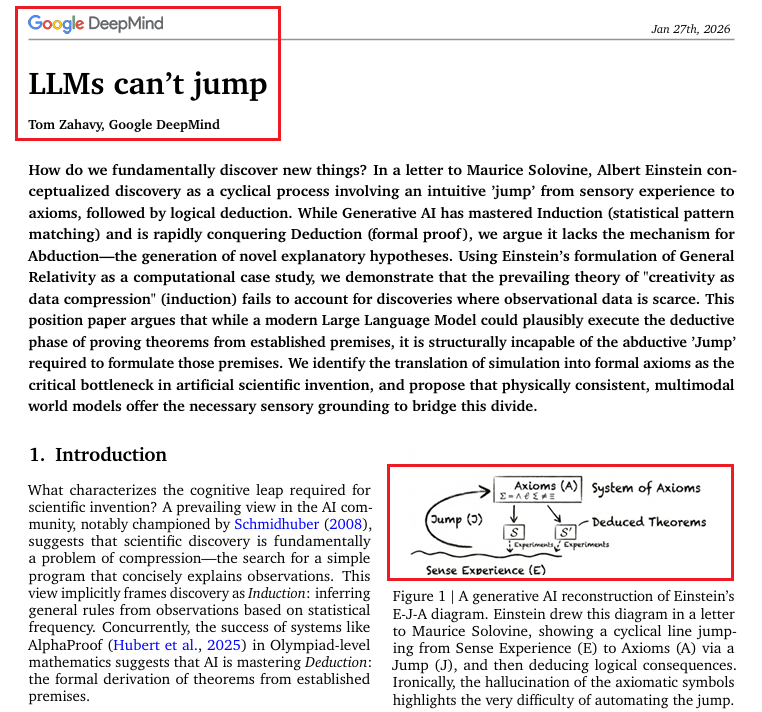
The paper is called "LLMs can't jump."
Not a joke about video games. It's about the one cognitive move that produced General Relativity - and that Google DeepMind's own researcher argues no LLM has ever actually made.
venus@RitOnchain
English

Don't waste 2 years learning to become an AI agentic engineer in 2026.
Andrew Ng, the godfather of AI, gave the complete playbook to become one from scratch.
1 hour course. Free:
• 00:00 - AI agent basics
• 12:12 - AI Agentic workflows & design patterns
• 53:27 - Practical tips for building AI agents
• 1:20:30 - self-improving AI agent loops
• 1:30:19 - multi-agent AI systems
I watched it last night.
Halfway through, I realized I could get into Anthropic in weeks, not years.
Bookmark now. Watch it. Then build your own AI agent with the guide below.
Roan@RohOnChain
English
OpenAI pays $865K/year to developers who know how to apply Forward Deployed Engineering in AI.
in 40-minute talk, Head of FDE at OpenAI revealed full roadmap for how they actually use FDE internally.
venus@RitOnchain
this is f*cking insane playbook released by Palantir. Forward Deployed Engineers are paid $450k/annum. this playbook tells exact Roadmap to become FDE. Bookmark it and then read article.
English
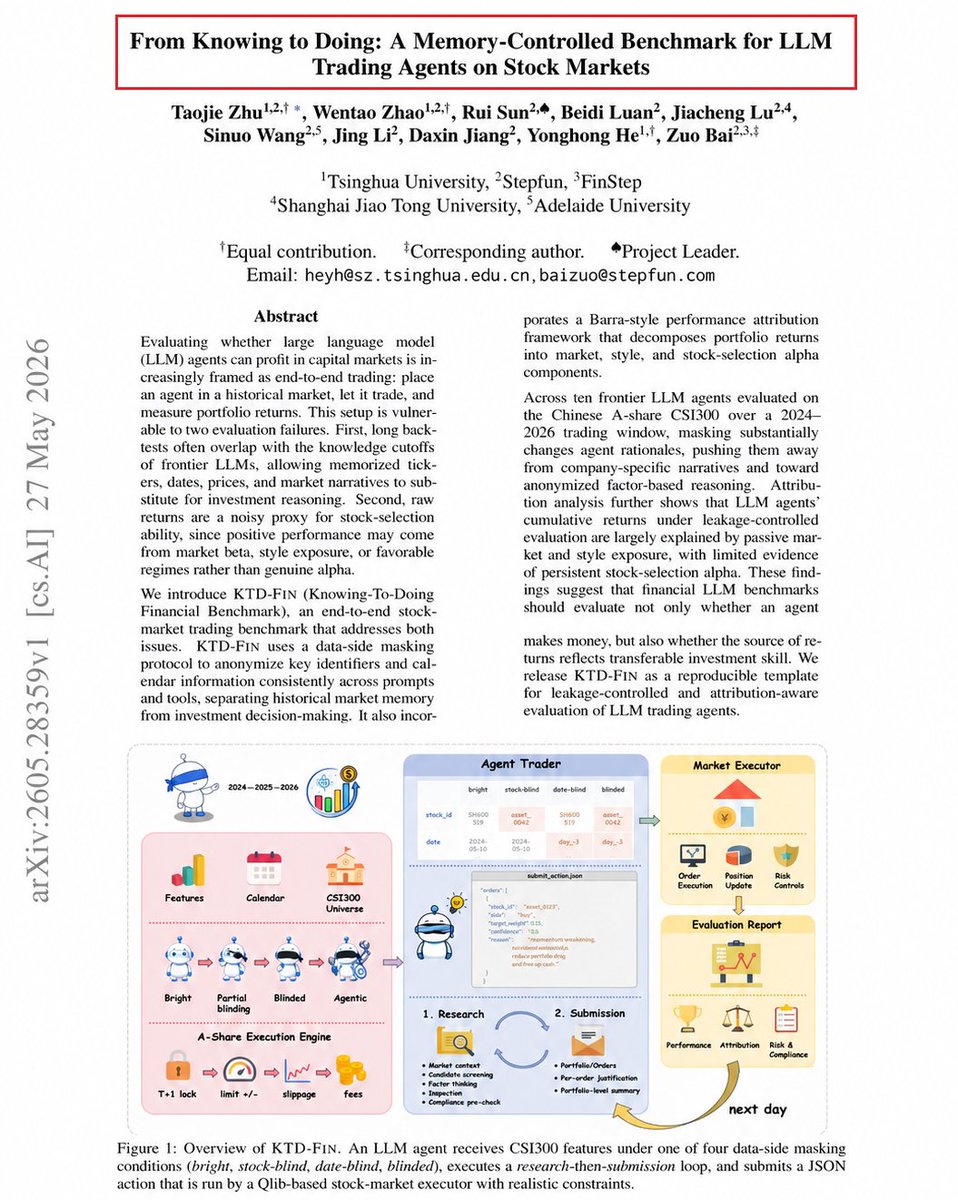
As anyone building trading agents knows, the hardest part isn't getting an LLM to place a trade. It's proving the model isn't just pattern-matching a name it already knows from pretraining.
This paper solved it with a 4-level masking protocol -
hide the ticker, hide the date, or both - then had an
independent panel of LLMs try to break it.
Sharpe ratio: 2.02
Bookmark it, this is best read of week for me.
venus@RitOnchain
English
Stanford AI lab just revealed how decision-making under uncertainty actually works under the hood.
80-minutes. free. By Stanford Researcher.
here's what they cover:
• search problems vs Markov Decision Processes (MDPs)
• Q-values, discounting, & expected utility recurrences
• policy evaluation vs Bellman value iteration
• Monte Carlo rollouts vs exact dynamic programming
watch full video then read article below.
Voltex@VoltexGar
English
Anthropic engineers just revealed how they build agent systems internally:
The workshop covers:
• Agent workflows as graphs
• Stateful memory architectures
• Long-term memory systems
• Self-improving agent loops
• Production graph deployment
Watch the workshop, then read the graph engineering guide below.
venus@RitOnchain
English
this is f*cking insane playbook released by Palantir.
Forward Deployed Engineers are paid $450k/annum.
this playbook tells exact Roadmap to become FDE.
Bookmark it and then read article.

Codez@0xCodez
English

$3 trillion evaporated from American retirement accounts in 2022. The 60/40 portfolio had its worst year since 1937. Risk parity, sold as the fix, lost the same year. A Morgan Stanley risk chief had drawn the whole story on an MIT chalkboard in 2013. He was right nine years early. The lecture is on YouTube.
His name is Jake Xia. In October 2013 he gave lecture 16 of MIT 18.S096, Topics in Mathematics with Applications in Finance. The lecture runs about eighty minutes. Every portfolio at Bridgewater, AQR, and Panagora runs some version of what he wrote that day.
Xia opens with a list of asset classes. Cash, Treasuries, corporate bonds, commodities, FX, ETFs, real estate, lotteries. Yes, lotteries. To a portfolio manager they are the same object. A distribution of returns and a variance.
Next board is Markowitz. Return on the y-axis, standard deviation on the x-axis, the efficient frontier curving up to the right. Cash at the bottom, then Treasuries, stocks, real estate, commodities, private equity, venture. The last point marked on the far right is a coin flip. That dot is the retail trader with no plan.
Third board is Sharpe. Portfolio return minus the risk-free rate, divided by portfolio volatility. Signal over noise in a single fraction. Every hedge fund on earth is measured by that number.
Fourth board is where the industry hurts. Xia works through a 60/40 portfolio in every correlation regime. When stocks go up and bonds go down, you make money. When bonds go up and stocks go down, you make money. When both go down at the same time, you do not.
That was 2022.
Risk parity was supposed to fix it. Instead of weighting by dollar, weight by risk. Bridgewater's All Weather runs a version. So do AQR, Panagora, and about 200 other funds. When the correlation broke in 2022, they broke too. Because it is the same math, re-weighted.
Xia said it on the board nine years earlier.
The lecture is free. The board is free. Wall Street built the fund on top of it and sold you the fee.
Rossst.03@Rossst_03
English
Don't waste 2 years learning to build AI agents.
An Anthropic engineer who built Claude Code tells you what to learn from scratch instead.
60 minutes course. Free:
00:00 - AI agent architecture
24:47 - LangGraph AI agent
29:15 - building AI agents live
Prompting is the old job. Building AI agent loops is the new one.
Bookmark now & watch it. Then build your own AI agent with the guide below.
Roan@RohOnChain
English
AI Hero founder Matt Pocock just showed the complete blueprint for autonomous AI coding agents.
96-minutes. free. By AI Hero team.
here's what they cover:
• 'Grill Me' protocol to align LLMs before writing code
• tracer bullets & vertical slices over layer-by-layer plans
• strict TDD feedback loops to stop agents cheating tests
• deep vs shallow module architecture for agentic repos
• 100K token threshold & AFK night-shift execution loops
watch full video then read the article below.
Codez@0xCodez
English
As someone who builds institutional-grade quant systems, this paper on trend-following is one of the strongest arguments against indicator bloat I've seen.
70 futures markets. 33 years of data.
A simple EMA matched theory with R² = 0.98.
Most alpha teams are probably overengineering trend.
Bookmark this.

venus@RitOnchain
English
The secret of Hedge Funds is revealed in a 12 page PDF.
Columbia University released the complete Black-Scholes Model framework that quants at firms like Jane Street & Two Sigma are known to use & released it for free.
Bookmark & read this before someone takes it down.

Ruuj@RuujSs
English
OpenAI Codex engineer Jason Liu just showed how he manages 400+ sub-agents using foot pedal voice dictation and long-running threads.
75-minutes. free. Full Workshop in single video.
Bookmark it & then read article below.
Codez@0xCodez
English


this is f*cking insane talk released by Startup School 2026.
Former YC President Garry Tan & OpenAI CEO Sam Altman just shared playbook on how 4-person teams are about to build trillion-dollar companies.
worth more than any $500 AI course.
Bookmark & watch today. Then read the article below.
Avid@Av1dlive
English
The most valuable stock tip in Wall Street history was given for free in June 1983, in a tent in Aspen, by a 28-year-old founder whose flagship product was seven months from launch. His name was Steve Jobs. Nobody in finance was in the audience. Warren Buffett did not buy the stock for another 33 years. A $1,000 position that day is worth over $2 million now.
The venue was the International Design Conference. Theme that year: "The Future Isn't What It Used to Be." Jobs waited at the back of a big canvas tent on the morning of his talk, holding a stack of slides, listening to the crowd file in. He walked to the mic and spoke for an hour to a few hundred designers. Most of them had never touched a computer.
He read them a list of things that did not exist yet.
Networks that let a computer in California send software to a buyer in Nebraska. Radio waves so any device could talk to any other without a cable. A computer light enough to carry in a briefcase and cheap enough that a family bought one instead of a second car. Voices for input. Screens for storage. Objects on desks in every home. The web was six years away. WiFi was 16. The App Store was 25. He described all of them in one hour.
The Macintosh was seven months from launch. IBM ran the industry. Retail chains had started throwing Apple boxes into the back room. Wall Street analysts were writing that Apple would not survive the decade.
Jobs told the designers to build the thing anyway.
"We have an opportunity to do it great or to do it so-so. And what a lot of us at Apple are working on is trying to do it great."
Apple stock that morning traded at roughly 10 cents on a split-adjusted basis. It sits above 200 dollars now. That is a two-thousand-bagger. The roadmap was already read out loud in a tent, in front of a crowd that had no idea what to do with it.
None of them wrote it up. No one on Wall Street picked it up. The cassette recording sat in a designer's moving box for decades before it surfaced online. Warren Buffett bought his first Apple share in 2016. Thirty-three years after Jobs told the room what he was building.
The trade was not the stock. The trade was believing a 28-year-old with the Mac still unshipped when he described the next 40 years. Every generational winner sounds like a crank until the proof arrives. The market pays whoever can tell a crank from a builder before the ticker moves.
Jobs is dead. Apple is worth over three trillion dollars. The tape is free.
The vision was free. The patience to trust it before the tape leaks is the edge.
Veles@velesxbt
English