WSPN

1.4K posts

WSPN banner
WSPN

WSPN

@WSPNpayment

A global digital payments company that provides TRANSPARENT, FAST and EFFICIENT digital payment solutions leveraging Distributed Ledger Technology (DLT).

Присоединился Ekim 2023
540 Подписки22.4K Подписчики
Закреплённый твит
WSPN
WSPN@WSPNpayment·
🚀WSPN: Redefining Stablecoin 2.0🌟 2 minutes to see how we're shaping the future of digital finance. 🎥💡 Watch our vision unfold and join the revolution! 👇 #WSPN #Stablecoin #DigitalFinance $WUSD #Web3 #FutureOfMoney
English
16
11
44
16.3K
WSPN
WSPN@WSPNpayment·
🌟 Happy Labor Day! While you rest, the stablecoin industry doesn't slow down. 📈 Market cap hits $325B. GENIUS Act implementation sprint: FDIC, FinCEN & Treasury all issued rules in one week. Real-world B2B payments surged 733% to $226B in 2025. The compliance era has begun. Read our latest monthly report for the full picture 👇 @WSPN/regulatory-clarity-meets-real-world-payments-may-2026-d6e54f788e2a" target="_blank" rel="nofollow noopener">medium.com/@WSPN/regulato… #WSPN #Stablecoin #DigitalPayments
WSPN tweet media
English
0
0
0
81
WSPN
WSPN@WSPNpayment·
💳 Big Tech is back in the stablecoin game. Meta has quietly rolled out USDC payouts for creators in Colombia & the Philippines — 4 years after Libra's demise. Mass adoption isn't coming. It's already here. #WSPN #Stablecoin #DigitalPayments
English
0
0
0
87
WSPN
WSPN@WSPNpayment·
🪙 Stablecoin Weekly Report Apr 21 – Apr 27, 2026 Week in Brief This week was defined by regulatory acceleration and institutional infrastructure expansion. The GENIUS Act implementation moved into overdrive with the OCC proposing a sweeping 376-page federal framework, while European banks launched a coordinated euro stablecoin push to challenge dollar dominance. At the same time, TradFi giants like Morgan Stanley entered the reserve management space, and cross-border payment rails went live with USDC at the center. Top Stories 1. OCC Proposes Comprehensive GENIUS Act Framework 📅 Apr 21 |🔗mondaq.com/unitedstates/f… Summary: The Office of the Comptroller of the Currency released a 376-page proposed rule translating the GENIUS Act into enforceable regulations covering every phase of stablecoin lifecycle—from chartering to reserve management, redemption, and wind-down. Issuers must maintain segregated reserve assets exceeding par value at all times. Separately, Treasury/FinCEN/OFAC proposed joint AML and sanctions compliance rules requiring written AML/CFT programs, SAR reporting, a US-based compliance officer, and real-time sanctions screening on all transfers over $3,000. Banking associations have requested extended public comment periods, noting these proposals are interdependent with the OCC's framework. The compliance deadline remains November 2026. Why It Matters: The GENIUS Act is now entering enforcement reality. The combination of OCC chartering rules and FinCEN/OFAC AML mandates creates the most comprehensive US stablecoin compliance regime to date—reshaping competitive dynamics, especially for offshore issuers like Tether. 2. 12-Bank European Consortium Backs Qivalis Euro Stablecoin via Fireblocks 📅 Apr 21 | 🔗cointelegraph.com/news/european-… Summary: A consortium of 12 major European banks including BBVA, BNP Paribas, ING, and UniCredit, organized under Qivalis, selected Fireblocks to provide custody, wallet infrastructure, and tokenization technology for a MiCA-compliant euro stablecoin. The 1:1-backed electronic money token will be structured under Dutch supervision by De Nederlandsche Bank and is targeting H2 2026 launch. The initiative comes as the BIS General Manager warned that 98% of the $320B stablecoin market is dollar-denominated, urging European policymakers to reduce reliance on foreign-denominated tokens. The Bank of France has also called for limits on non-euro stablecoins in everyday EU payments. Why It Matters: This is the most credible challenge yet to dollar stablecoin dominance in European markets—with 12 regulated banks, institutional-grade infrastructure, and full MiCA alignment. If launched successfully, it could become the default settlement layer for European DeFi, tokenized assets, and cross-border payments. 3. Nium x Coinbase Partnership Enables USDC Payouts Across 190+ Countries 📅 Apr 21 | 🔗 prnewswire.com/news-releases/… Summary: Nium and Coinbase went live with a partnership enabling USDC-based payouts across Nium's network spanning 190+ countries and 40+ licenses. Businesses can fund in USDC and settle in local fiat, eliminating wire delays and capital-intensive prefunding. Coinbase handles stablecoin payments, liquidity, wallet infrastructure, and regulated custody. Nium also allows USDC balances to power card programs spendable at hundreds of millions of merchant locations. Coinbase CEO Brian Armstrong called it "unlocking stablecoin payments around the world." The integration is live today. Why It Matters: This is not a pilot—it's live infrastructure for stablecoin-powered cross-border payments at global scale. For enterprises and fintechs, it's the first plug-and-play solution combining stablecoin liquidity with a licensed, multi-jurisdiction payment network. 4. Morgan Stanley Launches Stablecoin Reserves Portfolio for Issuers 📅 Apr 27 | 🔗pulse2.com/morgan-stanley… Summary: Morgan Stanley Investment Management launched a Stablecoin Reserves Portfolio—a government money market fund within its Institutional Liquidity Funds platform—purpose-built for stablecoin issuers seeking compliant, yield-generating reserve management. The fund invests in US Treasuries, cash, and overnight repos, targeting a stable $1 NAV with daily liquidity. The offering is designed to align with emerging regulatory requirements mandating fully backed, liquid reserves. It represents a direct bridge between digital asset issuers and traditional institutional finance. Why It Matters: TradFi is no longer just watching stablecoins—it's now providing the underlying infrastructure. Morgan Stanley entering reserve management signals that institutional capital is building for a regulated stablecoin future, and issuers now have a regulated vehicle to earn yield on their reserves. 5. UK Introduces Unified Payments Framework Covering Stablecoins and Tokenized Deposits 📅 Apr 21 | 🔗 coincentral.com/uk-moves-to-re… Summary: The UK Treasury presented a unified payments framework at London Fintech Week covering traditional services, stablecoins, and tokenized deposits under a single legislative structure. Payment stablecoins will be regulated under a new issuance regime integrated into existing payments law, with reduced administrative requirements for stablecoin payment service firms. The FCA will gain expanded oversight over Open Banking and AI-driven payment activities. Chris Woolard CBE was appointed as Wholesale Digital Markets Champion to coordinate tokenized wholesale market development. The government committed £1M to the Centre for Finance, Innovation and Technology. Why It Matters: The UK is positioning itself as a major regulated stablecoin hub post-Brexit. By embedding stablecoins into its core payments law rather than treating them as a separate asset class, the UK is taking a pragmatic, pro-innovation approach that could attract stablecoin issuers seeking a stable regulatory home outside the US and EU.
WSPN tweet media
English
0
0
2
238
WSPN
WSPN@WSPNpayment·
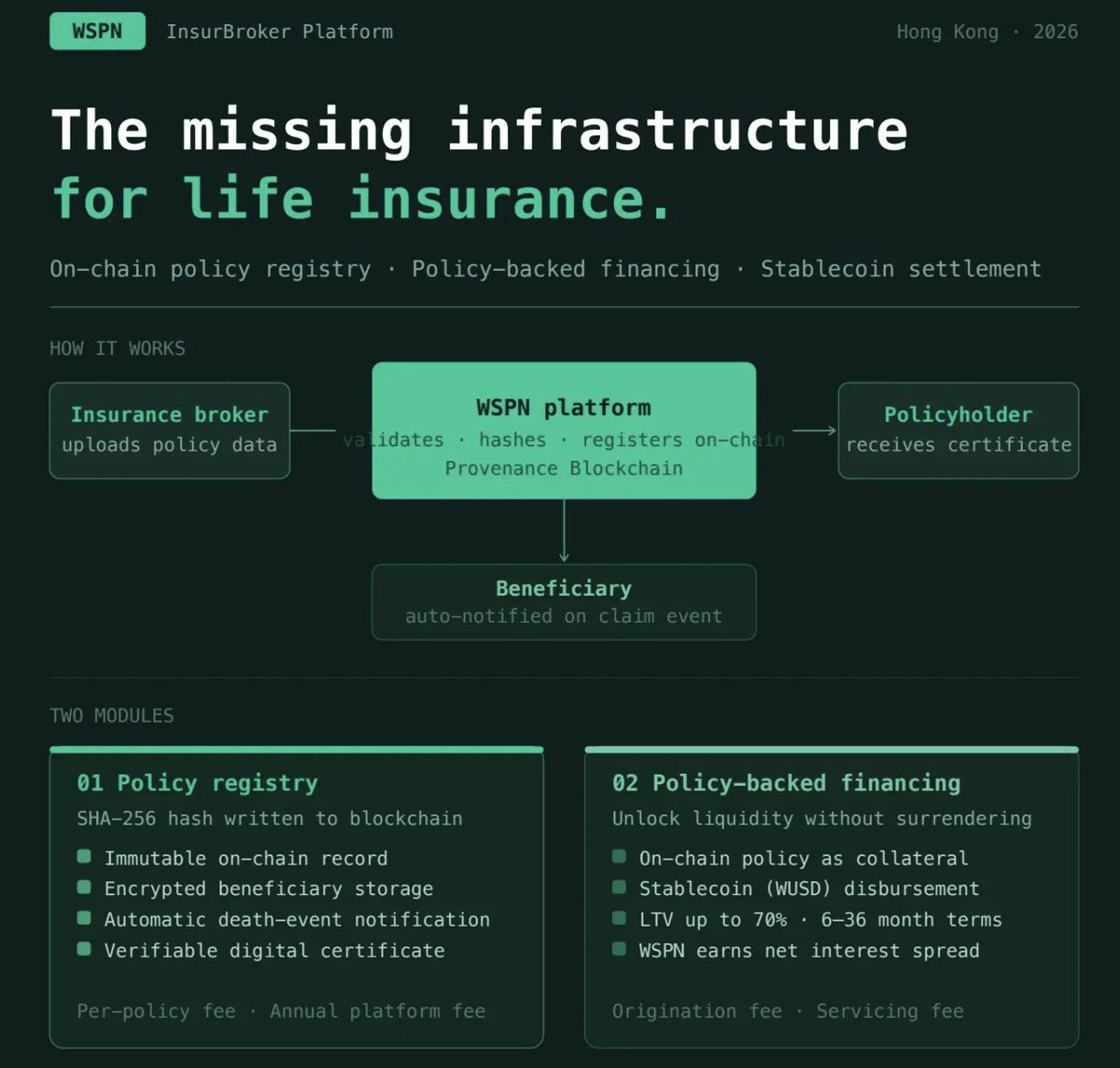
🌟 Quietly building the future of insurance infrastructure. WSPN brings life insurance on-chain in Hong Kong: → Immutable policy registry on Provenance Blockchain → Automated beneficiary notifications — no more lost claims → Policy-backed financing — unlock liquidity, keep your coverage First partner live. Pilot underway. 🔗 Insurance + #Stablecoin settlement + #RWA — this is the missing layer. #WSPN #HongKong #InsurTech #DigitalPayments
WSPN tweet media
English
0
0
0
493
WSPN
WSPN@WSPNpayment·
🚀 Exciting news! We're launching an A2A payments system that turns any agent into a buyer. Install one skill, plug into the discovery registry — your agent finds merchants, compares quotes & settles on-chain in stablecoins. Internal testing ✅ complete. Launching soon. 🟢 Stay tuned. 👀 #WSPN #Stablecoin #DigitalPayments #AgentPayments #Fintech
WSPN tweet media
English
1
0
0
187
WSPN
WSPN@WSPNpayment·
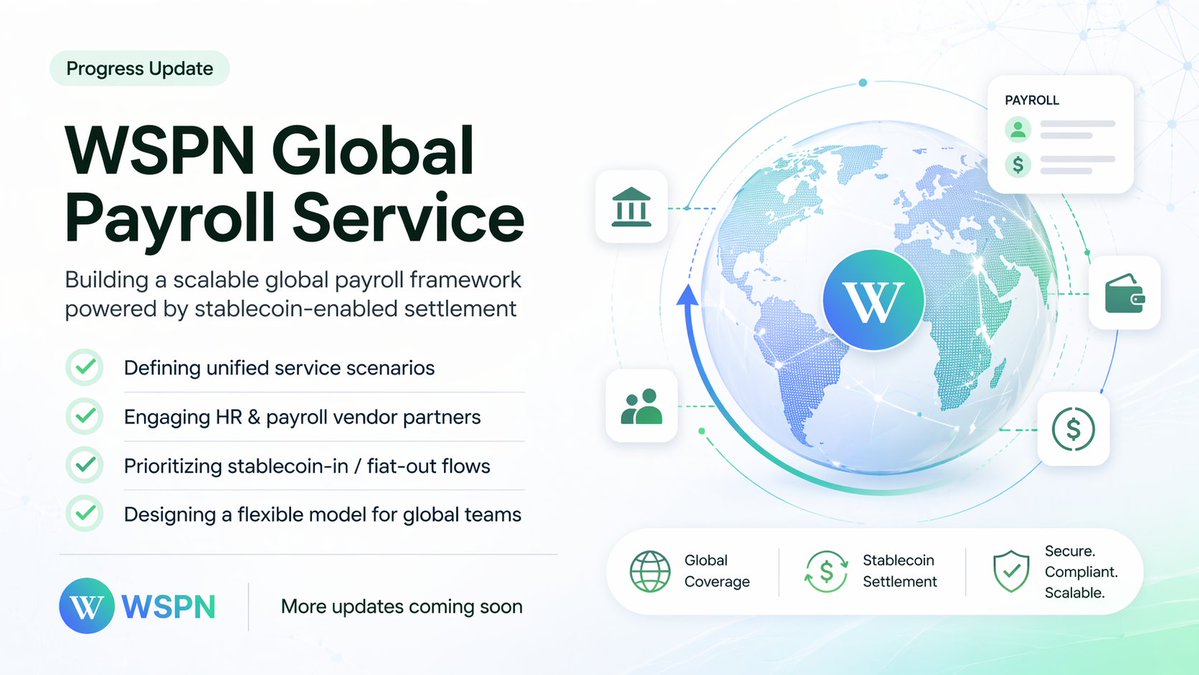
Something new is cooking 👀 We’re working on WSPN Global Payroll Service — a new payroll solution designed for global teams, powered by stablecoin-enabled settlement. From service scenarios to partner integrations, we’re building toward a more flexible way to support cross-border payroll and payouts — with stablecoin-in / fiat-out as a key focus. Still early, but we’re excited about what’s coming. More soon. 🚀 #WSPN #Stablecoin #GlobalPayroll #CryptoPayments #Web3 #Fintech
WSPN tweet media
English
0
0
0
129
WSPN
WSPN@WSPNpayment·
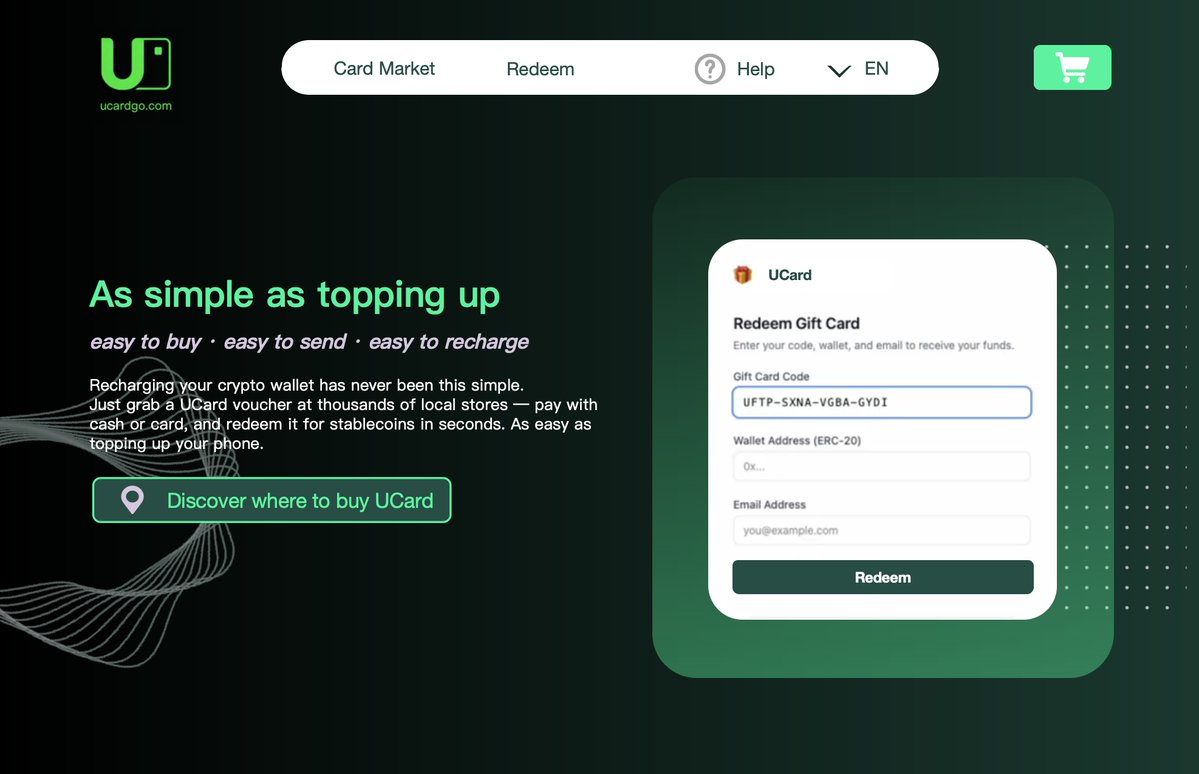
🚀 Exciting news — WSPN is launching something new. Introducing UCard — a prepaid recharge card that lets you top up your digital wallet with stablecoins as easily as buying a phone card. Purchase, send & recharge in 3 simple steps. No bank account required. No exchange registration needed. 💳 Coming soon. 🟢 More new launches dropping in the days ahead — stay tuned! #WSPN #Stablecoin #UCard #DigitalPayments #Fintech
WSPN tweet media
English
0
0
0
245
WSPN
WSPN@WSPNpayment·
The UK just made a bold move for stablecoins. HM Treasury unveiled a unified payments framework bringing stablecoins, tokenized deposits, and traditional payment services under one regulatory roof. Less friction. More clarity. A greener light for builders. Regulatory certainty is the foundation of trust — and trust is what powers global payments. 💎 #stablecoin #fintech #WSPN #DigitalPayment
English
0
0
0
148
WSPN
WSPN@WSPNpayment·
🪙 Stablecoin Weekly Report Apr 13 – Apr 19, 2026 Week in Brief This week was defined by three forces: a U.S. legislative sprint toward the CLARITY Act with the yield debate nearing resolution; Tether's landmark consumer wallet launch marking its boldest move into end-user infrastructure; and Visa & Stripe joining the Tempo blockchain as validators, signaling deep TradFi commitment to stablecoin payment rails. Total market cap crossed $320B mid-week, driven by $2.54B in seven-day inflows. 1. Tether Launches tether.wallet — "The People's Wallet" 📅 Apr 14, 2026 🔗coindesk.com/business/2026/… Summary: Tether launched a self-custodial mobile wallet supporting USDT, USAT, XAUT, and Bitcoin across Ethereum, Polygon, Plasma, Arbitrum, and Lightning Network. Users transact with human-readable @tether.me usernames, with fees paid in the asset being sent — no gas tokens needed. The app builds on Tether's open-source Wallet Development Kit. CEO Paolo Ardoino called it infrastructure for "billions of humans, machines, and AI agents transacting at the speed of light," and projected tens of millions of new wallets per quarter. Why It Matters: This is Tether's sharpest pivot from pure B2B infrastructure to consumer payments. With 570M+ users already touching its rails, tether.wallet could be the mass-market catalyst that brings USDT to everyday commerce — and directly challenges MetaMask, Trust Wallet, and Phantom. 2. Visa & Stripe Join Tempo Blockchain as Validators 📅 Apr 14, 2026 🔗 blockonomi.com/stripe-and-vis… Summary: Visa, Stripe, and Zodia Custody (backed by Standard Chartered) joined Tempo's Ethereum-compatible Layer 1 network as validators. Tempo — incubated by Stripe and Paradigm and valued at $5B after a $500M Series A — is built specifically for institutional stablecoin settlement, featuring sub-second finality and fees under $0.001 per transaction. Validators are responsible for transaction verification, sequencing, and confirmation. Visa's digital assets head noted the goal is to bring fraud and security expertise to the expanding stablecoin ecosystem. Why It Matters: When Visa and Stripe — which collectively process trillions of dollars annually — commit infrastructure to a stablecoin network, it's not an experiment. It signals that stablecoin settlement is entering the backbone of global payments. Tempo's Machine Payments Protocol also supports agentic AI payments, an emerging frontier. 3. CLARITY Act Yield Debate Nears Resolution — Senate Markup Targeted for Late April 📅 Apr 14–16, 2026 🔗 news.bitcoin.com/report-stablec… 🔗 coindesk.com/policy/2026/04… Summary: Sen. Thom Tillis announced plans to release revised CLARITY Act draft language targeting a Senate Banking Committee markup in late April. The Tillis-Alsobrooks compromise framework bans passive stablecoin yield (interest for simply holding a balance) but permits activity-based rewards tied to transactions or platform engagement. White House crypto adviser Patrick Witt confirmed the yield deal "remains intact" as a must-have condition, with remaining disputes narrowed to 2–3 issues. JPMorgan analysts also described the bill as "close to completion." Prediction markets give the Act a 59% chance of passage in 2026, down from 82% earlier in the year — with a mid-May floor vote as the critical deadline before midterm season. Why It Matters: The CLARITY Act is the broader legal framework governing how digital assets — and stablecoins specifically — are regulated in the U.S. Its stablecoin yield rules will directly determine which business models are viable, how stablecoins compete with bank deposits, and whether institutions accelerate or hold back adoption. 4. JPMorgan CFO Warns Stablecoins Risk "Regulatory Arbitrage"; White House Pushes Back 📅 Apr 14, 2026 🔗 coindesk.com/business/2026/… Summary: During JPMorgan's Q1 earnings call, CFO Jeremy Barnum warned that yield-bearing stablecoins could allow firms to "run a bank" without banking oversight — putting a theoretical $6.6T in deposits at risk. He argued that if identical products aren't regulated identically, it creates systemic arbitrage. On the same day, the White House Council of Economic Advisers formally backed stablecoin yield rights, finding that banning yield would only increase bank lending by 0.02% while costing consumers $800M in net welfare loss. JPMorgan itself runs JPM Coin and tokenized deposit products via its Kinexys blockchain division. Why It Matters: The TradFi vs. crypto divide on yield isn't just theoretical — it determines whether stablecoins can compete for the $6.6T retail deposit base. The White House's endorsement of stablecoin yield is a significant policy signal, directly undercutting the banking lobby's core argument. 5. Digital Asset PARITY Act Proposes Tax-Free Status for Stablecoin Payments 📅 Apr 14, 2026 🔗 crypto.news/stablecoin-pay… Summary: House Representatives Steven Horsford and Max Miller circulated a revised draft of the Digital Asset PARITY Act, which would exempt everyday regulated stablecoin payments from capital gains tax. Under the proposal, "no gain or loss shall be recognized" on transactions using stablecoins that maintain a $0.99–$1.01 peg, treating them like foreign currency under the tax code. Currently, every USDC or USDT disposal — even buying a coffee — is a taxable event under IRS guidance. The bill also extends wash-sale rules to other crypto assets to close tax-loss harvesting loopholes. Why It Matters: Tax friction is one of the biggest barriers to stablecoin use in everyday payments. If enacted, the PARITY Act would remove the compliance burden for U.S. consumers using regulated stablecoins for routine purchases — a potential step-change in mainstream adoption velocity. 6. Circle CEO Defends USDC Freeze Policy Amid $420M+ Hack Criticism 📅 Apr 13–14, 2026 🔗 pymnts.com/cryptocurrency… Summary: Circle CEO Jeremy Allaire publicly defended the company's freeze policy during a Seoul press conference, stating USDC will not be frozen without a court order or law enforcement direction. The comments came after blockchain investigator ZachXBT cited $420M+ in alleged compliance failures since 2022, including the recent Drift Protocol exploit where ~$230M in USDC moved cross-chain. Allaire contrasted Circle's approach with Tether's more proactive freeze policy, arguing that Circle operates as a regulated financial product — not a real-time intervention tool. Why It Matters: The compliance philosophy divide between USDC and USDT is sharpening. As stablecoin transaction volumes grow to trillions of dollars, the question of who controls the freeze button — and under what legal standard — has direct implications for institutional risk management, regulatory treatment, and user trust.
WSPN tweet media
English
1
0
0
213
WSPN
WSPN@WSPNpayment·
🌍 The stablecoin market just crossed $320B in total market cap — and it's not slowing down. $2.54B flowed in just this week alone. Stablecoins are no longer a crypto-native tool. They're becoming global financial infrastructure. At WSPN, we've been building for this moment. 💎 #stablecoin #DigitalPayment #WSPN
English
0
0
2
135
WSPN
WSPN@WSPNpayment·
🚀 Three major stablecoin policy moves in 48 hours: GENIUS Act NPRM, Clarity Act yield deal, JPMorgan calling for oversight. Regulatory momentum = market maturity. This is exactly when infrastructure-first players like #WSPN shine. #WSPN #Stablecoin #Fintech
English
0
0
1
187
WSPN
WSPN@WSPNpayment·
🪙 Stablecoin Industry Weekly Report April 7 – 13, 2026 Week in Brief A landmark week for stablecoin regulation and infrastructure. The U.S. FDIC released GENIUS Act implementation rules for bank stablecoin issuers, Hong Kong granted its first stablecoin licenses to HSBC and Standard Chartered, and Circle launched a fully managed settlement platform. Meanwhile, a McKinsey report revealed that real-world stablecoin payments account for just 1% of total on-chain volume — with B2B cross-border settlement driving virtually all genuine growth. Top Stories 1. 🏛️ FDIC Releases GENIUS Act Stablecoin Rules Date: Apr 7 Source: news.bitcoin.com/fdic-proposes-… Summary: The FDIC approved a proposed rulemaking under the GENIUS Act establishing prudential standards for bank-affiliated stablecoin issuers (PPSIs). Requirements include 1:1 reserves in eligible assets, redemption within 2 business days, a minimum $5M capital requirement for new issuers, and a 60-day public comment period. The regulatory deadline is July 18, 2026. JPMorgan, Bank of America, and Citigroup are already positioning to enter the market. Why It Matters: This is the first real implementation of America's federal stablecoin law inside the banking system. A finalized framework opens the door for traditional financial institutions to issue regulated stablecoins at scale — representing a structural shift in how digital dollars enter mainstream finance. 2. 🌏 Hong Kong Issues First Stablecoin Licenses to HSBC & Standard Chartered Date: Apr 10 Source: finance.sina.com.cn/roll/2026-04-1… Summary: The HKMA awarded Hong Kong's first stablecoin licenses to HSBC and Anchorpoint Fintech (a JV of Standard Chartered, HKT, and Animoca Brands), selected from 36 applicants. HSBC plans to launch an HKD stablecoin in H2 2026 integrated with PayMe and the HSBC HK App. Anchorpoint (HKDAP) targets a phased Q2 2026 launch using a B2B2C distribution model. Why It Matters: Hong Kong's stablecoin regime has moved from sandbox to live licensing. HKD can now circulate as a programmable, on-chain asset within a regulated framework for the first time — a pivotal moment for Asia-Pacific cross-border payments and non-USD stablecoin adoption. 3. 🚀 Circle Launches CPN Managed Payments Date: Apr 8 Source: businesswire.com/news/home/2026… Summary: Circle launched CPN Managed Payments, a fully managed stablecoin settlement platform allowing banks, PSPs, and fintechs to operate entirely in fiat while Circle handles USDC minting/burning, compliance, payment orchestration, and blockchain infrastructure. Use cases include cross-border settlement, merchant acceptance, and high-volume global payouts. Early partners include Thunes, Worldline, and Veem. USDC has processed over $70T in cumulative on-chain settlement. Why It Matters: Circle has dramatically lowered the barrier to stablecoin adoption — institutions no longer need to build a digital asset stack from scratch. This signals intensifying competition in the "stablecoin-as-a-service" infrastructure space and validates the market WSPN operates in. 4. 💳 MoonPay Stablecoin Infrastructure Goes Live Inside Paysafe Date: Apr 7 Source: finance.yahoo.com/markets/crypto… Summary: MoonPay's stablecoin infrastructure is now embedded inside Paysafe (NYSE: PSFE), which processed $167B in transactions in 2025. The first product, "Pay with Crypto," lets U.S. users fund accounts with USDC and other crypto, instantly converted to USD. Merchants can settle in stablecoins or fiat via a single integration, targeting e-commerce, retail, financial services, and iGaming. Why It Matters: A clear playbook for scaling stablecoin adoption — not direct-to-consumer, but embedded inside existing payment processors. This B2B2C distribution model is becoming the dominant go-to-market strategy for stablecoin rail providers and a benchmark for infrastructure partnerships. 5. 🌍 Europe's Stablecoin Adoption Shifts from Exploration to Execution Date: Apr 12 Source: timesnewsnetworks.com/europes-stable… Summary: Post-MiCA, major European banks including ING, UniCredit, CaixaBank, and BBVA are now actively selecting stablecoin infrastructure partners, with board-level approval already in place. ClearBank Europe became the first Dutch credit institution approved under MiCA as a crypto asset service provider. A bank consortium is developing Qivalis, a MiCA-compliant euro stablecoin. Chainalysis projects stablecoin transaction volumes could reach $719T by 2035. Why It Matters: European institutional adoption is moving from narrative to real execution, driven by practical treasury needs rather than strategy. Non-USD stablecoins are gaining ground — a trend directly aligned with multi-currency cross-border payment infrastructure plays. 6. 📊 McKinsey × Artemis: Real Stablecoin Payments Are Just 1% of Volume Date: Apr 7 Source: chaincatcher.com/article/2257024 Summary: A joint McKinsey and Artemis Analytics report found that of ~$35T in annualized stablecoin on-chain volume, only ~$390B represents genuine end-user payments (~1%). Of that, 58% is B2B payments (up 733% YoY), driven by cross-border supply chain and treasury flows. Consumer stablecoin usage remains negligible. Real payment monthly run rate has grown from $5B in early 2024 to over $30B by early 2026. Why It Matters: Stripping out speculation and automated flows, B2B cross-border settlement is the real and rapidly growing core of stablecoin payments. This report provides a credible baseline for infrastructure-focused narratives and confirms where enterprise stablecoin value is actually being created.
WSPN tweet media
English
0
0
2
213
WSPN
WSPN@WSPNpayment·
📈 42% of CFOs are now exploring stablecoins — not as speculation, but as payment infrastructure. 88% convert stablecoin receipts directly to USD. The message is clear: stablecoins are becoming the new payment rails. We're building them. #WSPN #Stablecoin #B2BPayments
English
0
1
0
129
WSPN
WSPN@WSPNpayment·
Stablecoin Weekly Hot News Week of March 30 – April 5, 2026 ─── Market Snapshot The global stablecoin market reached $317 billion on April 4, 2026, recording $1.36 billion in weekly inflows. Total Q1 2026 transaction volume surpassed $28 trillion — exceeding Visa and Mastercard combined. Stablecoins now account for 75% of all crypto trading volume. USDT holds 58% market share at $184B; USDC at $77.5B. ─── 🔟 Key Stories This Week ─── 1. U.S. Treasury Publishes First GENIUS Act NPRM Source: BlockReq News — news.blockreq.com/en/news/genius… On April 1, the U.S. Treasury released an 87-page NPRM — the first implementation rules under the GENIUS Act (signed July 2025). The proposal creates a dual-track system: issuers under $10B can opt into state oversight; above $10B triggers mandatory federal regulation via OCC. 100% reserve requirement in T-bills or cash. 60-day comment period through June 1; full rules targeted November 2026. Why it matters: This converts the GENIUS Act from law into an operational framework with hard deadlines. The 100% reserve requirement structurally channels hundreds of billions into U.S. Treasuries — stablecoin issuers become a major new class of T-bill buyer. The industry finally has a clear compliance timetable. ─── 2. Coinbase Gets Conditional OCC National Trust Bank Charter Source: American Banker — americanbanker.com/news/coinbase-… On April 2, Coinbase received conditional OCC approval to charter Coinbase National Trust Company (CNTC) — a federal custody entity. It joins Circle, Ripple, Paxos, Fidelity Digital Assets, and Stripe-owned Bridge in the wave of 11+ crypto firms receiving OCC trust charters since December 2025. Coinbase holds $376B in customer crypto assets (~13% of total market cap). Why it matters: A federal charter replaces Coinbase's 50-state license patchwork with a single federal regulator, and formally qualifies it as an SEC "qualified custodian." This is a fundamental shift in Coinbase's regulatory standing — and a gateway to institutional asset management at scale. Traditional banks are openly alarmed. ─── 3. CLARITY Act Stablecoin Yield Fight Nears Resolution — Senate Markup Targeted Late April Source: FinTech Weekly — fintechweekly.com/magazine/artic… Coinbase CLO Paul Grewal stated on April 1 the CLARITY Act yield dispute is "very close to a deal" and said a resolution was "48 hours away" on April 2. The current draft bans passive yield on stablecoin balances but permits activity-based rewards. Coinbase estimates the passive yield ban costs it $1.35B annually. Senate Banking Committee markup targeted for late April after Easter recess (April 13). Why it matters: CLARITY Act + GENIUS Act together form the complete U.S. crypto regulatory framework. Missing the April markup window risks losing the bill for all of 2026. The yield debate determines whether stablecoin platforms can compete with banks on interest — analysts say it could shift $1 trillion in deposits by 2028. ─── 4. Tether's Final Push for $500 Billion Valuation Fundraising Source: PYMNTS — pymnts.com/cryptocurrency… Tether gave investors a 2-week deadline to commit to a ~$5B raise at a $500B valuation — placing it alongside OpenAI and SpaceX. USDT circulation: ~$184B. 2025 net profit: $10B+. Supporting the pitch: KPMG hired for first-ever full audit (March 27) and USAT, a GENIUS Act-compliant U.S. stablecoin, launched in January. Why it matters: $500B at 50x earnings is aggressive; investor pushback is real. But the story reveals how much Tether has pivoted toward regulatory legitimacy — moves unthinkable 12 months ago. Success validates the stablecoin business model at institutional scale; failure signals concern about reserve-yield sustainability as rates normalize. ─── 5. Drift Protocol $285M Hack — Largest DeFi Exploit of 2026, Attributed to North Korea Source: TRM Labs — trmlabs.com/resources/blog… On April 1, North Korean hackers (UNC4736 / Lazarus Group) drained $285M from Drift Protocol in 12 minutes via a 6-month social engineering operation. Attackers posed as a quant trading firm, gained admin access, manufactured fake token CVT as collateral, then executed 31 pre-signed withdrawals. $232M in USDC was immediately bridged to Ethereum via Circle's CCTP. DRIFT token fell 40%. This is DPRK's 18th attributed crypto theft in 2026. Why it matters: The Lazarus Group has upgraded from smart contract exploits to multi-month governance infiltration attacks. With $2B+ stolen in 2025 and $300M+ in Q1 2026 alone, DPRK crypto theft has become a serious national security issue. Expect accelerated pressure for DeFi governance security standards and mandatory audit requirements. ─── 6. Circle USDC Freeze Controversy: $230M in Stolen Funds Passed Unblocked Source: Bitcoin.com News — news.bitcoin.com/usdc-freeze-co… ZachXBT documented 15 cases since 2022 where Circle failed to freeze $420M+ in illicit USDC flows. The key contradiction: Circle allowed $232M in DPRK-stolen USDC to transit its own CCTP over 6 hours during business hours — while 9 days earlier it froze 16 legitimate corporate wallets (including DFINITY's ckETH Minter) in a civil dispute. At least 5 legitimate wallets were later unfrozen. Circle's position: preemptive freezes without legal authorization create liability. Why it matters: Centralized stablecoin issuers have freeze powers that create both compliance obligations and reputational risk. How issuers balance legal requirements vs. proactive crime prevention will likely become a specific GENIUS Act regulatory requirement. This controversy arrived in the worst possible week for Circle's public image. ─── 7. Circle Mints $10B+ USDC on Solana in One Month Source: Coinfomania — coinfomania.com/circle-mints-o… Circle minted $10.25B in USDC on Solana in the past month (multiple days at $750M/day). Solana now holds 18% of total USDC supply (up from 8% a year ago) and processes $650B+ in monthly stablecoin volume — overtaking Ethereum and Tron in adjusted transaction volume. Why it matters: Solana's 340% YoY USDC growth vs. Ethereum's 45% signals a structural shift in settlement layer preference. The Fed's endorsement of regulated stablecoins over CBDC has made USDC the de facto digital dollar on the fastest available settlement chain. Projected to reach 25% of USDC supply by Q4 2026. ─── 8. Nium Launches Dual-Network Stablecoin Card Platform (Visa + Mastercard) Source: PRNewswire — prnewswire.com/news-releases/… On March 30, Nium launched the first enterprise stablecoin card issuance platform spanning both Visa and Mastercard via single API. Businesses can convert stablecoin balances to spending power at 100M+ merchant locations globally. Crypto-to-fiat conversion at point of sale. Visa's stablecoin settlement program had already hit $3.5B annualized volume. Why it matters: Stablecoins have crossed from crypto treasury tool to enterprise payment infrastructure. Nium abstracts the blockchain entirely — merchants never touch crypto. This is GENIUS Act regulatory clarity producing real commerce products. It's a CFO-friendly product, not a crypto-native one. ─── 9. Stablecoin Q1 2026: $28 Trillion Volume, 75% of All Crypto Trading Source: The Crypto Times — cryptotimes.io/2026/04/05/sta… Q1 2026 stablecoin transaction volume exceeded $28 trillion, with $508B classified as real user-to-user payments. The sector saw $1.36B in weekly inflows as of April 4 despite broader market weakness. Top 5 stablecoins control 87% of market share. Why it matters: $28T in one quarter puts stablecoins on pace to process more annual volume than any payment network on earth. FinTech Weekly projects stablecoins will represent 3% of U.S. dollar payments in 2026 and 10% by 2031. For banks and payment processors, this isn't a future threat — it's a current market share loss. ─── 10. OCC Comprehensive PPSI Supervisory Framework Under GENIUS Act Source: Sidley Austin LLP — sidley.com/en/insights/ne… The OCC's February 2026 NPRM (comment period through May 1) establishes the full Permitted Payment Stablecoin Issuer framework: approval requirements, 1:1 reserve standards, AML, redemption obligations, capital safeguards, and 211 specific questions for industry. A new OCC regulation (12 CFR 5.20, effective April 1) explicitly authorizes non-fiduciary custody for national trust banks — closing a legal gap banking groups had planned to exploit. Why it matters: This is where regulatory theory becomes operating reality. The simultaneous Treasury + OCC dual rulemaking is the most coordinated federal crypto regulatory effort in U.S. history. How these rules are finalized will define the compliance cost structure of stablecoin issuance for the next decade. #WSPN #Weeklyhotnews
WSPN tweet media
English
0
0
1
138
WSPN
WSPN@WSPNpayment·
🚀 Stablecoins hit $1.8T monthly volume in Mar 2026 — 2x Visa+PayPal combined! USDC flips USDT with 70% share. $310B market cap, $33T annual settlement. Infrastructure era is HERE. 📈See our research below: @WSPN/stablecoin-industry-report-the-infrastructure-decade-begins-april-2026-0751795850f9" target="_blank" rel="nofollow noopener">medium.com/@WSPN/stableco… #WSPN #Stablecoin #Infrastructure
English
0
0
1
160
WSPN
WSPN@WSPNpayment·
The stablecoin space just got more crowded — USA₮ expands to Celo with 14M+ MiniPay users, and major payment networks are racing to stake their claim. The future of cross-border payments is on-chain. We've been building the infrastructure for it since day one. 🌐 #Stablecoin #CrossBorderPayments #WUSD #Web3
English
0
0
0
170
WSPN
WSPN@WSPNpayment·
🚀 Q1 2026 stablecoin transfer volume hit a staggering $21.5T — 3x YoY growth, with USDC commanding 80%+ share and $13T on Base chain alone. Supply stayed steady at $300B, but the velocity tells the real story. Stablecoin rails are becoming the default for global value transfer. Source: talos.com/insights/state… #WSPN #Stablecoin #DigitalPayments #Crypto
English
0
0
0
112
WSPN
WSPN@WSPNpayment·
Key takeaway: This week's events split the stablecoin market into two tiers — regulated, audited large players (USDC/USDT) navigating new rules, while smaller unvetted projects face existential risks as regulators and exploiters both target the space. Transparency is no longer optional. #WSPNResearch #Crypto
WSPN tweet media
English
0
0
1
181
WSPN
WSPN@WSPNpayment·
🚨 Big moves in stablecoin land: Circle's stock plummeted 22% in 24h after the proposed Clarity Act could ban yield payments on stablecoin balances. Coinbase dropped 11% as the domino effect hits. Meanwhile competitor Tether announced a full Big Four audit for USDT reserves — a major transparency push. #Stablecoins #CryptoRegulation
English
0
0
0
195
WSPN
WSPN@WSPNpayment·
⚖️ U.S. stablecoin regulation moves forward: Crypto and banking leaders head to Capitol Hill this week to review the compromise CLARITY Act text, after the Senate and White House struck an "agreement in principle". Latest drafts reportedly ban yield rewards on stablecoin holdings, classifying them as non-deposit products. Landmark U.S. stablecoin rules are finally in sight. #CLARITYAct #StablecoinRegulation #CryptoPolicy
English
0
0
1
204