
cryptobtc
20.2K posts


cryptobtc
@crypto___btc
Bitcoin is crypto. 🇺🇦🇵🇸🇹🇼
Присоединился Mayıs 2022
2.8K Подписки1.9K Подписчики
cryptobtc ретвитнул
Now that you have a clear idea of what a Hamiltonian System is, we can finally begin Statistical Mechanics.
Lecture 1
Take something as ordinary as a gas in a box. Try to describe it microscopically and the amount of information blows up almost immediately. Every particle has a position and a momentum. In 3D, that gives three numbers for position and three for momentum. So, each particle contributes six numbers. For N particles, the exact state of the whole system is one point in a 6N-dimensional Phase Space.
If we collect all positions into q and all momenta into p, then the full microscopic state is written as
(q,p)
This is one point in that enormous Phase Space.
For any realistic system, 6N is so large that following this exact point directly is hopeless. The system is still in one precise microstate, but that description is too detailed to be useful. So Statistical Mechanics changes what we track. Instead of one exact microstate, we work with a density over possible microstates:
ρ(q,p,t)
What does that mean?
It does not mean the system is physically spread out across Phase Space. The system is still in one actual microstate. The density tells us how our description is distributed over the microstates consistent with what we know.
Therefore, the first move in Statistical Mechanics is this:
We replace one exact but inaccessible trajectory by a density on Phase Space.
Now, if the microscopic state moves in time, how should this density move?
To answer that, go back to Mechanics. Suppose the system is Hamiltonian, with Hamiltonian
H(q,p)
Then the equations of motion are
dqᵢ/dt = ∂H/∂pᵢ
dpᵢ/dt = -∂H/∂qᵢ
These equations move one exact point in Phase Space. So, if our state is now a density over many possible points, that density must move with the same flow.
The Math Breakdown
We describe the microscopic state by canonical coordinates
(q,p) = (q₁, …, qₙ, p₁, …, pₙ)
and our uncertainty by a Phase-Space density
ρ(q,p,t)
normalized so that
∫ ρ(q,p,t) dq dp = 1
This says the system must be somewhere in Phase Space.
Now, ask the central question. If points in Phase Space move by Hamilton’s equations, what equation must ρ satisfy?
The basic idea is conservation. Probability should not be created or destroyed as it moves through Phase Space. Therefore, ρ satisfies a continuity equation.
Take a tiny region in Phase Space. The amount of probability inside it can only change if probability flows in or out.
The Phase-Space velocity field is
v = (q̇,ṗ)
with
q̇ᵢ = ∂H/∂pᵢ
ṗᵢ = -∂H/∂qᵢ
Thus, the continuity equation is
∂ρ/∂t + ∇·(ρv) = 0
Write that out:
∂ρ/∂t + Σᵢ ∂/∂qᵢ (ρ q̇ᵢ) + Σᵢ ∂/∂pᵢ (ρ ṗᵢ) = 0
Expand with the product rule:
∂ρ/∂t + Σᵢ q̇ᵢ ∂ρ/∂qᵢ + Σᵢ ṗᵢ ∂ρ/∂pᵢ + ρ Σᵢ ( ∂q̇ᵢ/∂qᵢ + ∂ṗᵢ/∂pᵢ ) = 0
Now, use Hamilton’s equations again:
∂q̇ᵢ/∂qᵢ = ∂²H/(∂qᵢ ∂pᵢ)
∂ṗᵢ/∂pᵢ = -∂²H/(∂pᵢ ∂qᵢ)
These cancel, so
Σᵢ ( ∂q̇ᵢ/∂qᵢ + ∂ṗᵢ/∂pᵢ ) = 0
That is, Hamiltonian flow is divergence-free in Phase Space, and the continuity equation becomes
∂ρ/∂t + Σᵢ q̇ᵢ ∂ρ/∂qᵢ + Σᵢ ṗᵢ ∂ρ/∂pᵢ = 0
This is the so-called Liouville’s Equation.
In plain language it means that the density ρ is not created or destroyed. It is carried along by the microscopic dynamics. The flow can stretch it, bend it, and fold it into complicated shapes, but it does not compress or dilute Phase-Space volume in the Hamiltonian sense.
Thats why people often say Phase-Space probability behaves like an incompressible fluid.
Equivalently, we note that along a trajectory generated by Hamilton’s equations,
dρ/dt = 0
So if you move with the flow, the density attached to that moving Phase-Space element stays constant.
Therefore, the real foundation of Lecture 1 is this:
Before Equilibrium, before Temperature, before Entropy, Statistical Mechanics first tells you how uncertainty itself is transported by Mechanics.
English
cryptobtc ретвитнул
The “age verification app” the EU wants to impose on the world got hacked in 2 minutes.
Step 1: Present a “privacy-respecting” but hackable solution.
Step 2: Get hacked (you are here).
Step 3: Remove privacy to "fix" it.
Result: a surveillance tool sold as “privacy-respecting”.
English
cryptobtc ретвитнул
Warmup to Statistical Mechanics
What Exactly is a Hamiltonian A
System?
In ordinary Mechanics, you might begin with position and velocity. Hamiltonian Mechanics rewrites the same motion in a different language. Instead of position and velocity, it uses position and momentum. We write the position variables as q and the momentum variables as p. Then the full state of the system at one instant is
(q, p)
That pair is one point in phase space.
Why do we do this?
Because in these variables, the equations of motion take a remarkably clean form. Everything is generated by one single function, the Hamiltonian
H(q, p)
and in the simplest cases this Hamiltonian is just the total energy written in terms of position and momentum.
So if you know H, you know the dynamics.
You might wonder, but how can one function generate motion?
The rule is
dqᵢ/dt = ∂H/∂pᵢ
dpᵢ/dt = −∂H/∂qᵢ
These are Hamilton’s equations.
Now read them slowly 😄
The rate of change of position comes from differentiating H with respect to momentum. The rate of change of momentum comes from differentiating H with respect to position, with a minus sign.
This constitutes the whole engine.
A simple example makes this less abstract:
Take one particle of mass m moving in a potential V(q). Then the Hamiltonian is
H(q, p) = p²/(2m) + V(q)
The first term is kinetic energy. The second term is potential energy.
Now apply Hamilton’s equations.
First,
dq/dt = ∂H/∂p = p/m
So momentum tells you how position changes.
Second,
dp/dt = −∂H/∂q = −dV/dq
Thus, momentum changes because of force.
If you now combine these two equations, you recover ordinary Newtonian mechanics. Since p = m dq/dt, we get
m d²q/dt² = −dV/dq
So, Hamiltonian mechanics is not a different theory. It is the same mechanics, written in a form that exposes its geometric structure much more clearly.
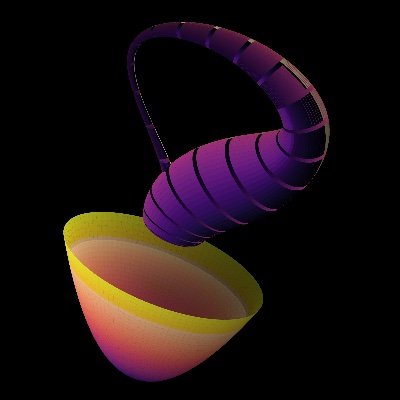
The animation
The full 3D surface is the Hamiltonian itself, the energy landscape H(q, p). The floor underneath is phase space, marked by energy contours and the local flow field. The bright moving point is one actual state (q(t), p(t)) evolving under Hamilton’s equations. Its trail shows that the motion is not arbitrary. It is guided everywhere by the geometry of the same single function H. The render is doing more than illustrating a particle moving, it is showing how one function organizes the whole phase-space motion.
The math breakdown:
Start with one degree of freedom. The state is described by position q and momentum p. So the system lives in a two-dimensional phase space with coordinates
(q, p)
Now choose a Hamiltonian
H(q, p)
Think of H as the energy function. In many standard systems,
H(q, p) = kinetic energy + potential energy
For a particle of mass m in a potential V(q), this becomes
H(q, p) = p²/(2m) + V(q)
Hamilton’s equations say
dq/dt = ∂H/∂p
dp/dt = −∂H/∂q
Now substitute this specific H.
First compute the p derivative:
∂H/∂p = ∂/∂p (p²/(2m) + V(q)) = p/m
So
dq/dt = p/m
Now compute the q derivative:
∂H/∂q = ∂/∂q (p²/(2m) + V(q)) = dV/dq
So
dp/dt = −dV/dq
These two first-order equations completely determine the motion.
Now, connect this back to Newton’s law.
From
dq/dt = p/m
we get
p = m dq/dt
Differentiate both sides with respect to time:
dp/dt = m d²q/dt²
But Hamilton’s second equation gives
dp/dt = −dV/dq
So , together they imply
m d²q/dt² = −dV/dq
This is exactly Newton’s second law for motion in the potential V(q).
Thus, Hamilton’s equations do not replace mechanic, they reorganize it.
#HamiltonianMechanics #PhaseSpace #ClassicalMechanics #MathematicalPhysics #DifferentialEquations #Mathematics #Physics
English
cryptobtc ретвитнул


cryptobtc ретвитнул

The IRS buys your data. ICE buys your data. The military buys your data. The FBI buys your data.
If the govt wants to know anything about you, there's a vendor for that.
Wasn't the 4th Amendment meant to protect us against this?
The 3rd-Party Doctrine destroyed this protection.
English
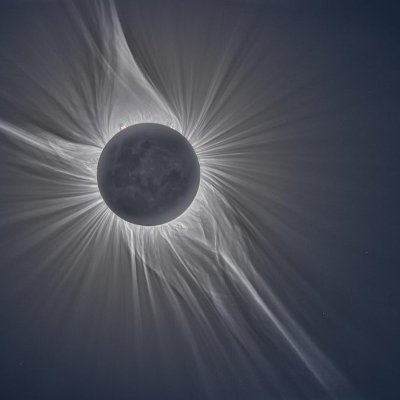
Artemis ll captures the clearest view of moon ever.
Beauty of moon.
Just look at those craters and detail.
English
cryptobtc ретвитнул

Terence Tao proposes what he calls a "Copernican view of intelligence".
Instead of buying into the common, one-dimensional narrative that artificial intelligence will simply evolve from "subhuman" to "superhuman" and ultimately make humanity entirely redundant, Tao urges us to look at the bigger picture.
Much like the Copernican revolution proved the Earth is not the center of the universe, Tao suggests we need to realize that human intelligence isn't the only, or necessarily the highest, form of intellect. Historically, we have treated other forms of storing or creating knowledge—like animals, books, and computers—as secondary. However, we actually exist within a much richer universe of intelligence.
Both human intelligence and computer intelligence possess their own distinct strengths and weaknesses. The true potential lies not in viewing them as direct competitors, but rather in focusing on collaboration. By working together, humans and computers can achieve additional things that neither could accomplish on their own, requiring us to think in much wider terms than just what humans or computers can do alone.
English
cryptobtc ретвитнул
We are the first humans to witness a sunset on Mars. For 4.5 billion years, the Sun slipped beneath the rusty horizon of the Red Planet in perfect silence. No eyes had ever seen it. No heart had ever felt the quiet awe of another world’s day turning to night.Tonight, that changed forever.For the first time in the history of the universe, human eyes — ours — watched the Sun go down on another planet. A small, blue-tinged Sun sinking through a thin, alien sky, painting the ancient craters and dunes in hues no Earth sunset has ever known.Let that sink in.We didn’t just send machines this time.
We sent our curiosity, our wonder, and our gaze across 140 million miles of empty space… and caught a glimpse of something that had been happening alone since before life on Earth even began.This is more than a photo.
It’s a milestone in the human story.We are becoming a multi-planetary species — one sunset at a time. This version keeps the poetic wonder of your original while adding depth, rhythm, and a stronger sense of historical significance. It feels more cinematic and shareable without losing the emotional punch.
English
cryptobtc ретвитнул

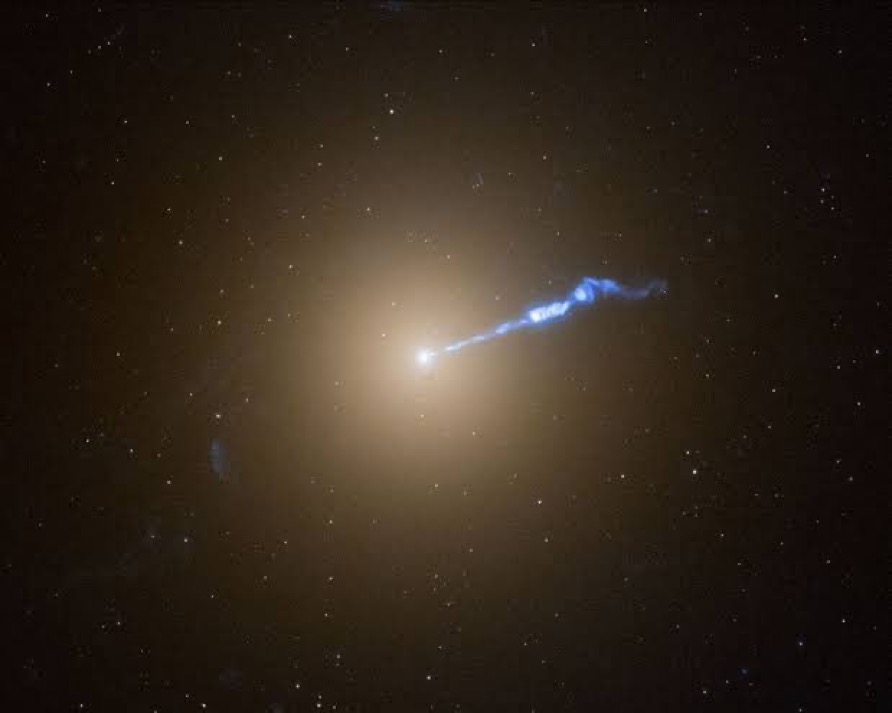
The math on this black hole should mass-humble every physicist who thinks we understand gravity.
M87's central black hole is 6.5 billion times the mass of our Sun. It's 38 billion kilometers across. It spins at 80% of the theoretical maximum speed allowed by physics. And it's firing a plasma beam at near light speed that stretches 5,000 light-years into space.
To put 5,000 light-years in perspective: if you started driving at highway speed when the Egyptian pyramids were built, you'd have covered roughly 0.0005 light-years by now. This beam covers ten million times that distance.
The plasma travels in a spiral along a coiled magnetic field. Hubble watched it for 13 years just to confirm the motion pattern. And the beam isn't just decorating empty space. Stars near its path explode twice as often as stars elsewhere in the galaxy. Nobody knows why. The lead researcher at Stanford said they don't understand the mechanism at all.
The black hole eats roughly 90 Earth masses of material per day. The energy output from that feeding process matches the power of the jet itself, somewhere between 10^33 and 10^37 joules per second. The upper end of that range is a number so large it has no human analogy.
Your brain runs on 20 watts. This thing outputs more energy per second than every star in the Milky Way combined. And we photographed it with a telescope in 2019.

English
cryptobtc ретвитнул

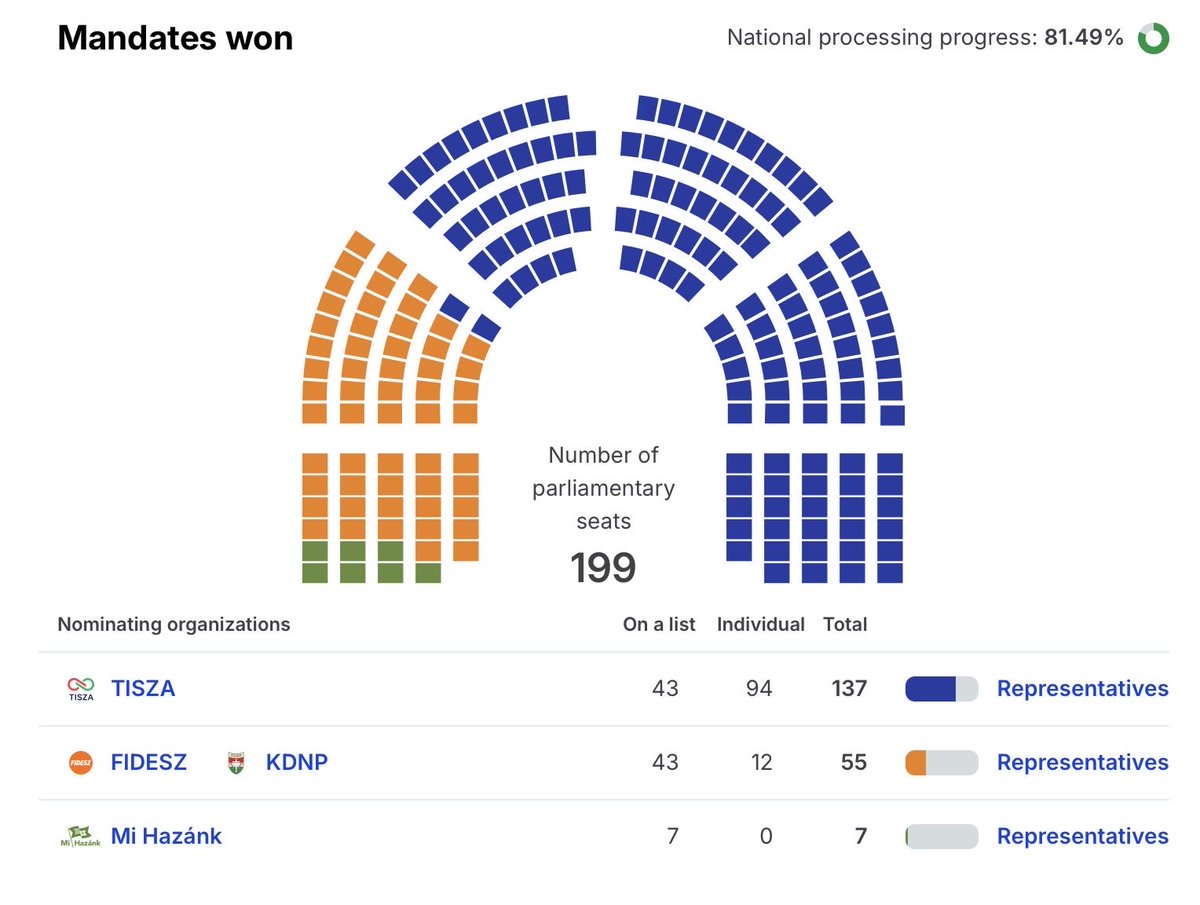
That’s it - decisive win for tor the opposition in the 🇭🇺 elections. It’s not been a good week for JD Vance.
English
cryptobtc ретвитнул

El rover Curiosity de la NASA ha revelado cómo se ve el cielo nocturno en Marte, que está a 225 millones de kilómetros de distancia.
Español
cryptobtc ретвитнул

cryptobtc ретвитнул

cryptobtc ретвитнул

Cautionary tale.
A friend was just hacked. He got a new computer, downloaded a ledger wallet app, entered his keys and his bitcoin was instantly gone.
Sadly it was a fake ledger app, which should not be allowed to exist in the App Store.
Be careful out there.
English
cryptobtc ретвитнул

lots of fat transactions in the mempool today
many are about $1.2 million
any ideas?
English
cryptobtc ретвитнул

Do you remember Shaban, the 19-year old who was burned alive with an IV drip chaining him to his makeshift hospital bed?
He was 19 years old, studying software engineering student, displaced multiple times. He was trying to get enough money to get his family out of Gaza.

English
cryptobtc ретвитнул

Mark my words.
In about a week, Americas are going to wake up in the morning and feel what this chart actually means.

English
cryptobtc ретвитнул
Russian Genius Found Structure in The Mess of Turbulence
In 1941, Andrey Kolmogorov proposed a simple but powerful picture of turbulence:
Energy does not disappear where it is injected but moves. Large eddies pass energy to smaller ones, those smaller ones feed even finer motion, and viscosity finally removes it at the tiniest scales.
That cascade picture became one of the foundations of modern turbulence theory.
The point is not just that turbulence looks messy. The point is that the mess has structure, and Kolmogorov’s great insight was to treat that structure statistically.
English
cryptobtc ретвитнул

Connect the dots ... the censorship of the dollar -- the freezings of dollar bank accounts, the confiscations of dollars, etc . that you blithely call "sanctions" -- is the chief reason *why* other countries are moving away from the dollar.
BitcoinSapiens ⚡️@BitcoinSapiens
MARCO RUBIO: "We won't have to talk about sanctions in five years because there will be so many countries transacting in currencies other than the Dollar that we won't have the ability to sanction them."
English