Закреплённый твит
でかいくま
20.6K posts


でかいくま
@dkkm_
地方に潜む熊|ゆるいスノ担|時折ラッパを吹きに下界に降ります|慶應通信法秋期に合格したくて勉強中
Присоединился Kasım 2024
1.8K Подписки227 Подписчики
でかいくま ретвитнул
でかいくま ретвитнул

イチ沖縄県民として恥ずかしく思うのは、もう蒸し暑い4月の沖縄で喪服を着て献花に来てくれた政府の人達の誠実さ。一方は簡略的なかりゆしで、それも辺野古から距離のある瀬嵩でPR動画撮影もした姑息なオ繩と知事の恥知らずな行い…
国土交通省@MLIT_JAPAN
4月24日(金)、佐々木副大臣は、令和8年3月16日に発生した沖縄県名護市辺野古沖転覆事故の現場を視察し、亡くなられた方々の追悼のため、献花・黙祷を行いました。
日本語
でかいくま ретвитнул

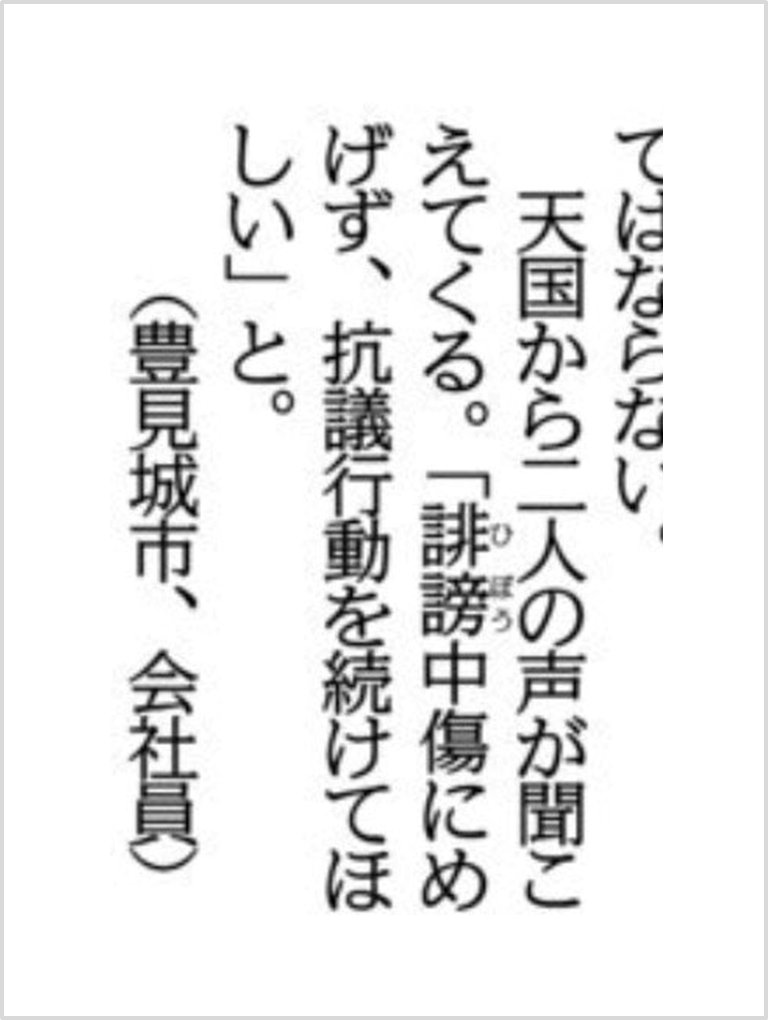
本日の沖縄タイムス
卑怯にも読者投稿という言い訳を隠れ蓑に、言うに事欠いて知華さんの胸の内を勝手に代弁
書いたのは読者かもしれないが、選んだのも掲載したのも沖縄タイムス
言い逃れはできない
これを掲載したらどのような事態に発展するか分かりそうなものだが、バカなのか?
ボギーてどこん(浦添新基地建設見直し協議会)@fm21wannuumui
【今日のタイムス投稿欄】 天国から二人の声が聞こえてくる。 「誹謗中傷に負けず、抗議活動を続けて欲しいと」 ご遺族のnoteも公開されてるのに こんなのよくも掲載できたものだな。 反基地なら何を書いてもいいのか💢
日本語
でかいくま ретвитнул
でかいくま ретвитнул

でかいくま ретвитнул
でかいくま ретвитнул

でかいくま ретвитнул

でかいくま ретвитнул

でかいくま ретвитнул

でかいくま ретвитнул

でかいくま ретвитнул

"Japan is the Emerald Isle [Ireland] of the east. Its people call it the Empire of the Rising Sun. Its sun is rising fast. The transformation is so complete that the Japan of fifty years ago is forever past and gone. When I dream over again the adventures of that famous Expedition, I seem to be sitting among the shadows of past centuries and watching the argosies of the middle ages, or the bucaneering voyages of Raleigh and Cavendish and Drake."
"The document entrusted to Commodore Perry asked of the Japanese court two things, friendship and trade. Friendship, for the safety of our seamen; that first and foremost. Many a hapless crew had been driven into their ports by storm or wrecked on their rocky coast, escaping the perils of the deep only to be welcomed to a dungeon or a cage on shore. This wrong must be stopped at all hazards. The American flag is bound to protect the American sailor; and it was high time to teach the island empire of the east how to behave to the citizens of the great republic of the west. And if in addition we could persuade Japan to enter into friendly relations of trade, the two countries by mutual interchange of productions might promote each its own prosperity and the welfare of the other. It waa thought that an Oriental might see that as well as a Yankee, In the end they did. It cannot be said that Japan ever really yearned to be "opened" any more than an oyster does; yet when the time came, she yielded as gracefully as any oyster I ever had the pleasure of meeting."
Both quotes from The Logbook of the Captain's Clerk: Adventures in the China Seas, by John S. Sewall, published in 1905 (linked above)
I am going to take a break now, as I have been researching and writing this for several hours now. I will continue this with more information on Perry's landing in Japan. Please feel free to send me any images or information that you have! I will continue to look over the records of the trip and may add some more information out of chronological order. The list of illustrations alone in Perry's memoir is 3 pages long, and the book is 750 pages, so I will keep adding info as I go.
Thank goodness so many of these works are in the public domain. 😁 I will share a link if I can find a pure text file of Perry's memoir of the trip, as that should be the easiest to translate, though some of the language used in these memoirs is fanciful and old-fashioned, best enjoyed in English. Is there already a Japanese translation in existence?
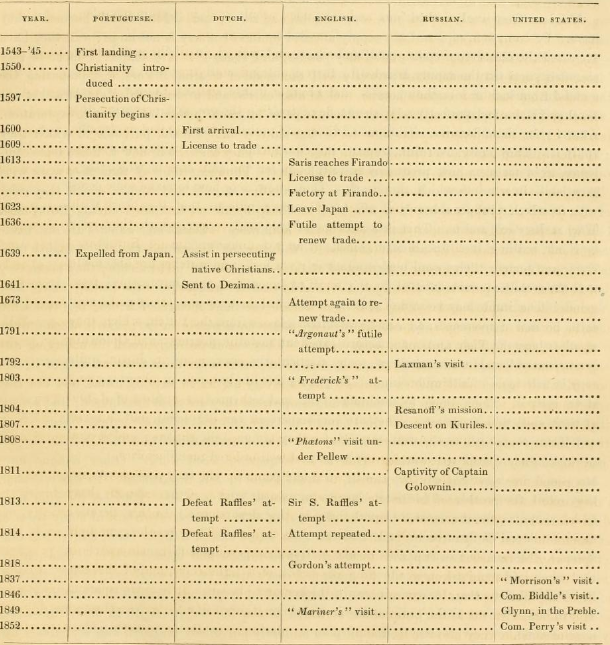
Pictured is a timeline by Perry of Western visits to Japan from 1543 to 1852, sorted by country. The United States, in the right column, was a late-comer. Sorry for no translated copy - I can type this up at some point for translation.
English
でかいくま ретвитнул
Perry had first set sail in 1850 from Virginia, on the East Coast of the United States, to join the East India Squadron, which he was later given control of. He reached Macao, then owned by the Portuguese, in April 1851. He set sail again from Virginia in 1852 for the Perry Expedition and reached Japan on July 8, 1853. This was long before the construction of the Panama Canal, and the American Navy was centered on the East Coast, so Perry had sailed around Africa, through the Indian Ocean, and into Hong Kong in 1853. There, he had official letters translated into Chinese, and he had them translated again into Dutch in Shanghai. During this time, the Taiping Rebellion had started in China, and many adventurous merchants and officials in Chinese ports wished to join the expedition, and Bayard Taylor, then a well-known American poet and author. Perry's fleet first landed in the Ryukyu Islands (then written "Lew Chew" in English).
I will fill in more details about the voyage, including the many stops along the way, when I have some more time.
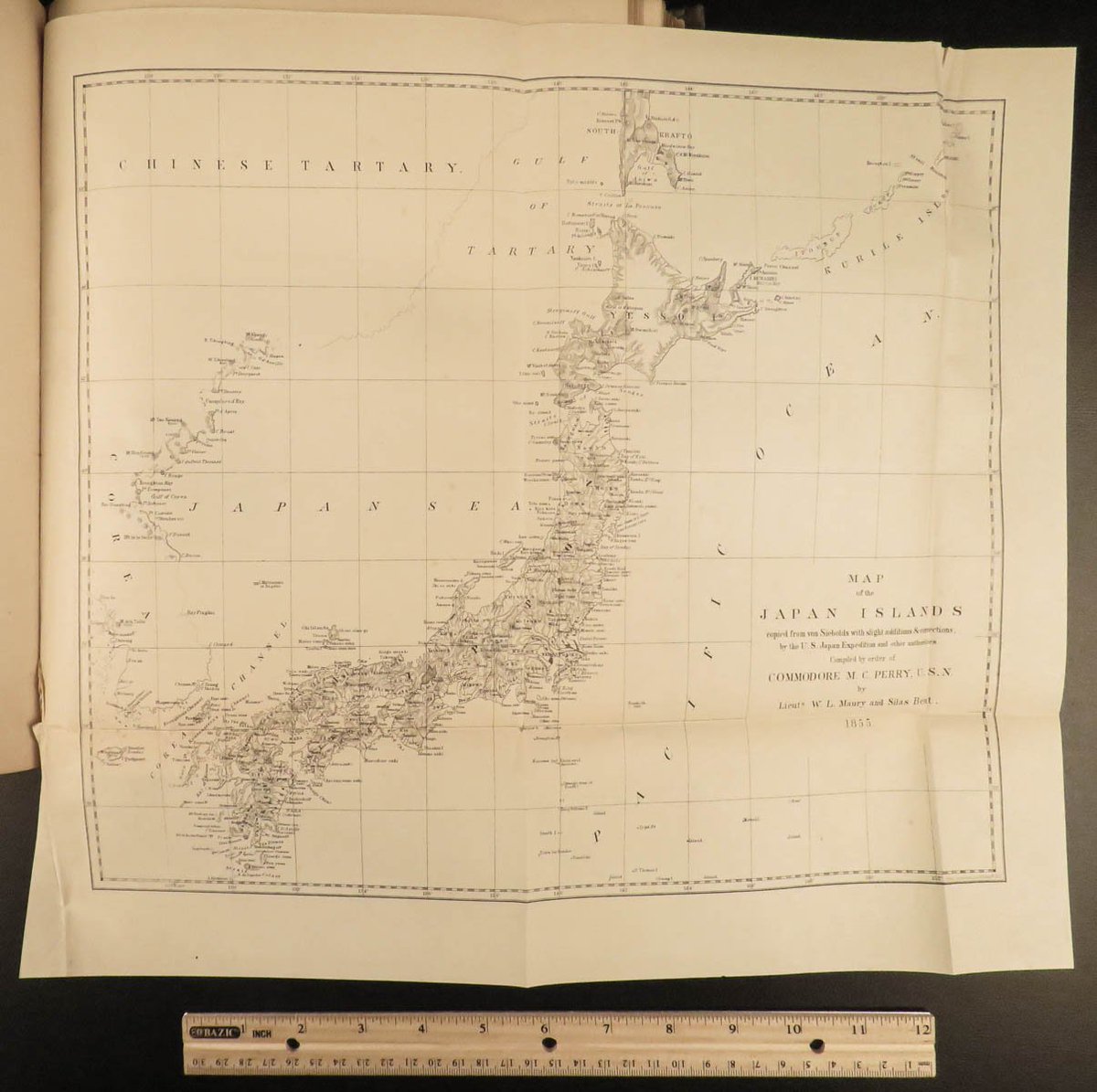
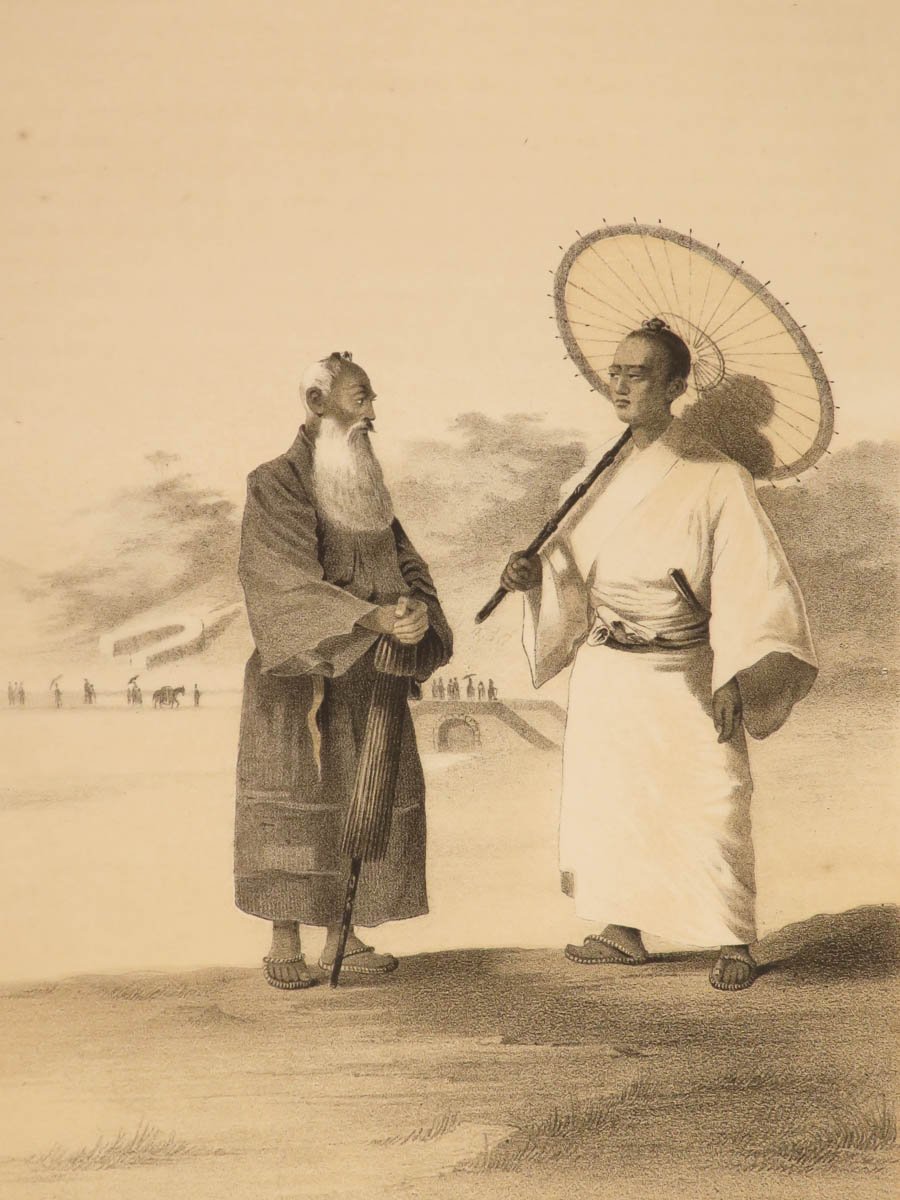
Pictured: Funchal, Madeira; A map of Japan; An unlabeled image of two men, I would guess from one of his stops in China
A digitized copy of Perry's own memoir of the expedition: archive.org/details/narrat…
A site with images, including maps, from the first edition of Perry's book: schilbantiquarian.com/product/1856-1…
Perry's clerk's logbook is available in scanned format here: archive.org/details/logboo…
The journal of an interpreter:
archive.org/details/journa…

English
でかいくま ретвитнул
Finally, the Perry Expedition itself! As I mainly learned this history through genealogy and conversations with family, I am reviewing some information including Perry's journal and will likely add some more information later as I research it.
The expedition was authorized by president Millard Fillmore, who is known for failing to prevent the ensuing American Civil War, making him one of our most forgotten and unpopular presidents. Many of the presidents after our Founding Fathers and before the Civil War are not very well remembered or focused on in our historical education. Fillmore was not even elected and was perhaps unprepared - he was the vice president of Zachary Taylor, who died after a year in office, and Fillmore never won a later election. However, his work in delaying the conflict may have helped ensure the ability of the Perry Expedition to be launched.
There had already been several expeditions to Japan previously, though only one was successful. The first American to speak Japanese, Ranald MacDonald, had purposefully shipwrecked himself on Hokkaido in 1848 and taught several Dutch-speaking samurai the English language. (Dutch and English are related, both having Germanic language roots.) In 1849, James Glynn's expedition rescued MacDonald and a group of other shipwrecked sailors from captivity in Japan through negotiation. Such incidents emphasized the need to open up Japan and allow passage through its waters, though America also had self-interested motivations. Christianity was also banned in Japan at the time, and foreigners would be imprisoned or executed, which threatened shipwrecked sailors as well as any attempts at diplomacy and trade. Some Americans hoped to do missionary work in Japan as Protestants, where Catholics had not fully succeeded.
Perry's instructions were clear that he was to engage in firm diplomacy, with the threat of military force if necessary. "If, after having exhausted every argument and every means of persuasion, the commodore should fail to obtain from the government any relaxation of their system of exclusion, or even any assurance of humane treatment of our shipwrecked seamen, he will then change his tone, and inform them in the most unequivocal terms that it is the determination of this government to insist, that hereafter all citizens or vessels of the United States that may be wrecked on their coasts, or driven by stress of weather into their harbors shall, so long as they are compelled to remain there, be treated with humanity; and that if any acts of cruelty should hereafter be practiced upon citizens of this country, whether by the government or by the inhabitants of Japan, they will be severely chastised."
Another motivation was the securing of Japan's large coal reserves for the new steam powered economy of America, including the steam navy that was advocated by Perry himself. However, the more peaceful aim of returning shipwrecked Japanese sailors, themselves having been stranded by the isolation policy, was part of the expedition as well.
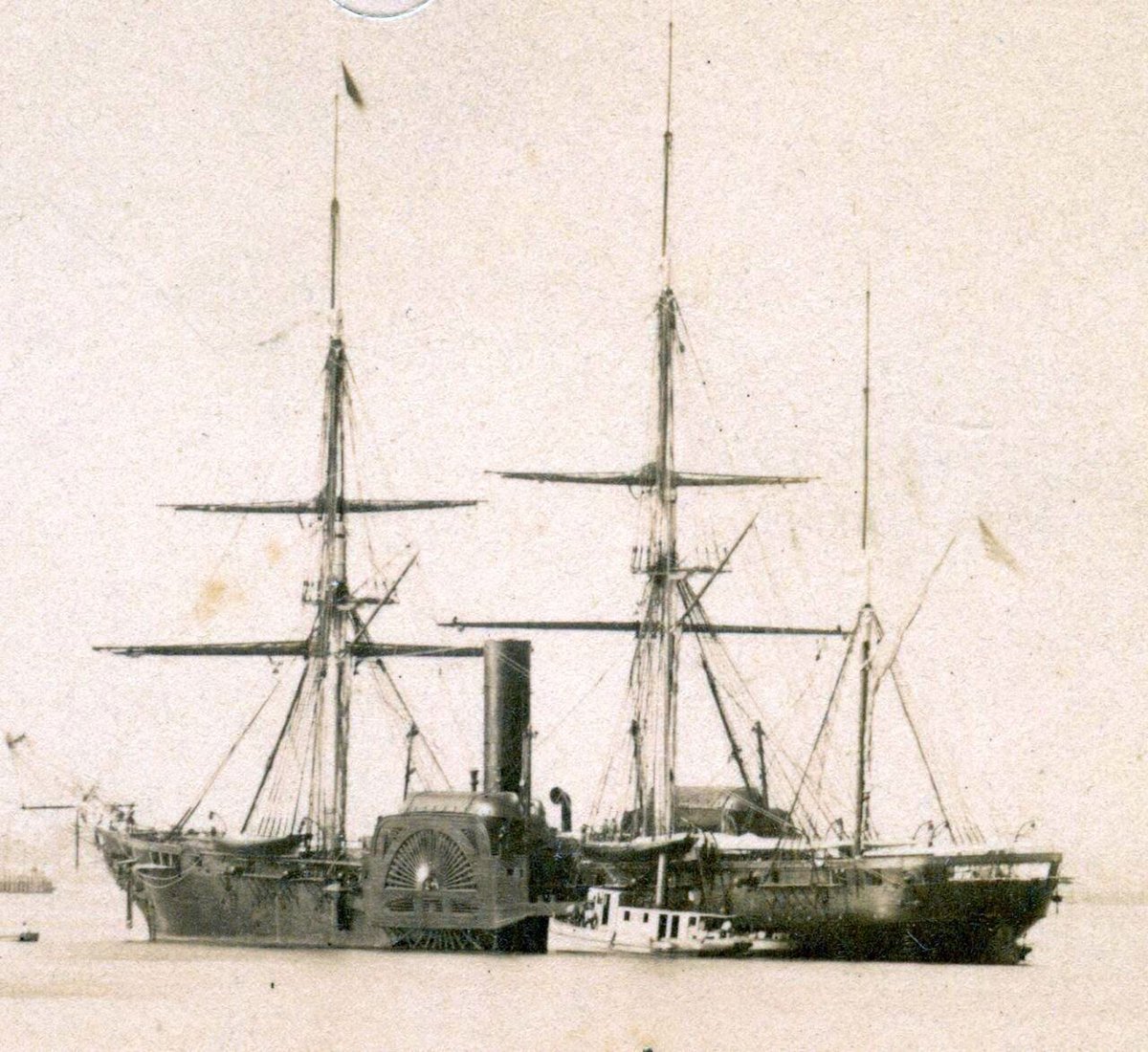
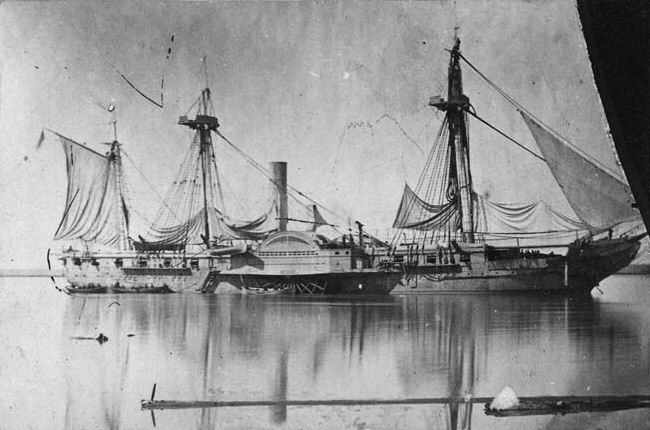
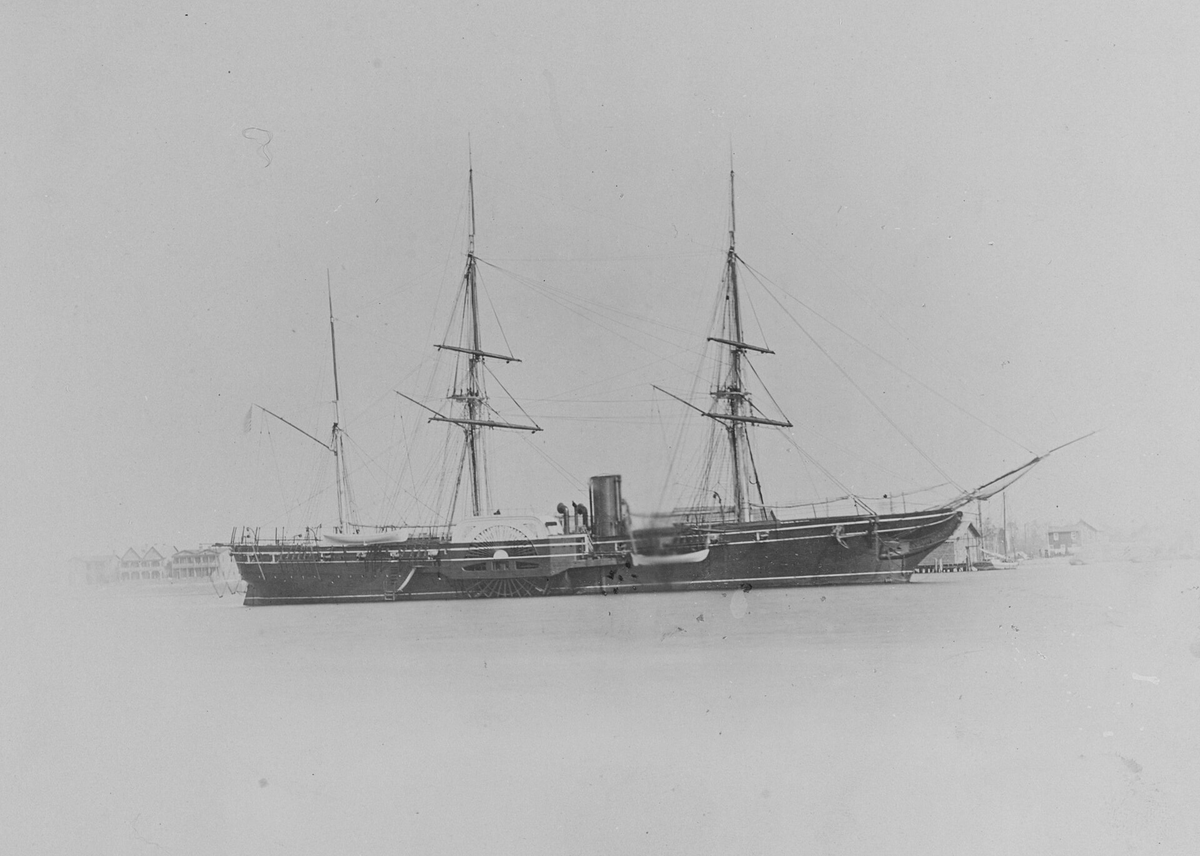
Perry took six ships on his first voyage to Japan, including several paddle-wheeled and sidewheeled steam frigates. The steamships are pictured here, the Susquehanna, Mississippi, and Powhatan. One of the other ships, the Macedonian, is the fourth image - Perry took a mix of steam and traditional ships on his voyage. You can see the development of technology since the War of 1812, less than 10 years before the first ironclad would set sail in 1859.
This site contains information and citations regarding Perry's instructions on voyaging to Japan: classicsofstrategy.com/2015/07/07/com…

English
でかいくま ретвитнул
After the war, Matthew and Oliver Perry served in the Barbary Wars to put down Ottoman and North African piracy, which involved the taking of British and American citizens as slaves to what was then known as the Barbary Coast. In 1821, Matthew Perry, then 25 years old, was given command of his own ship and helped claim the Florida Keys as well as continuing to protect the Mediterranean from pirates and slavers. Perry would advocate for naval education and the creation of a steam-powered navy. He oversaw the construction of steamships and would later oversee the production of his own fleet for the Perry Expedition to Japan. He conducted the first naval gunnery school and was made commodore and commandant of the New York Naval Yard in 1841 at 45 years of age. He continued to police North African waters as leader of the Africa Squadron and served in the Mexican-American War.
At the time, America did not yet control California - we would annex it and much of the Southwest in the Mexican-American War, which ended in 1848. We had also just gained control of the Oregon Territory in the 1840s, meaning that America had expanded from those 13 colonies to the full width of the continent in less than a century. Suddenly, we shared a major ocean with Japan and China. Our first ambassador to China was sent in 1844, and a later ambassador, Anson Burlingame, signed a treaty with China for friendly relations in 1868. My hometown in California is named after Burlingame, and we have a significant East Asian population here nowadays.
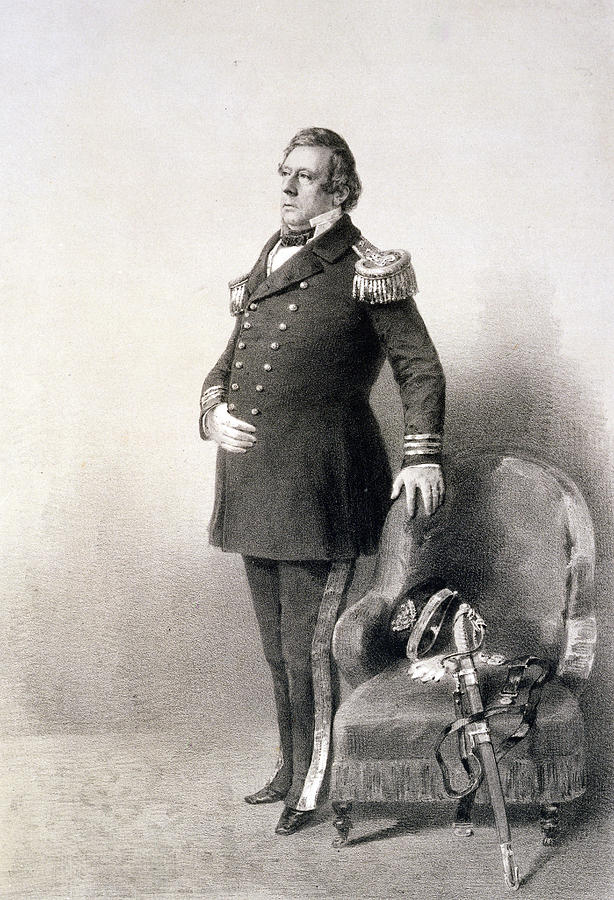
So, before the Perry Expedition, who was Commodore Matthew Calbraith Perry? He was a seasoned naval veteran of several wars, the brother of the greatest war hero of the 1800s, the Father of the Steam Navy, and a liberator of slaves. He had helped create the curriculum for the Naval War Academy and had captured multiple cities in Mexico in the recent war. His legacy was already grand, and America remains a great naval power today thanks to him. He was nicknamed the Old Bruin, an old term for a brown bear.
Below is a picture of Perry by a companion on the expedition to Japan and a commemorative stamp issued in 1953 for the anniversary of the opening of Japan.
The third picture is from a scan of a book on Perry, with a younger portrait of him from 1835 and a long subtitle, which I've typed out for ease of translation: "The American Naval Officer Who Helped Found Liberia, Hunted Pirates in the West Indies, Practised Diplomacy with the Sultan of Turkey and the King of Two Sicilies; Commanded the Gulf Squadron in the Mexican War, Promoted the Steam Navy and the Shell Gun, and Conducted the Naval Expedition Which Opened Japan"
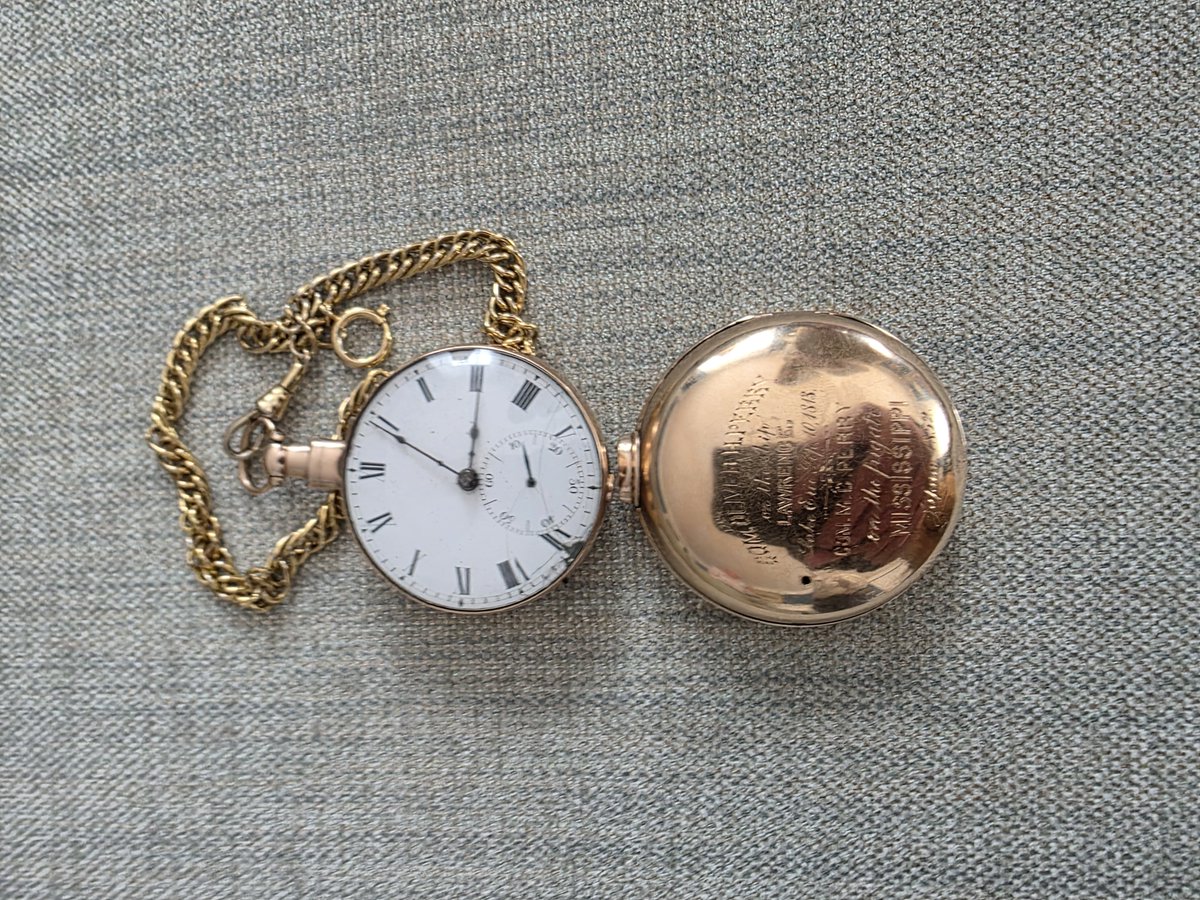
The fourth picture is a golden pocket watch gifted to Commodore Perry by Oliver Hazard Perry. In these days, accurate watches were of great importance when navigating by the stars. (This was the origin of many finely tuned mechanical watches such as Rolex.) The inscription is difficult to make out but refers to Oliver in command of the Lawrence and Matthew in command of the Mississippi.
Source: archive.org/details/oldbru…


English
でかいくま ретвитнул
Oliver Hazard Perry and Matthew Calbraith Perry were born in South Kingstown, Rhode Island, across Narragansett Bay from Newport, where they are both buried, along with August Belmont, another famous descendant. Their father, Christopher, was descended from two of the original Mayflower colonists and joined the Revolutionary War at 14 years old. He was captured by the British and escaped a prison ship in the New York harbor; after this, he was captured again, sent to (Northern) Ireland, met his future wife, and escaped yet again! After the war, he joined a merchant vessel to return to Ireland and bring home his wife, Sarah Wallace, who was descended from an uncle of William Wallace, a hero who helped win Scottish independence in the 1300s. The Perrys were thus raised in a family of sailors and warriors from England, Scotland, and Ireland, in a town that is still a major naval center today.
Oliver was born in 1785 and Matthew in 1794, making them 27 and 18 years old at the outbreak of the War of 1812 with Britain, America's first major war after the Revolution. At the time, British ships were capturing American sailors and conscripting them into their navy, as they considered them British citizens. This "impressment" was one of several reasons for the war, as well as a wish to oust some native tribes from the Great Lakes area and claim Canada from the British. Both brothers had already joined the navy at 13 and 15 years old, respectively. Matthew was injured by an exploding cannon and did not see as much fighting, but Oliver was by then a Master Commandant. He was given command of multiple ships, making him a Commodore, and he won a decisive victory over the British in the Battle of Lake Erie.
Oliver (first picture) oversaw the construction of a fleet on the lake, where the British already had a small fleet, and had nine ships prepared within the year. On September 10, 1813, six ships of the British fleet sailed out to meet them and focused their fire on Perry's flagship, the Lawrence. Perry was forced to abandon ship and transfer to the Niagara, which had held back from engaging the enemy. Despite this, several British ships were destroyed, and the battle was a great victory known across the United States for years to come. Oliver sent a simple message to the general and future president William Henry Harrison, beginning with the words "We have met the enemy, and they are ours." The second picture below is a flag flown by Perry, hastily made before the battle, reading "Dont give up the ship". These were the last words of his friend Captain James Lawrence, who had died several months earlier in the war. The third picture shows the climax of the battle, where the Niagara fired upon two British ships that had collided in the battle. The fourth shows Perry after abandoning the Lawrence to take command of the Niagara, a commonly painted scene.
The war ended inconclusively. Impressment stopped, and the tribes around the Great Lakes were pacified, but America failed to conquer Canada, and the British marched as far as Washington and burned the White House. However, Oliver Hazard Perry became incredibly famous, leading 10 different American states to name a county in his honor as well as several towns. At the end of the war, America only had 18 states, but many more were added from the Louisiana Purchase, with 28 total states by 1845. Many of these new states in the Midwest honored Perry, as he was the most famous American war hero since the Revolutionary War.
Unfortunately, Oliver would die in 1819 at the age of 34 and never live to see the impact of his brother, which today is perhaps greater.
More art: history.navy.mil/our-collection…
A recent article about the battle: worldhistory.org/article/2593/b…
Another article with good citations: pabook.libraries.psu.edu/literary-cultu…




English
でかいくま ретвитнул
Hello Japanese Twitter! I wanted to share some history of Japanese-American relations in honor of the relationship that has been built on X recently. I am the relative of two of the first visitors to Japan, Commodore Matthew C. Perry and the artist John La Farge. I'll share some Perry history and pictures in this thread and follow up with La Farge in a separate thread.
Last summer, I visited the current Matthew C. Perry in Rhode Island, where the commodore was buried, across the water from his hometown of South Kingstown. He is descended from a younger brother of the commodore, and I am descended from Oliver Hazard Perry, the eldest brother and at one time the most famous war hero in the United States. I have not yet met a direct descendant of Commodore Perry himself, but there were several that many Americans might recognize. A few of our relatives have given talks in Japan about Perry.
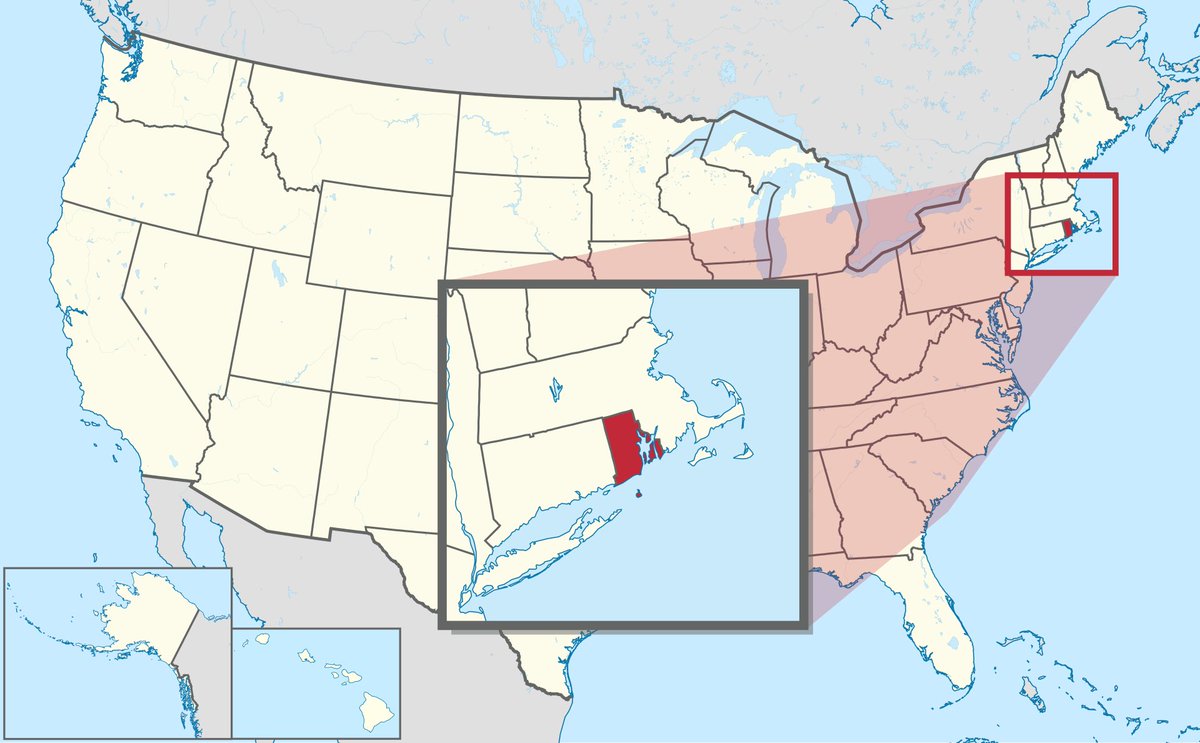
For those of you unfamiliar with American geography, Rhode Island is a tiny state next to Connecticut and Massachusetts in New England. It was one of the original Thirteen Colonies. This is a map of America in 1775 - Rhode Island is the tiny state in the Northeast. It's not an island either, and it's not named after Cecil Rhodes, who was born much later. Its capital city is Providence, giving it the old name of Rhode Island and Providence Plantations. The second image points out where it is today, not far from Boston.
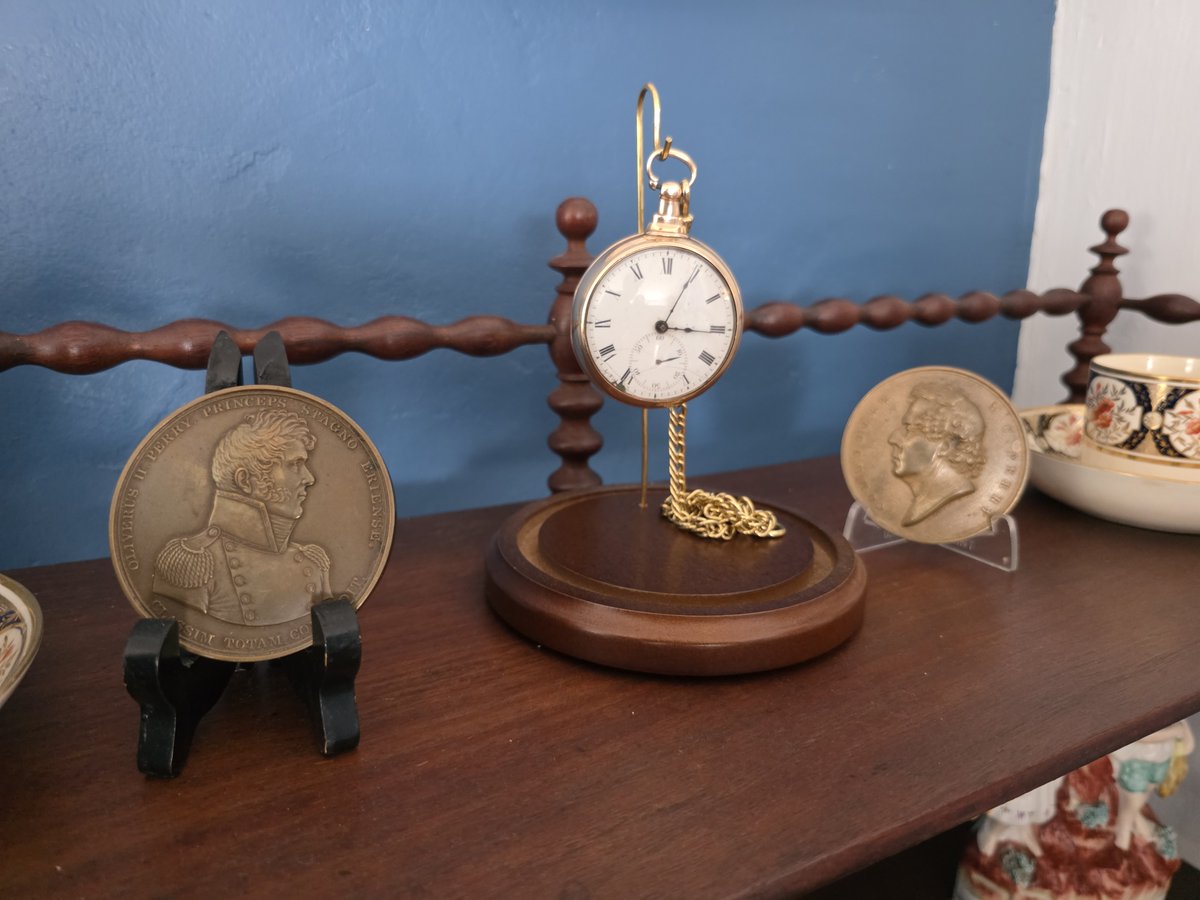
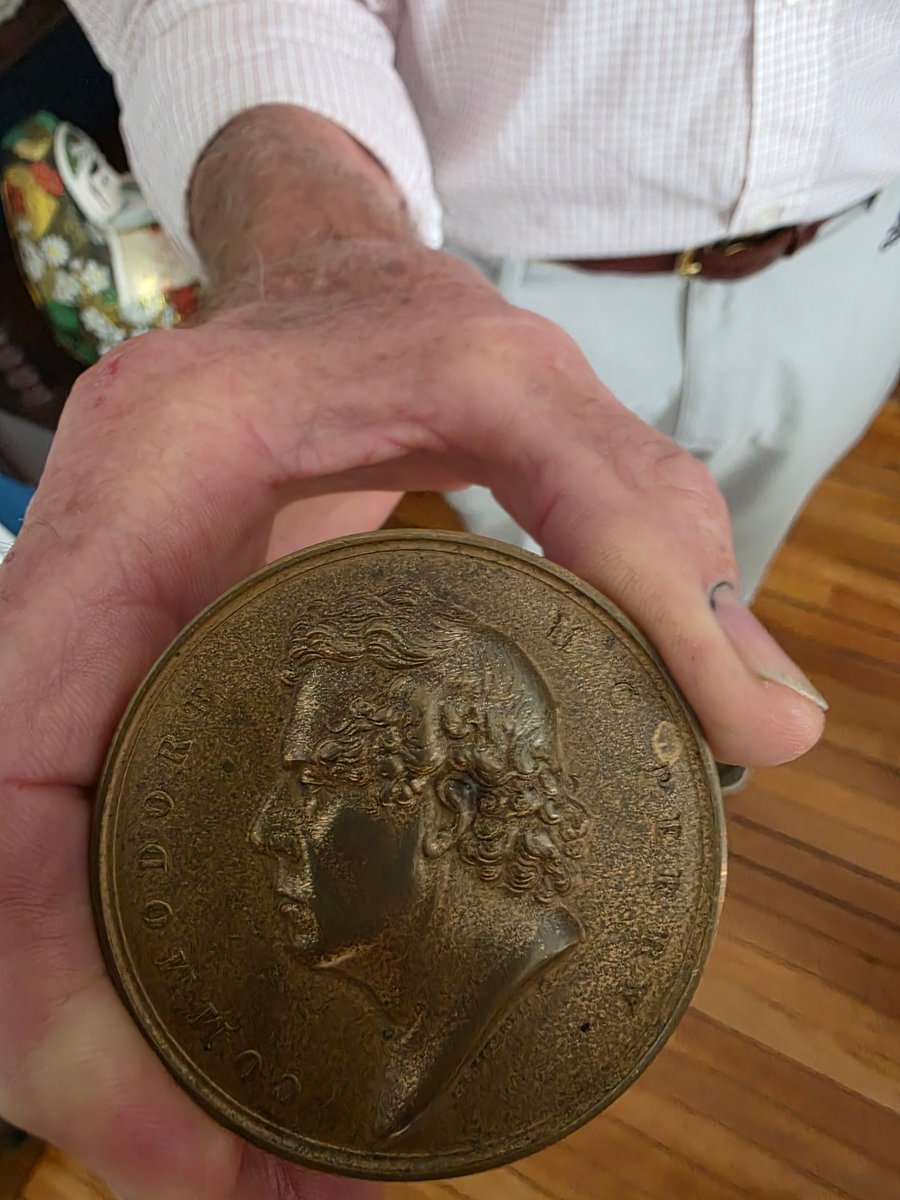
The third picture is a commemorative coin for each of Oliver and Matthew Perry, as well as their pocket watch (pictured later in this thread). The fourth image is a better picture of the Matthew Perry coin, in the hands of the current Matthew C. Perry.
Thread below - I will keep adding to this for a bit. I have tried to list names as specifically as possible for translation purposes, but please let me know if anything is unclear when translated to Japanese. Unfortunately, I don't speak the language myself.

English
でかいくま ретвитнул