
Закреплённый твит
drslo
331 posts

drslo
@drslo
Spine Surgeon to Venture Capital. Trusted resource for MDs on career strategy and healthcare investing.
Park City UT Присоединился Haziran 2008
116 Подписки211 Подписчики
@grok didn't answer but.....Certificate of Need (CON) laws are healthcare's version of:
"We can't build more restaurants because people might start eating too much."
Yet in 39 states, we still limit new hospitals, ASCs, imaging centers, and physician-owned facilities in the name of "controlling costs and improving access" by limiting access?
Competition isn't the problem. Lack of competition is...
#Healthcare #CON #ASC #PhysicianOwnedHospitals #HealthcareInnovation #MedTwitter
English


@DutchRojas @grok Lawyers giving themselves jobs.
English

@coreybichel He was paid $7.71. I owe $23.29 and I'm happy to pay it. He will get his full $31.
English
I got a chest X Ray a few weeks ago.
Got the bill today.
To read the X-ray, the physican got paid $31.00
To shoot the X-ray, the hospital charges $886.16
I also got lab work. Hospital charge: $784.19
Hospitals are the reason for high healthcare costs.
English
@DrDiGiorgio Let me rephrase that: the DOCTOR was paid $31. A drive through car wash in the SF area is $49.
English
English
Once they realize how much they can save on these Carve Outs, they can go to their employees and tell them if they use these new hospitals or centers , the company saves so much money, there will be no out of pocket cost to the employee.
See where I’m going with this ?
The path to universal HC starts when big companies , who in aggregate cover more than 60 pct of insured employees, start getting smart about eliminating the middlemen, by first using Carve Outs and then expanding them to all elements of care. Then, hiring claim administrators that are not affiliated with the big conglomerates, and only paying a fee per claim, they can offer to cover all care, with no patient OOP.
If 60 pct of insured employees are moved from the big conglomerates to direct contracts , the cost of care would go down, because those companies are actually directly negotiating and working with providers.
The revenues of those providers will go up , because the middlemen are out
And of course employees will spend less on care.
Effectively smart companies can offer Universal Health Benefits with no out of pocket beyond basic copays for all their employees.
If companies can negotiate and offer Universal Care , so could a city , or state and then potentially the federal government, using the corporate template and approach
English
This may sound counterintuitive, but the best place to start a path to Universal Healthcare is with big companies.
Our biggest companies are really bad dealing with the economics of their healthcare benefits. They get ripped off. A lot. They are not functionally set up to address both cost and quality of outcomes.
They take on all the cost risk. But. They hire companies affiliated with huge HC conglomerates to manage it all for them.
Those conglomerates keep the huge companies as much in the dark about actual costs as they do the 20 person start up
I can’t tell you how many times I have talked to companies with tens and hundreds of thousands of lives who had no idea whether the price the company administering their medical benefits paid a hospital for a surgery and in patient stay, was the same price they billed the company. They have no idea at all.
In many cases, they only receive a weekly invoice for millions of dollars for their medical and pharmacy benefits and they have no idea if it accurately reflects their contract, or, if they got the best price , or if there is a spread and more
Some try to audit, but the claims data doesn’t incorporate the actual amount paid to the care provider. Nor does it have all the fields necessary. Or even worse, sometimes they only get their weekly invoice and don’t have full claims available to them
Still, despite this they “ trust” these big conglomerates to act as middlemen and rip them off.
Why don’t they switch ? This is the conundrum they find themselves in.
They have tens or hundreds of thousands of employees and their families they cover. The law of big numbers say a lot of those folks are in very messy situations. They dont want to go through the pain, fear and uncertainty of moving from their current source of care. And the HR department knows the emotional switching cost of moving away from the incumbent is incredibly high. They don’t have enough people working in HR to deal with it.
Those same big companies rarely have more than one person acting as a “HealthCare CFO “, responsive for making sure all the pricing is accurate or negotiated.
And of course, no big company wants to admit they are getting ripped off. And none will violate their confidentiality clause of their contracts. I literally tell them to put a pdf of their HC contracts into their LLMs and just ask it “where am I getting ripped off “. Not perfect. But the list is always very long and eye opening
So what should they do. The word of the week is “Carve Out”.
These companies are big enough they can ask to Carve Out anything they want. I tell them to use their Carve Out to direct contract with transparent surgery centers and providers. Maybe just hop or knee replacements to start. Hopefully CostPlusDrugs.com too :)
This is the starting point
English
Yes, Ro, we believe that millions of individuals making economic decisions free from state coercion will make Americans prosperous.
We don’t want the government “investing” in healthcare because we know that means the government controls healthcare.
Who would you rather control healthcare decisions? Millions of individual patient-physician interactions or a single bureaucratic machine controlled by the secretary of HHS?
Ro Khanna@RoKhanna
This the basic difference. Republicans believe that that if you let the wealthy spend capital it will make Americans prosperous. Democrats believe that the federal government investing in the healthcare & education of our people will make America prosperous & productive.
English

I’ll be in Chicago for Becker’s.
I get to co-present with my good friend Paul Slosar, MD @drslo.
Our panel is moderated by @BKRBusinessMin
That alone makes the trip worth it.
But I’ll also have cigar time.
We’ve done these meetups in Dallas, Phoenix, Tulsa, Washington D.C. and every time the same thing happens:
The best healthcare conversations happen away from the stage.
No panel timer.
No corporate script.
No badge scanning.
No polite nonsense.
Just physicians, founders, operators, employers, investors, and builders talking like adults about what healthcare has become and what has to be built next.
Chicago is next.
DM me if you want to meet up.
The cigar is optional.
The conversation is the point.

English
Healthcare innovation isn't just about technology — it's about vision and courage.
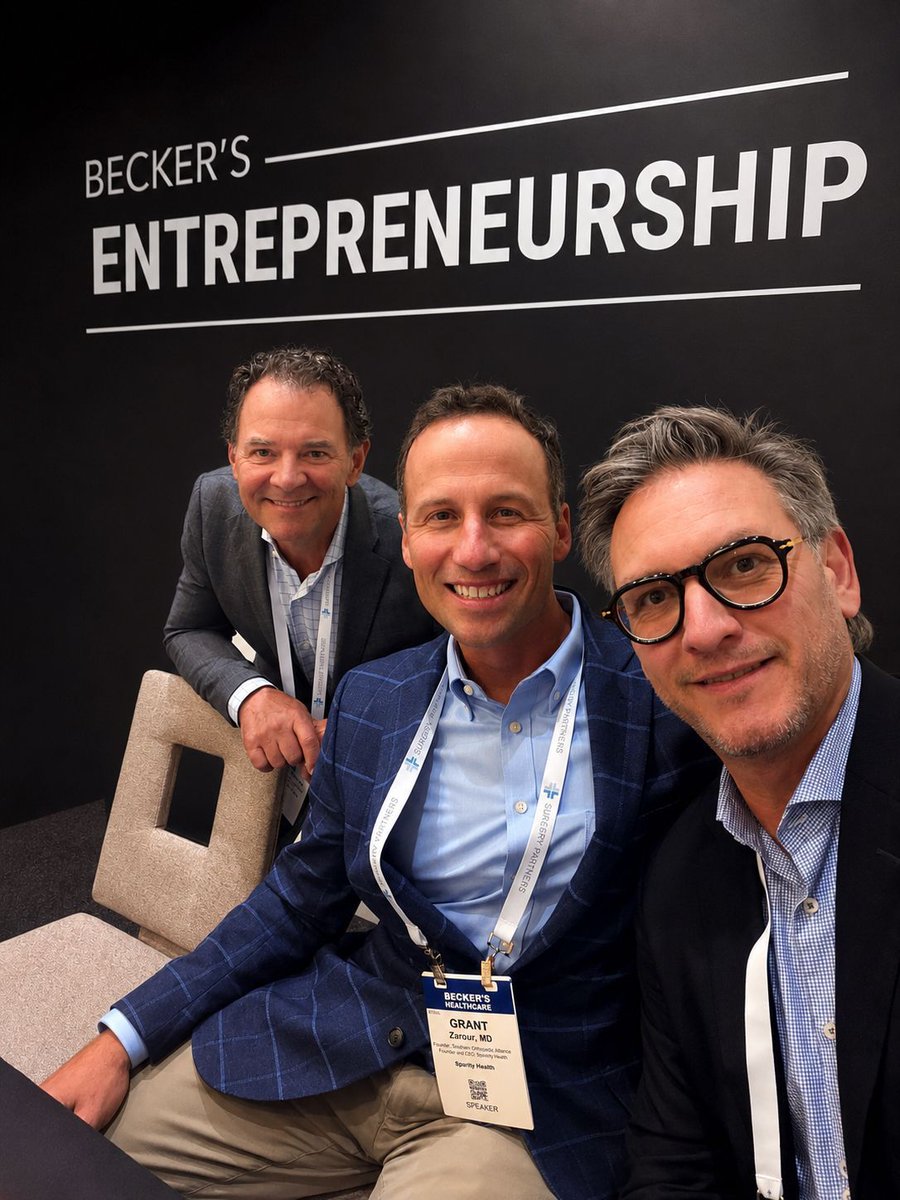
Honored to join @grantzarzour , @DutchRojas and the incredible @BKRBusinessMin Scott Becker on stage yesterday.
Vision. Persistence. Leadership. These are the real foundations of entrepreneurial success.
Disruption in service of physicians and their patients — that's the only kind worth building.
→ @MedMergeco
→ PhyCap Fund
→ Sperity Health
The future isn't coming. It's already here. 🔥


English
The most disruptive idea in American medicine is still a physician who owns his own work.
Yesterday I joined Grant Zarzour, MD and Paul Slosar, MD at Becker’s to talk physician entrepreneurship.
Our case was simple.
An independent practice with a real balance sheet can deliver higher quality at a lower price than the hospital-owned or PE-backed practice across the street.
Obvious, on its face.
Instead, it remains contrarian.
Healthcare spent 30 years separating physicians from ownership, capital, and control. Then it acted surprised when prices rose, quality flattened, and doctors burned out.
Physician ownership is not nostalgia.
It is the threat.
English
I run at 5am. I drink coffee at 6am.
I smoke a cigar at 9pm.
None of it is on a calendar invite.
Nobody pays me to do it.
No client will ever care that I did it.
But every one of those three things is a promise I made to myself, alone, that nobody else gets to renegotiate.
Build a life with a few non-negotiables that exist purely because you said they exist.
The rest of the day learns to fit around them, not the other way around.

English
I love the direct contracting business. Not because it is clever.
Because patients would call after surgery and say:
“No deductible.”
“No copay.”
“No prior auth.”
“I didn’t know healthcare could work like this.”
When we started, there were four companies.
Today, the model has been absorbed by most brokers.
Yesterday in Dallas, I taught 300+ physicians the next frontier:
Permanent capital.
The money used to belong to health systems and carriers.
Now physicians can keep it.
That is how we make independence the proffered model…
Come on!!!

English
Take a peek at SF area home prices over past 6 months....just a small preview of the tsunami of wealth soon to be unleashed by theses IPOs. It won't all be parked in real eatate...
PhyCap Fund@PhysiciansCap
Five percent of US market capitalization is about to enter public markets through three IPOs. Paul Tudor Jones laid out the structural read on Invest Like the Best. The contemplated IPOs over the next year represent 5-6% of US market cap. Normal IPO issuance runs 0.5 to 1% in active years. The 2026 pipeline runs ten times that ratio. The mechanism is direct. Buyback capacity has supported equity prices for a decade. The mega-IPO pipeline reverses it. The funding for SpaceX, OpenAI, and Anthropic is already being pulled out of existing technology stocks. Magnificent Seven weakness year to date is the rotation, not a coincidence of earnings cycles. Standard 180-day lockups place the insider supply wave in Q1 through Q3 of 2027. The 2000 parallel is exact. Supply hit demand at the same moment fundamental concerns began to bite. For physician allocators, healthcare sits structurally outside this pipeline. That creates the asymmetry worth positioning for.
English
Physician is the word....
Dutch Rojas@DutchRojas
No wonder he doesn’t understand healthcare! Abdul El-Sayed told a podcast in 2022 that during his only clinical rotation, his job was “to be the, like, worst doctor on the team” and that he was “cosplaying a doctor.” That four-week sub-internship at the end of medical school is the entirety of his time at a patient bedside. He is now running for U.S. Senate in Michigan calling himself a physician. El-Sayed earned an MD from Columbia in 2014, after two years at the University of Michigan Medical School and a Rhodes Scholarship at Oxford where he completed a DPhil in public health. The academic ladder is real. Two doctorates. “Dr.” is accurate. He never entered residency. He has never held a medical license in Michigan, New York, or any other state. He has never independently treated a patient. In March 2026, El-Sayed told a group of Teamsters nurses he had “been in enough codes to watch who really does the work.” On a podcast that same month: “I’ve been a doctor my whole career.” His campaign objects to the Politico report that surfaced these statements. The spokesperson’s response was that “he has earned the right to be called ‘doctor’ twice over.” That is true, and it is beside the point. The contested word is physician. In American medicine, the MD is the beginning. Residency is the apprenticeship, three to seven years long. State licensure follows residency. Independent practice follows licensure. The structure exists because patients pay the price when it is skipped. Every physician in this country surrendered most of their twenties to those steps. Eighty-hour weeks. Overnight call. Boards. Maintenance of certification. Malpractice exposure that follows them for the rest of their careers. Physician is not a credential of the classroom. It is a credential of the bedside, the licensing board, and the legal accountability of both. To borrow it without paying for it is to take something from every doctor who did. El-Sayed knows the difference. He named it himself. Excellent reporting @adamwren politico.com/news/2026/05/1…
English
No wonder he doesn’t understand healthcare!
Abdul El-Sayed told a podcast in 2022 that during his only clinical rotation, his job was “to be the, like, worst doctor on the team” and that he was “cosplaying a doctor.”
That four-week sub-internship at the end of medical school is the entirety of his time at a patient bedside.
He is now running for U.S. Senate in Michigan calling himself a physician.
El-Sayed earned an MD from Columbia in 2014, after two years at the University of Michigan Medical School and a Rhodes Scholarship at Oxford where he completed a DPhil in public health. The academic ladder is real.
Two doctorates. “Dr.” is accurate.
He never entered residency.
He has never held a medical license in Michigan, New York, or any other state.
He has never independently treated a patient.
In March 2026, El-Sayed told a group of Teamsters nurses he had “been in enough codes to watch who really does the work.” On a podcast that same month: “I’ve been a doctor my whole career.”
His campaign objects to the Politico report that surfaced these statements.
The spokesperson’s response was that “he has earned the right to be called ‘doctor’ twice over.”
That is true, and it is beside the point. The contested word is physician.
In American medicine, the MD is the beginning. Residency is the apprenticeship, three to seven years long.
State licensure follows residency. Independent practice follows licensure.
The structure exists because patients pay the price when it is skipped.
Every physician in this country surrendered most of their twenties to those steps.
Eighty-hour weeks.
Overnight call. Boards. Maintenance of certification. Malpractice exposure that follows them for the rest of their careers.
Physician is not a credential of the classroom.
It is a credential of the bedside, the licensing board, and the legal accountability of both.
To borrow it without paying for it is to take something from every doctor who did.
El-Sayed knows the difference.
He named it himself.
Excellent reporting @adamwren
politico.com/news/2026/05/1…
English
Already the preemptive shock waves rippling through the SF area...rent and property values are the early indicators...
PhyCap Fund@PhysiciansCap
5-6% of US market capitalization is about to enter public markets through three IPOs. Normal run rate is 0.5 to 1%. The 2026 pipeline is ten times that. SpaceX. OpenAI. Anthropic. $240 billion combined. Healthcare sits outside the supply wave.
English
I was given this question set about simplifying life and clearing things out to make life easier and better and clearer. I thought deeply about this and I decided that I will not have a 3 hybrid or 3 wood in my bag all of June. To go one step further I will take driver out and use the mini driver and also stop switching back and forth between putters. I feel a lot better.
English